Get More Door Swings Tomorrow. Local Business Content Strategy
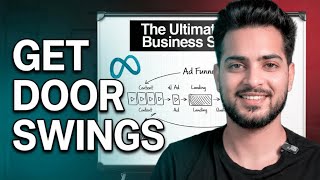
Areeb Mirza breaks down how to scale local businesses by offering low-ticket "door-swing" services to get prospects in the door, then upselling high-ticket work. He walks through the ad funnel: a strong video hook, a landing page with qualification forms to filter leads, and the math of cost-per-qualified-lead versus cost-per-conversation.
Chapters
If you're a local business, I have a strategy mapped out for you today that you can apply to get more door swings and just more leads overall. And this is something you can pretty much apply to your organic content strategy, your paid ad content strategy. And this is something that we've used for hundreds of other local businesses to generate them more results. So without further ado, let's just pretty much straight get into it. So at the top we have is just, you know, scaling local businesses. Now, another example I wanted to give first before we even start, and this is something a lot of local businesses or businesses in general do whenever they're running is let's say this is kind of like your competitors over here. You have competitor 1, 2, 3, 4, and this is you. What most of you guys do is pretty much run the same offer to the same people. Same offer, same people. Now what this creates is just a market saturation, meaning nothing's being differentiated over here. Like, why should this specific person, like this specific person, go with any of you guys? He's pretty much kind of like now looking at the content. He's now looking into other variables to even make a decision on why they should even go with you in the first place. So if the line is equal, meaning if everything looks the same, sounds the same in front of an ad, then you need to make sure that your content is top-notch, your reviews are top-notch, and the backend processes are pretty much like solidified. So this lead can make a decision on who to go with. And, you know, after doing the due diligence, we want to make sure they land on you. But let's say you don't necessarily have the best of profiles built. You don't have a lot of organic content. Your competitors have kind of like way better things going on. In this case, you need to differentiate what your offer is going to be. So for inbound leads over here, you need to create an offer that invites them and not sells them the higher ticket first, because over here you might be creating an ad that might say the same exact thing. Like, hey, we offer this at a 10% discount. Someone's doing 12%, 15%, but it's all the same thing. It just sounds the same. What you need to do is make an offer that invites them into the door and not sells them to the highest ticket item first. Like, I want you to just forget about that. Like, don't necessarily worry about selling your highest ticket item first. Worry about how do you get them Indoors. That's the main challenge for ads. It's like, if you're just selling them on kind of like the highest ticket item first, you're just setting yourself up for failure. Yes, you might have some here and there, but it's not going to be an effective ad strategy. The first thing you need to do is by taking that market share is you need to have an offer that just invites people to the door. Maybe it's a free consultation. Maybe it's kind of like a very intro offer, like $49, $39, whatever it is. That's kind of like a door swing that you want because once they're in, they're in your ecosystem now. Now you can slowly sell them onto the higher ticket stuff. So let's say if you're a med spa, you just invite them onto something super low ticket. Then now you have them on pretty much kind of like a recurring basis. Now you're pretty much collecting cash on top of cash with this specific person. If you're a dentist, if you're like any physician or vein specialist, whatever it is, invite them into the door first. This is where the report is built. This is where like, they've already done the hard part. Like you've already done the hard part, which is getting them inside of the door first. As soon as that's done, that is where you can start selling more and more to the same specific person, which is kind of like increasing your LTV, lifetime value per customer, which also makes your ad extremely profitable because you're basically any type of customer you acquire, you're extracting way more resources from them instead of just selling them for one specific thing. So very, very important. If you're going to be, of course, running ads, you need to have an offer that invites them and not necessarily just sells them to the high ticket first. Like, how do you, what offer do you need to have to have them just come into the door first? Maybe it's something for free. Maybe it's something super cheap. What that is, is something you need to do your homework on. Now, of course, the main challenge, like I said, is just getting them into the door, having more conversations and having more reach. Your problem is not like, okay, I'm going to sell this $5,000 item first. And it's not selling for some reason. That is not your issue. The issue is getting them into the door, having more conversations in order for you to get them to the door. And how do you have more conversations is by of course having more reach. So, and of course another caveat about it is for conversations and actually getting them into the door, you need to have a solid sales process as well, which is something we're going to get into, but follow this formula. And this is kind of like extremely simplified. If you have more reach, you're going to have more conversations. And then of course you're just going to have logically more door swings. Which is something of course our ideal goal is. Now in terms of content, like this is not a strategy where you can just skip content overall as a whole. Like content is still a very important part because this is where credibility is built because a good lead, they will always do their due diligence before even walking into the door in the first place. But they want to see, okay, like what type of content they're creating. They might go to Google. People like to bounce around. It's not a very straightforward process. Of course, there are leads who will follow that straightforward process, but you have to calculate for every type of lead. Maybe even you, maybe if you're about to make a purchase or a decision, or if you're about to visit somebody, you need to make sure you're doing your homework. So it's kind of like travel plans. You know, if you're planning to like travel to another company, you want to check if it's safe. You want to see if it's kind of like, you know, what other people's experiences were. You need to have all of this information before even giving that country a chance. So kind of like have the same mindset of what a lead does before they even come to you in the first place. They're not only going to check your rules, your website isn't enough. You need to make sure all of the variables are pretty much present. Do you have good reviews? Do you have good content? Are you posting consistently? Um, and the consistent part is mainly because if people follow your page, meaning if they give your page a follow, you're by definition also nurturing that lead. Because yes, direct sales are important, direct door swings are important as well. But another thing an ad is going to do for you is introduce deals into the future. So you're going to, of course, get a lot of followers, get a lot of reach, get a lot of posts saved. Um, some people are going to send your post to another colleague of theirs, friends of theirs, family of theirs. There's a lot of ways. And this is pretty much deals for the future you're collecting. So this is where you need to make sure you're doing your due diligence to post consistently onto your feed and also your stories, so you can pretty much keep your current audience engaged as well. So this is what content will do for you. And of course, content also organically is going to give you some free leads, um, which is always of course nice to have. After that, of course, comes the ads funnel. Now every single ad process needs to have some sort of funnel. I don't care what you're running. Maybe it's a direct profile visit campaign. Maybe it's a direct messaging campaign. Every single thing needs to have a funnel process where somebody sees you first and then becomes a conversion towards the end of this. So over here, this could be something as simple as this. Your ad, they visit your landing page. And on this landing page, you see a qualification form. And this is going to be extremely important as well. And this is where they become a lead. Now, the reason why you want to make sure that we're specifically qualifying them is not only because for you, it's also because for the ads platform itself, meaning if a lead does not necessarily meet your criteria, you don't even want their information in the first place. You want to disqualify them. And the reason why this happens is because Facebook or Meta or whatever you're learning, they just give you what you want basically. So for example, let's say if you optimize for leads, optimize for, And then you don't have any filtering in place. So let's say filtering. So meaning anybody could come in and just become a lead. Facebook sees this as a successful event, but you might be thinking, you're like, hey, Areeb, you know what I'm speaking to? I'm speaking to like 20 people a day and none of these are qualified, but Facebook doesn't know that. Facebook thinks all of these people are qualified because that is how the funnel was set up in the first place. But when you start actually adding a filtering system, meaning this is in place, then you're going to reject a lot of people as well, because now you add a conditional logic, which is of course DQ and Q, qualified, disqualified. So meaning this person over here and this person over here. So of course now logically you're going to get less leads, but we're going to have more quality conversations. This is of course a math you need to understand is if you're spending, let's say $2,000 a month on ads, and let's say you're getting 200 leads, for your current campaign. So the math is kind of pretty much boiled down to, okay, so it's gonna, it's gonna boil down to like $20 per lead, $10 per lead. My bad, um, my math needs to improve clearly. Okay, so $10 per lead. And then from there, let's say out of these 200 leads, but now let's say out of these 200, you're only having like 15 good conversations. So your actual cost per lead might be $2,000 divided by 15, that is going to be $188 cost per qualified lead. So we're actually losing money here because this, like depending on your business, this might be extremely unprofitable. So you're spending $188 to have a qualified conversation. So this number looks good on paper. Like, yeah, it's $10 cost per lead. Wow. But this is what kind of like you might be actually paying for. So this is the math you need to do within kind of like your own marketing system to get to the bottom of this. So this is where a filtering system comes in pretty handy as well, because you already know transparently going to be and if this is profitable for you in the first place or not. And this is something now Facebook kind of like sees as well. Okay, so he wants this but he doesn't want this, so I'm by definition going to only show people who meets these characteristics and is more likely to become a qualified lead. So that is what Facebook's going to do because it is in Facebook's best interest in the first place to show your ad to better people who are most likely to be a successful event so you can continue paying Facebook. That's the entire business model. Like, they want you to keep paying them. But of course they don't necessarily realize if they can't read your mind, they don't know what a good quality lead is, what a bad quality lead is. So it's very important that you train your ads as well, train your ads, because this is going to fix pretty much kind of like having good quality conversations in the first place, which is something we mentioned over here. So this is something we're going to solve pretty much right off the bat. And then reach of course automatically comes from ads and of course content as well. So that's something kind of like homework you have to do either way. And even when it comes to the ad, you need to make sure it's a well-scripted ad with a good hook, good value portion, and a clear call to action. 'Cause if you just run something like an image campaign or something extremely boring, you're just not going to attract the right type of audiences. So you need to make sure it's a video ad and it's well-crafted because your best campaign or your best ad is going to be a video ad. And also your worst ad is going to be a video ad as well. So, and if your images are outperforming your video campaigns, that means your videos are not good enough. So you need to keep remaking videos, test out a lot of variations to see which ones performs the best. 'Cause ads is all about testing. Like you're not going to, most likely if you're doing this by yourself, you're not going to hit a home run when it comes to running ads, especially within the first try. So extremely important right over there. So this is the kind of like the entire purpose of having a system like this. So you can kind of like just boil down the system and just make benefit of it as soon as possible to the door in the first place. So let's say you're having good quality conversations, but now you're just having trouble convincing them to even come to like your store in the first place. This is a lot of, this is a very common issue because let's say now you're having like actual good genuine people pretty much giving you their information. Now the job becomes, which is the other, I would say 40 to 50%. Sometimes people think marketing is like 90% of the efforts, which it is to generate traffic, but actually close the traffic introduces another 50% of effort that needs to be put in, which is the sales process. And sometimes people take sales process completely lightly. You have to understand, like, there's businesses dedicated which are sales agencies. Like, there are people dedicated who are salespeople. Like, they have kind of like a specific formula and specific process they follow to close more deals. So this is something you might need to train your receptionist on, you might need to train yourself on, to kind of like test out different variations on how you can get more people into the door. Because this might be kind of like the biggest differentiator between you and your competitors, because if you don't have a sales process like a good sales process, you might be just leaking cash pretty much every single day. It doesn't matter how much of a good quality lead you have. If you can't close, you can't close. So that's something you need to solve for pretty much immediately, because on that call, ideally, like, we need to be collecting deposits. Because another problem you'll face is, like, let's say people are booking appointments left, right, and center, but they're not showing up. So what do you do? You need to make sure you have certain filtration systems in place to weed out the people who are actually serious and who are just, you know, saying yes to just to get off the call. Like, this is something where you can just, you know, talk to them and be like, yeah, um, before we of course solidify your spot, are you just okay putting down a deposit, which is completely refundable after a visit? Something like that. Or something like, um, yeah, so we've confirmed your spot. The only thing we'll need from you is just to have kind of like a quick call on the file, um, which is something we do, which is something we use for like no-shows. Like, whatever it is, I'm just saying this from the top of my head, but we need to have kind of like a solidified sales process so we can actually get people to show up to their appointment as well, because that's another battle that you need to be facing. But that is all for today's video. Just wanted to show you this exact system that we use for, you know, just scaling local businesses. And if you are trying organic content and ads and none of it is working, I definitely want you to give this a go and do exactly as this document outlines. And I'm sure, and I'm very confident, you're going to see results. And if you already have a big business doing like $30K, $40K a month or more, there's a Calendly link in the description. If you do want my team's help making you the ad funnel, making the content for you, like literally scripted, recorded, edited, publish it, and also just building the entire ad system, there's a link in the description. Just click on that and we'll be in touch very soon. I'll see you in the next one.








