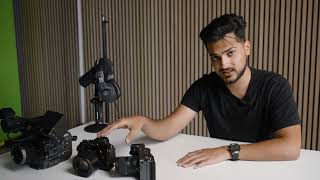
Areeb Mirza explains why his studio uses only Sony cameras: lens and accessory compatibility, shared troubleshooting knowledge, and avoiding the adapters and wires that come with mixing brands. He applies the same logic to keeping his computer environment consistent.
Chapters
Hey guys, welcome back to a brand new video. And in today's video, I want to talk about ecosystem and streamlining all systems. So if you're into cameras, if you're into computers, if you're into anything that creates content or, you know, actually does things to promote or just the technical side of things, then, you know, there's always this debate on, okay, Mac versus Windows or Sony versus Canon, or which camera should I get. So my formula for this is pretty simple. I don't necessarily care which camera to use. Like you could either use Canon, Sony, Nikon, whatever, they're all good. They all shoot 4k. Does the layman understand what 4k is? Do they understand what log is? No. So as long as it's like a good quality camera, you're fine. The only thing you should worry about is the ecosystem. So for example, over here, as you can see, it's a Sony camera. The one that's being recorded is also Sony camera. This is another Sony camera. And this is another Sony camera over here. So when it comes to ecosystem, it makes decision making pretty simple. So this lens can go on this, this lens can go on this. And even the cinema camera, I mean, they're all cinema camera apart from this one. This lens can go on this. It's so versatile. Like, if this was Canon, I'd be like, okay, I need an adapter. Okay, I need, Let me get another wire, let me get another lens. Oh no, I forgot the adapter. I can't use this lens. Like what?
You don't really need to do that, do you? Just get one camera. Just make sure it's a one size fits all. They could have different functionalities. But let's say another example. This camera has a problem, like it's not doing certain thing.
And I somehow fixed it. I watched some tutorials, I went to a technician and he told me what exactly to do. Now this one's fixed. Now this one's acting up. Same thing over here. Now I know exactly what to do because I've already fixed it on this one. So I know what to do for this camera. Now this was a different brand and I did the exact same thing and it didn't work. I'd be like, wait, what? You see what I mean? So that is what happens when you don't stick to an ecosystem. Let me show you the computer setup to the computer side of things is super simple.
So apologies if it's a mess here. So as you can see, Mac, Mac, it's a Mac setup over here. You'll See another Mac setup, pretty simple. And over here you'll see another Mac setup, this one we just got, and then a laptop. So what this does is especially here in the US everyone has like an iPhone, everyone uses an Apple product, everyone has an iPhone, everyone uses an Apple product. So a place where like a studio, a lot of people come here and if we want to just share them their photos or something with them right away, we can just airdrop it to them. And even with, let's say one of the computers was Windows in there, let's say my computer was Windows and if I needed to share a document or some files really quick, I would need to upload it to Dropbox and then send them a link and then they'll be able to download it. Apart from just, you know, share airdrop, boom, done. It's that simple. That's, that's what I mean by ecosystem. So this debate of, okay, should I get Mac or Windows, plan for a whole system. Like in my personal setup at home, I use a Windows and I also have an Android phone. And I love those things because they sync together pretty well. But when I'm working with more of a group, when I'm working with the team, then you need a proper ecosystem because you need to communicate with each other. If you're speaking different languages, it gets very tricky to always pull out your phone, use Google Translate and just to. It just delays everything, you know, so that's what I mean. It also enhances speed a lot. It makes everything fast, it makes everything more succinct. So when it comes to the cameras, even when it comes to like video editing, it uses the same software, same files go on top, same everything. So it's very simple, super basic video. Just wanted to touch bases on ecosystem real quick. Hope this helps you kind of just to make decisions on what products to choose and what to plan for. So if you're, let's say if you have two Sony cameras or two Canon cameras and you're deciding to switch to Nikon or something like why you've already like spent money on one ecosystem might as well like save that money and just go through all the route. Like for example, I was about to buy the DJI Cinema camera instead of this Sony one. But then I saw the cost. I was like, okay, I'm going to buy this, then I'll have to pack it in a separate bag, then I'll have to buy another lens, then I'll have to like just different things. I was like, that's not necessary. Let me just get this one. It's better for me because I already have like the system involved in it. All right, that'll be all for today's video. Really quickly, wanted to mention my newsletter which is free for now. I send daily emails Monday to Friday. Super valuable. Something I don't mention on Instagram, TikTok, YouTube or Facebook. So if you, I recommend you check it out. 100% wireless free. And if you want one on one help with content, social media for your business, there's a link, just kindly the link in the description, just book it and we'll talk. See you next week.