3 video marketing tricks to convert leads and get more sales | The Ask Avi Arya Show
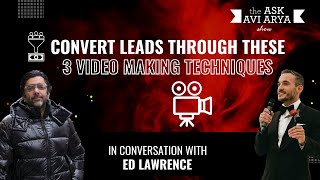
Avi Arya and Ed discuss three video marketing strategies to convert leads into sales. They cover storytelling techniques, content planning, and equipment basics for entrepreneurs looking to use video to grow their business.
People will come to us and say, I want to generate leads. And we'll say, okay, fine, you know, you need to pay the ad budget and so on. You need an audience out there. Do you have that? And the answer is no. So we look at how we can help them use video to communicate, to actually win more business. And often that comes down to sales based content.
Ed, firstly, thank you very much for taking the time out for us. We are an online school and we teach people how to use micro videos to become from everyday entrepreneurs to video entrepreneurs. So that you can take with three objectives in mind. To get known, get leads and get sales using videos. And we love the fantastic work that you do around videos and therefore we sent you the request and really appreciate you taking the time out. So I jump right into it. You know, before we. I always say to my students, the shortest distance between two human hearts is a story. And the best way to tell a story on the Internet is through videos and it has to be short and crisp. So people relate to you and we ask them to put a story in the beginning and end of every video. So I'm going to tell you my. We call this story the hero introduction.
Yeah.
I'm going to give you mine and I'll request you to tell us yours.
Okay, cool, go for it.
So, Ed, my name is Avi Arya, father of two girls, six dogs, husband to a superwoman, a streetcar racer turned hotelier, now social media marketer and founder of Internet moguls and creator of the Micro Video Mastery system, a system of 33 videos that allow every entrepreneur to become a video entrepreneur, to get known, get leads, get sales using just a smartphone from anywhere in the world. Over to you.
Brilliant. I've not got anything that's so.
Well, I just do this every day.
So yeah, no worries. So yeah, I met no wife, one dog, a girlfriend. I used to own a lawn care company which is a thing basically everything they do on football pitches, golf courses, fertilizer wise. Yeah, I left school when I was 18 and set that up as a franchise and I ran it for 10 years and then sold it because I absolutely hated it and wanted to do something that I loved. And video had basically been a hobby. So with the money in the sale of my company, bought all the professional kit. I'd never used it before. I'd literally just been making silly GoPro videos, thought how hard can it be? And then, yeah, six years later, this is where I am as a production company and you know, it turned out all right. So now we Sort of help businesses communicate in ways which we call uncorporate. So like you just said, using stories, things like that to help try and make business communication more interesting because a lot of the time it's pretty dull. So, you know, getting personality and humor in there helps a lot.
Perfect. So your company is called the film booth.
Business Film booth.
Yeah, Business Film booth. So tell us, Ed, what are the three things? Because we, you know, everything is about in our interview, it's going to be about actionable steps that the audience can take and say, you know what, I can do it too. So what are the three things that you advise an entrepreneur, business owner that they should do? Using videos to be able to get the word out there?
We usually would start off and say we need to look at your goal. So for example, awareness might be their goal and they want to generate leads from the Internet. A lot of the smaller businesses that we work with, because they don't have a very big distribution network, it's not actually the best place for them to start with video often. So we do what we call a lot of conversion content. So people will come to us and say, I want to generate leads. And we'll say, okay, fine, you know, you need to pay the ad budget and so on. You need an audience out there. Do you have that? And the answer is no. So we look at how we can help them use video to communicate, to actually win more business. And often that comes down to sales based content. So other than making videos for 10,000 people that you want to see it, making videos for a select group of the right people to help convert, give them an experience and turn them into a client. And we tend to find that's a great place for people to start. Things like testimonial videos or even personalized pitches where people are on camera presenting kind of like this, talking through how they can help a business, putting a testimonial in it, but targeting at that one person instead. And you'll find that gets a really fast return, one that the MD can see, one that the marketing team can see and they're not going or didn't it work? And then from there build, build confidence in video and they might start to use it more in different ways, repurpose it for things like awareness and generating leads. So I'd say that's the first thing that we say to businesses is think about your goal, your distribution and your strategy and work out within your budget how you can get it. Because it's not often the case. You know, social media Video is a long term project for many businesses and if you've got a win over a board with a quick result, it might not be the best way to do it. The second thing we kind of promote a lot is person to person communication. Just like me and you were chatting right now. I said a second ago, you know, the videos become, the Internet's become very impersonal. You know, there's automation and things like that and producing content where you see someone and they give them information, they're educating, it helps build rapport and trust. And personally I think there's only really two things, two reasons, two things. You need to make a sale online, you need attention, which is very hard to get, but you can buy it and you need trust and you cannot buy trust, you have to earn it from people. So showing your face, showing that you're a human and giving people information, that proves your credibility, that helps with the trust. And then I'd probably say the third thing is what you touched on earlier is really story and using creative storytelling devices, metaphors, things that help people come into the content themselves. So you know, when you tell a story, people envision that situation in their head and it brings them into the content. So that might be, you know, like you said, starting a video off with a story. It might be capturing your customers stories and unpacking the results that you've given to them. But it's very powerful. And you know, using video as a creative way to tell a story is how you're going to get the most impact and appeal to people's emotions. So those are three things that I definitely advise businesses look at.
Perfect. I'm sure the audience listening has got a very clear understanding of what are the three questions they should ask themselves before embarking on a journey with videos. What kind of stories to tell, what kind of budgets they have for promotion, distribution, and most importantly, point number one that you said, what is their goal? What, where do they want to reach with this exercise? Because it's not going to be a one day event, it's going to take time and a lot of commitment.
That's right. It's about consistency. If you're doing awareness, it's a long game, but if you stick with it, it'll work perfect.
So tell me, you know, for people who are saying my, how do you deal with this question when somebody in the audience, because I'm asking on behalf of the audience, somebody is definitely sitting and saying, you know what? My audience is not on the Internet. I mean, they're not watching My videos, I mean, I can't send in, you know, I'm a B2B company, I'm into industrial fertilizers, I'm into something so boring that videos don't work for me. How would you address that question?
Well, I mean one of our companies that we work for sells bins to other businesses. And in fact a lot of the businesses we work with sell products that are kind of everyday, they sell services to business. In fact, pretty much majority of what we do is what you just said. What it is is everyone when they hit play on a video from maybe in this niche, they're going to think it's going to be boring. It's not necessarily going to become an experience. And because it might be considered boring before someone hits play, this is a really good chance to exceed their expectations. So it's actually quite easy to impress people with a business video when their expectations are so low.
I like that point.
So I think if you're thinking, okay, business, business, it doesn't work, you might be right. And sometimes people say my clients aren't on Facebook, they're not on Instagram, and that's fine, go where your clients are, but find ways of using video in the mix. And I think I mentioned it earlier, if you're all in business to business, you might be working with high value clients and a contract might be worth £100,000, say or you know, 10, £20,000. If you're pitching against three other businesses, well, use video, a personal video like this to communicate the benefit of your offering because they won't be doing it. And if you can make your potential prospects feel like you've gone through all this effort for them, their ears are going to prick up, they're going to think, okay, this person's innovative. I like what they're saying, I've met them, I'm starting to trust them. So I'd say be right to be cautious of video because I don't, you know, it has been pushed as this thing that all businesses need and it often, like I said, pushes people towards awareness and social media where some businesses don't need that. So it goes back to your strategy. I'm sure you'll be able to find a use for video. I mean we made one for someone that was just about a Hoover, you know, not an innovative Hoover. They were just selling, there's Henry Hoovers and it's them presenting, talking about the basic features. They put it on YouTube, it ranked and it got hundreds of thousands of views and drove loads of Traffic to their site. We also worked with a company that sells paint supplies, so just, you know, spray paint. They started using YouTube as a place to put educational videos around spraying paint. They put four up. A few weeks later they landed a contract that was six figures as a result of someone discovering them on YouTube. Now you have to kind of try these things out before you write them all off. But, you know, there is definitely a use of video in there. And I think the first step is to go personal rather than mass, get a result with that, get some return, and then go back at mass and start putting some of that return back into a wider audience. That's fantastic.
Yeah, I love the ideas that you gave. That's fantastic, Ed. My next question is, do I have to be a good looking bloke like Ed, or can I still make videos? A lot of people have this thing, you know, I don't look good in front of the camera. It's not my place, you know, I need to lose some weight, maybe shave my beard, take off the hat. People stop themselves from putting themselves out there and let go of so much in opportunity. What would be your message to them?
My message would be people judge and that happens. And they judge everyone, no matter how good looking or, you know, bad looking or overweight or underweight or whatever they are. Once you come out with some quality content and some information and you present it in a way that captivates people, they will completely forget about what you look like. And there's tons of celebrities, there's tons of famous people out there who have got somewhere. They're not necessarily being the best looking sort of people. I mean, if you look at Gordon Ramsay as an example, he's kind of a bit different looking, but, you know, his credibility and his personality is quite infectious. So often when people are worried about, you know, what they're gonna look on camera, they're often worried about watching themselves back. And we don't like the way we sound and we don't like certain things about the way we look, but the person watching you isn't picking up on those things. And, you know, they may judge, but if they do, that's their problem, not yours. And if you can hit them with some great content, they'll forget about it pretty quick.
Got it. I want to get started with videos and I'm an entrepreneur. And what are some of the prerequisites? I mean, do I have to go for a voice modulation class? Do I have to buy a lot of expensive equipment like the mic and the pop filter? You have there?
Do I.
Do I have to get a green screen? Can you give me at least three things that I can do to be able to get started?
So we tend to go against the grain with our advice. So if, let's say you're talking about presented videos like, you know, kind of look like what I'm doing now, I'd say the first thing is write. A lot of people make the mistake of jumping straight in front of the camera and trying to present off the top of their head because they've seen people maybe on YouTube or LinkedIn, present what looks like off the top of their head. But if it is, this takes a long time to get used to. But really, you kind of need to get used to the camera and actually writing out a script and editing it and building in stories and working out what you really want to say first. It takes a lot of strain off you when you're presenting. So I'd say the first thing is, you know, write a short script, 3, 400 words, and just get in front of your phone and practice it. If you can get a little auto cue that will sit sort of on the front of your camera, you can, you know, that would take a lot of the strain off you, too. So writing will really give you the opportunity to trust what you're saying rather than wonder if it was any good. I also then think, you know, bear in mind this, this is not something that comes naturally to everyone. Some people it does. Most people, it doesn't. So be in the mindset that you're going to get better, and actually your first video is going to be your worst, but your second is going to get better and your third, and just keep looking for ways to improve. So that doesn't cost anything. Practicing in front of your phone if you've already got one that doesn't cost anything. But you'll get to a position where you're confident on camera, where you think your content sounding good. We'll actually want to release it because you'll be proud of it. And it's getting to that step that most people struggle with because it is, you know, it's a scary experience making video. You're putting yourself out there and you always wonder, what are people gonna think back? So practice it doesn't cost anything. And then I think once you're happy with that, then you might be, you know, and you think, okay, I want to put something out online. What's the response like? Then it might be time to start investing in some kit. And if you are, I'D say, probably go for a mic first just to get your sound better, especially as phone footage is pretty good these days. And then start experiment with editing. The problem I have with video is that there's so much to it. It's like, you know, creativity, writing, presenting, filming, lighting, sound editing, promotion. You need an army of people to do that and to learn it all is a long process. So just do a bit by bit and keep improving and it will feel less stressful.
Right, awesome. So tell us, what's the difference, Ed, between the kind of videos like you put a phone and you start talking about? Give a message of the day, learning of the day, motivation of the day, or one filming tip of the day, easy to do. Put out your phone and do it. Then there's another format where you're storytelling and you're teaching people a concept to be able to have them have understand you as an authority on the subject. And then There are those YouTube videos where you're going around the city and creating a story and all of that. I want, when I, as an entrepreneur, want to get started with three objectives. Get known, get leads, and get sales. Can I just start with putting a camera right in front of me, a phone camera, and just talk, thinking, telling them about my thought. How should I get. How do I structure a series of topics that will eventually get my first 30 videos out there?
Okay, so, yeah, that's a good point. So it's kind of. It's looking at. First thing, it's looking at, what do your viewers care about? Not necessarily what do you want to tell them? That doesn't mean you have to go and do surveys and things like that. But if you want to keep it, say if you want to keep it short and sweet, start off the example. Just what I tend to do is I listen to what my clients are saying, and if the same questions keep appearing, I think, oh, that would make a good video. So you want to get your first batch of topics ready in order to create content that will eventually generate leads. Um, and just write down questions. Basically, I've got a Google sheet that's got about 40 different things on it. And I just dump my questions whenever they come to me. And then once I think, okay, I'm gonna make a video on this topic, I'll then, you know, research it a bit more and work out ways to present it. So that's the first thing you kind of need an ideas bank. Don't just think that ideas will come to you. You know, they do, but it's also Quite a good idea to dedicate some time specifically to it, maybe an hour in the morning to get creative and think, you know, just, just have a real good deep dive and you know, hit Google and research to try and find some good ideas. So then you could produce these pretty simply. Let's say, were you assuming, were you talking about maybe using social media for this to help generate leads or was there another platform you had in mind?
Social media.
Social media, yeah. For social media really is all about consistency and turning up on a platform or two or three if you can on a regular basis. But you know, for most people they can't. So you can look at different ways of doing it. You could stick to, let's say LinkedIn as a platform and just make lots of short, try and keep the content short on their like two minute videos. Or you could do what I do and I make long YouTube videos and then I'll cut bits out and I can repurpose them on LinkedIn. So you're attacking different channels at the same time. But, but for most people, two is quite a lot to start off with. So let's say you start shooting and I would recommend shooting in batch, so shoot 10, 12 videos in a row if you can and get them edited and ready and then maybe try and just put one a day out on LinkedIn. And if you can do that for 30 days consistently, what you'll find is as long as people are engaging with it and commenting it and your write ups good enough, it should start to, you know, bring, bring your connections up and get people talking to you. But for social media, yeah, you've got to turn up daily, really, whether or not that's a video or a post.
And you did, you did give us a template. You said you have to go daily but you don't have to be scared because you said use the concept of batching. So whenever you. What I do is I cannot stick to a. Every Monday I'm going to do videos. I like to do videos when I'm in that, in that mood to create videos and I want to teach and I want to train and I'm fired up myself. That's the day I'll finish all my videos and tell my team to just pick it up from the drive.
Yeah, that is the hard thing because if you're not in the mood for it, forcing it isn't going to help. So for me, like I write my content in the morning and past 11 o', clock, forget it. My brain just isn't in that right mode. So I'll spend a few hours writing and then the next day I might film. I don't tend, for me, I don't tend to do it in one day because I just get worn out. And then the same with editing, but I try and batch those creative, different creative elements together. Of course, everyone works completely differently, but you do like, you do want to have the energy and the right sort of mindset to do this all. You're right. So yeah, as part of a template. You know, when we started in business, every Friday, we didn't work for clients. We just worked on content for our business. And what we found was by 3 o' clock every Friday, we couldn't do any more. We were just useless. We couldn't present, you know, writing didn't make sense. We were just worn out. So our Fridays became, we finished at three and up to that point we got a lot done. So yeah, as part of a template, it's like do it when you're, you know, your body, you know, if you're an evening person, maybe do it in the evening, try and get structured, try and batch things together. Because if you're constantly trying to chase one video after the next, it just feels like you're behind all the time. I like to have, I like to be two weeks ahead minimum. Really three weeks ideally of what's going to go out. Does that answer your question?
Okay, 100%. I have a very important question to ask you now. Once you finish your videos on Friday at 3 o', clock, which bar do you hit for your beers?
Me and Dave are business partner. When we started going, when we started working together, we went to, went to the pub, you know, a local one near our studio, and had a beer and then I think I went to bed at 6pm I stopped doing it after a while because. Yeah, I don't know about you, but Friday afternoon my brain just shuts down.
Absolutely, absolutely. So my next question, Ed, is you do YouTube for yourself and your clients. You do online courses as well. You do videos for websites, you do videos for social media. Now as an entrepreneur, is there of. What would you say about these different formats? Like if I want to create videos for my online course and I've got a course which is three hours long, 10 modules, every module has three videos each. Do you have a specific video genius idea or something that you can share with me? I do. When I do it on social media versus what is, how should I go live? Just these three formats, if you could.
Yeah. Okay. So for course building, I've just finished a course with a client that's about two hours long when, when all the videos are added up, each video within that is sort of 10 to 15 minutes. Now one of the things that we did on this course, which was pretty cool is it was a, it was a TikTok course, believe it or not. So we're hoping that President Trump doesn't ban it. So the. Each module within the course had two videos. The first video was presented like kind of teacher training, you know, like a long educational video like you would see on YouTube teaching you how to, you know, module. One might have been something like the basic setup and so on. The second video within the course was where we felt added the most value because what we did is we interviewed a TikTok influencer. So just like we're chatting now. So I called her up from America, she was in California and I interviewed her based on that module. So what you got was the teacher, which was actually me presenting it, giving you the step by step things. And then the second video within the course was an influencer's experience. And what happened was when we started interviewing her, she came out of all this stuff that you could never know unless you've been, you know, you've grown a following very quick. Loads of tips and things that as someone researching a course, you just wouldn't come up with. And as a format that worked amazing because the interview itself might have taken 10 minutes for a 10 minute interview. The edit wasn't particularly bad either because it wasn't like we were having to cut loads out or add much in. And it was a very engaging format that has given the course a lot of credibility. So I was thinking about it and I thought what I would say to people making a course is do your traditional course videos, but if you can find experts within your field and use something like Zoom, you know, like this and interview them on it and add that to your content, getting someone else's perspective who's got some credibility on things. It really does make a big difference to the content and you know, it just made the course look so much more complete. So that's something to maybe consider for that format within courses, interviewing other people.
I've just got my, I'm just in so many directions right now. I'm just thinking because I have interviewed the, you know, some of the best people around the planet now to add them to my course is what I'm going to start doing starting today. So thank you.
It makes a lot of sense. And you know what the best Thing about it is if they want to be part of it and they start sharing that they're in this course, you know, they're happy to be in it. It then just brings more promotion on you as well. So it's kind of win, win.
Oh, yeah, absolutely. You know, I, we'd asked for 40 minutes but you were so bang on with your answers. We've, you know, we've, we're almost at the end of. So I've got one, one last question. I've got two dogs. I've got two daughters, I've got six dogs. I've got one wife. I've got lots of amazing things that happen in my life, especially when I travel. I meet amazing people. I'm on a flight every day. I used to be on a flight every day. I took 102 flights last year.
Wow.
I'm happy not to take many flights. So there's a lot of interest around my life. And so I've got a friend of mine who lives on the farm, he's got his farm life, he says, not interesting, but it's interesting to me because all about farm and the animals and all of that. How, what would be your advice to entrepreneurs who feel, you know what, thanks to Ed, I did my first 30 videos and I've understood now I want to start showing more of my life. It's what, how should I start showing more of my life? I mean, how should I begin?
So kind of like more lifestyle vlogs.
And so on or just I'm a serious B2B entrepreneur, but just to break the monotony and the impersonalized nature of the Internet, like you said. Yeah, good idea. If I show everybody that I chase my sheep in the morning or I, you know, or I take a plunge in ice water in an ice water bath in the morning. So those things you recommend people putting behind the scenes in their, in their.
Business videos, it's very interesting. I've been discussing that recently about how much to let people in on. So, you know, the celebrity culture, especially in the uk, people love seeing what other people are doing. I personally, I'm not that big on it, but it's all, but it's, it's, it's incredibly popular. You know, people like to see that side of things and the more human side. So I'd say if you want to tackle it, you know, by all means do. I've never really done it very well for myself. I'm going to start a new YouTube channel where I'm going to do a Little bit more. But I'd say look at Casey Neistat, the YouTuber, the way that he did a vlog every day for years, but it wasn't just like a vlog on his phone. It was like, it was amazing.
That was a lot of work.
Yeah. But the way he does it is, what he does is he films in a studio, like, kind of like this, chatting to camera, and then that will be the backbone of his content. So he may be talking about something that happened and then he'll show footage of that that's relevant and then maybe be talking on camera in a different area. But to produce that sort of content, you do need kind of a base, because if you're always running around trying to tell a story, it's fine, but you might miss bits and so on. So depending on what your goals are and how much you want to let people in, by all means, give it a shot. You tend to find that sort of content gets a really good response. And people might sort of gravitate towards you because they feel more of a connection. But it's not something I've ever encouraged, but it's something that I think if you do it well, it will set you apart. But it's also very easy to do badly and it just looks a bit kind of like cheesy. Yeah. So again, it goes down to storytelling. If you can turn, you know, my life's not particularly interesting. I work at a desk most of the time. If you've got stuff and you're going, like you said, you're traveling and you're seeing things, that's interesting stuff, by all means, film it and get it out there because it's interesting. If, like me, you get up and sit a desk and there's not much of a story to tell, maybe don't show that side of things.
Got it. So my, my last question into two parts. If you can tell us what is the equipment that you're using right now to show such a beautiful video? Audio, you know, blurred background. What should I do to. In my next video, make my video look like yours? Okay, from here. And I can't turn my desk around this time just because of the logistics of the room.
So I'm currently having my bedroom wardrobes all been smashed out. So what you can't see right now is that the floor is completely covered in clothes. But I've made a video on it actually. So I've got. This camera is a Sony A7. You can do just as good a job on this. This is an A6500 which you can pick up secondhand pretty cheap. It goes into what's called a cam link. So it's now ghetto cam link. And that's basically a little micro HDMI that goes into this little USB stick basically which goes into your computer and it connects to zoom. Then the mic I'm using, which I don't usually use, is just this. It's a condenser mic. I've got little lapel mics that I use as well, but the batteries are running low and I hadn't charged them. So this came in just before he called and I have one light and the light I'm using to make it softer. Right. I've turned off every getting a bit darker now. So it's probably, it's probably changed as the interview's gone on. But it works. You only really need one light at kind of a 45 degree angle. You've got a bit of, a bit of light coming in from behind you and that's it. But you know, for zoom in from.
The right hand side. So I should worry about, you know, how to, how to hide that light. All I put in a DSLR and. Which I was too lazy to put on for this interview and I just moved into this office. So I was actually quarantined. I'm not quarantined. I was actually stuck in India for five months. I just made it back to Vancouver. I've got this camera.
Yeah.
But I've lost all the, all the wires with it. So I need to get a wire.
Has it got an HDMI out? Has it got a micro HDMI out?
I just bought it from a friend of mine recently.
It might do.
Yeah. It has an hdmi.
Yeah. So that's, that's all you need to connect it to something like this. I would say that the reaction I've had from just putting this effort into remote calls, it's one me business people have been. You know when you call up as a video production company and you have a meeting with someone like this, if I do it on a webcam and I do like this, it suddenly sets me apart and I understand that that.
Makes so much sense. So I'm going to attach this to the cam link and then the cam link goes into my laptop. So that's the DSLR and I should set it up right behind the laptop so it. At a, at a height or at an angle.
Well, I usually. This is quite low at the moment. I would usually say have it above your eyeline looking down. So that you're looking up slightly. Um, I've got it level with me at the moment just because my usual.
Behind my laptop.
Yeah, so you can have it behind the laptop. What I tend to do. So this isn't my usual. I have a slightly different setup, like I said, because there's always stuff in the corners. I actually usually have the camera pointing that way. And what I have is. I have an. I have a. I have my computer and I have another monitor, and I put the other monitor underneath the camera. So your laptop would work fine. But it's.
And then I just blur the background. But I can't do anything with this light coming from the side, and that's okay.
Well, if you've got a. I mean, I've got a. What's it called? A rail? Yeah, a curtain. You know, if you can shut the curtain or even just put something over that light and then get another light to fill it in. Ideally you want to be able to control it because if suddenly the sun shines in it, it blows out. Yeah. But another option would be I can see behind. You've got a gap, You've got a wall, and you've got blinds on them. Have you got blinds on your other light?
No, I don't.
Okay. So you could move back slightly maybe, or maybe even flip it around the other way. But it's kind of like a thing to play around with until you're happy with your kind of set and your look. But having, you know, having a mirrorless or a DSLR camera is great because you can blur everything. You know, everything behind me is blurred. If there's stuff there, it just kind of becomes part of the scene. So it just looks cool.
I'm going to do that in my next video for sure.
Yeah. Cool.
Ed, thank you so much for your time. This was not lots of learning for me, but I'm sure we launched this to our 800 students who come live on a training every Saturday. And also we're going to send it out to a community of 143,500 people. We email and we have a Facebook community and all of that. So all of them are going to see this. Thank you very much for your super fast response to our email. We have an office in India, but I'm based in Vancouver, Canada. We have a community of over 200,000 people and they all talk about videos and video entrepreneurship. If you have a course, if you have a podcast, if at any stage you have to promote something and you need a friend or a partner to help promote that. I would love to thank you back for your time. To add anything that you need, just send us an email. We're going to be there for you.
Cool. That sounds great. Have you ever. There's a guy who's in Vancouver who I follow on YouTube and I chat with quite a lot. He has a lot on live streaming. So this sort of setup that we've got now, his name is Rob Balasabas. If you're looking for anyone else, Rob.
Is a very good friend of mine. I know.
If you're looking for someone to interview.
Sorry.
If you. Look, I was gonna say, if you're looking for someone to interview, he's very good.
Yes, we did that. We did that. Yes. Rob is a great guy. I've known Rob for years and years and years. Yeah.
Oh, good.
It is a small world. Yes, absolutely. Ed, thank you very much. And like I said, before you go, please promise us that at any given point in time, if we can be of help to you, you will reach out to us.
Yeah, sure. Definitely.
Alrighty.
Thank you very much. Bye.
More from Avi

The strongest mindset doesn't begin with meditation. It begins at home. Before you conquer the wor

The strongest mindset doesn't begin with meditation. It begins at home. Before you conquer the wor

Your mindset isn't something you fix once. It's something you train every single day. Just like yo

Don't build a company just because your friends are. Build one because you're ready. A startup is

Everyone dreams of becoming the boss. Very few understand what that really means. The moment you b

Most entrepreneurs say, "I don't have time for coaching." The truth? You don't make time for what

Over hiring doesn't always solve problems. Sometimes, it creates them. Having a small buffer in you

"The highest-paid" isn't the goal. The highest-value is. People often ask why premium mentorship co

The founder will always be a bottleneck... at some stage. The goal isn't to pretend you're never th

People ask me how I stay consistent with my morning routine while traveling across countries and tim

People ask me how I stay consistent with my morning routine while traveling across countries and tim