Agency Secrets Revealed: How @HarshilKaria Built a 1300-Person Agency| Avi Arya
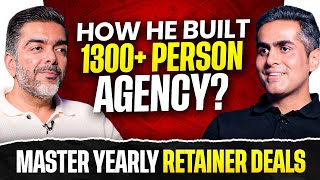
Harshil Karia built an agency to 1300 people by focusing on systems and team building. He talks about the mindset shifts that got him there, how he measures success, and why fitness matters to his leadership.
How did you become an agency founder?
So I was seeing this intersection of advertising and tech and social media.
Where did that confidence come from? Like your parents said, don't worry, become an entrepreneur, we got your back.
I had the confidence to say that, okay, you know, I can give myself a few years. So I would be drawing a very base salary, hardly bringing any money home for three to four years.
You knew that?
Yeah.
You were okay with that? Were you self aware at that time?
No.
Okay.
No.
I love how you just immediately said it. Personal branding is such a big part of what we do as agency founders. So what do you do to get known?
When Avi Arya says come on my podcast, I say yes, I always try to get known through the work.
Right.
Because if the work is good, people always ask who's behind the work.
Sure.
They say shebang and they want to know who's behind shebang.
Lovely.
Acher, thank you from our podcast. And this is for agency founders.
Yes.
And you know, I remember when I started the agency it was like what is it? Are we advertising agency? Digital marketing? When? So we called ourselves Internet moguls. And when I went to my first few client visits, people said Internet connection. That was the beginning. From there to now, obviously things have changed and at that time it used to feel that it's going to, you're going to be like a 70 year old man before you become successful or a large agency. But you've done it in, in record time. Maybe it was not on your mind but how did, did you grow up and think how did you become an agency founder?
I actually after college straight, I became an agency founder. My first internship was at an advertising agency, it was called Dentsu. And my third internship was at what would become a social media agency called what Consult. So what consult had two parts. What blog and what consult.
Right.
And what blog? You had to write articles every day. So about six to seven articles every day I would write and that was my upbringing. So I was seeing this intersection of advertising and tech and social media. And then I got out of college, I started my first agency, Foxymoron.
Which year was this?
2008. So 2008 to 2014, I built that about six and a half odd years, probably 2007 and 2008, you know, so I built that.
How old were you then?
Just out of college. 20, 21.
Okay, so so where did that confidence come from? Like your parents said, don't worry, become an entrepreneur, we got your back.
Or something like that was also there. I think I have to Acknowledge that I also come from slight privilege.
Right.
Because I didn't have to fend for bringing the, you know, the food on the table.
Sure.
So because I didn't have to fend for bringing the food on the table, I had the confidence to say that, okay, you know, I can give myself a few years.
Right.
To build this out. So I would be drawing a very base salary, hardly bringing any money home for three to four years.
You knew that?
Yeah.
You were okay with that?
I was okay with that. Not that I was okay with that. My situation was okay.
Sure.
And that time when you are younger, the opportunity cost is a bit lower.
Sure.
So it's not like the other salary which I was letting go was also very, very high. So whatever I was making, it was fine.
But it was still a choice between different careers.
Yes. But it was fine. And I kept building and I kept enjoying what I was doing and I was always experimental by nature. I love design, I love writing, I love business. So I felt like this career gave me a combination of everything I could.
Say non chatgpt days.
Yeah, yeah, yeah. Non chat GPT days. So it gave me, it gave me a lot in terms of the career. Gave me the option to learn a lot and learn fast. It gave me the option to be among people. It gave me the option to do new business and sales and it gave me the option to do creativity so I could mix all of it together and it was like I was really enjoying myself.
Were you self aware at that time?
No.
Okay.
No.
I love how you just immediately said it.
Yeah.
Most of us are not right at that.
Yeah.
So is it okay to start a business when you're not self aware or it's that the process of finding yourself is what it is.
Yeah. It's like, you know, your quote of the pain pushes you to vision, pulls you.
Right.
So I think sometimes you go in, you started not to. You don't start a business to become self aware. Self awareness happens along the way.
Right, right.
That's a good one. So you, you start a business because you, you, you want to be in that space. I knew when I started in 2008 that this space of social media marketing is a relatively unexplored space. It's a space where makers are going to be created. So I was one of the first few to latch onto that space and that worked out well for me. It also worked out well for me because I had a good entry point because even though I was a kid, I was accepted because in a new industry, a Kid is always accepted because nobody wants to listen to the gray haired guy on a new industry awareness fields then kind of. Okay, yeah, I knew and I was walking into rooms. So like what I was doing is I was doing through what blog and what consult. I was doing pitches and proposals for many large agencies for clients.
Lovely.
And they used to send me and I would go as a guy of that agency and I was seeing that I'm making sense here and they like to see what I'm selling. So then I said, I'll back myself and I'll do this. My presentations were good, my points were sound. The senior people in the agencies like to work with me. So I said that, okay, maybe there's something here that I can build out.
Awesome. You know, so this is the hero introduction. So like, you know, when I say my name is Abhiare, father of two girls, six dogs, husband to a superwoman, a streetcar racer turned hotelier, now founder of Internet moguls. So if you can use a similar framework and tell us your hero introduction.
This is a, this is putting me on the spot a little bit, but I'm going to try. I'm Harsher Karia, founder of two advertising agencies and one mental wellness platform. I am on a journey to find myself lovely and help many find themselves. I am looking to instill beauty in the world through the work that my teams and I build. And I'm looking to build meaningful and deep relationships with the people I work and collaborate with.
Perfect.
Love it. So, you know, the rest of the podcast is going to go in this format. We have something called the Agency Smoothie.
Okay.
Where we have these modules. Get mindset. So it's like a smoothie. You have to put these 6, 7 things to make your whole diet successful. So it starts with get mindset. It goes to get fit, then get known, get leads, get sales, get systems, get teams, and then get success. So I'm going to finish this on this chronology. So when it comes to get mindset, so what do you, how many people do you have right now in your teams?
About 1200.
1200 people. What do you do for your mindset?
For my mindset, I think I'm always curious to learn and I'm always curious to sharpen my skills. So I see the work that is happening outside and I'm trying to get inspired by that work and I'm trying to reach my level of skill to that work. Right now the challenging part is that I am running many services.
Right.
So I have to try to be at the Top of the skill game on many services. So I have increasingly gotten faster at understanding what top is on many skills, and I've had to start increasingly getting better at breaking down what makes the top lovely. So that I can, when I'm speaking to teams, I can assess whether they're going the right direction and I can help them go into that direction. So mindset, I think, is a constant. Learning mindset is the first thing. The second is an insulation mindset against all of the many challenges that may arise. You know, speaking to a colleague of mine today, and he said that being on an agency floor with lots of young people is like living inside. You don't get fires, you get forest fires.
Oh my God.
Because, you know, like you've got two people upset and then it spreads.
Right.
Mood and vibe is such a thing. So when you are trying to douse a fire, which has very quickly a propensity to be a forest fire, you need to be at the top of your game as far as your equanimity is concerned.
Right.
So I've tried to work a lot on that.
So on a score of zero to seven, what is your get mindset score right now, seven being the highest, I.
Would say about four and a half.
Okay, awesome.
Now let's go to get get fit. But I remember last time you were like, this happens in New York. I didn't know it's happening in Bombay. You ride a bike to your office.
Yeah.
So tell us a little bit about that and then tell us how what you do to get fit.
So what I do to get fit, I'm probably not at my peak fitness level at this point in time.
Okay.
When I'm at my peak fitness level and I now reorienting to get back at it, I feel like my fitness level fluctuates a little bit when stress levels are slightly higher. And then it's a challenge to come back to that fitness level. What I do typically for good fitness level is I'll do a combination of workout because like most people who run companies, I tend to get easily bored if I do just one thing right. So I have a mixture between Iyengar yoga workout, which is what I do ideally I should do two times a week. I have a swim workout, which I would do typically three times a week. And then I have a gym weight training workout, which would be about two times a week. And then I make sure that my daily commute is a cycle ride. So it's about, give or take, 25 to 28 minutes of cycling every day, two ways. And yeah, I make 25.
25.
No, 25 total. It's not very far from where I'm at. It takes me about 15 minutes to get to the office on longest period of time. So if I'm riding fast, I'll be there in about 12, 12 and a half minutes. So about 25 minutes of cycling every day. Cumulative is what inevitably happens. And on some days it could be more because if I'm. I have a rule that if I have a meeting in a four square kilometer radius, then I will cycle to the meeting.
Lovely.
So cycling, swimming. I am good. Yoga and weight training.
Yeah.
So what is your score on Get Fit on seven?
Probably four.
Four. Okay.
But. But I love the. I love your folded folding bike. And you know, you have a helmet and you walked up the. Took the elevator, walked up the stairs last time when I met you. I'm sure it sends a beautiful message to everybody.
Yeah, yeah.
But did you pick a drop from somebody in New York or Vancouver or somewhere or.
No, actually, a friend of mine, his sister came back from New York. She was staying in New York, I think, studying at Columbia University. She had bought a folding bike. So she brought it back to India. I went to his house. I said, wow, this is a beautiful bike. I'd love to try it. I tried it. I said, it's amazing. I should buy it. But can I try your bike for a few months to see if I'm actually serious about it? And once I'm serious about it, then I can.
Sure.
Then I can buy it. So two months I rode his bike and his sister's bike, and then I ordered my folding bike after that. And then it's been about five. Five years plus five and a half years of me riding every day.
Lovely.
That's a virus story in itself. You know, 1200 person company founder, bikes to office, go for a show. I love that. So now we go to get known.
Right?
So personal branding is such a big part of what we do as agency founders.
Yeah.
So what do you do to get known?
When Avi Arya says, come on my podcast, I say yes. So that's what I do to get known. I think honestly, to get known. And it is important to be visible is important. And now it's not just about putting out content, but it's how meaningful that content can be. So I find that I have to try to always get better at trying to understand what more meaningful I can say. I've not really focused that much. I put actually a lot of my effort on Getting shebang known. Because I tried to make sure that, you know, we are buzzing on Instagram every time we have what, some 113,000 followers on our Instagram. We've never promoted anything. It's all organic. People follow us. So I, I always try to get known through the work.
Right.
Because if the work is good, people will always ask who's behind the work.
Sure.
They say shebang and then they want to know who's behind shebang.
Lovely.
So that story of work is what.
Yeah, I try to get known through the work and off late, I think because of my avatar and level supermind, I had to bring my face out a bit more. So I'm podcasting, you know, so like I did one with you. Similarly, you know, we have a lot of different podcasts lineup. So that's another place of getting known.
Right.
I think it's also important to get known in the right circles when you're an agency founder. So to get known inside the power circles is important. And to be able to be known inside the power circles, you have to be contributing to the power circle. So what can you do to contribute to power circle? So I feel like one of the things I need to do, I am doing and I'm trying to do better is that if I can contribute more to skilling in this country. Because if people are talking about this country, India's population being its biggest strength and you know, recently in this independent day speech, prime minister said, there's make in India, but there's also design in India.
Right.
So how can I contribute to that? So I'm, I've signed off something in end Jan.
Right.
Where we are doing a 2400 Designers Designathon. 12 hours.
Wow.
People designing together for 12 hours across.
The 400 laptops at play.
Yeah, yeah.
So, you know, those kind of things. Can I contribute? If you, if you help people, you will get known.
Right.
So that's what I'm trying to do. Or like, you know, we have a partnership with Shebang Academy and Masters Union. So we are now in our fifth cohort. We train people. We also do a lot of trainings in our office. We have a program separately, a program for teachers, which is a teacher training program across nine schools where we. Again, this is not to help in digital, but I'm just trying to help them, which is that we help them with things like social, emotional reasoning, you know, things like the gazing eye. A lot of these teachers are from lower economic background schools. So the parents always look at them with a very gaze you know, like that I'm attracted to you. Okay, how to avert that when kids are not getting along, how to do that? So we do a 14 week program for the teachers and then we do lots of other stuff and we have total of 18 schools we support between urban and rural where again we try to infuse creativity in the day to day curriculum. Basically what we do when we, what I mean when we support it is that we run for them the tuition classes before and after school. So it's kind of like, you know, it's in partnership with my foundation, Greater Good foundation and Enrich Lies Foundation 1 and in Palgar it is with Sri Chaitanya Seva Trust. So we run the tuition classes before and after school so that people do things like sports day, art, craft, creativity, music. So there's an environment for them to explore themselves and upgrade their intellectual skills. So how can I contribute more and more to that? Is what I'm trying to, you know, just live my life perfect.
And what's your score on get Known.
On seven maybe again four, four and a half.
Is it because you're hard on yourself that's why all the fours or because they are a bit of both?
Kuchkarnai Karnai when we are both 85. When I am 85, you'll be roughly 96, I think final score. So. So we'll do.
And I, I have full intentions to cross the 100 mark.
I mean, so we'll do it that time. Let's be recorded. We'll do it that time. Before and after. That's a good one.
I like that. I've never heard this before but that my calendar may. I'll send you a calendar invite.
Yes, definitely.
So now comes get leads. So leads for the business can come from the big, you know, the conglomerates that you may meet at a dinner.
Yeah.
And second is all the Facebook ads or whatever you might be doing. So how do you, how does your agency get leads?
I just put out our work. I keep doing good work, I keep putting it out. And I serve my existing clients well. They always give referrals.
Right.
The other thing is that at client level also people move between companies. Somebody's a good working experience with you, they'll move to another company, they'll call you, your earlier contract stays, you get a new contract. So what I try to focus on is that actually I measure for all my teams and for all my units, I measure what we call a client satisfaction score. And we measure that every 90 days. And we measure a Net promoter score from the client to understand that how much would they promote us? If we do good client satisfaction, we do good Net promoter, we are doing something right. The other thing we measure, which we look at, is measure the client churn and attrition, and we measure the people churn and attrition. So we have to bring client churn, attrition lower, Net promoter score, and client satisfaction score higher. So there's a mentor of mine who I used to work with, and he guided me a lot. He used to always say, Mr. RSR Murthy used to always say, you can't manage what you don't measure. So if you measure the client satisfaction score consistently, you measure the promoter score consistently, that means you're doing something right for your clients. If you're doing something right for your clients, they'll promote you in the bargain. You will also get good work that you can promote.
Perfect.
Other people will see it and they'll.
Call you and it's all now synced with the appraisals and all the performance. And so everybody knows what they're doing.
Yeah, yeah.
But so this is beautiful. And I think that's the main mantra. But just for the audience, if you could shed some light on what they should do to get leads if they were using a Google or a Facebook ad campaign from your experience, like for agency founders, because we help others get leads. But how should agency founders get leads? Like, what would be your right. 2 cents on that.
My 2 cents on this is that I am not very sure that an Internet lead converts well for business.
Right.
I'm not very sure about it because it becomes transactional is my caution. Now, I don't know if some people will take it in the right way or wrong way, but I would, I would be cautious of that.
Sure.
Because what happens when you are an Internet lead, that means you have been pushed.
Right.
Whereas what you want is always to be pulled.
Right.
So you always want. I always have this thing on a pitch. Is that what can we do to win the pitch before the pitch?
So when they walk in, they think, oh, Shabang is here.
I already want to work with him.
Right.
I just put everybody else for formality. I kind of know I want to work with.
Right.
So if I had to put one advice on that is if you're doing performance marketing, then don't focus on the cost per lead. Focus on what the lead will see that they. That they will be convinced that I want to work with you. Ah, nice that they, you know, it's not about the filling of the form.
Right.
It's about how much more time they spent on the form, how much more time they sent spent on everything else. Looked at your cases, measure that, make that your North Star, not the fact that you got a lead, because that will help you win the pitch before the pitch.
Lovely.
No, that's fantastic. I've never heard this before. This is beautiful. So what's your score on get lead on.
Get leads? We're doing okay. I think I would put on seven, six.
Okay, excellent.
So now get sales.
Touchwood.
Yeah, touchwood. And get sales now. So it's like, you know, a lot of people, agency founders will be listening to this. For them, this is like, I think, I'm sure this part of the podcast is going to get maximum traction and people are going to play it again and again. So should people have a sales team? Should a founder always. Is always going to be the best person to go and get sales. Is there a right way of doing proposals, pitches, any ideas?
I think agency business works on three pillars. Human resources, business development and finance. These are the three pillars. You need to have great HR to be able to recruit great people and keep them happy.
Right.
You need to be able to have great business development to be able to win your businesses. And you need to be able to have tight finance to make sure money comes in on time and that the terms are correct. Finance, legal.
Sure.
So these are the three spokes, which are the operational spokes. Of course. A great agency should definitely have great creative and great delivery on all the KPI metrics. So you should be oriented to deliver outcomes and you should be great on creativity. Outcomes are always money outcomes for the customer.
Right.
But that's always money. Eventually. Should you always think like that?
I think so fundamentally, somebody is hiring you to increase their bottom line.
Got it.
Or to be better on their bottom line. There are many ways to increase that. But if we say fundamentally, that's what they're doing. So now for sales, I have a simple logic on sales. Twofold. One is win the pitch before the pitch.
Lovely.
And second is that when you're in the pitch, you always start with cab category, audience and brand.
Okay.
So go very detailed into the category. Understand exactly what is working in the category. So if you are selling, let's say hypothetically, if you're selling to a biscuits manufacturer, please make sure you understand the category by going and talk to 10 retailers, go to the stores and say, productive. What is it that you know? Why does this product move a little faster? Do they Give more money? Do they give more margin? What do people like about the product? What kind of people are buying this product? What kind of people are buying that product? So that is category understanding. When you show the client category understanding by going on the ground where the product is sold and talking to the people who sell the product, client will respect you.
Lovely.
Because category understanding means they can vibe with you, they can tell you that. Look, okay, you understand Thorasa. See, it's always the more information you will get from your client, the better for you.
Sure.
And the only way to get more information is for you to show them and give them the confidence that you understand what they are saying.
Right.
Because every subculture has a unique code. 100% and that your client is a part of a subculture which has a unique code. So if you understand the category, they'll give you more.
Speaking my language. So me being a hotelier has helped me all. Like we only serve hotel clients at Inside Mobile because I'm a hotelier.
Right.
So good to get that validated.
Yeah. So if, and if you're serving multiple categories, then you need to know those multiple categories.
Right.
That means you're selling a car, you go to the dealership and you understand from the dealers and you go to four dealerships.
Right.
And you take some test drives.
Right.
It's time consuming. But that's.
When is your next foldable bike client coming?
Because you know that category I would love, I would love to bring that client, actually. Yeah, I've never thought about it. I'd love to bring it because you.
Do it every day in a place like Bombay. I'm sure many other people would like to come in. So your score on gets anything about proposals.
So category, that's first category. Second is audience, which is that speak to the consumer who's buying it. So that's linked to categories. So category is basically the sales people, the distributors, the retailers. Audience is the people who actually buy. And third is brand. Most people, what they do is they go first to brand, say, I know this about your brand, this is what your brand stands for, this is what I'm going to make it. But if you understand the category and you understand the audience and then you understand the brand and you create that funnel in your proposal to say that this is what I'm going to change and therefore this is my solution, that will always sell. And then to your point about proposals, usually we tighten a scope of work where we say that, you know, X person will spend Y percentage of time, so very senior resources will spend 10% on your account. Another person will spend 25% on your account, and you will have two people dedicated to your account at 100%.
Right.
So we make it clear who's going to spend how much time. So the expectations are locked on paper signed and basis that the pricing is great.
So. But sometimes is there also a multiple on what we want to deliver? Percentages, performance, guarantees?
To be honest, not yet. Like, I feel like, you know, there's a discussion I was having in a meeting yesterday. We had about 28 CMOs. I was in presenting something to them. This came up and I said that agency business has to transcend to the level of outcomes. And I think also what happens, agency business have to realize that if they want to be paid on outcomes, they should also have some amount of understanding that there can be some amount of penalization downsides.
Right.
So I think that we've not arrived at yet, which is not too far away, but that's where we.
I was painting a future once in the office in Vancouver. To some extent, some clients are open to these things. And I was saying there might be a future or not everybody, but a hybrid future where you don't pay any salaries to the team and you don't get any retainer from the client. It's all performance.
Yeah, but teams need salaries. So I think that's where it can't be zero. It has to be that your margin gets significantly compromised, but on the upside, your margin gets significantly rewarded.
Perfect. So what's your score on get sales?
Get sales? I think five.
That's not bad. So now get teams. You know, teams are everything on all sides. So 1200 people, it's huge. When I met Gary, he's a 12. Now he's a 36.
3700.
So 1200 is a different ball game. So what are your few suggestions or comments on how to build a good team and when there's a crisis, how to manage it?
Yeah, I think I'll tell you, my score on team is about three right now. So take my advice with a pinch of salt.
Sure.
I think that to build good teams, at least I'll tell you what I need to focus on. As your team increases, you will have more leaders. It's important to measure your leaders, but it's also important that your leaders like each other. So I am focusing a lot.
How does that happen? That's a separate podcast. Everybody has to like each other.
Yeah, I mean, it's the same thing that, you know, there's a podcast we've Done on Right on Mental wellness and workplace. And you know, you spoke about in that podcast that when people understand each other, when they know their backstory.
Sure.
They judge each other less. And when there are extremely competitive individuals who don't know each other, they see themselves as a target. It's like Hunger Games. So I have perhaps been guilty of creating some kind of Hunger Games kind of system because I made my system very numeric oriented and not heart oriented. So numeric is very important because everybody's measured on similar parameters, but there also has to be hard. So I would say that's definitely one very important thing. The second important thing I would say is as you have more and more people, it's important to measure again, mood scores. It's important to measure promoter score, Net promoter score of your client. It's also important to see your glass door.
Right.
Those are harsh realities which come in. So I would say second way to do it is build a great tracking system. Third reality is I would say recruit wealth. If you bring in the right apples.
Right?
Sure.
Yeah.
I mean, just, just nothing beats just getting it right the first time is not much, you know, as strong about your culture.
What?
And like you said, you know, like, like they say, don't attract. Create a nice garden and the bees will come. So create an atmosphere people talk about. So I. Many years ago we had about 112 people we named. We said our HR ID is heartmoguls.com just so that everybody says that, you know, it's a symbolic gesture. Read from the heart. If it's feeling right to you, then say yes to the person. Don't even ask me kind of a thing. Do you follow Claude Gary V's HR head on LinkedIn?
No, I should.
Yeah, you should.
She.
She says she and Gary, you know, she talks a lot about the conversation they're having and when he is guilty of saying, you know, yes, I better own Achiyata or he didn't. Was not as candid. And how she. So it's a very nice sort of dialogue that she posts once in a while. So three on seven. Three on seven, you said. And so great. And thanks for sharing those insights.
Get Systems is the last part of our smoothie.
Yes, this is the last part.
Last part of the smoothie.
Cool.
So I'm just like kind of sloping.
Sloping, yes.
So get systems.
Get success is just the closing line at the end after that.
Okay, yeah.
Then how to get systems? I think there are a few things I can add here. One is that we have built A repository of all the available information. What we call something called Shebang Basecamp. So Shebang Basecamp has a lot of access to all the vendors you can reach out to, all our case studies, all our sales decks, all our good presentations, videos from you, maybe not so many.
Okay.
But it has access to, you know, a lot of it has an access to our Shebang Academy portal, which is all the trainings done by many, many different people. And it has, yeah, it has a bunch of like 14 AIs that we've created which are customized for our team.
Oh, lovely.
So that's a real, you know, one place where systems are organized. Second place is the academy where there's lots of trainings and we are on Zoho Spotlight and we get a lot of data on that. Then the other thing with respect to systems is that we do a quarterly track and now a monthly track of every person's billing by month, target versus achieved.
Interesting.
So we measure each business unit on about close to, I think over 50 parameters. So right from. So we do, at the start of the year, we do a business plan exercise for every business unit that month on month, how much will they achieve at the end of the year? Therefore, what's their target? How is their target split into retainerships and projects?
Right.
And how they're doing against that, how much new business they had to get, how much they've got, how much salary, budget they had to disburse, how much they've disbursed. So we keep a tight check on what we've projected for and we really just follow through on that. And then we track the mood score of the team, we track the net promoter score of the team, we track the client satisfaction score of the team, we track the net promoter score of clients, we track what client has been committed on scope versus what has been delivered on actuals. We track their North Star metric for the client. So is engagement or saves or shares, how are they doing against what their commitments to clients are? We track, yeah, like any new initiatives, Business Velocity initiatives that they wanted to take for new business, how they are doing against that. So we track a lot of things that keeps us in check.
Lovely.
And we also have a. Yeah, like also creatively we track or like the work, work front. We track once a quarter every unit, what is upcoming, what were the big wins of the last quarter. So we track that also. So it's across close to 150 to 200 clients. We track that and we do that well.
And your score on get System Is five. Okay, now the last part. Get success. Are you successful?
Not yet.
Okay, when will you be successful or you don't care?
See, we are trying to build out. We know that in our business there is Japanese conglomerates, American conglomerates, British conglomerates, French conglomerates. So there are all of these. But there's no Indian which is everywhere in the world. So we are working to be that from India to the world and bring the best of the world to India. We are now in India, in Mumbai, Delhi, Bengaluru. We are in Jaipur and we have a small setup. We've just opened in Ranchi, which is like a pop up. We'll be there for a campaign and out I guess we've just acquired a very, very super specialized design house in Amsterdam and we've now in a good run rate in London. So now we are trying to go to different parts of the world. I think we have to try to build. We are 1200 member company but we should aim to build a hundred thousand member company.
Hundred thousand.
Yeah.
But tell me, is there a trade off? Is, I mean isn't whenever there's a dream, isn't that a trade off with something or the other in life?
Yeah, my life.
Right.
So you, you say you, you be aware that I'm trading off this part of life to get to see this level of success.
Yeah.
So do you think that changes every five years and if it does change in the next few years, five years, 10 years. Because you're into spirituality, you're into self awareness and one day you say, you know what, this 100,000 dream doesn't excite me so much. Would you by then have see a future where leaders will be running a company, your company?
Yeah. I mean as the company evolves, the quality and the caliber of the leadership will also really elevate and that you.
Work actively on that, finding leaders all the time?
Yeah, I am working on that. Again. See the thing with running this kind of business is you will always fall short on some things. Your marks will always fall short on few things. You'll always be good in some zones.
So many variables.
So balancing the variables is the trickiest part. Yeah. I'm working to see how I can build that 100,000 setup of people across the world. Is it going to be people as a number? Is it going to be working as outcome as a number? I want to be all over the world.
Right.
So now then what?
Let us know when you're coming to Vancouver.
Yeah.
Buying Vancouver.
Yes.
So do you sleep well?
Yeah, very well.
Okay.
So Khusha, definitely my last question is, you know, I haven't seen since I met you, I haven't seen, you know, when somebody becomes successful or has money or whatever at, you know, level. You said you were all already, you know, sort of privileged. And then you build your company. I don't see you wearing any fancy watches or crazy shoes or a Lamborghini or a Farage. So what did you think about it?
I can't afford a Lamborghini.
Okay, whatever you could afford. But, you know, a lot of things you can afford that you, you know, I don't see. Only I see a very simple. Either it's black or it's white. It's kurta, it's thaki. And like, what, what? How come? Because everybody said, I don't think there's.
A plan for this and I don't think there's like a real answer. I just, I try to live authentically.
To when you started, did you say no?
There has been phases. There have been phases. I used to wear tailored shirts and, you know, custom tailored pants and I've been through all of those. I guess I have to ask myself this, which is, what's the reason I'm doing what I'm doing? I know that I have to use my life as a saver wherever I may be failing. You know, there's so many people who work with me, I may be failing them in some way. My intent is always to come from Seva. I wish you have a great time at my company. When you're working here. If you're a client, I wish you have great work coming out of the work I do. If you're a partner, I wish you have great success with, you know, the equation that we are building.
If you're a consumer, you lose 15, 14 kilos.
Yeah, that's what I'm trying to do.
Right.
And that is my single minded focus that how can I do that? How can I access parts of me which is sitting inside me to be able to do more of that? And that's my focus. So maybe the outcome is that it comes across like this, but my focus is this. I'm not trying to control that.
Oh.
I never look at it that way. I will never look at it.
Right, of course.
So now, thank you very much for the Agency Founder podcast. I'd like you to give a message to two communities. One is the rich agency founder club and the other is the Secret Society. Secret Society is a little more premium crowd of people who invest a little bit more time, money and energy in themselves.
So, to the secret society of agency founders, I had the privilege of hearing from Avi everything that you guys are doing in terms of the schedule, the learning, the workouts, the meditation, the upgrading of your mindset, and it all sounds so fantastic. And I think, I mean, I would like to, when I heard it, I just want to tell you that nobody likes to hear this, but I feel you should hear this, which is that you're incredibly lucky to be a part of this. And you're also incredibly lucky that from inside is coming to you, that you are doing all this consistently. And I wish you all so much success, so many clients, so much great work. I wish you to be able to build great teams and great people and then ultimately contribute to the world and, you know, really bring a lot of success and happiness to your personal wealth and to your families. I'm so excited to know about everything that you guys are doing, and it's very heartwarming to see the effort that you guys are putting in. Thanks so much for being. I mean, I have no reason to say thanks, but it's just coming to say thanks for being part of this and doing what you're doing.
Awesome. And now for the rich agency founder, that's the same similar community, different members. And here maybe if you can say that, take care of your agency smoothies and have them every day.
To the rich agency founders, there is a secret to be a rich agency founder, which is to have the smoothie. To have the rich agency found the smoothie. And the smoothie has many, many levels. So keep having the smoothie, keep slurping it right up till the end, till you reach the level of success and wish you a lot of abundance, a lot of success, a lot of wealth, and a lot of richness to be a rich agency founder.
Awesome.
If you can just end it by saying khush robas.
Khush Robas.
Awesome.
Thank you.
Ashut.
This was amazing. I took a little bit more time than 20 minutes, but thank you so much.
Thank you.
More from Avi

The strongest mindset doesn't begin with meditation. It begins at home. Before you conquer the wor

The strongest mindset doesn't begin with meditation. It begins at home. Before you conquer the wor

Your mindset isn't something you fix once. It's something you train every single day. Just like yo

Don't build a company just because your friends are. Build one because you're ready. A startup is

Everyone dreams of becoming the boss. Very few understand what that really means. The moment you b

Most entrepreneurs say, "I don't have time for coaching." The truth? You don't make time for what

Over hiring doesn't always solve problems. Sometimes, it creates them. Having a small buffer in you

"The highest-paid" isn't the goal. The highest-value is. People often ask why premium mentorship co

The founder will always be a bottleneck... at some stage. The goal isn't to pretend you're never th

People ask me how I stay consistent with my morning routine while traveling across countries and tim

People ask me how I stay consistent with my morning routine while traveling across countries and tim