Are Podcasts the Next Big Thing in Digital Marketing? Tyler Basu on The AAA Show.
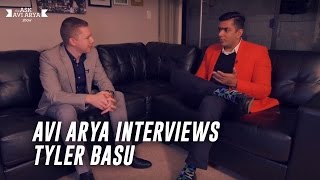
Tyler Basu, a Canadian podcaster and digital entrepreneur, talks with Avi Arya about podcasting's potential in digital marketing and Asian markets. They discuss how to monetize podcasts and the lifestyle benefits of building an online business through audio content.
A late night interview for the Askavi Arya show. It's almost 9pm but I'm really happy that Tyler accepted this interview. Now, this Tyler Basu, he's going to be an overnight podcasting sensation here in Canada, I kid you not, because he's one of the very few people who started his podcast very recently and learned how to monetize the blog. And a lot of people who watch this show, especially in India and other parts of Asia, uae, they've not really figured out podcasting. So I wanted to interview Tyler for this show so that this is going to be rocking. You need to stay tuned, Sam. Thank you everyone once again for tuning in to the Ask Kaviaria Show. Today we are interviewing Tyler Basu. And yes, you've heard it right. We're sitting in Vancouver right now. Tyler is born and bred in Vancouver, is that right?
That's right.
And you got a name, Basu, which is a Bengali name. I've got a lot of friends called Basu. I've got a friend of mine who I work with at the Lemon Tree Hotels, very successful hotel company in India called lemontree Hotels. Prateek Basu, head of digital, a great guy, knows his digital down pat. And so, and I work with Pratik a lot. So, you know, Basu. And I heard this name, I was like, and you've never been to India? And Basu, how did this come about?
Yeah, I get that question a lot because, you know, I'm, I'm as white as they come.
People are wondering, as white as they.
Come, why does this white guy have an Indian name?
Right.
So the name comes from my grandfather. It's a Bengali name like you mentioned.
It is a Bengali name, right?
It is a Bengali, right? He was actually born in, in Burma and this was back in 1940. And he had to leave Burma as a baby in 1942 because of Second World War. And there was Japanese. They came and they were bombing the city that they were in. My great grandfather, he was an engineer in Mandalay in Burma. So he had to pack up his family and they left and went back to India where they had some family there. And so he spent most of his childhood in Calcutta and then from there he went to university in the uk, fell in love with a Scottish woman.
Okay.
They were married.
You know, I've been following you on Facebook and I saw your podcast has been doing really well.
Thank you.
And you know, a lot of our audiences at the Askavi Arya show are in Asia, everywhere from Sydney to, I would say UAE So, you know, so between that belt, you know, the AskAviaria audience is mostly there, slowly expanding to North America as well. But I'm, you know, they're mostly. And podcasting is not very big over there yet. At the same time, I recently was invited to speak at a conference which, where they were talking about the future of technology and all of that, where they said every car is going to have a world class, you know, podcasting system. And so everybody, on an average, in a major city, you're driving one and a half hours a day. So listening to podcasts, listening to motivational video soundtracks, audiobooks is going to be big because sound clarity and more options available. You don't only need to hook in your iPad or your iPhone, they're going to have these systems there. So podcasting is going to fit, fly through the roof. And this whole conference and the section where I was invited to speak was only about this. So therefore I'm very interested in knowing that. How did you know? Do you know that it's going to become that big and that's why you got into it?
Yeah, I've seen the trend, like, I've been watching the trend over the last few years and it's definitely picked up more so in North America than some of those other countries you mentioned. But I'm seeing this trend not just with audio content. Like, what's happening is people want content on demand, like content that they chose that's maybe not interrupted with ads or things like that, that's very custom and very personalized to what it is they want. So we're seeing that trend with like Netflix, for example, right? You see people canceling their cable subscriptions in favor of subscription.
Yeah, yeah, I've heard of that.
Because they want to choose what they watch, you know, when they watch it and have that convenience, you know. So the same thing's happening with audio content. So all the new cars, they have the podcast app. Anyone with a smartphone can listen to a podcast.
All the new cars, all the new 2016s will have them. Right.
I think it might even be 2015.
Oh, that's not bad.
Maybe this is North America, right?
Yes, yes. Yeah, yeah.
But most, most new cars, anyway, they've got the app built in so that you can listen to your favorite podcast just directly from your car instead of from your phone.
Right.
But there are.
That is such a cool feature. And I think if there are any people who are working in the car industry or car manufacturers in Asia, because most parts of Asia, the cars are double the Price here, do you know that? I didn't know a regular. How much is a regular? Say BMW 3 series, say 40,000. A good one, high end. It's at least $100,000 in India because the duty is say 105, 110%. So people are paying double for the same car. Just imagine somebody buying a Ferrari in India and there's a wait list for a Ferrari or a Lamborghini in India. So that's the amount of people who pay amount ready to pay double for the same car. And it does not come with the apps that you're talking about.
How much are they paying for smartphones then? Like for, let's say an iPhone.
See, a smartphone in India, or India specifically, a smartphone is not available through a deal of the carrier like this here. Here you can get around $60 a month and then get. But in India you have to pay a thousand dollars. The price is the same, it works out to the same, but it's upfront. So the carriers are not really sponsoring them yet. There are some of them, but then you don't want to go with those carriers. So that kind of a situation. So people are actually shelling out that kind of money for. But having said that, the market is just so huge that even this 35, 40% penetration that's happened with iPhones has taken iPhone to another level. So another 5%, even if it's not 100%, another 5% is going to make a few more apples. So there's a lot of stuff happening there. So you realize this potential early and you realize that people want on demand content when they're driving, when they're in the gym, maybe, or.
Yeah, because I think that as a marketer such as yourself, we're competing for somebody's time and attention. Right?
We're competing for somebody's time and attention. I don't know if a lot of people realize that as a marketer this is what they're doing.
Well, there's so many marketing messages that we receive on a daily basis. So we've got these filters, I guess. Right. We're trying to sift through everything that's coming at us and figure out what's relevant for us, what we actually want to pay attention to. So with audio content, somebody doesn't have to stop what they're doing in order to listen to audio content. Like let's say you put out a video. You can't really multitask while watching a video if you're really wanting, if you're trying to Pay attention to that video. But with audio content, you can be at the gym, you could be driving, you could be going for a walk, you could be cleaning up the house, you could be doing other things. So it enriches an activity that you're already doing. It doesn't require you to stop doing something that you're already doing. And just because there's so little of somebody's time available throughout the course of a day, if you're trying to share your message with somebody, probably audio content might just be the best way to do that.
That's very nice. That's a great way of explaining why podcasting is going to rule. I mean, I went for this conference, I went for the future of technology. I saw these cars. But the way you explained it actually makes sense. First you said that as marketers, and that's the learning for me, because we don't really. We should bring it to the fore more often that as marketers, we are vying for somebody's time and attention and that the podcast is something. Podcasting or audio content is going to be even more important because we have less time and this allows us to multitask as against video content. Yes. So that's a huge point. So you understood this well in advance, or you read some books or somebody told you.
I'm not saying I understood that from day one. These are some of the things that I've learned over the last few years. I got into podcasting almost by accident, I guess, because I was just looking for a way to learn from people that I wanted to understand what some of their philosophy was. I guess when it came to business and success, I wanted to learn from people who are much more ahead of me. So I set up a blog. And this was back in 2012.
A blog or a blog.
Basic WordPress blog. And I started reaching out to people and asking for an interview so that I could. Similar to this, except I would do it over Skype. I would call them and record the call, and then I would put that on my blog. And I did that for about a year. And then some of those people who.
Were about a year. How many did you do in that one year?
About 30.
Okay.
Yeah.
So you have to put in that hustle before anything happens, right? Did you get discouraged during those. Anytime during the 30? That or you didn't?
Well, I started with my warm network, so I didn't encounter a ton of rejection, if that's what you mean. I started off with people that I knew personally, people that I met at events People that were referred to me. So I started off with that warm market and then I did about 20 or 30 interviews just off of those introductions from there, once I had that track record behind me, people saw, okay, Tyler's taking this kind of seriously. He's really, he's making an effort to do good interviews and to reach out to good people. That's when I was able to reach out to a bit of a bit more well known or more higher level entrepreneurs that I probably wouldn't have been able to reach otherwise.
When you started, right?
Yeah. But it was around that 30th interview that people started telling me, you should check out this podcasting thing. You know, you're putting these interviews on a blog. Nobody goes to blogs to listen to interviews. They're going to itunes and some of those podcasting directories. So fortunately I listened and I checked out the itunes thing and realized, okay, it's actually not too hard to get a podcast on itunes. So I had taken those 30 interviews that I did. I put them up on itunes and.
From that point forward as one series.
Yeah. So I just put. Well, all you do to set up, like to get a podcast on itunes is you basically just submit a feed. So it's like a URL where they're just going to scan a specific place, like maybe your website or a media host, if that's where you're putting your files. They just scan to see whenever you have new audio content. When I submitted them and I already had 30 when they did that scan, they saw all 30. So they put those first 30 interviews up there. And from that point forward, whenever I did a new interview, put it on my website, it would also show up on itunes.
Oh, so it's as easy as that. Yeah, but obviously the content had to be good because I saw you've been ranking top 4, 2, 3 or 1 or. What was that?
Yeah. So you're talking about my second podcast. The first one was a lot of trial and error. I spent about two and a half years hosting that first podcast.
Two and a half years.
I published over a hundred interviews.
Okay.
And if you go back and listen to the first interview and compare that with the last one.
Right.
You'll see, hopefully see a big improvement. Not just in terms of like the, the audio quality.
Right.
And the format of the show and the consistency and all that stuff, hopefully in my, in my ability to do an interview as well and my skills as an interviewer, but because again, I didn't get into it from day one knowing that I Wanted to have a podcast and build an audience online and all that kind of stuff. That was beyond my goal. My goal is just I want to learn from some people that I don't have access to yet. So how can I do that? So my answer at the time was to create a blog. Then after a bit of time, I realized you should use a podcast as your platform would be a better platform to have.
So tell us about your second podcast.
Yeah, so the second podcast is the lifestyle business podcast.
What's it called? We want to link it up here. What's it called again?
So it's called the lifestyle business podcast and it actually coincides with my magazine. It's digital magazines. So in the summer of 2015, I left real estate. I was working as a full time realtor. I quit real estate to start a digital magazine. Hired a designer and a virtual assistant. So a small team at first, but we got our digital magazine in the app store in September. And then because I was interviewing people who I was featuring in the magazine, I had recordings of these interviews. Right. So in November, we launched the podcast. Same branding. Right. Added it to the same website. So it helps to promote the magazine, but it also helps give those people who we feature in the magazine a lot more exposure. Because again, audio content is the form of content that some people prefer. So we give our audience that choice. If you want to read a magazine, no problem. Go to the app store, you can read a magazine. If you want to listen to something, go to itunes and listen to our podcast.
So how did this take off and become, what are you now in the top 10?
So when you launch a podcast, and this is specifically on itunes, there are other directories, but we focused our launch strategy on itunes, I guess because it's the largest. Yeah, there's a lot of research that shows that the majority of podcast listeners, they're subscribed through itunes. So there are other directories as well, like Stitcher and soundcloud and even Google Play is now creating a podcasting platform as well. But itunes is the biggest, so we focus there. And when you first launch a podcast on itunes, from the moment you submit your show, and this is in the US So it might be a different period in other countries, but in the US you have eight weeks where they'll feature new podcasts in what's called their new and noteworthy section.
Oh, they will. Okay.
Yeah. So if you open up itunes and you select the podcast category, you'll see the first thing on the top there is that new and noteworthy section. So Any podcast that's been launched in the past eight weeks, if it seems to be picking up in progress, if it seems to be.
Obviously, it has to be good content.
Yeah, it has to be good. You probably won't rank high there if nobody's listening to the show, but that being ranked there gives your show a lot of exposure to an audience that. That you wouldn't have otherwise.
So which is for our audience to, you know, which is a new episode coming out.
Pardon?
Which is the new episode coming out in your series?
Well, so the last one that just came out last week, I actually did. I recorded an episode where I shared the launch strategy that I had for the podcast, because a lot of our audience are entrepreneurs, online marketers and so on, and many of them are considering starting a podcast. So I did a quick episode just to share our strategy. So in the next few episodes that we've got coming on, we've got some people that we featured in the magazine. We've got an expert on outsourcing. He owns a call center in the Philippines. Sorry, not a call center. A virtual staffing agency.
Who's this guy?
His name is Joseph Kiss.
Okay. It's not Jagger. I know this Jagger guy who does something similar.
There's probably quite a few people doing it. He has a company called Somebody to Hire.
Somebody to Hire.
Somebody to Hire. And so I interviewed him and we talked about working with virtual teams. I interviewed an entrepreneur named Derek Gale. He's from Vancouver. Actually, you should probably chat with him. I'll introduce him.
Yeah.
Doctor, we talked about information marketing. So I try to bring on guests from various backgrounds, but that relate to the subject of online business and have them share their story in there. So, yeah, they're coming up on the next couple.
Did I tell you that? You know, in some parts of my episodes, when I'm doing the show alone, when I'm in the office, I'm mostly doing shows alone on this. There's a guest coming in. And when I'm traveling across the world, then I meet interesting entrepreneurs like yourself. But when I'm doing the show alone, I have a section on my show called seven Puppies, because I've got seven dogs at home. And I believe you've got dogs as well.
I do, yeah. So I have two retired hunting dogs. Actually. They're American pointers.
Retired hunter hunting dogs.
Yeah. So I'm like, they're, you know, living. They're actually, I think they're cousins. Anyway. They're from the same kennel in. In Ottawa, Ontario, because I Spent some time working in direct sales in Ottawa while I was there. Somebody that I worked with, his father owned a farm where all he did was train these dogs, raise them to compete in those locations where they.
I'm sure my wife and kids would love to have that kind of life.
Yeah, it was super exciting. But there's, there's limited space at the farm. Right. So once the dogs read a certain reach a certain age, if they can't hunt anymore or they can't have puppies anymore, they don't have much use for them. Right. So we took.
And what age is that?
Then we got Duke. Duke was the first dog that we got in the male and he was 8 years old when we got him. And he had just retired from his career as a hunting dog. He competed all over North America. It's pretty cool story.
Retired dogs, I've never heard that term.
Yeah. So we gave him a second life. You know, he had never lived in a, in like, in a house. Like the first time he ever went on a couch or saw television, it blew his mind. So we drove from Ottawa to Vancouver, about five or six day drive across Canada. We had him in the back seat, brought him back with us. And then a year later I get a phone call from that friend and he says, we have a female who's, you know, she's too old for breeding now, but you know, she's still going to be around for a while. So would you like her so that Duke can have some company? So we said yes and he flew her out here. And so we've had both of them in our home now and they're both, they're both retired. It's been just over two years. Coming up on three years now.
Okay.
That we've had.
And they're loving and part of the family.
Oh yeah, absolutely. They love each other. They, you know, they keep each other company.
Of course.
They love being in a home and they love relaxing. They've forgotten that previous life, I think.
Wow, that is so amazing. And you have a book, Your wife is.
Yeah, my wife, she works with children.
Okay.
And she wrote a book about these dogs.
And so thanks for giving this book to us. I'm sure I'm going to give it to my daughter Raya, who's crazy about dogs. And so it's a true story of. Oh yeah, it is a true story, right?
It is a true story. Yeah. The true story of Duke and Duke.
Duke and Dot. I'm, you know, I am. We are such dog lovers at home. Like I said. We got seven dogs at home. There was a time when I was growing up and my grandfather was still alive. He was in the army. I always talk about him on every show because he left such a. Such an impact on my life. Gentlemen used to read, write, speak 14 languages.
14.
14 languages. And because he was such a decorated senior level army officer, he had a huge house. The army gives you one of the largest large houses. And at that time, we had 14 dogs. Wow.
Okay.
Yeah. So seven. Yeah, seven is like, for us. It's like, you know, we don't have. Because when we had the larger house, we had an opportunity to keep bigger dogs like the Alsatians or, you know, the Alsatian. The German shepherd is also called the Alsatian or a variation. Yeah. So, but then, since then I've had. I've had boxers, spaniels, pugs. I call them cats because pugs are the. Hardly dogs. I mean, but we had all kinds.
That snore and breathe a loud.
Exactly. Those are the ones. We got four of them. We had one, and then they just multiplied somehow. But they're still part of the family and they're awesome. So, you know, so great. So we've learned on this show from you how to do your podcast and all of that. But tell me, as an entrepreneur, what are the kind of mistakes that you would. So you've been a digital entrepreneur for three years?
Yeah, for full time. I was doing it part time while working in real estate, so I was doing all the stuff online on the side for about three years, and then I jumped into it full time about six months ago.
So, you know, you know. You've heard of Gary Vaynerchag? Yes, everybody's heard of him. Everybody's heard of him. Okay. So, you know, he says something which resonates with me a lot. He says people who are working in a profession which they might be wanting to leave, they still have the 7pm to 2am window when they can sleep at 2am and then get up at 8, and they still have enough time. So. So you chose that 7pm to 2am window to do online marketing while you were doing your real estate. So. And then you gradually made that shift.
Pretty much. Except in real estate, I would. I would work weekends.
Okay.
So I would work Saturday Sundays doing open houses for a developer. So I would have two weekdays where I was not working in real estate. So I would work full time, you know, the full day on those two weekdays on my online stuff on the podcast, and then the ebooks and the blog and that kind of thing. And then every other spare moment in the morning and in the evenings. And I did that for about three years before I decided to leave real estate.
And do you regret that decision or you.
No. You came to a point. There's only so much you can do on the side.
Right.
I think to really do well at something, you have to commit to 100%.
Right. But you're happy with online marketing?
It's much more exciting to me. And it was like a lifestyle choice. Right. I didn't necessarily set out, you know, from. You know, from a young age to grow up and be an online marketer. You know, the con. The term is not in my head.
Yeah. Maybe it wasn't even coin back then, you know?
Yeah. Yeah, maybe it wasn't. But I'm pretty young, so maybe it was. I don't know. But just working in real estate and always having to leave my home on the weekends and knowing that my wife, who worked 9 to 5, Monday to Friday, would be home by herself on the weekends and getting to that age where we want to have a family. Now we have a baby.
Congratulations.
Thank you.
What's his name?
His name's Samuel.
Samuel.
Yes.
Samuel Basu.
Samuel Horatio Basu. He. And, you know, just to sidetrack for a second, he's going to be a little bit confused about his identity because he's got a dad who's Caucasian.
Okay.
A mom who's from El Salvador, Indian last name. So he's got three cultures in him there.
He's going to have the strongest of everyone.
Yeah. Yeah. So. But wanting to, you know, wanting to be home when that time came, like when. When he was born and even in the. In the few months leading up to his birth, like, I was home full time, I was home on the weekends, and that's what.
You made a conscious choice to do that.
So I made the. I was. Yeah. The decision to jump into the online marketing world was really just driven by my desire to work from home.
Thank you for being so honest. Because many times people like to say that I always knew that I wanted to be a marketer and this and that, but this is such a true story that, you know, so online marketing is one of the only channels that allow or careers that allow you to actually spend more time at home, which doesn't mean that you don't work as hard. Right. But you have flexibility of time, and you can actually talk to clients, customers, prospective customers, and millions of people out there and be number one on the Canadian podcast while taking care of Samuel and Duke and Dot and your wife. So the online marketing does offer those opportunities. Awesome. So it's been absolutely wonderful because I have slight bit of a selfish motive behind doing this show because I like to learn a lot. I make it a point to read a book a week, and if by Thursday, Friday, I realize that I'm not, then I get the audio version and I finish it. But I have to surround myself with that. And as an Internet marketer, we work, you know, we work in many countries, we have our teams, Internet moguls, office. But I find myself as the head of the company. And while I'm meeting clients every single day, so I meet individual clients and I meet hospitality centric clients. And there's a lot of stuff I realize that I don't know and I cannot know everything. So the selfish motive behind this show is to learn a lot from entrepreneurs like yourself. And today I sincerely think it's going to be a very, very enriching day for me because I learned lot about what not to do in podcasting and how to be number one in Canada. And I'm sure a lot of people who are wanting to do podcasts because these cars are coming in and why I'm focusing again on the cars is because that is where you have maximum time. A lot of people are going to the gym. A lot of people are spending a lot of time multitasking. Let's just say that. So while you're multitasking, what better than to enrich your mind? Ancient spirituality, science, wisdom, now even, you know, modern science. People in schools, colleges, teachers, companies like us, we are telling people to slow down, quieten the mind, clean the mind, meditate more, all of that, and surround yourself with the information. The mind is always absorbing information. And the mind makes you what you give to the mind. So what better than audio books? And what better than podcasting? And however I might, I would like to add that you have a slight advantage over others, which an unfair advantage has been given to you by, you know, your parents or whatever. I think you have an amazing voice and I'm sure many people have said that to you. I'm very, I'm sure you in your comments or whatever, because it's so even toned and it is so comforting that I can just imagine somebody listening to you while driving. It is so. It is so soothing. So you have that advantage. So I'm not saying that people who don't have a great voice should not start a podcast, but you definitely have that.
Everything is learnable. I thank you for, you know, for that compliment, but this has taken a lot of practice.
Oh, yes.
Yeah. I don't think, you know, it started off the way that it is, and hopefully I get better.
Okay. Okay. Okay. Yes. So there is hustle involved in everything. But, you know, I've been talking to you for the last half an hour, 40 minutes, and I really think that. That you have a very, you know, when two people talk or when two people. There's an energy which takes time to settle down. And then you. When you're comfortable with each other, and your voice is such that I'm sure that when. And I'm. While I'm talking to you, I'm thinking your voice is such that once you're talking to hundreds and thousands of people, they're somehow feeling comfortable that, you know, I'm, you know, this guy is reaching out to us. So. Great. And thank you for bringing up the point that that also didn't come easy. Anyway, thank you so much for talking to us. We love to travel around the world, put this show together, meet entrepreneurs like yourselves, and we get help from great photographers, videographers like Jeremy, who helped put the whole setting together. Thank you very much, Jeremy, for the show. And we now, in the last section of the show, we're inviting startups. Anybody who is a startup and looking at a similar podcasting idea or wanting to take whatever service or product that you're selling and make a podcast around it and have an idea. Do share the idea on the Askavya show in your comment section. Send us a video, send us a link. We know more about you through the video. Or send us an audio file. Especially for this show, we'll accept audio files and we will share it with Tyler and both of us will come back to you with your strategy, which will help you be successful for the next level of your business. Once again, thank you for watching the Ask Aviaria Show.
More from Avi

The strongest mindset doesn't begin with meditation. It begins at home. Before you conquer the wor

The strongest mindset doesn't begin with meditation. It begins at home. Before you conquer the wor

Your mindset isn't something you fix once. It's something you train every single day. Just like yo

Don't build a company just because your friends are. Build one because you're ready. A startup is

Everyone dreams of becoming the boss. Very few understand what that really means. The moment you b

Most entrepreneurs say, "I don't have time for coaching." The truth? You don't make time for what

Over hiring doesn't always solve problems. Sometimes, it creates them. Having a small buffer in you

"The highest-paid" isn't the goal. The highest-value is. People often ask why premium mentorship co

The founder will always be a bottleneck... at some stage. The goal isn't to pretend you're never th

People ask me how I stay consistent with my morning routine while traveling across countries and tim

People ask me how I stay consistent with my morning routine while traveling across countries and tim