Greg Smith | AVI ARYA
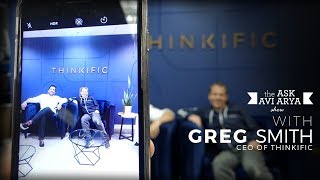
Greg Smith built Thinkific, an online course platform, by focusing on community and creator support rather than just technology. He talks about the early challenges of the business and what he learned about helping people teach online.
Sam.
Okay, so we're at the ThinkFake office, Raya and I for this is a little bit behind the scenes. So for the imotw. And so Greg, thank you very much for taking time out. You've always, you've always been so giving. A lot of people talk about giving and all of that. I've told them that every time that we've gone to any of these conferences, you've sort of almost opened up your entire Rolodex, you know, invited us from every party and made it's so special for us at Internet Mogul. So thank you very much for always being so awesome. And when we thought of this venture together with Raya I and my younger daughter, we thought that we want to cover people who are actually Internet moguls. And we say who are Internet moguls? These are people. Our definition of Internet moguls are people who obviously leverage the Internet to grow revenue, but at the same time hold that bond of family close to them. And to be able to do that, leverage as much technology as possible so that you have to travel less, spend more time with your family and help technology sort of grow your business. Anyways, so your name instantly came out and then we reached out to you. So thank you for taking the time out to do this.
Thanks. I really appreciate you coming and it's always awesome to run into you at events and conferences. Fun to hang out. Yes, I'm honored to be even considered as part of the Mogo Group.
No, of course, of course, of course. So like I said, this is a daddy daughter venture and we've chosen that, you know, we could be going to publish this book at the Social Media marketing world in 2020 in February. And then all the profits from the book are going to go to our favorite dog shelter, which is next door house, which we have been supporting for the last five and a half, six years, so that they're going to be part of this as well for us. So. So let's get right into the questions.
Okay, so my first question is, what was the toughest part that taught you the most while you were building up thinkific to be what it is today?
So what was the most difficult part of building up thinkific that taught me the most? I'd say so in, in any venture I've been involved in. And think of it especially because I've been at it now for over seven years, there's that quick win, early success part of like, almost like, I don't know, beginner's luck or whatever you start You've got a new idea, you got tons of energy. It's a new idea. You see a few quick wins, and that's what gives you the energy to kind of keep going. And then I found you go. And definitely with Thinkific, you went through this kind of dip, right? Where for us, it was revenue, but revenue like individually, customer by customer, you usually by check, not, you know, signing up and giving us a credit card online. Not really sure. We had an idea where we wanted to go, but we didn't have the product or the team or anything to be there. So we were trying to shoot for that in the future, but we were going through this really. And it was a couple of years of just, are we going the right way? We're not getting enough feedback to tell us that we're going that right way. So I think every entrepreneur, I think, goes through this. Not right in that first few months or that first year, but at some point, early stages of. I think there's something here, but I don't know if it's this way or that way. And you're. You just don't have enough information. Data, revenue, customers, whatever it is coming back in those early days to really make you feel like you're 100%, you're going in the right direction. And so it's in that phase where you. I think you question yourself a lot more where you have. I personally had way more disagreements with my co founders of, like, we all kind of wanted to go there, but we each had different views of, like, what the next step to get there was. So that phase, for me was the most challenging. And also at that time, your. I remember, like, six weeks of financial Runway before bankruptcy. Felt like we had good breathing room. Right. There were times where I was like, I think I'm gonna have to put the next payroll on my credit card. So that definitely. That was the by far the toughest phase. Now we've sort of hit this phase where it's like, lots of customers, lots of revenue, things are growing. There's still tons of challenges and pains and difficulties, but at least I feel like we're really adding value and making an impact every day in the world. And I think when you're questioning if you're making any real impact or if there's really even something here, that's when it's so hard to keep going. And that's actually usually when you need to work the hardest and power through that. Yeah. Okay. Thank you.
And what was the. What is the hardest course that you teach or that was created. That is the hardest to teach.
Oh, so I've only created. Well, I've created a. The first course I created was the lsat. What we do at Thinkific is actually just built the software that lets anyone else create courses.
Yeah.
So my first course, before we even started thinkovic was, was the LSAT teaching people how to write the LSAT and get into law school. And that was, it was certainly an epic adventure to create. I wanted to create like an 80 hour course. But my brother very smartly said, you've got 30 days while managing your full time job, produce whatever you can, and then we're gonna see if it sells. And so we get the time called the project Mondays at 9 or Tuesdays at 9. Because Tuesday night at 9pm we would start work on the project. Like I get home from work, you get home from work. We work as late as we could on Tuesday night, you know, and by the end of 30 days, that's what we're gonna launch. That went out, we sold a few copies of it, and then from there invested in building out a much bigger, more comprehensive course and going from there. But we got that early feedback, so it turned into a monster course to build. And I wouldn't recommend people build courses that big. It's kind of a unique space in the LSAT where people want a huge course. But that first one for me was, you know, the most effort expended. Yeah.
Because you're a lawyer yourself. Right. And you were, you, you work in, you were practicing law.
Yeah.
And then from there from to creating this course and then becoming an entrepreneur, going out on your own.
Yeah.
So, you know, in terms of the Internet mobiles, you know, everybody says the Internet allows you the leverage to be able to work from anywhere, work with anybody and grow a business. Is it actually that easy? Just because you have the Internet and all of that, but you still need human beings. What, how do you, how do you balance both?
Yeah, I feel like I gave a lot of that up. So my, I was law school and then practicing law. I had, I created an online course and when that started to go well, I actually moved to Squamish, which is little mountain town an hour from here, halfway to Whistler, really amazing kiteboarding. And I just, I worked for half the day and I went kiteboarding for half the day all summer. And I had the total freedom. No team, just me working on the course, shooting videos in the spare bedroom, marketing at night and going kiteboarding in the afternoon. And I had like total, total freedom and Then we started Thinkific and built a software company. Now we've got a team of 85 and growing people. So I've given up a lot of that sort of freedom of to live anywhere, traveler or, you know, do all of that kind of stuff. But the trade off is now with thriving business, get to make a massive impact and have so many super happy, awesome people to work with. So it's, it's been a fair trade off.
Amazing guy. So you know what I've seen that, you know, some of the, the biggest course creators or the biggest Internet celebrities, Louis Howes, Mari Smith, every single social media icon is on Thinkific. And I see that you build a relationship with them and that relationship translates into your course providing them amazing value, number one. Number two, what I've seen is every time I've gone to your website, there's a humongous resource guide of how to create a course, what kind of courses to do, the length of the course, duration, what kind of videos to do. And the third part I've seen is that you built a community on Facebook where there are hundreds or thousands of people who are talking to each other, helping you, helping each other. So how important has community building from the customer side to prospective customers, so existing customers, prospective customers been for you? You know, sort of a driver in the growth of your business?
It's everything, it's at the core of everything we do is our customers and specifically their success. So everything we do and have from the beginning is how do we create success for our customers? And I think coming at it that way, we get to feel better about what we're doing because the stories we hear back of, you know, I bought a new house because my course is doing so well, or I was able to educate a thousand people last year because my course is doing so well. That's really the stuff we thrive for. And so from day one, for years, I was in our support queue till whatever time in the morning it took, one o' clock in the morning or whatever it took to answer every single ticket. So I knew every customer by name, most of them knew me and we really just talked to them to understand their problems, solve their problems and help create success for them. And we continue to do that now. So that really is fundamental to everything we're doing. And I think that creates that community and then has them go and say, you gotta join this community, everybody in it cares about you and your success. That's why you want to be a part of it.
Nice. So you're saying even till Date, it's not just a software as a service that thinkific is. It is supported by an offline team that's actually, you know, helping you on phone, on Facebook, groups and all that.
Yeah, yeah, yeah. And then even as you said, within the community, it's not just we help as much as we can, but then there's also the other course creators and then social media influencers, others who are creating courses about how to create courses and coaching everyone. So it's really started to scale into this partner community, even where you now have people who will hop in and help you design your or set up your thinkific site. And so that don't work for us. They've started companies around setting this stuff up.
That is amazing. So, Greg, tell us. You know, one of the things I know that the audience would like to know is people at Raya's age at 13 or people at my age at 42, people running digital marketing agencies or thinking of what to do with their careers and saying, you know what, maybe just for college money or maybe just for me to say, you know what, I've been doing this for 11 years. I just, you know, make a course and, you know, make a parallel income. What are the first few steps you would recommend to course creators wanting to get into online course creation? A. A lot of people say, is it saturated? This industry started about 10 years ago. Are this, is it, is it still thriving? Is it still opportunity? And if, if yes, what are the first few things you recommend people should do before getting into a course?
Sure. So on the saturation point, it's scaling rapidly and continues to. And I don't see it being full or saturated or too competitive at this point. There's a lot of people in it and a lot more people getting in. But the interesting thing is the demand continues to scale faster than the supply of courses. So we see more and more demographics and groups adopting online learning as the accepted, even first place to go to level up. So whether it's like in your career of I want this skill for a promotion or to take on a new job, the first place all our engineers here go is online to learn the next thing. And same with everyone else, same with myself, and then also all sorts of other demographics. So you have these empty nesters now who have some disposable income and they want to learn a new hobby or skill or craft and they could wait until September, enroll in the local college and go to school for six months to learn it, or they can hop online and pick it up this weekend. And we're seeing more and more people across all demographics except online learning is that first place. And as that scales and more and more people get Internet access, because still not everyone has perfect Internet access. More and more people have devices to get online and more people who already have that are accepting education as the first place to go. The demand continues to grow more rapidly than the people supplying courses. So I see still, I still see this as a huge and growing opportunity that's just getting started. And then beyond that, the, the first things to do in getting started and building a course for me is setting a goal, right? And I know Brian, we were talking about goal setting and stuff before is like setting that goal of, I've got 30 days and I'm going to launch something. Let's see what I can get done in 30 days and a goal with the timeline. Like a smart goal of, like, by this day, I'm gonna try something. So my first course, I wanted to do an 80 hour course. And my brother said, you got 30 days, get what you can done. We're gonna sell it for $29. I was like, oh, I wanna, I want this 80 hour course that sells for $500 like our competitors are doing. He said, nope, 30 days, 29 bucks, whatever you can do. And he was right. We got it launched, we sold 10 copies in that first few weeks, and that gave us the feedback to go and build the next version. And the beautiful thing about setting that cool goal in getting something out quickly is you get that real feedback as opposed to like going in your room or your studio and trying to create a perfect thing that no customer has seen. You don't get that customer feedback.
Very important.
More from Avi

The strongest mindset doesn't begin with meditation. It begins at home. Before you conquer the wor

The strongest mindset doesn't begin with meditation. It begins at home. Before you conquer the wor

Your mindset isn't something you fix once. It's something you train every single day. Just like yo

Don't build a company just because your friends are. Build one because you're ready. A startup is

Everyone dreams of becoming the boss. Very few understand what that really means. The moment you b

Most entrepreneurs say, "I don't have time for coaching." The truth? You don't make time for what

Over hiring doesn't always solve problems. Sometimes, it creates them. Having a small buffer in you

"The highest-paid" isn't the goal. The highest-value is. People often ask why premium mentorship co

The founder will always be a bottleneck... at some stage. The goal isn't to pretend you're never th

People ask me how I stay consistent with my morning routine while traveling across countries and tim

People ask me how I stay consistent with my morning routine while traveling across countries and tim