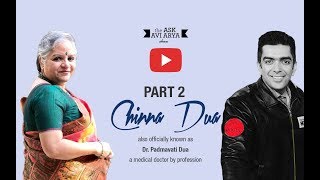
Dr. Chinna Dua reflects on her life from her 20s to 50s, covering education, marriage, parenting, and career. She discusses how she adapted to technological change over decades and navigated family responsibilities alongside personal growth.
Hi, good afternoon. Hi Chin aunty. I'll call you auntie because I've always known you as a family friend. I wanted to ask you two questions. You've been very successful, everybody knows you for some great work you're doing and you know, for the amazing human being that you are. I had two questions for you for my show. Number one, over the years, you know, you've been a dairy art throughout. You're a doctor, you know, you've seen so much, you sing, you know. Tell me, how has your perspective in life changed over. Over all these decades? You know, the way you used to look at life, you used to look at dance or music and human relations. How has that changed over years? We'd love for you to share that with us.
That's a very interesting question, I must say. I'm 57 now, so going back to 20s is say like the last three decades and how it has changed the perspective of the world. Now I got married at the age of 23. Prior to that, at age 22 I completed my medicine. So in the age group say 20 to 30. It's been a landmark decade because there were a lot of achievements and a lot of changes in my life. As in I graduated to become a doctor. Thereafter the next very next year I got married and after that, after another two years I had my first daughter and after another four years I had my second daughter. So 20 to 30s saw a lot of changes where I was absolutely a free. But not to say that after marriage one isn't, but one has a very different kind of responsibilities and stresses as well. Earlier I remember before I turned 20, it was like I was a free bird and my mother used to take responsibility of everything. All I had to do is just to go to college and come back. My mother got married at a very young age of 13. So she wanted that, you know, since she couldn't complete her education, she got married when I think she had just completed Class 8. So she wanted all her children to be educated very well. And I come from a large family and my mother saw to it that we were all educated very well. So I completed my medicines at the age of 22, then got married at 23. And that meant a new set of responsibilities because you are no longer living in your parents home, you're now living with your in laws. Having said that, I had excellent in laws and my in laws, especially my parents in law who are not there anymore, they were like parents to me and I had such a comfort level with my mother in Law that, you know, I could, I would be sitting and I could even tell her that okay, can I have a glass of water? It was like that. But all said and done, marriage is a milestone and there is a responsibility of running your home. Then came in our elder daughter and within four years the second daughter. So I took a break from work. Both the times my children were born until the time that they turned three, I was off work, work. So 20 to 30 from a free bird. I got into that mode of being more responsible and parenting, looking after home. That was that particular period. So obviously it was not of a free word any longer. Then came 30s. By 30s, a bit from the age of 30 to 40, the children were growing up. And during that phase is the time when we made our own home. This home where we are shooting today is where is one that we built. And so going through all that process also happened during that time itself. That again was an added responsibility because by the time my younger one turned four, so which was in early 30s, in my early 30s I went back to full time work. So it was a jugglery of managing home, going to work. And at that time I'd also learned driving. Delhi was of course a much, much more easy place to go around in the sense that I could drive a big car and go to the markets, which these days it's like unthinkable. We all look forward to having a driver and not having to drive. It's no longer a pleasure to drive, but those days it was, it used to be a very, very packed day for me. And the freedom, you know, of doing just what exactly you want was even less because right from the morning, 6 o', clock, it used to be, you know, you wanted to bathe your children also yourself, teach them, make food for them yourself, those. I did have a help, but it was one of those things that you wanted to do all that yourself and then go to work, come back, get their homework done and then socialize as well. Being married to a celebrity, we obviously were heavily into socializing and that made my life even more hectic. So there were a lot more responsibilities and yes, a lot, lot more fun as well. And driving was something that, you know, it was a great feeling for me because I always wanted to drive as a kid. I wanted to be able to ride a bicycle, which somehow I never got to learn. So for me driving was such an awesome feeling. And. And that too I could drive any car. And that really kind of made me feel very empowered. And 20s to in the age group 30 to 40 was again more of responsibilities. And then came 40s to 50s age group. That is when my elder daughter, she had already gotten to college. And then we faced the empty nest syndrome during that phase. And actually speaking, there was not such an emptiness feeling because we were already into a lot of social, socializing and many other activities. We both are into singing also. So it was not a feeling that, okay, I come home and find an empty house. And our children also, they have, we have always encouraged them to have their own life. So of course we have, We. There are occasions when we have been spending time together also. But then they have to go their way like we did. So both my children, they went to do higher education after school, they went off abroad and that was that phase. So there was a different kind of responsibility at that time. The stresses were different because children were away. You were, they were not in front of your eyes. So that concern, you know, how they are and the, we were talking of different time zones. So, you know, at night I would worry, okay, have they gotten up, have they gone to the college or not? Those kind of things. But I, I won't say that I was too paranoid or anything like that. But yes, all the time there was this, you know, thought behind that, I hope they are safe, I hope they're managing well. That kind of a feeling was there. So, and along at the same time, what happened was I think the world definitely has changed from what it was when we were in 20s in the sense that there was not so much of traffic and it was easier to move around. Like these days, being a doctor, I come across a whole lot of patients earlier we could walk to any hospital and seek treatment. Now these days, everybody feels that unless they know somebody and people feel that they have to know people to get their work done. That was never the situation. So that way the world has changed a lot. It's not easy for a common man to get his way around. And then again, of course, the world has gone digital in a very, very huge way. And I'm very glad that though we never grew up with computers, but after having joined work, say when I was 32, when I got back to work after my children, I was exposed to computers. And that again was a great feeling. I felt that was a big achievement that I could do a lot of things, including computer typing, email, everything. I was very excited. I'm, I'm, I'm quite a technology geek and I, I love that. And I, I felt this particular phase of my life was very, very interesting to be able to communicate to everybody through emails and all. And life seemed a little simpler at that from that angle. Later on, of course, mobile phones came and I think like it is with all of us with the social media coming up and though phones make life are supposed to make life easy, at the same time I think we have much less time now than we had because we are all so hooked on to our phones and our Facebook and our Internet channels and all. So I find that I have. There are a lot of other things that I would like to do, but I seem to have lesser and lesser time as I'm nearing my retirement stage because I'm already 57. In another few years I do hope to retire and have a laid back life. But having said that, I think we are so much into the social networking scene and also socializing that I don't see that happening. And I think definitely the world has changed from what it was when we were in the 20s to what it is now and in 50s now. By the time like about two, three years ago my elder one got married. So I wouldn't say that I felt that. Okay, what a big relief because as if she was a burden. No, I still am concerned about her, her and I'm happy that she is happily married and I think marriage is an important part of one's life and that's it.