In Conversation With Prashanth Aroor
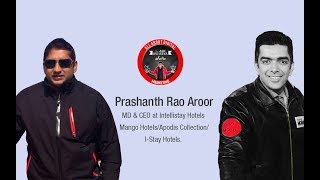
Abhijit talks with hotel entrepreneur Prashanth Aroor about running independent hotels in India. They discuss how online travel agencies are changing the business, why personalization matters, and what independent hotels need to do to compete.
And okay, perfect. How are you doing, Prashant?
I'm doing well, Abhijit. I'm here at Hyderabad at a new hotel in the high tech city part of town. Nice space for us to kind of have this session in the morning. Good weather today, 26 degrees outside.
Lovely. Lovely.
It is.
So tell me. You know, my first question always when I start is it's a, we've got some parts to the show, which is a format and many parts of the show, we just go with the flow. So the first question always is, what's your story? So tell us about yourself, how you grew up, where you grew up, Cricket, Bollywood, girls. What was encompassing your mind when you were growing up as a child. How did the journey start?
Well, I come from a small town called Mangalore on the west coast of India. Population of 1 million even today. So somewhere in the 90s in terms of population ranking, quite an old family business, real estate and transportation. We were building this mall when I was growing up, when I was in my early 20s and I was helping lease this mall and space. And in smaller towns it's easy to lease the ground floor and retail spaces. Gets much harder when you try to lease the upper floors. So I was thinking at the same time, hotels were very expensive back then. Very ordinary hotel with basic standards could be almost $50 plus close to $100 sometimes. So we were thinking that we have to create maybe a solution where we can one, create value to these building owners and help them use that space better. And on the other hand we can also create a new product of very classic business hotels without frills for people, you know, who travel often. Fmcg, pharma, consumer durables. These guys travel once a month, every month to their circuit and they just need a good bed, good shower, some good food, maybe some exercise and things like that. So it started there and then thereafter we, you know, as we went along we realized that the problem was much deeper and that there is, you know, enough mom and pop hotels in India, right? So I was doing an MBA in SPJ and I wrote a business plan. We did the first edition of the Economic Times, Power of Ideas and we came up as runners up, I think. And it gave us a feeling that we were onto something. This was four, five years before the new hotel, new age hotel companies race started in the last two years. So we were ahead of the ball. But we knew very well that we didn't want to kind of just lend a name to a property and sell them. We wanted to actually be responsible for the outcome at each hotel. And my view is that we looked at a very uberized model back then and we felt that there's too many touch points in a hotel. If you don't pay attention to the people and the training and the operations and define and own the operations, then it's very hard to get repeat business. And you know from your position how important loyalty is to keep these hotels occupied. So it's easy to. It's difficult to get people to come once, but if you, if you keep them happy, getting them back is that much easier.
Right?
Besides that, it's a boring life. It's a regular life, nothing special. I went to residential school for four, five years. Kind of makes you resilient to shocks and difficulties. So staying power, that's the key word, I think, right? So terms upwards of 20%, which goes to show that, you know, you have to hold it out. You have to build a product that can survive in the lean period and that can mine in the, in the good times. So there has to be a certain elasticity to the product that you put out. It must be not too expensive to operate that you can't sell it at a lower price when the time requires that. And when the market is ready to pay, your product must be good enough to charge higher and be able to keep the value perception same in both situations. So you pay 2,000 rupees a night, people must feel it's good value. But tomorrow, if you charge 4,000 a night for the same product, people must still feel it's good value. So you have to be able to scale up and scale. And I think, you know, man proposes, God disposes. So you might have an idea and a plan, but the one feature that kind of keeps getting proven in the process of a journey of an entrepreneur is that you have to be ready to turn on a dive. So global situation changes. We started this company when hotels were very expensive in India and there was a very high demand and very poor supply. And the next 10 years we had the opposite situation. Everybody built hotels. We had very high supply and very low demand. So we were born in them right in the middle of a recession. By the time this business plan went to the ground and I got my first funding, we were right in the thick of a recession. And, you know, it was the worst time to build a new business. But perhaps in hindsight, it was the best time to build a new business because, you know, you learn to be frugal, you learn to value your capital, you learn to put your money Absolutely where it's required. And it doesn't allow our entrepreneur to be responsible with the way he plans things. We just wanted to get to size. We wanted to create reputation and want to get to size. We don't want to be the largest player, we want to be the most admired player. Which means that in the eyes of our customers, we want to be the best hotel chain out there. And a lot of that has to do with value. So we're trying to keep a price bracket in mind. That's our fundamental philosophy. All our products are flexible, but the price bracket of each market that we go to is inflexible. So if we know the market and we decide this is the price point, what we want to be at, then we'll design the product to make it worthwhile. The hotel owner's time and our time and our customers time. And India is a unique country. You can't take one plan and roll out. So you might think that you'll prototype Bombay and then you roll it out to the rest of the country, but that wouldn't work either. You have to treat India like, you know, 15 different countries and you need to plan for each area, for each territory. The food changes, the culture changes, the people changes, the attitudes change. So you have to keep factoring that into your plan and keep modifying your plan to account for these things. So the one thing that's absolutely clear to me is that you can't be inflexible on your plan. You have to keep it open to what's happening in the world around you and what's happening in the micro markets. Got it.
Okay, makes sense. So tell me, as the journey of an entrepreneur begins and you like yours began, a lot of changes happened because you are so governed by regulation, you're governed by market sentiment, demand and all of that. And now you're saying in the last 10 years the Indian hospitality market has turned on its head and now it's more supply and less demand. So what happens now? I mean, do you still keep powering through or you slow down on the number of hotels or, or you look at the long term vision and say these cycles of demand and supply will keep happening. We have to sort of create a.
Global footprint or a India, right? So it's a very cyclic business. When I said the next 10 years were really difficult, things have changed a couple of years ago. So demand is back on the rise. The minute, you know, there's oversupply, new supply stops. And then you have to hope that the economy grows. And when the Economy grows, new demand arises and then again supply takes time to catch up. So we are now going through a phase where occupancies are through the roof, at least as far as we are concerned. I think none of our hotels have less than 80% occupancy at the moment. Which basically goes to show that if you put a good quality product out there and you play for the long term, you don't worry about the short term. Supply and demand cycles pick good markets. Let me give you two examples. PUDE and Jaipur, two cities that reeking of oversupply for the last four, five years and the last year they've shown massive rebounds. Both of them have grown revpar terms upwards of 20%. Which goes to show that you know, you have to hold it out. You have to build a product that can survive in the lean period and that can mine in the good times. So there has to be a certain elasticity to the product that you put out. It must be not too expensive to operate that you can't sell it at a lower price when the time requires that. And when the market is ready to pay, your product must be good enough to charge higher and be able to keep the value perception same in both situations. So you pay 2,000 rupees a night, people must feel it's good value. But tomorrow, if you charge 4,000 a night for the same product, people must still feel it's good value. So you have to be able to scale up and scale down the operations and the service layers, the service design to keep up with what the market is doing.
And so in a manpower intensive business, to be able to add these layers and remove these layers and be as nimble must be a big challenge.
Yeah, I mean in the end, if you are a mango or if you're not to use names, but if you're one of the larger Indian luxury brands, you're fighting your people from the same pool. And unlike many other western countries, people who do service in India, they don't themselves have an empathy of service. They have not been served. So if you have a hotel in the US or Canada, for example, they finish their shift, they walk across the road to a Starbucks and they in turn would be served by someone else. So they understand what it is to be served. The people in Indian hotels, they don't do that, they don't walk across to the Starbucks. It's an indication of the economic condition of this country where manpower is still very affordable. And because it's affordable, it gives additional value to customers to be Personalized to be served well. And we've created relationships with Skilling Centers. One of our primary investors, IL and FS have 40 skill centers across the country. So we've adopted a few of them. And we get these dedicated batches of 30, 40 kids, young boys and girls, very eager to work and prove themselves. They're also open to move around the country. So we move them around. We provide accommodation at all hotels. This really helps. I mean, for our staff, this really helps us to move people around. So. And if anybody is willing to grow and willing to move, those people grow very fast in our company and they can have a 15 year career in five years by just, you know, prioritizing what's important to them, committing to the job.
Excellent. Now coming to the, coming to the side. You know, we talk about demand and supply. So it's not hoteliers versus hoteliers. It's not one brand versus the other brand. It's also all the hoteliers versus all the OTAs. And then it's the OTAs who are wanting to become hotel hotel brands as well. So there are so many people who are fighting for the same customer. Where do you see this going?
Yeah, that's a tough one. I keep getting asked that one a lot and you think the answer is simple, but it's not. It depends a lot on what the big movers do. So when we started this whole concept of OTA about eight, nine years ago, when it really started taking root in India, everybody saw them as friends, which basically means that they help you fill up your occupancy and they spend a lot of money to do that. And definitely that's a valuable relationship because I don't think hotels can spend that kind of capital on marketing. Having said that, in any business, you mustn't depend on another business for your revenues beyond a point. So, I mean, I think the happy number is about 20% from any one client. So I think it's important that if we treat OTS as one of our buyers, and if they are going to own more than 20% of your business, then you're putting too many eggs in one basket. What's happened is the OTAs have gone to war against each other and they've been egged on by new age aggregation type hotel companies, which are many ways ota, with one more layer of hotel branding and a lot of capital has gone to kind of fuel this war. And in the process, hotels have become cannon fodder, for lack of a better word. I think the hotels must remember that in the end the inventory is theirs and that they control the inventory and they're responsible for the inventory. The customer lays down on a bed inside our property and that gives understanding better and to kind of, you know, be able to create a direct relationship. And I think we should use that to our advantage. And you know, while the OTAs have to generate and originate customers, I think the hotel's job is to keep them and nurture them thereafter.
Right? Prashant, tell me, you know what, in the old school philosophy that I have, and I call it old school because a lot of people challenge this. So you know, when we talk to a hotel and recently I was talking to the GM of Zuri Hotels and he had, he had, you know, he and I said shared similar insights. But there are many hotel owners and GMs who don't believe this when we say if you have a 100 room hotel, you have an 80% occupancy. You have 80 customers checking out every day. You have 2,400 customers checking out every month. You have to have personal relationships. You have to have an SOP to make sure that you address them by name. This has to be human to human personalization involved. I remember checking into the Taj palace and once and you know, they just knew so much about me from one previous history. In fact, I was speaking to a friend of mine yesterday. He went from New York to the Taj Palace, Mumbai and he said, I had a cold when I landed and the guy got me medicine. So this kind of personalization is what he's talking to me about now. He went to New York, Bombay about 10 years back. So this kind of personalization, when the big guys did it 10, 20, 30 years back and they became legendary brands like the Taj and the Oberois. I still find small hotels saying, I.
Want a quick fix.
Earlier on they had quick fixes saying I'll go to an OTA panch percent or when it became 30, 35%, they're like, what should we do now? Now what should we do? So they're looking for one tech company, one quick fix to come in and.
There is no quick fix.
There is no, not one company which is going to come and say, fine, you install my software. So as a digital guy, I know that every new company has come into the country and around the world promising that my software will change something very drastically. And you know, it still remains the same. So it's not technology alone that can help. It has to be that personal service. What do you think about that?
So obviously you and I are children of the 80s or late 70s, depending on where exactly. When we grew up it was about brands everybody wanted. I mean we grew up at a time when standards were not a standard. So we had to trust brands. When it was restaurants, whether it was hotels, whether it's cars, whether it's perfumes or watches, we were a very brand crazy generation. As I look at the audience that's emerging today, they are more eclectic seeking audience. If I go to the US and I've been there recently, it kind of tells you what's going to happen in India a few years later. US is a good kind of, you know, weather vane for India. And if you look at coffee for example in the US where you had a such a proliferation of Starbucks at every corner, you now have so much craft coffee. In the USA I was walking down the street in la, every other store was craft coffee and they were full of people. These are unknown brands, one off locations. Similarly, when I drove, when I drove the Pacific highway from LA to San Francisco and we stayed at every hotel we stayed on the way was a mom and pop because we didn't go want to go to the US and then stay at high art because that's. You've been to one, you've been to most of them. When I see her, we had an option to talk to the owners, to interact with families. So you know, I think the mom and pops are making a big comeback because they are unique in their experience. And I think the job of a brand now is not to be to define the standard and define the product, but to rather assure the standard and assure the product. So in Intelli Stay we took a decision as soon as I came back that we are no longer a chain. We are now a collection of independent hotels. So each hotel is unique and honest to its location. It customizes, it personalizes. Personalization is not a domain of the five stars. There's no reason why three star hotels can't customize. In personalized me we have 40, 50 rooms. We have a much easier option to recognize each customer individually for who he is. But also there is some decent software now in the back end which allows you to do that as a policy and as a standard. Otherwise you'd have to depend on people particularly to do this and that's not necessarily scalable. So some basic software, as an organization you recognize each person. So intuitive service, it originates from the fact that you have enough data on your customer to know what he likes and dislikes and to be able to kind of Say that you know, one step before he thinks it. You already kind of figured out that that's what's going to happen next. And I think software is becoming much easier to find, it's much cheaper to borrow, it's available on SaaS models, it tells you who your customers are, what they like, it allows you to kind of delight them. And we will keep this independent hotel mindset going forward. We stopped completely trying to make hotels look similar in any way. There are standards. The mattresses, the linen, the toiletries, the basic stuff are all standardized. I mean the safety features, the comfort features. But in terms of design, in terms of program, in terms of service, in terms of menus, in terms of amenities, we completely throw the standards book out of the window and we do what's required in each place. I think that as a customer, when you travel between our hotels, you don't feel like you've been to one, you've been to all. I think for this generation, more than ever before, that's a very important sentiment.
100% it's all about the experience and it's about very new experiences every time. So tell me, you know, today. So if today a 50 room hotel owner or his son, a standalone hotel owner, is crying that the OTA is taking away all my business, then it's hundred percent his fault because he's not investing in personalization or the CRM or the technology to build, to train, you know, to maintain that loyalty which he can so easily do.
Like you said, the 50 dupes. Yeah, it's, it's a lazy thing to do, isn't it? To just give away the. I mean the main function of an owner of a business is to drive his revenues. And if he wanted to outsource that completely, then he has only himself to blame. Whenever new brands want to penetrate markets, they throw all kinds of sweeteners on the table. And without asking questions, you know, owners are ready to lap it up right Then they pay the price. I've seen so many hotels brand for short term benefits with new age emerging companies and in six months their arrivals are eroded. They're completely. And by the time they realize this and they want to get out, they've gone 10 steps back and they have to start all over again. I am not in any way, I believe OTAs are great support to the hotel community. They've spent all our best. OTAs spend more money on us than they make offers today. Having said that doesn't mean that we also going to give up our brand. So in the end we are the brand of the hotel and I think that has to be very clear. And we must own our inventory. We decide how much inventory each of our buyers get and we have to keep the right and the responsibility to plan that. So I think a distribution mix and limits are very important. If you use the OTAs all the time, they are making your sales force very lazy, aren't you?
Sure. Oh yeah, I'm redundant. I agree. So tell me Prashant, when it comes to standalone hotel, 550, 60, 70 rooms and they have a restaurant and they have a captive audience of 50 people, do you think it is advisable for them to have a restaurant or. Or it is only advisable for a collection of hotels like yours to say that we are going to focus on F and B because our F and B costs and everything can be spread. Economies of scale can be gotten. Or can a standalone hotel also consider saying that I have a rooftop and I have a ground floor restaurant and I should also run a restaurant. What's your thoughts on extra revenue from F and B for standalone hotels?
I'm very glad you asked this question. Five minutes before we started this call. I was sitting here with Mahadev who is our new manager here. He comes from a really large five star hotel and he was telling me that, you know, fnb, we are inside the hotel, the restaurant has no visibility and you know, how do I get people to try it out? And while he has the option of new technology like Zomato, etc. I gave him an example of what we did very successfully in Jodhpur with Mango hotels. When we are in the large cities, we are more room focused, we have larger inventories, our food is lighter because there are a lot of independent food businesses in those cities. And you don't want to take these on because there are entrepreneurs behind these businesses and entrepreneurs will do a better job than a company no matter what. But when you go to smaller towns, you know, the rooms become less critical part of the business. There is not that much demand. So you should do a lesser number of rooms and you have to scale up your FNB a lot because FNB tends to be not as organized in smaller towns. And with good banquets and good restaurants, you have a great option to kind of really make use of that. You can be a local business as much as you are a business for outsiders. Two examples, Jodhpur, we have a nice little lawn outside the hotel and it was basically free except for wedding dates. So our manager decided that one Saturday a month he's going to organize a local party for the five kilometer radius of that hotel. And so he went to all the schools, he gave out this 250 rupee vouchers for a kids party. And he filled up the garden with jumpy castles and clowns and magicians. So one Saturday every month, we had so many parents with their kids coming in, interacting with the hotel, talking to the managers, talking to the staff, having a good time and having a good memory to take away. And tell me three days later, if they need to have a function in their family, who are they going to call first? So when you have an audience around you and if you're in the middle of a population, then you can design your food to be too tired. You can do what you require for the internal audience to create a broader community. So I think hotels need to become friends of the neighborhood. With mango, we say your friend in the city. So we are like a citizen of that city. And therefore we must have a one on one rapport with our neighbors around us. But if you go to say a more isolated location like a Ganpati Phule or your own family hotel in Goa, which is in the middle of very rustic and you don't have a huge captive audience to come in and have food, then you have to design your food to be more eclectic and not a large program but more of a. It has to, basically it has to back up your room business and create that loyalty. So you have to use food in that case as a loyalty feature. Having said that, I think you've created a great reputation for your restaurant and it's popular as a high street restaurant in Goa. So maybe not a good example.
It's a. It's a lot of work. It's a lot of work. That's why I'm saying a lot of seeing a standalone hotel. It's because, you know, my family seems to be passionate about that. But I just see that, you know, it is a non stop struggle and therefore a lot of people who will be watching what we are talking about this show because every Tuesday morning I write a musical that goes to 42,000 hoteliers and then they'll be watching this. They create some insights from this. So the idea behind these questions that I'm asking you so that they can start thinking to themselves, am I doing the personalization correctly? Am I giving out the range of my business to the OTAs? Am I utilizing my FNB properly? Or should I just leave everything and call Prashant and give him my ot?
Bang on. Great.
So Prashant, you know what I think I asked you for 40 minutes of your time. I think we are very close to that. Is there anything that you would like to see, you know, that outrages you to say when you see a standalone hotel because you know, you're so passionate about your business and you meet so many hoteliers. Is that something when you see. When I see something digitally and I feel, oh my God, this guy is leaving hundreds of thousands of rupees or dollars on the table because he's not doing this part. So is there something that frustrates you when you see a hotel owner? You say, you know what? This guy wants the revenue, but he's doing just the opposite. There are some things that you can maybe get some giveaways.
Well, there's not one thing that comes to mind. You must remember I work with independent hotel owners. I spend more time with them than I spend with my own family. So nothing shocks me anymore. What bothers me a lot is that many times I see an attitude of being pennywise pound foolish. They try to save up the initial phase on costs. And I always tell them for 12 months, don't talk to me about cost. Let's just go after revenue. When we know what revenue can be achieved, that's when we should look at cost. Because if you use cost to lead your plan right up front, then you're basically, you define the limits of your revenue even before you tested that. And that bothers me a lot. It takes me a lot of energy to explain that and I feel like I'm offering an MBA every time I sit with them and, you know, explain how this works, that there is a lead time and that you have to invest before you can get some returns. Having said that, we break even pretty quickly. So it's usually a matter of a month or two before the trust builds up between the brand and the owner. The other thing that bothers me a lot is this home away from home concept. I mean, if I was paying top dollar for a hotel, I don't want to feel like I'm at home. I better be pampered.
Okay, okay, understood. Those were two very good points. So everybody should look at personalization. Everybody should look at taking over control of their own revenue. They should also look at their FMB opportunities and like you said very correctly, be the citizen of the city. We are a friend in the city. And so there are opportunities to monetize. And if all these things sound overwhelming and say I can't do it, then call Prashant and He'll do it for you.
And call Aviaria.
Excellent, Prashant. Thank you very much for your time. I look forward to person very soon. Thanks a lot for this interview.
Lovely talking to you, Abhijit. Have a nice day.
Thank you.
See you soon. Bye Sam.
More from Avi

The strongest mindset doesn't begin with meditation. It begins at home. Before you conquer the wor

The strongest mindset doesn't begin with meditation. It begins at home. Before you conquer the wor

Your mindset isn't something you fix once. It's something you train every single day. Just like yo

Don't build a company just because your friends are. Build one because you're ready. A startup is

Everyone dreams of becoming the boss. Very few understand what that really means. The moment you b

Most entrepreneurs say, "I don't have time for coaching." The truth? You don't make time for what

Over hiring doesn't always solve problems. Sometimes, it creates them. Having a small buffer in you

"The highest-paid" isn't the goal. The highest-value is. People often ask why premium mentorship co

The founder will always be a bottleneck... at some stage. The goal isn't to pretend you're never th

People ask me how I stay consistent with my morning routine while traveling across countries and tim

People ask me how I stay consistent with my morning routine while traveling across countries and tim