Interviewing The Famous LinkedIn Expert
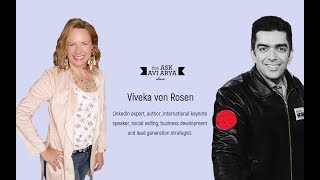
Viveka Von Rosen talks about building a LinkedIn presence through personal branding, video content, and the Sales Navigator tool. She covers how to use LinkedIn for networking and business growth, and how the platform has changed over time.
Record to the cloud. Yes, Record to the cloud. Hi, Viveka, how are you doing?
I'm good. How are you doing, Avi?
Excellent. So in Colorado, how's the weather over there right now?
Well, you know, it's been gorgeous and it just started snowing again because we have people coming in to work on our house today, so of course it started snowing again.
Of course, of course. I know that feeling. I know that feeling.
I couldn't let you go without a request or even a task.
You know, the first section of the interview. I always like to start with a story. You know, we've met many a times, you know your story, but just for the audiences. I would love to know your story. Where are you from? How did you grow up? Your best friends? Your first pet? Just tell us, you know, let us know who.
Sure. Well, I'm actually Canadian. I live in the US now, but I'm actually Canadian. Yes. Was I like I was conceived in Vancouver, born in Edmonton, raised in Windsor and Kitchener Waterloo and went back to school in bc, ubc. So very Canadian. And then I. Then I also like to say I moved from heaven to hell because I moved from Vancouver to Miami. Nothing against those of you who live in Miami. It just isn't my thing. So that's kind of like where I've lived. I've been teaching and training LinkedIn for the past 12 years now, I guess had nothing to do with the degree I got in ubc. So, of course, no one who works in social media is using their degree. I don't think.
I know.
Right. But yeah, no, I'm just, it's, you know, I'm a big fan of social media and I'm a big fan of opportunities that businesses have, so. Or people have who are in business to really use the different tools, all the different tools out there. And I think it really levels the playing ground for us. We have the opportunity of reaching people that we've never been able to reach before. And, you know, with sweat equity, we're really able to do a lot as far as marketing and selling that we might have had to have paid significance amount of money for in the past. So I think it's really kind of leveled the playing field with how we engage and how we build our businesses on social 100%.
But you know what, so you said 12 years. And I know that you've been doing LinkedIn for a long time and you're obviously all of everybody in the industry, let alone the customers, but even people in the industry, you're the go to person for LinkedIn when we get stuck with our clients. Welcome to you. We know that. But tell me you started doing LinkedIn even before LinkedIn became the cool thing that it is today. So how did you get started on LinkedIn?
Yeah, so I was running a business center, what we're now calling co share spacing, you know, co share space like Regis or Galvanize, you know, we work those different types of offices. So I was running one of those. And what I discovered about myself is I'm really bad at managing people, but I really love the marketing and the entrepreneurship world. And so I was running a lot of like face to face networking meetings, right? Like what we used to do before social media and still do sometimes. So I was running networking events and I brought someone in to educate the my clients, my customers on web 2.0. So that kind of shows you how long ago it was. Because the idea that there was something that the web could be interactive, that it was more than just a brochure, that was a new thing. That was a wild idea. That was crazy. And so at the very end of her presentation, she mentioned this thing called LinkedIn. And I was thinking to myself, like, I'd managed to grow our business, double our business in a year just doing face to face networking. But this thing called LinkedIn had, I think it was 7. It was either 7 or 12 million users. It wasn't a lot, but back then that was a really big number. Like, you know, back then, right? We were like, if you had, if you had 10,000 people in an association that you were a member in, that was a big number. So, you know, 12 million people or even, you know, that was the ability that we, or the idea that we might be able to reach out and engage with, you know, any number of those people was just, it was, it was mind blowing. So I started learning as much as I could on LinkedIn. Fortunately, within about a year, I was able to quit my day job and start teaching and training on LinkedIn. It was good, it was a good time. Mari Smith was starting in on Facebook and she and I were friends. She was a little, you know, she was ahead of me. So she was kind of a mentor to me. And you know, the group of people who were doing social way back then, Joel Calm, Warren Whitlock, you know, there were a lot of, lot of folks, early days, and it was a really small community and everyone was extremely supportive. So it was, it was a good time to get in. And then I actually got the Twitter handle Inkedinexpert and that helped too.
Of course it did. So tell me, what is, what is, what has changed? So in terms of people still want to connect with people across the world, I think one of the biggest things that social media allows all of us to do is to spend more time with our families and loved ones and have to travel less and to be able to, you know, sort of conduct business remotely. So how does LinkedIn, how do you think LinkedIn has and will continue to change the life of small and large businesses, business, corporation, people wanting to reach out to people in another country and have, you know, sort of showcase their products? Yeah, it's a touch and feel. Do I still need to go to conferences, show them my product or service, or can I do it on LinkedIn?
Well, you can absolutely do it online, right? I, I still like going to conferences. I've just, I'm literally back last night from, from AAISP in Chicago. And so I love going to conferences because it allows me to meet face to face people that I fostered relationships with online. And that's always better. Anytime you can have a face to face. If it's like this through zoom or face to face, you know, at a conference, a trade show, et cetera, or meeting someone, that, that's always great. Now, most of my friends, you know, most of my colleagues, most of my friends, most of my acquaintances I've met through social, like, there's very few people I'm planning my wedding and I was, I was looking at my bridesmaids and the people I was inviting. And other than my family and other than friends that I had back when I was a kid, everyone that I had met, I had met through social media. I had met online at conference, right? Crazy. And people go, you can't really make real friends on LinkedIn. I'm like, well, you might not be able to make real friends on LinkedIn. You can make bridesmaids on LinkedIn. So there you go. But it was, you know, it's amazing, but I think it's not either or. You have a much better opportunity to find exactly who you want to engage with using social. And I really love LinkedIn and I really, really love the Sales navigator tool on LinkedIn because it allows me to dial in on exactly the people that I want to be engaging with. Strategic partners, vendors, prospects. And then I can deepen those relationships and then I can take those relationships offline and then I can, you know, maybe get new business. But finding those individuals and finding the right individuals I think is key. And the thing about social media is so big, right. All the huge numbers that we have with Facebook and Instagram, it's so big that it really does allow us to niche where before, if you had a brick and mortar or you had a consulting business or whatever, you kind of were a little bit like, I'll work with anyone. Like, I have to pay my bills, I'll work with anyone. Anyone with a face, anyone with a computer, anyone who owns a business, I'll work with anyone. We can be pickier now, which means we enjoy more because we're working with people we like and want to work with and who we're aligned with. And the people that we're serving are getting better results because, you know, it's not. We're actually creating the content, the products, the services that are specific to them and their industry and their product and their service and their business. And so there's not a lot of one size all. Well, there is still a lot, but there doesn't have to be so much. One size fits all. Because we really can strategize and niche down when it comes to social.
Sure. So tell us, what would be the best tips to sort of a, you know, connect with people, the right people to say, these are, this is my customer audience, this is my niche. B, how to get in touch with them. Is it InMail? Is it, you know, what kind of sales navigator tools do you use? Or does business always have to be connecting online and meeting offline? Can we conduct business completely online and finish it there?
Well, I think so. I'll answer the first. The last question first and then back up. Yes, well, yes, of course you can do all your business online now. By online, I still think you still have to like pick up a phone call or have a zoom meeting. Unless your product's $47. Right. So you got a $47 product, you put people into a funnel all day long. You can process and sell that product or service as long as it's, you know, at a lower price point. When we start talking, you know, four or five or six or seven figures, you have to have the human. I think you have to have the human interaction. So, yeah, there are definitely some things that you can do completely online. But I think in my lifetime, I've only had like one deal that was over $1,000 where I never had a conversation with the individual, where it was all emailing back and forth. One deal, like thousands and thousands and thousands. So I think there still needs, especially at a certain price point, there still needs to be some human interaction of some sort. Now, to back up, what do you need to do? Right? So first of all, you need a good brand because I think a big mistake that people make is, you know, they got on LinkedIn in 2007 and haven't touched it since. And LinkedIn keeps changing. Like LinkedIn literally released its newest user interface. I'm working on the blog as we speak, just a couple days ago. So it's constantly changing and you have to, at least quarterly, I think, go into your profile and make sure that it truly represents you as a business. LinkedIn can be your personal brand, even if you don't have a website. You can create a very branded, very Credible presence using LinkedIn and some of the different features. So I think that's key because people are not. If you're invisible on LinkedIn or you're like kind of ghosty, you're barely there, it's going to be a lot harder to get people to know, like, and trust you and want to work with you. That's one thing is just making sure that your brand is strong. And then beyond that, it is using the different search tools. So the free LinkedIn search is pretty good. It's not as good as it used to be, but there's still some good features in there. And you can get pretty close to finding the right folks, the right folks to engage with. One of the reasons I prefer Sales Navigator, which is just a premium account that LinkedIn has, is it allows me to sort my network not only by title and company and industry and geography, but I can really nail down on, you know, headcount at a company just in case I want to work with a certain size company with seniority levels within like 5 miles or 10 kilometers of a zip code or an area code. So I can really get to exactly who I'm trying to engage with. And then with Sales navigator, you get InMail, which is basically like a FedEx, right? You have to pay to send the message. But I am able to reach just about anyone with an InMail. And done the right way, you almost always get a response. Just most people do it the wrong way.
So, yeah, now we love to know the right way.
Right? Right. So the right way is what I tell people is you just. LinkedIn is just a platform. But those best business practices that you Learned, you know, 40 years ago still apply. You wouldn't go to a networking event and, well, hopefully you wouldn't go to a networking event, shove your card in the faces of everyone you meet and talk about yourself the whole time. Hopefully. You would do that, right? You would see who you wanted to talk to. You would work your way into that conversation, maybe by commenting on something that if they're. If that person is having conversation with someone else, maybe you kind of slide in and you comment on the comments being made, and then you introduce yourself, and then you continue on with the conversation. And then at some point, while you're listening to them, not talking all the time, but while you're listening to them, they give some kind of buyer clue, right? They give some kind of indication or have a need or point of pain that you solve, and that's when you can slide in the solution. But what people do on LinkedIn is they're like, hi, I'm Vivica. I'm a LinkedIn expert. Your profile sucks, and you should really hire my company. It'll be 1995. I think you should do it today. Okay, thanks, bye. Next. Right. And that's, unfortunately how a lot of people use LinkedIn. It's just so aggressive and salesy and gross. Instead, you would do like you do in real life, like, look at someone, maybe make eye contact by following them. Maybe they follow you back. That's like eye contact. Right? And. Right. And then you go in, and maybe you see they're talking about something. They're sharing updates, they're sharing video, they're sharing posts, you know, but you see, if they're talking and you read it and you listen, you engage their content. And then after doing that a while, then you go, hey, you know, I'm Vivica. It's nice to meet you. I'd love to hear a little bit more about what you do. That's the invitation. And then after the invitation, you continue to listen. And then again, when that buyer signal comes up, you can move in and offer your solution. But you don't just jump in with a sales pitch. Unfortunately, most people do. That's why a lot of us don't even look at our LinkedIn inboxes anymore. But by building that relationship, you can really get in there.
Sure. Sorry. Excuse my doggy.
That's. I was. I thought it was mine for a second. So that was cool. We can have our dogs just do the interview from here on. That's awesome.
So you tell me, is it a good idea? I mean, in terms. So InMail is obviously a great tool, but for InMail people to get in touch with other people, do you think it's a good idea to send a video link? You know, that's what we've been practicing with, you know, we do a video thing and we send a video link. Do you think that's a good idea?
Yeah, yeah. Not only that, yeah I do. I'm a big fan of. I mean I personally use. Yeah, I'm a big fan of using video in engagement, whether it's email or messages on LinkedIn. And what's really exciting is LinkedIn obviously they've had native video for about a year now. So they just introduced native video for company pages. And when they released the news that they were adding video to company pages, they also said video will be coming to messaging and InMail too. So I'm really excited about that. So it won't just be a link, it'll actually be a thumbnail of your video can hit play. So I'm a huge fan. Yeah, I'm a huge fan of video. Now having said that, if it is someone that you've built some sense of relationship with, even if it's just following each other back or commenting on their content. Absolutely. Say hello, introduce yourself, send the video, that's absolutely fine. I do it all the time. When people invite me to connect, I respond with a video and some links in the video. We personally use one mob and so it's our opportunity to create that human interaction. If it was a really, if it's someone who doesn't know you from a hole in the ground, they're not going to click on the link. Right. Chances are. So you might use your InMail just to introduce yourself or ask them if they'd be even willing to accept an invitation from you as long as they, even if they say not interested, as long as they respond at all to that InMail you get it back number one. So you don't want to go in there and like just be pushing all these salesy inmails because it just cost a lot of money, it wouldn't be cost effective. But inviting the person to connect or asking if they'd be willing to connect, then you send the invitation request and through that message, you know, or the follow up message then you can send the video. But yeah, no, I think videos important and again that's why you want to update. You want to make sure that your profile is up to date because oh my gosh, it's really interesting when you see a lot of people, usually marketers, but you see people using native video on LinkedIn and you see them and you see who they really are and what they look like and like I'm having a bad hair day myself. But, you know, you see what they really look like and then you go to their LinkedIn profile picture and you're like, yeah, that was like at least 20 pounds, 20 years and like 2,000 pounds ago. Because you like that. So you don't want that disconnect either. You want to make sure that your whole brand is aligned with who you are.
One thing I like to do is always wear this jacket offline every time I go online.
Yeah, exactly. I know, exactly right. Because then, yeah, you. Every time I've seen you, you've worn it.
Yeah, yeah, yeah. So you said, is there anything else? Like Facebook allows you to do Facebook advertising and it's still affordable. So what about LinkedIn ads? Are they prohibitively expensive? Should everybody still do it because there's an ROI at the end of the tunnel?
Yeah, so a couple things. First of all, you can now have sponsored video. So I'm super excited about that too. You know, LinkedIn ads are not as bad as people think they are. The problem is people get into LinkedIn ad, they kind of follow LinkedIn's lead, which is bigger audience, bigger audience, bigger audience. Well, of course, the bigger your audience, the more expensive it's going to be. Where we've had success with LinkedIn ad advertising, it's made much more easier. Much more easy. With LinkedIn's new, well, it's not that new, but you can save your audiences now. So you can do a lot of split testing and see what works and doesn't work.
You can do video ads to these audiences now.
You said you can do video ads to these audiences now. Yeah, that's brand new. That's like a week old, but that's super exciting and it's just really about niching down. So you create an, you know, maybe you create one basic video that you're going to promote, but in the text around that video that you're promoting, maybe I'm talking to lawyers in New York City, or maybe I'm talking to physicians in San Diego, or maybe I'm talking to consultants in Denver. So I can change the languaging to suit that very niche audience. It doesn't take that much more time. But then they self identify. Like if they just see some basic LinkedIn tip, they're like, meh, whatever. But if it's like, you know, watch this video for great LinkedIn tip on how lawyers can use banner images to build more visibility. Like, now I'm a lawyer, going, oh, for free. Now I'm a lawyer, I'm going, oh, I'M going to click on that. Well, it's the same like here's how you use banner images, video. But I happen, you know, but in just the lead up to that video, I'm describing a very niche market. And so then I would target that market. If I can keep my audience down to a thousand people, my ROI is significantly higher than trying to reach tens of thousands of people.
Nice. I like that. So you're saying instead of preaching, say 20,000 people have say 10, 15 ads, different videos. It's a bit of hard work you're doing targeting and we all know the riches and the niche.
Exactly.
Makes a lot of sense.
Yeah. It's easier to track too. I mean, as far as metrics and things like that. It's much easier to track if you've got the niche audiences as well. Yeah. And the folks who come open and pick up, you're like, okay, you're gone. I'm going to focus on these people instead because they click through and they're in my funnel now. And now I've got even more top of mind awareness because I'm building, you know, marketing outside of LinkedIn too.
So do you cross promote between LinkedIn and Facebook and Instagram and all of that?
Yeah, absolutely. You know, through tools, manually. Yeah, it's. My audiences are similar on all my social platforms and through my email. There's some things I'll put on LinkedIn I won't put on Twitter, but generally I'll cross promote. I don't do Facebook ads only because I don't know how to do them. I mean, Facebook ads are sophisticated and I'm like, you know, we tried and failed, but LinkedIn I can do. But as far as just sharing content, blog posts, updates, video. Absolutely, I'll cross promote.
Okay. So you know what, a lot of people say that, you know, LinkedIn is such a professional network. I cannot post about my, my something that happened in my personal life and I can't post about the fact that I bring my dogs to my office and all of that. So what do you think about that?
I think talks to office is fine. I mean, because it's still business. Right. There's some stuff that doesn't belong on LinkedIn, the math quizzes. I'm not the biggest fan of the inspirational quote meme canva thing that you see on Facebook all the time on LinkedIn, but they get a lot of shares so maybe it causes positive sentiment. Now you will see stuff that gets crazy amount of views and shares on LinkedIn that have no place there whatsoever. And usually the comments in the share or the comments are this video doesn't belong on LinkedIn. Unfortunately, every time someone says this video or this article doesn't belong on LinkedIn, it gets back up to the, back up to the timeline and it gets seen by even more people. So if you ever see something that doesn't belong on LinkedIn, just, just don't say anything like don't comment on it because that only makes it work. Yeah, exactly. But you know, if you're a veterinarian, do the cat videos. But if you're, if you're trying to build a reputation as like a serious, thoughtful, credible businessman or woman and you've got just dumbass stuff up there, then right then you're not helping your cause. Having said that, our CEO of the new company, Mario Martinez, any junior, anytime he shares stuff with his family, he always has a business. Like he always pulls in some kind of like business tip with it. But anytime he has his sons on or his beautiful wife on his videos, those things go like 10, 20, 30,000 views. So, you know, absolutely. It's okay for people to know that you have a personal life, but you, you need to make sure it's not hurting your brand when you do that.
Understood? Understood. So tell me about long form posts because Facebook, you know, we long form posts are doing well and it's almost like a short story, it's like a mini essay that, you know, sort of describes the whole state of affairs or whatever you're talking about. So what do you think about long form posts on LinkedIn? Do people have much time and attention? Does it make sense?
Yeah, they're doing really well. Yeah, yeah, I know the algorithm loves it. So not to be. So there's long form up, there's long form posts and there's long form article. Right, the article, the publisher tool. They're really more like blog posts. Those are not doing well right now. LinkedIn is kind of dropped them off. The algorithm completely weird. I don't know why, but yeah, my everybody's stuff is just getting significantly less views. It's like LinkedIn doesn't want you publishing right now, I guess. But anything native, either native video or native posts do well. And I think long form posts do so well because well, there's a lot of keywords in there, so it's a lot of search terms. So your content's actually more likely to show up. If it's more likely to show up, it's more likely to be seen, liked, commented on and or shared the More it's seen, like commented on and or shared. The more LinkedIn likes it, it brings it back up and it just starts snowballing. I had an article, it was, you know, it's kind of interesting. It was an update and I'll admit it was a rant. I was, I was very, very frustrated with a company that gave very, very bad customer service. And on top of that, the person just couldn't say my name. And, and that's fine if you can't pronounce my name. It's a hard one. I that no big deal because they could not get my name right. Like, I didn't matter. I was Victor, Igor, Victor, Edward and Albert. Like, it didn't matter that I was spelling my name. He couldn't find my record and I just lost it. And I happened to be on LinkedIn, I'm like. And I ranted a little bit about that. That got like 25,000 views. Right. I don't know that it hurt my brand or that it helps my. But it really started a good conversation about customer service and the necessity of training people and the necessity of having a strong brand and all that kind of good stuff. So it really started a conversation, meaningful conversations. But native content. LinkedIn likes native content. It doesn't like you sharing links or posts that really like stuff that, that's born and bred and shared through LinkedIn. It's got it.
Yeah. That was good to be the second part of my question. So don't link out. Don't link out of LinkedIn.
You know what we're recommending. Yeah. So I'm telling people to split test. But generally when we split test content that has the link in the comments below and we'll literally, I'll do like little emoji fingers going, you know, check comments below for the link. So those do better than actually adding the link right into the post. And another little ninja trick though is you can do, you know, check link and comments below and then after it starts to get some activity and some visibility, edit it and put the link inside the post.
Nice. I like that.
That's working too. Yeah, little ninja trick. But yeah, things with links in it get so like on average and I've now tested this a few times, my publisher post will get like, I mean publisher article will get like 50 views and an update with a link back to the article get like 150 views. And then video and long form update about the video will get between 5,000 and 15,000 views. So it's significantly different. Yeah. Wow.
You know, coming back to the profile when you're setting up your profile or every time that you want to revamp, like for example, you went, say you go to a new conference, a new conference for the first time. I'm sure there are no new conferences for you. You've been all around and repeat speaker at most of the conferences.
No, I'm in sales now.
But if you were to come back, if you were to come back to a conference, say in India or Asia, if it's a new conference for you and you go back and update your LinkedIn profile saying that I spoke at this conference. So does it help with your keyword search next time when people are looking for those conferences? So every time. Should we keep on updating our profile?
It absolutely can.
Okay.
Yeah. Yeah, I think so. Now, by updating your, you know, you don't want 5,000. Like, if I put every conference I ever spoke at, my experience section, forget about it. But as a speaker, I've got like one of my experience sections reflects or one of the. One of. Yeah, one of my experiences reflects my speaking, my keynote speaking. And it's got my speaker's reel in it and it's got my sizzle reel and it's got my one sheet and stuff like that. My. But I'll also list some of the bigger conferences I speak at. And yeah, and within that, those are definitely keyword optimized.
Got it. And tell me, when it comes to pictures, should pictures be relevant? Like, you know, you have one picture and you keep it forever.
Oh, my God, yes.
Or should it be relevant like summers and now it's the winters, you know, in different parts of the world, different things are happening. Should we keep evolving so that they see that this profile is also evolving with time?
Yes, please. You know, and that's like what I was saying earlier is if your photo doesn't look like you, first of all, there's a huge disconnect if you're doing video and your photo doesn't look a thing like you. I mean, that just disconnect. But also when you go to those conferences, you know, if you change your hair color, which I do upon occasion, or you get bangs, well, boys don't have to worry about that. But girls, we get bangs. Or you wear glasses, or you don't wear glasses, or you've lost your hair, or you've gained or lost weight, you know, you need a photo that actually looks like you. I've. There's been to a conference with someone that I've been engaged with. And friends with on LinkedIn for ages. And I will not recognize them because truly their photo is the best version of them, but it doesn't look a thing like them, of course.
This is amazing. We're getting so many new insights, like, I didn't know about the video part and we're getting validation on so many things that customers want to know. B2C because this interview is going to go out to a lot of people in B.C. vancouver, where you're from, where I spend.
Exactly.
And it's going to go to a lot of people in Asia as well. So I'm sure that, you know, perfect.
I'm always open to speak in Asia.
And that will happen. We will make it happen.
I really definitely want to come out.
This video is going to be very well promoted and we look forward to having all of you over there. So tell me, you know, we've got a little time, you know, I know you have another meeting after this. I just wanted to know my two last questions. One is that as entrepreneurs, I've always said that impatience is a virtue. And because we should get stuff done quicker if it's possible, otherwise we lose them. Like, for example, a lot of entrepreneurs sort of Facebook was way easier two years ago, it's way tougher now, so they should have done it easier, less expensive, all of that. So there are, and if you, if you, if, if you be slightly impatient, you can get stuff done in time. So if for the impatient entrepreneur that I sort of cater to, what would be the two, three things that you would say do this, do this, do this, because you have no time and these things will give you immediate results.
Exactly. So the first thing is as far as branding your profile, get a banner image up. It's 1584 by 398 pixels. You can have your marketing department do it, go to Fiverr. Fiverr will do it for five bucks. Right? You can go to Camp Monkey, relay that there's lots of places, but create that background image that reflects your brand, that reflects your website. That's number one. Make sure that you've got an updated photo that actually looks like you, the best version of you, but still looks like you. And then right underneath your photo is what's called the headline. That's your professional headline where most people of your title, title at company, but you actually have between 120 if you're on the computer or actually 210 characters if you're on mobile to really tell people you know what you do, who, what you do. But more Importantly, who you serve and how you can help them. Because your LinkedIn profile, think of it as a resource, not a resume. It's all about how you can help people and it's about sharing media. So that's the other thing I would say is look at your website, look at your computer, look at your marketing collateral and see what media you can upload into your profile. Do you have videos? Do you have checklists, do you have white papers, do you have PDFs? Do you have brochures? Upload that media into your profile and really make it a resource for your reader. For the reader. So that's as far as branding, like do at least those things. And then as far as sharing content once a day, share your own content, share somebody else's content, just find an article in your timeline, find an article on your company's blog post, find one of your friends or clients articles and share that article just once a day. It takes like five seconds. Realistically it takes about 25 seconds. And then maybe once a week, if you're comfortable doing so, start thinking about sharing videos, sharing video tips, hints, things like that, because that can make a huge difference in your branding and in your credibility. And if you just do those few things, it'll really take you to the next level online. LinkedIn.
That's excellent. That's excellent. So for people you know who've enjoyed this show and want to know much more, because I'm sure that the kind of information that the kind of experience you've amassed over the last 12 years and I've seen you speak, you're completely on fire when you speak.
Oh, thank you.
A lot of people have not had the privilege to hear you speak. And this is, this is almost about 40, 45 minutes. But if people want to reach out to you, you know, hire your services or know more about you or an online course, you know, tell us some of the resources that they can reach out to.
Sure, sure. So you can always email me. I'm still old fashioned, so that's probably the best way to get in touch with me. Just because I get so many invitations and messages through LinkedIn, sometimes things get lost. So if you want to email me, Vivica V I v e k aangresso.com we can put in the show notes. But Vivek, @vangresco.com you're more than happy to answer questions or yes, come, come speak at your next event. If you Google LinkedIn expert, like literally just Google LinkedIn expert, my LinkedIn profile will show up first, thank you very much. Google, please invite me to connect. I've hit my limit of connections, so just let me know that you heard me on this show. If you let me know you heard me on this show or, you know, Avi, then we're good and I will accept you into my network. I'm always sharing content and then vengrasso.com is our website, so it's V E N G R e s o.com and is there. We're always sharing podcasts. There's five of us now, so we're always sharing podcasts, blog posts, videos. Like I said, I'm just working on the new user interface now, so there's always great stuff there. And then we've got a YouTube channel too. So we're always sharing helpful, useful information that'll get you started. But yeah, any of those would be a great way to learn more about LinkedIn and about me too.
That sounds absolutely lovely. You know, the first thing I'm going to do is tonight the see, because when I do all these interviews, sometimes I, you know, validation of what we're already doing and sometimes there's so much new information as I'm talking to you, I'm learning so much new information. And the first thing I'm going to do is to have this meeting in the evening with my team, have them run through the interview so that they start doing the videos for the clients and all of that. So thank you so much. This has been power packed. Thank you. But I promise that we will have you back again for round two sometime in the very near future.
Yes, I like it. That sounds good.
Excellent. Excellent. Thank you for making the time and sorry for the technology glitches earlier on.
No worries. We figured it out.
We did, yes. Thank you. Take care.
Thanks. Thanks, you too. Cool.
More from Avi

The strongest mindset doesn't begin with meditation. It begins at home. Before you conquer the wor

The strongest mindset doesn't begin with meditation. It begins at home. Before you conquer the wor

Your mindset isn't something you fix once. It's something you train every single day. Just like yo

Don't build a company just because your friends are. Build one because you're ready. A startup is

Everyone dreams of becoming the boss. Very few understand what that really means. The moment you b

Most entrepreneurs say, "I don't have time for coaching." The truth? You don't make time for what

Over hiring doesn't always solve problems. Sometimes, it creates them. Having a small buffer in you

"The highest-paid" isn't the goal. The highest-value is. People often ask why premium mentorship co

The founder will always be a bottleneck... at some stage. The goal isn't to pretend you're never th

People ask me how I stay consistent with my morning routine while traveling across countries and tim

People ask me how I stay consistent with my morning routine while traveling across countries and tim