Making Big Money Through Small Things || Brennan Agranoff 😎 || IMOTW
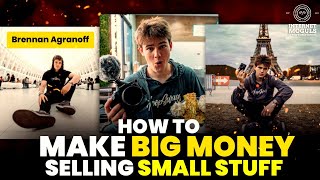
Brennan Agranoff built a sock printing and manufacturing business into a money-maker. He walks through e-commerce basics, Facebook ads, email marketing, and how he balanced it all while in school. Practical advice for young people trying to start something.
My name is Brennan Agronoff and I started a sock printing company which has now transformed into a really manufacturing company where we will do all sorts of customization, personalization on all sorts of products, anything from socks to blankets to ties. I'm very good at math, but I'm horrible at English. And so I got all a lot of my English classes out of the way online ahead of time because I was actually ahead of math. Like, I sort of found these different, like, ways to manipulate my schedule where it allowed a bit more time to work. So I do run the sock company. Like that is my main thing. But because we're so heavy in November, December, I get. And I like, my mind likes to wander. So I end up with a lot of these random side projects. So some of these are like developing into other things. So I mean, with the sock company, we're moving more towards a manufacturing model. So that's almost turning into a larger scale manufacturing company. And people like to put the blame on Facebook ads, but it's actually never Facebook ads problem. Like it's actually your own fault. Well, my name is Brennan Agranoff and I started a sock printing company which has now transformed into a really manufacturing company where we will do all sorts of customization, personalization on all sorts of products, anything from socks to blankets to ties.
Nice. Okay, that's Raya and that's Aviana, and Benji is somewhere under the feet.
All right, are you guys. Are you guys not together?
No.
You know what I got so I could make it back in time? I'm in India and lockdown and the girls are back home in Vancouver, Canada.
Okay, gotcha, gotcha.
Okay, I'll start with. So I talk a lot about self love on my YouTube channel and my Instagram. So do you think I can start a clothing line on socks or hoodies or whatever on self love even if nobody knows me and like I'm not famous yet or what would be the first steps to start?
Yeah, I mean, so it's a good question. I think a lot of it comes down to like the goal of it, right? Like, are you gonna try to start a clothing company to become like a. Make a couple million dollars in the first year? Like, that's likely not gonna happen. The thing I see with clothing lines is a lot of, it's like more development over time and like, like you guys were just talking about. Actually the story behind it is way more important than the product itself. And developing a story like that is partially you, but partially. It just sort of takes time to Build that. And so I think starting a clothing brand, honestly, is a really, really good experience, which it sounds like you guys are already being immersed in a whole bunch of stuff, which is super cool. But that's the biggest thing is when you're younger, there's so much to be learned from even the sort of, like, simplest kinds of businesses, because you just don't know that much. Like, I would argue most of my best lessons came from super simplistic business things, but they apply at a larger scale too. But I definitely think it's possible it's just a matter of, like, creating a brand story behind it and sort of sharing that with people. Because, again, even if you get one or two people to wear something, if they become longtime fans, that's huge.
Got it. So you're saying a story is more important, and a true, genuine, authentic story helps your brand go a long way.
Yeah, I personally believe so. Like, your product. Your product has to be good too. But, like, yeah, yeah. What's gonna hook them in the front door is the story.
So, Aviana.
Okay, so my first question is. So I'm Aviana. I'm 10 years old, and my passion is around horses. So if I wanted to do something, like something around a commerce, how do I decide what to sell online? But how do I decide what to sell online? And could you give me a few tips and ideas?
Yeah. Are you talking about in, like, sort of around the horse specific area?
Yeah.
Or just in general. Okay. Yeah. So I'm not gonna lie. I'm very unfamiliar. I actually live next to a giant horse stable, but I used to ride them as a kid. But I have not gone near a horse in, like, five, 10 years. So I'm not crazy familiar with it. What's that?
I said, how could you do that?
I don't know. I do not know. But no, I think one of the best things you can do is, like, it sounds like you're. You're sort of involved with that, so you sort of look at it and see, like, what is a very, maybe even minor issue that you could potentially solve and work to find a solution. And that doesn't necessarily mean you have to, like, go reinvent something or, like, do some fancy development of something. Sometimes that's just taking something that's used in a different application and applying it there. So, like, in my case, I do this a lot with socks. This is really my best example because I just live and breathe socks. But, like, normally you think you would just wear socks to wear on your feet or. Because they look cool or whatever, but a lot of the times, the way we sort of create new revenue streams and find new ways to sell them is like showing people a purpose for them. It's the same exact product. We're just trying to explain to people a different way to use them. And so if you were going to do something around horses, I couldn't give you any ideas because, again, I'm clueless on horses. But I would go look at something and even something simplistic that could save someone like three, five minutes a day. Go look at that, see how you could potentially get some, and then try selling those. And honestly, you might try selling those in person before you put all the effort into doing it online, too. I mean, granted, right now that's very difficult, but I always sort of like prototyping by at least asking a lot of people and getting their thoughts and stuff.
Okay, so people who are other people who might be coming for those horse riding classes that Abhiana goes for for all horse lovers, maybe ask them, if we developed a product like this, would you buy and all of that.
Exactly. It's just much easier to check with Ask5, 10 people than it is to spend a couple months doing development on something people may or may not even want.
Got it. Okay. So, Brennan, tell us a little bit about your business. We actually loved your talk and you said, I sell a million dollars worth of socks from 27 November to 25 December. And that was fantastic. So tell us about all of that.
Yeah, it's really crazy. So I started selling these socks probably six, seven years ago, and it's totally changed from where I started to where we are now. Our business model is very interesting, and I don't know if you guys have seen socks with dogs or cats on. We actually do horses too, but. But, yeah, but it's very interesting how it's changed because we ended up in this very seasonal product. So, like, socks are the number one gift item every year for Christmas. And so what we end up with is between basically like Black Friday and December 20th, which is like the shipping deadline, we do 80% of our sales for the year, which comes out somewhere over a million dollars. But it's because we're doing all of our. I live in Portland, so we're actually not that far from you guys. But because we do all of our own manufacturing, it's a completely different ball game. Most people online selling stuff, they just have to worry about how do you respond to the influx of emails and how do you spend More money on ads and that sort of thing. With us, we're actually having to manufacture all of it. And so I get this whole other sort of spectrum of how do you grow a manufacturing team? Last year we got upwards of 150, 200 people. And then how do you manage that and the HR behind that? And so there's a lot of moving pieces, which I really enjoy because I kind of like playing around with a bunch of different stuff. But my business is very interesting because, like, right now it's not. I mean, we're sort of busy right now and we started selling like printed masks. So we're doing. It's a little busy right now. But normally this time of year we spend doing like, I guess you could call it not so fun stuff, like cleaning up all the internal systems and writing new stuff, software that's gonna help us sort of maximize our time during Christmas and working on manufacturing processes. And so it's just interesting cause from the outside it looks like, oh, we just sell a lot of socks. But there's so many different moving pieces that go into it that the revenue thing at the end of the day is like an incredible number to get to. But it's crazy how much of that wouldn't be possible without like the hours of work we put in in like June. So it's just. It's very interesting.
Yeah. So do you depend hundred percent on Facebook ads or do you have like couple of channels to get your sales?
Yeah, yeah. So I definitely was more dependent on Facebook ads at first. I'm very cautious of like pushing all my eggs into one basket, being that Facebook, that they could shut you off whenever. They'll just do that, even if sometimes, like, there's not really a lot of good reason. I've heard horror stories where they shut you off. And so, I mean, not just that, but in any scenario, you don't really want to just dump everything into like one basket. And so for that reason, we do a lot of Facebook, definitely, but we sort of diversified and we do a lot more sort of influencer stuff. We've worked with a bunch of YouTubers and then also just once you acquire them from Facebook. The way I look at Facebook is not an ongoing marketing channel. It's a great way to acquire customers. And once I acquire them, how can I keep them buying? And so we do a lot of that through email marketing, retargeting across different platforms, whether that's like Even Pinterest, Snapchat, YouTube, Google, Google Ads and Facebook. But the way I look at it is like, Facebook's a great way to acquire, but you have to find a way to create a community and retain them. Otherwise you pay for a customer that you'll never get more money out of.
Got it. So are you saying that. I'm trying to understand, are you saying that your Facebook ads get you customers, but the real profit comes in when they continue to buy from an email list where you've spent no money to get them the second or third time?
Exactly. Yeah. I'm not making money on that first Facebook purchase. I generally am trying not to. If I like, if I don't lose money on that first Facebook acquisition of the customer, then, like, that's a win for me because I know I can get them to purchase more from the email list.
So can you tell us a little bit of. We were speaking to Amy Porterfield a few days ago, and she said. And Pat Flynn, and they said, you know, build your email list. Build your email list. So you said, you're saying that your email list allows you to get to mine to mine back from the existing database that you have. So if I have a thousand people in my sock selling or you know, when I say socks, I'm trying to say a small ticket item on the Internet, my Facebook ads, a couple dollars. So I just about break even. And I feel happy when I've broken even. Now they're part of my email list. What kind of two questions. What kind of emails do you sell somebody who's buying socks from you? I mean, this guy's not emotionally invested into motivation or online courses or whatever. He's bought socks. Right. So how do you keep them motivated? And secondly, what is the ROI when you send them an email?
Yeah, that's a very good question. So this has actually been. I spent a lot of time on this in the past couple months, sort of doing. We didn't send a lot of emails before. I knew we should, but I was running the same exact thing you just asked me, which is like, what do you send someone who buys socks from you for $25? That is not enough money for someone to open your emails every week. It's just not. And so what we found is we started. I was overthinking it to an extent. So we started sending things. Anything from cute stories about dogs that went to. Through hospital recovery. We're just giving these people content at this point. And then eventually we do a lot of seasonal stuff. Right. And so because everything's print on demand, we can release new things. So it's great. So A lot of the emails we're sending are they either kind of fall into a content or a sales category. Content being like we'll send fun facts about dogs or maybe we do like an interview with some famous influencer dog about their life or tips and tricks or whatever. It is like sending stuff that we're not just trying to push our content or like a sales thing out. And then we'll do some new stuff. Like we launched masks, so that was a whole campaign. Father's Day, Mother's Day. We end up with a lot of these, like, holiday events since a lot of our items are gifts that we can sort of do promotions around that. Or sometimes we'll do like sales in the middle of summer. But like really on like a timeline perspective right now is like the biggest gap where there's just nothing but. But really it's only like a month and a half, two months, then we've got back to school and then we go back into like fall sort of promotions and going into Christmas, like, we start advertising in September, we're advertising gift guides in September. And so we use a lot of seasonal holidays to sort of fill those gaps. But we're only talking two, three emails a week. So you toss in like some sort of promotional thing with maybe like a new release and then a content one and it's nothing crazy. It is a lot of stuff to put together, though.
Do you have a, like, what's the buying rate? 2 to 3%.
Oh, yeah, good question. So I don't know how familiar you guys are with like e commerce email flows. I could go way into this, but basically, like, you've got your campaigns which are sort of like those things that we're sending once, twice, three times a week and then we've got like our flows. Right. So those are the automated things when someone signs up but doesn't purchase when. So on those we do very, very well. Those are about a 2 to 3% conversion rate on like a welcome series. I think that's good. I don't have extreme metrics for comparison industry, but on the other ones it's not as good. I'm not sure on conversion rate, but I know we're looking at about $0.02 per subscriber in revenue per email. So hopefully that answers out a bit.
Yeah, absolutely. Raya, Sorry, One more question I had was in this context, do you send. Do you have lead magnets to just get people into your system or it's only the buyers who get into the email list?
Good question. So we have lead magnets, you want to call them. They're just pop ups on the site. I guess that's more like an E commerce version of a lead magnet where we give them like 10, 20% if they sign up, but no like dedicated landing page with a lead sign up.
So my next question is how do you plan your Facebook ads like months ahead of time and how many ad copies and ad variations do you need to try and continue to get demand? Because I believe demand with just one type of ad can dry up pretty quickly.
That's a really good question.
Small dogs. Yes. Red dogs, White dogs, Cats. Red cats. I'm just.
No, seriously? Yeah. No, this has taken a ton of testing and I don't know that I have an exact answer. It's kind of one of those things where you're always trying to figure that question out. But what I've sort of learned or picked up on is like Facebook just has so much data, they know so much better than any of us. And so the way I sort of structure things is so running ads ahead of time. One of the largest things that plays into factor for us is this called like so if you seen ad today and. But so I believe it's yeah, if you click on an ad today and purchase within 28 days, that counts as a conversion from today. So if you see an ad, there's a difference between seeing click. One of them is 28, one of them is one day it's in. I forget which one's which. But anyways, there you end up with this window of like 28 days where someone could have saw your ad but can still purchase. And so a lot of people make the mistake of looking at like if we go look at our ads at the end of the day, that's not accurate. Like we wouldn't know for 28 days how many sales it generated. So a lot of that's looking at historical data from last year. Because when we do so many sales between Black Friday and Christmas, number one, people are advertising more just in general because businesses advertise more that time of year. So your cost to advertise goes up. And so the way we sort of work around this is we will actually spend a significant amount of money, probably like 60% of our money in the first two weeks of November. And we lose money on all of this. But the reason we do this is because we can look at numbers from last year and the year before and know that those people will come back and buy within 28 days. But it might be at the end of that 28 days, which falls within that window of like, sort of prime selection. But we are buying those customers and paying for that traffic ahead of time, in a sense, and then continuing to retarget those people. And when you buy that traffic, they're on your email list. So then you have four weeks of emailing them. And so there's a lot of. There's a ton of calculations that go into this. And honestly, it's just a giant math equation in an Excel sheet that I have. But we call that like a delayed attribution multiplier, which basically talks about how much you see on the. When you look in Facebook's dashboard on the first day versus 28 day. And sometimes for us, it's crazy. Like, we'll see, like, let's say we had like 10 purchases day of. We can go back in and see anywhere between 20 and 30 purchases when we look back a month later. So it's a significant difference. So it's definitely something we have to look at. And in terms of ads, I try to keep them relatively generic just because I do the dog and the cat socks, right? And if I were to go into every breed I could, but then I'd have to go film videos for everyone, and I just haven't. I tried that for a couple of them to see if you'd get, like, some big bump by doing that. But I didn't really see that, like, it was pretty comparable to the generic one. So I was like, this really probably isn't worth, like, the time and effort to go film 90 different videos for each breed and size of dog. And so I try to make it relatively generic, but I've tested all of this stuff, right? I basically tossed them into ad sets and let Facebook do the testing for me. And like I said, like, Facebook just has more data than us. And so you've sort of let them do the. The hard work of figuring out what needs to be served when and where and just keep testing new things, like, always test new stuff.
That is brilliant. I love the fact that you actually went on the journey of having multiple types of dogs and all that, because that's how it works. Right then. And great, Aviana.
Okay, so my second question is, how can me, Raya and Daddy start in comic E commerce? Start e commerce business like yours? And can you tell us how to start, where to do the research from, and how we can get set up by Christmas time?
Yeah, well, the nice thing, first off about E commerce is, like, it is so fast to set up Just because everything is online. Really the biggest piece I think about E commerce is number one, sort of the story like we talked about, and then also the product. Like those two things are super important. So if you're able to find a product and like I said, like in that horse example, that could be something that fits that area. Maybe it's something else. Like, I just always try to be looking for things in my life or even looking for things that you see that are doing really well online that maybe you could replicate. Like, I don't see any problem with taking someone else's thing that they're working on and maybe like improving it a bit and then that's yours. That's what I do. I'm not necessarily a super innovative person, but I'm really good at improving current things that exist. And so that's sort of how I approach it. But in terms of setting it up, I mean, you're looking at probably setting up a Shopify website and then from there, as long as you have a product and take honestly, you could get your own photos and videos off your phone and maybe make a couple videos about the brand, why you started it and whatnot, toss those on the website. Like, you have a much more branded website than 90% of people already. Most people don't put any sort of personalization or thought into it. So I think that's probably. And in terms of research, so I did a bunch of research. Mine was a bit different because I was doing manufacturing and that's why I was doing research. But with the research aspect, I mean, I still research things all the time, but I recommend Google, YouTube, like everything is out there. And then also like, one of my favorite things to do is like, if I'm really getting deep into a topic on something, I sort of like flow in between topics. But if I'm getting into a topic, I'll go on YouTube and generally like you have the same. Three or four people are making a lot of videos about this topic. I'll usually email them or Instagram DM them or somehow try to get a hold of them and just be like, yo, I really appreciate the videos you're putting out. Like, these are super helpful. And honestly, most of the time these people will talk to you who are complete experts in the field because you just reached out and said thank you for their videos. They just really appreciate that. And honestly, that's why they posted them, was to help people. And so they're happy to help. If you have questions that sort of go beyond things you could Find on the Internet, Talk to these experts. And I found that's a great way to get ahold of them.
Got it.
Okay, awesome. So my next question is, when you sell socks, can you tell us how deep you go in showing targeted ads to your different types of customers, like dog prints or dog lovers or, you know, etc.
Yeah. Yeah, that's a good question. So. Oh, I love the answer to this. So I tested all of this too. Like, I was like, how many? I've gone through hundreds and maybe thousands of these saved audiences with extreme specific targets. Like, we're gonna target. Like, I know my target demo is, like, females 18 to 24. So I'm like, okay, I'm gonna target females 18 to 24. Test the people. The Ohio group versus California. Like, we've gone super in depth with all of this. And the answer that continually comes back is you just let face, like, off none of it. I have not been able to beat Facebook.
I think the Internet. Internet died for.
Oh, oops. But no, no, no. The one thing I continue to come back. Am I gone still?
No, we can hear you.
Okay, cool. No, like, the one thing is Facebook will always win. I've tested all this different stuff manually, and I was like, okay, well, maybe if I do, like, this manual bid and this specific audience, but what ends up happening is you could literally spend all day just creating audiences and testing all of this. And what I found is Facebook. Now I'll go in there and throw an audience into the ads with, like, 4 million, 3 million people, and then click, like, expand interest targeting, which means they'll literally show it to anyone who they feel is a good fit. And it just always outperforms my ridiculously targeted stuff. It's annoying because I wish my stuff would outperform, but again, their thing is just too smart at this point because they know when someone wants to see an ad that would make trigger them to buy something that, like, I. You just don't have. So it's. I have tested all this, and it really, honestly annoys me that I can't beat them. But I have not been able to beat their algorithm yet.
Sometime at 300 ads and now came to 10. Or you were never at 300.
I think the highest I probably ever got was, like, 50 to 100. I mean, during Christmas, it's a totally different story because we're trying to spend 10 to $50,000 a day. And just the way you structure your ads and that sort of stuff, like, it. There does come a point where, like, you can't just turn the budget to like $50,000 a day and expect it to do well. And so that's a totally different, like, game plan. And at that point, yeah, we have 50, 100, couple hundred ads in there. But again, they're all very. They follow like, the ads themselves still follow a very specific formula to get to create them. It's just different information made or pushed into them.
Okay, I'll go on to the next question. So something that I was really curious about was when what were some of the struggles with starting this business while being in high school or being a normal teenager? You know, like, what were something that you faced personally?
Sure, sure. Also, I'm just curious, what year in school are you guys?
I'm in grade nine right now and she's in grade five.
Okay, nice. Okay, cool. Yeah, no, so definitely. That's a good question. Like, growing up, I mean, I started this when I was probably in seventh or eighth grade, but it wasn't like a real thing probably to like my freshman year of high school. And so the way I looked at it was like, I always, like, got by in school without, like, putting that much effort. I know there's some people that, like, I went to school with and that are everywhere. Like, they have to put a lot of effort and time into school. And, like, I just kind of got school. And so I also structured, like, the way I took my classes. Like, for example, I'm very good at math, but I'm horrible at English. And so I got all. A lot of my English classes out of the way online ahead of time, because I was actually ahead of math. Like, I sort of found these different, like, ways to manipulate my schedule where it allowed me a bit more time to work. And this was largely because, like, I had a conversation with my parents. Like, I'm very grateful for, like, my parents that I grew up with. Like, we've always been. They've been. I mean, like, they're literally your mentors for the first 20 years of your life, like, whether they just are. And so I'm very lucky in that department. But we had this conversation when I was sort of starting all this before it was really even that big of a deal. They've always been very supportive. Like, okay, like, look, like we are fully aware there's things that are probably more valuable to you than school, like, from a real world life experience type perspective. And they were like, we're not suggesting you, like, flunk out of school. Like, the expectation was that I get like, all A's still But they were like, if there becomes a situation where it. They get like pitted against each other in new school or this, like, let's have that conversation at least and see where you want to spend your time. And as long as we're like, having that conversation, I think like, we were all on the same page. And so like, for me that was. They were like, had. The conversation was like, okay, I can maybe take a couple less AP classes but put more time into the company, which who can quantify what's more important, right? It's different for everyone. But at least talking about that. But in terms of that, I mean, I also worked really hard during high school. Like, I would go to school, I'd get my stuff done, I played sports, I still tried to hang out with friends. Like, I probably didn't hang out with friends as much as the average high schooler did. But also, like, I genuinely enjoyed what I was doing. And I'm more of an. I don't want to say antisocial, but I definitely like timing to myself more than like, I couldn't go. I'm not extroverted, so I couldn't really go hang out with people like 24 7. And so for me, it worked out really well and I met a whole bunch. I've made all my best friends through my business and company and stuff. And like, I talk to these kids all the time and they have nothing to do with anything that I do. But I've just met them because they're young entrepreneurs and we get along. But like, definitely growing up, it's a matter of like scheduling and prioritizing because, like, I still had schoolwork, I had this company thing to run. And again, this company was nowhere near where it was what I'm doing now. But again, I've been working on this full time for two years now. And so it's definitely just at smaller scale, but sort of picking off what I could do and also like passing off like upwork and that sort of stuff when I couldn't. But like, for example, I had this teacher that I worked at a deal with where happened to be a coding class. And so I would get to go basically work for two hours a day while at school. And in return I would go do some like, public speaking stuff for him because my story was perfect. And so it's like finding these little scenarios where it's win wins for people. The same way that like my win win was I got to go to school and I still got to like, work on this business. And like, these People started to recognize that my business was actually teaching me more than I was learning from the curriculum in school. And it's totally different because you've got, like, your basic learning things in school, which are important, but it's a different type of learning. And I don't think a lot of people got exposed to that. And so it was. It's definitely largely in part to being clear with my parents about what I was doing. Because, again, you can't just go off on a tangent and be like, I'm gonna start this company and screw school. But it's a lot of, like, hard work, planning, and I think just communication with, like, parents, at least in high school.
Yeah, for sure. Amanda, do you have your next question?
Yeah. So my next question question is we use the term Internet moguls a lot. And definition of an Internet mogul is someone who spends quality time with their family, but also works hard on improving their business and growing their business. So what would your definition of an Internet mogul be?
Interesting? That's a good question. No, I think what you just said, I'm not going to steal it. But definitely parts of that where, like, you've got your portion right, of, like, your Internet, where you, like, work hard online and you've built something that's pretty sustainable and can be passive over time, but, like, also finding the balance of where that ties in with real life. Because, like, online is great and making money is great, but it's not everything. Like, it's part of life. And being able to have a balanced life and good friends and family that, like, care about you and you care about them, I think is honestly more important because that's sort of like your framework for anything you want to do on top of that. And so I think there's a large misconception where it's like, oh, we need to work 20 hours a day and don't sleep. And it's like, no. There's certainly maybe a time and place for that, where you have deadlines to meet or whatever it is. But for the most part, I think it's important that we try to have somewhat of a balanced life. And for some people, balance looks different. I don't like when people try to classify balance because it just doesn't work. My balance is much probably different than your balance. Everyone's balance is different. My balance could be working 12 hours a day and hanging out with family the other six or eight or whatever. And some people, they don't want to work 12 hours a day, and they want to work four. And like, that's their ideal. Maybe some people, it's not working at all. But being able to find balance and define it for yourself is extremely important. I think it's hard because you can't copy someone else's balance. Like, you got to figure that out for yourself.
Wow.
Okay.
So, Brennan, where is. Where are you headed from now? What's the next five years looking like?
Yeah, very good question. So I do run the sock company. Like, that is my main thing. But because we're so heavy in November, December, I get. And I like, my mind likes to wander. So I end up with a lot of these random side projects. So some of these are like developing into other things. So I mean, with the sock company, we're moving more towards a manufacturing model. So that's almost turning into a larger scale manufacturing company that's able to essentially create brands on the fly, which is super cool. So that's definitely headed in the personalization route. We've been doing a lot of fundraising with schools, logos, bigger companies, because not a lot of people can do, like, print on demand next day turnaround type stuff in the US and especially with all this Covid stuff you've seen all this manufacturing that's gonna have to come back to the US because they're realizing that, like, stuff coming overseas just might not be as sustainable as it is here. So it's being in manufacturing, it's not a sexy business at all, which is kind of nice because no one else wants to get into it. Like, it's a bunch of old dudes that run this industry. There's certainly some younger people, but for the most part, you're not looking at your college grad coming out of school. And it's like, yeah, I want to go work in manufacturing. And so I definitely like that for that reason. There's not a lot of people, and it's not very fun from the outside, but I enjoy it on the inside. And then, I mean, some other stuff. So I run this video production company actually on the side with a buddy of mine, and that's sort of actually taken off in the past couple months too. But, like, we shoot a bunch of music videos for artists and such, and so that's been cool to see how that's grown and shooting, like, more content for other brands. Since I do it for myself. We ended up sort of branching out, doing that for other people. So there's that and there's a bunch of other sort of random things that I work on helping other people, like with their, like, I'VE got all these friends now that run companies and it's very interesting me to be involved with their stuff too and sort of help them out. Um, and so I just like love meeting people and speaking is fun. It's a great way to connect with people. And so like I realized at like 20, there's not really much better time to go out other than we all are locked inside. But like, it's a great time to go out and meet people because people are willing to help you and these like are building relationships that are going to last a long time. And so for me, like now that's sort of what I see the next five years is like continuing to build relationships with people and sort of helping to provide value in other people's lives as well as like my own companies and stuff. But like from a broader perspective. Awesome.
So at the age of 20, you are busy. You said that you gave equal importance to the learning that you get from school and your family. And you took the experience of your parents, like your mentors very seriously. And you came to where you are and you told us about your five year vision and what are the things that you're involved in. But tell us all the 13 to 25 year olds watching this, what they've learned from you in the last 10 minutes, that you can balance it all. You can start an E commerce business. You need to continuously learn, unlearn, hire on, upwork. If you don't really know what you know, if there's something that you need an expert for, what would be at least three pieces of advice you would give to somebody who's watching this right now, say during or after Covid and has to restart a business. And like I said, the Internet moguls of the world is a family school. You know, we're assuming a family to a set of parents and their two kids are looking at your video right now and saying, I wish I could get three actionable tips to be able to get started on my business right away.
Yeah. So I think the biggest one and you almost sort of just recap this, but like learning to learn, I think is a massive thing like that. That is the one thing I took from school that I will say, regardless of all the education stuff, most useful by far because when you're able to sort of learn to learn, you can go watch things on the Internet, you can teach yourself things that you want to and you'd be amazed that most people don't actually know how they learn effectively. And so figuring out how you learn and Honestly, going on YouTube and exploring a little bit. People always talk bad about the hole that you go down at night where you're watching videos till 3am I think it's great because their feed's recommending new stuff to you and it's opening your eyes to new things. So free, actionable tips. I mean, go learn new stuff. And I think that is huge. And then also, when you run across something or you have an idea, just do it. Don't overthink it. And people always get confused with, like, do I need to do this legally? Do I need to have this license? Like, give it a shot, see if it works and figure that stuff out later. Because the reality is you could sit around for months not doing anything because you're nervous about it or whatever. And there's really no downside. Especially, like, the Internet. You can't lose on the Internet. Like, there's nothing to lose. So definitely go out, learn new stuff, do something. Like, anything you will learn from and what you don't, it'll probably fail. Quite honestly, I failed at like 30 or 40 things before this. But you're gonna pick up stuff, and that knowledge compounds. And so the more you know, the more successful that next thing is gonna be, or the higher likelihood you have it being successful in that next thing. And then probably like, a third piece of advice would be like, go try to meet and surround yourself with other people who are sort of in the area of where you want to be. Like, it's a very cliche quote, but when they talk about, like, you are the average of the five people you're around, I have found this so true. And, like, being able to surround yourself with people that are, like, smarter than you in different areas are pushing boundaries in ways that you might not have thought possible. It really, really levels you up. And it's just been interesting. Like, I look at where sort of I have been, and a lot of my best friends run other companies. I pick up so much from them and, like, inspired to do more stuff. It's not a competition, but it certainly is, like, okay, like, they're doing that. Like, why am I not continuing to push myself further? And it's very hard to find those people because a lot of people, like the kids I went to high school with, if I hung out with them, no way I would be where I was. I still, like, see them, but, like, I spend most of my time with people that are probably smarter than me. And I love that because I'm always learning from them. But it's like, A value thing in a sense, too. Like, I'm smarter in some areas and they're smarter in some areas, and we help each other and it's mutual. But definitely, I would say go learn new stuff. Just try something, anything, and then find a good group of people to surround yourself with.
Love that. That was fantastic. Brendan, tell us. A lot of people who are watching this right now have this question. Brendan, I started on a journey that you suggested, or a similar one. Facebook ads. Cost went up. I ran out of business and I never tried it again.
Yeah.
What do you say to. I mean, does it ever end or is there always a way out?
I mean, I believe there's always a way out. And just to hit on that point real quickly, like, when people. Because people do say this, like, this is a fully real thing where they're like, I did it. I threw up a site. And, like, the ads didn't work. Like, this happened to one of my friends last week, actually. And like, Facebook ads and the site are like 1/100th of this picture. Like, there's so many different places it could have gone wrong. Your site load speed could not have been good enough. Your stuff on the site probably wasn't good enough. And people like to put the blame on Facebook ads, but it's actually never Facebook ads problem. Like, it's actually your own fault, because if you either the ad wasn't good enough, your website wasn't good enough, your product wasn't in demand, like, there's all these other things. And I feel like people very easily like, oh, Facebook doesn't work. And I'm like, well, didn't work in the scenario that you tried it. No, but, like, it took me a whole bunch of testing to get it to work too. It's a very specific sort of tuning thing. And so, yeah, there's always a way out. Like, and Facebook is one of a hundred different marketing channels, right? Like, there's a lot more bootstrapped ways you can go. You could literally DM people on Instagram. You could go find someone else's email list and convince them to do a collaboration with you. You could write blog posts, you could make YouTube videos. Like, Facebook is one way. And I think especially in the ecommerce world, people think it's the only way, and it's not. There's so many other ways to do this. You can get affiliates, you can rank an SEO. It's one channel out of hundreds that you should be utilizing. But that doesn't mean that just because Facebook ads didn't Work doesn't mean your product isn't going to work or you're not going to have success. Just make sure that you're validating your product. And if you try 100 marketing things, like, you have to be real with yourself. Like, at some point, you have to be real with yourself. Like, okay, maybe people don't want this product, which means you probably didn't do your validation very well. But just because one marketing platform doesn't work is in no way an indicator of the fact that what you're trying to do will or will not work.
That's fantastic. Very nicely put, Brennan. We're coming to the end very soon. I wanted to know from people who are saying, okay, Brennan, you motivated the entire family. We want to get into a business. We love the E commerce. We learn to learn. We surround ourselves with right people. We do everything that you said. But hang on. Never done Facebook ads in my life. Do I hire an agency? Is it going to be expensive? Should I hire somebody on upwork? How do I get started? Or do you want me to go through Facebook ads, YouTube, all these, buy some courses, run a tutorial, do everything for six months, and then get back into the business? I mean, how do I get started?
Yeah, that's a very good question. I don't think you. I don't think you. I definitely don't hire an agency off the bat. Like, I'm not a giant fan of agency pricing because it's just so expensive. But I will say, like, there's enough videos on YouTube like that. I mean, I learned a lot from, number one, talking to other people who have had success doing it, and then YouTube, really? And, like, I've watched the videos on YouTube and they're pretty very similar to what I'm doing, which is having success at scale. So, like, I know the stuff on there works, and so it's a matter of getting it to work for your specific sort of thing. But, like, the conceptual aspect, like, it's free on the Internet, but yeah, I mean, and then also, like, I really wouldn't start with Facebook ads. Like, it's very expensive. I'm not gonna lie. Like, it is expensive. Like, I would do all the stuff you can in your power to do free marketing channels first. Right? Like, again, like, can you build a bit of a following on Instagram? Can you DM people? Can you reach out to people? Maybe you send product to people to post? And Honestly, I love YouTube. I don't even do it myself. I really want to, but, like, I Love Marketing on YouTube. I think it's a great way to build a legitimate business from a very organic source. But I like if you're just starting, I really wouldn't start with Facebook ads. Like, like I said, it's the go to but like I think it's very expensive at first.
Sam.
More from Avi

The strongest mindset doesn't begin with meditation. It begins at home. Before you conquer the wor

The strongest mindset doesn't begin with meditation. It begins at home. Before you conquer the wor

Your mindset isn't something you fix once. It's something you train every single day. Just like yo

Don't build a company just because your friends are. Build one because you're ready. A startup is

Everyone dreams of becoming the boss. Very few understand what that really means. The moment you b

Most entrepreneurs say, "I don't have time for coaching." The truth? You don't make time for what

Over hiring doesn't always solve problems. Sometimes, it creates them. Having a small buffer in you

"The highest-paid" isn't the goal. The highest-value is. People often ask why premium mentorship co

The founder will always be a bottleneck... at some stage. The goal isn't to pretend you're never th

People ask me how I stay consistent with my morning routine while traveling across countries and tim

People ask me how I stay consistent with my morning routine while traveling across countries and tim