The 4 Es for a Good Debut Live Stream | Interview with Jim Fuhs | The AskAviArya Show
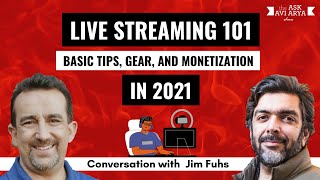
Avi Arya talks with Jim Fuhs about launching your first live stream. They cover the four Es: equipment, engagement, environment, and energy. The conversation includes gear recommendations, how to keep viewers watching, and ways to monetize.
And I'm in a different part of the journey than some of the people watching today. Just come, you know, just look at yourself in the mirror and say, how can I get better today? 1% of the time you don't need. You know, I think it's like $5,000 of equipment, right? You can literally start with this. Nothing more than the phone. And, you know, even if it's a short video, I know that you really like doing micro videos. People don't think about it. But probably the most important thing aside from like, even if it's your phone camera is this right here. It's your aud. Because people will forgive bad video, but they will not forgive bad audio. What do you want me to do after I've watched your video? Do you want me to make comments? Do you want me to share it with people? Because a lot of times, you know, people want. It's funny, right? People want to be told what to do.
Ask your audience what they want, give them what they want, ask them the price, and give it to them at that price. And that's what you need. So you don't need a lot of people, just an engaged audience.
Don't get in your own way. Get started. That's probably the biggest thing is Chris Kremitzo says start ugly, right? You don't have to be perfect. You know, like I said at the beginning, this is all you need to start doing live video. Two, here's the thing. One, wouldn't it be great to be able to have a virtual event where the people can come from anywhere? Like people from India could show up and not have to worry about, I gotta travel, I gotta get a hotel room. And it's really just a matter of coming up with those times.
Hey, guys, this is Avi Arya, father of two girls, six dogs, husband to a superwoman, a streetcar racer turned hotelier, now social media marketer and founder of Internet moguls. Welcome to my channel, do it, Jim. Thank you very much for being part of this show. We always start this show with this section which is called what's your story? I always believe, Jim, the shortest distance between two human hearts is always a story. You tell somebody a story and they remember you for life. I'm going to give you a short story of mine in under 10 seconds, and then we request you to do the same.
Okay?
Alrighty. So, Jim, my name is Avi Arya, father of two girls, six dogs, husband to a superwoman, a streetcar racer, turn hotelier, now social media marketer and founder of digital marketing Agency, Internet moguls, where we help coaches get known, get leads, get sales using our digital marketing systems. Over to you.
Yeah, I'm Jim Fuze. I'm a retired Marine lieutenant colonel. I do marketing the Marine Corps way. I'm married. I have two daughters of my own, and I also have two stepchildren. They're all young adults now. And I do live streaming, podcasting, digital marketing consulting through my company, Fusion Marketing.
Lovely. So, Jim, tell us. Covid has changed everything. Lots of people going live. So for our audiences who are saying, how should I get started with my first live, what would be your initial tips for beginners?
Well, I think one of the things. And you actually posted on this on LinkedIn, I think it was a week or so ago. Get started. You don't need, you know, I think it's like $5,000 of equipment, right? You can literally start with this. Nothing more than the phone. And, you know, even if it's a short video, I know that you really like doing micro videos. I've gotten more into the longer form. I've been doing interview style for over two years. But just get started. Don't be afraid. If you go back and look at my first videos, you may feel the same way. They weren't all that great, but as long as we try to get better 1% at a time, we're gonna definitely have success down the road. It's not an overnight success thing. It just, you gotta, you gotta be consistent at it.
So. But initial few steps would be give a name to your show, schedule a time to go live every week, use a software like Restream. Any of those tips.
Yes. Yeah. So I do, you know, in fact, I'm using ecamm right now as a virtual cam, so I can show you some of the things that you can even do within zoom. As you can see there, I put, put my, my name up there. And so I actually like to use streamyard. I'm actually, my show is sponsored by streamyard. Very easy to use. You can also use it on mobile, on tablets. They've, you know, there are three core pillars are ease of use, professional looking streams, and stream stability. And that's so important for you as a live streamer. And really, a lot of times people don't think about it. But probably the most important thing aside from like, even if it's your phone camera is this right here. It's your audio. Because people will forgive bad video, but they will not forgive bad audio. Because if you're, you're cutting in and out and they're hearing all kinds of noise in the background, they're going to go away and you're probably not going to get them back. So, you know, invest, even if it's in like a lapel mic, if you've got a phone, because a lot of times the phones themselves don't have great audio built in. So just by getting that little lapel mic and plugging it into your phone is a great way to get started. But I agree with you. You know, what is your. Why. Why are you going live? And I like to talk about the four E's of social media, even in regards to live streaming. And part of that is you really have a chance is you want to educate people. How are you telling them what you're doing? Just like you started out this segment today where we're telling a story like, why would you want to listen to me? Why would you want to listen Avi? Right. It's because we're going to teach you things. We're not. We're not trying to. You know, I think too many times people try to jump right into sales, but really we're all problem solvers. And so the first thing is to educate people about maybe how you solve their problems. In your case, I know you do a tremendous job of educating people about how short videos can really help you be successful. And not everybody's going to be able to do short stories, right? Some of us, we can't get our words out quickly. So I think the first step is, are we educating people with our live video? And I think one of the big things that happens is that we don't get an opportunity to think about. The thing I love about live video is we can build community because we're actually able to interact with our viewers in real time or. Or even after the fact on the replay, where that's where sometimes I think. And even the algorithms for a lot of platforms favor the live video over, say, recorded video. So I think that was one of the things that I've really seen during this, this time. The other thing is we want to entertain people, right? We don't want to be some monotone. I'm going to talk really slow like some of our teachers we probably had when we were younger. So how can we, you know, jazz things up? I mean, I love your background. I mean, that microphone on that poster back there makes me think, wow, what is that? You know, that's. That looks pretty cool. Who created that graphic? And so it makes me think. Or just even, you know, the way we Present ourselves. I don't know if you are Avi, but I'm a toastmaster, so that's helped me become a better speaker. So it's not just what we do on camera, but off camera, how are we making ourselves better? And so, you know, so if we can educate and entertain, I think that's extremely important. But the other thing is, how can we empower our viewer? Maybe they're having some sort of a struggle and we give them that. That tip, that thing that lets them move forward. I think too many people are worried about I'm going to give away all my secrets. Well, there's plenty, I think, to go around for everyone. And so I think when we can empower people, we help lift everyone up. And I think that's what this world needs probably this year, right? As my co host always likes to say, now more than ever, how can we help our fellow human being? And I think we can empower them. And then I think one of the most powerful things about live video is engagement. Like right now, you and I are engaging here on this zoom, and I know it's very early in the morning there for you, and so I know we'll get a lot of replay viewers. But the engagement is where I think the magic happens when we're able to have those connections. That's what I think. Whether it's Restream or Streamyard. I love the fact that you can share people's questions and comments to the screen. And when they see that, right. If you see your name and they start talking about, you feel that connections, like, wow, they really see me and hear me and we're able to have that conversation with them even if they're not physically on the screen. And so when we build that engagement through live streaming, we really build that know like and trust, which I think is so important in. In the world when we're looking to do things. Because I think too many times we look in trying to sell people right away, right? When we broadcast. Our video is nothing but a broadcast. It really needs to be more of a nurturing thing where we build that. And then I think finally, what I think I call it, the C that people don't think about is what is the call to action? What do you want me to do after I've watched your video? Do you want me to, you know, make comments? Do you want me to, you know, share it with people? Because a lot of times, you know, people want. It's funny, right? People want to be told what to do. Sure. We don't tell them, you know, and so I always kind of like to joke. Sometimes you've given me this video or this social post, and it's like, okay, so what. What. What do you want me to do about it? And so people want to be told what to do. And so that. That's really where I think live video is such a powerful medium because we can do this in real time. And so, yeah, so that. That's kind of my. My thoughts on why I do live video. It applies across the spectrum of social in general.
Perfect. I love that. Jim, my next question is talk to us a little bit about the gear. I see you have impeccable sound. I see there's a very nice white light on your face. And is that a virtual background at the back?
No, it's actually. It's funny. A lot of people think it is. This is actually a vinyl brick wall that I got off of Amazon for about 20, $30, and I pin it up to my wall. Of course, I've had some people say I look like I'm in a comedy club and they're waiting for me to tell jokes, but. So I may change it a little bit, but I like the plain background because, like, when I'm using ECAMM as my virtual cam, I can do things like put my logo up there and superimpose it, and it's not too busy. I love your background because it's got enough there, but it's not distracting in the sense that sometimes we see these people have all these books behind them. And then the problem with the books is people are like, what's the title of that book? And they're not necessarily paying attention to you. So you want to, I think, keep things simple. And so I'm using this microphone is a Samson Q2U, which runs about $70 US. It's both a USB and an XLR microphone. So the beauty of that is, you know, kind of like we were talking about earlier, maybe when you're first starting, you're not ready to go to an interface to your computer. So you can have that USB microphone plug right in, and you get amazing video audio quality with this. And then when you're ready to move up to an interface, which I have, you can then use that xlr, which is what musicians and a lot of public speakers are using, is they're using an XLR microphone. Yes, I have this tied into. It's a little box. I think I can lift it up to show you. So I have this Focusrite 2i2 that goes right into my. I use imac ties right into the Mac and I'm able to control my gain right there. I also have a headphone jack if I wanted to use that. So the Focusrite which runs about $100 depending on which one you get, becomes my interface. I know some people talk about like these things like the Rodecaster Pro, but Those run about $600 and so you don't necessarily need to go there in the beginning. I think all of this is like an incremental thing. Now one of the newest things.
Fantastic. So a $70 sampling mic which goes into $100 Focusrite.
Yes.
And then the Focusrite goes right into your Mac.
Yes, yes.
That is fantastic.
And then one of the new things I did, I think if I can reach it, I have them over there. I used to use what we call cans. I had headphones on all the time but I wanted to improve my look. So what I have now is if you can see in my ears. These are shure wireless, what we call in ear monitors. And I got them for $79. They have an eight hour battery life and they go over Bluetooth. Now you can get a wired one if you want to make sure that you have the. Don't have to worry about something going wrong with the Bluetooth. But I hear you, you know, perfectly and it just, I feel it looks better to have that look. And I'm also by having these headphones on, I don't have the worry of it because they are noise canceling. It's not bleeding into my microphone. Because that's the thing that happens too is sometimes people forget that, you know, if you don't have headphones on, you get feedback in your microphone and that's where you sometimes it, you know, it's almost like what when somebody scratches a chalkboard, that sort of thing. Now as far as my camera, I don't use the built in camera for the Mac because they're just not that great. I started out with a Logitech C920 which if you can find them right now they're usually about $50 or so. But I stepped up a little bit and I now use what's called the Logitech Stream Cam which runs about $160 but it also lets you go. I believe I can go to definitely 1080, maybe 4k but I could actually use it for vertical video if I wanted to by just doing a little bit of a switch on it and works. You know, it's USB C. So it's a little Bit more modern. But for me, I think the next step would probably be to go to an actual camera. My dream right now would be like a Sony mirrorless camera. They're really doing amazing things with those. But I think that's not stuff you need to have. Now, as far as lights, I have two LED lights coming in from each side that are on stands. They're about this big. And I got that kit for about $100 you could actually get. And they have batteries. If I wanted to go like in a spot where I don't have power and I could, you know, actually use them out there. And then I also have a ring light behind me. That's the one thing I would probably say eventually I would like to replace maybe with like a softbox light. And that's why a lot of times when I'm on video, I take my glasses off because I don't want people to see the, the rings. Right. Like you have. So that's. But those are just those little things that over time we, we start to see by following other people that are doing video. These are ways to do it. I mean, but even, you know, of course, where you are right now, it's, it's nighttime. But sometimes if you're doing something during the day, the natural light, if you set yourself up right, can be just as good as these lighting kits. So, you know, I think once again, right, let's not make the excuse to not start because we don't have lighting. But, but yes, I think, you know, even based on what I've talked about, I mean, for probably under $600, you could really start yourself out with a great, you know, setup that'll last you for quite a while. And I, and I started out, I was basically using like the little Apple, you know, earphones with the, with the wire going into my computer. And, you know, just over time I started to do this. In fact, the, the wireless headphones is probably something I started within the last couple months because one of the things that I started doing in July, and I believe it's available even to folks in India, is they, you know, they now have Amazon Live. And so I have a show on Amazon us called Dealcasters Live. So we're actually live streaming on Amazon and are able to interview people, you know, bring up. They have like a product carousel, if you're familiar, you know, with the QVC Home Shopping Network kind of thing. But you're doing that on Amazon. And so people buy things while they're watching your show. You're getting A small affiliate link from that. So that's been a lot of fun to do that. And that's all from building up your social following. You're able to apply for that. So I think right now it's available in India, the US the UK and Canada.
And how, how much of a social following do you need? Do they have parameters?
They haven't necessarily advertised them, Avi, but I know some people like, I know someone recently that the first time he got turned down, he was, and it was a you. He was using his YouTube channel. He reapplied and he got in. He had 2,000 subscribers. I had a friend who was on Twitter, he had about 5,000. They rejected him. He reapplied, he got it. Now, I had been an Amazon associate for a long time and then when I found out about this earlier this summer when I applied, I got it right away. And at the time I used my Twitter account, I had about 9,500 followers at the time. And so I didn't get that initial rejection. But I also don't know if it's because I already was, you know, in a sense using the Amazon affiliate program, but not at the kind of the level that I'm seeing now. It's been made a huge difference as far as the number of, you know, if you want to call it sales that we're making indirectly just from people tuning in and watching our show from time to time.
Is that right? You're already making sales and that's already a revenue generation generating show. I love that. You know, I've been talking about this for years and years and years saying that Amazon is going to make everybody do this. And I heard about this happening during COVID so. And yeah, and before that I had a lot of people in India who had, you know, like clothing stores making sales of 2 to 3 lakh rupees, which is 4, 5 to $6,000 every day, just displaying, you know, wearing a jacket, taking it off, selling it online without an Amazon show, just on Facebook. And now that Amazon had gotten into it, I'm sure this show is going to be very valuable for people. So I had a couple of. I just wanted to recap this part of the interview. A Samsung mic, a ring light pointing towards your face, two lights on either sides. Which lights are those?
You know, I wish I could. Let me see if I can look at the name of it on the back here. I think they're. Yeah, they're, they're Viltrux. Viltrox lights. And actually my Ring light is a neewer ring light. But there's a bunch of them out there. They all, you know, and, and you might get too. Some people get the smaller one so they can put their phone in it and mine could actually mount the phone. I've just never, never done that with my phone. I actually for the most part I prefer to live stream from my desktop but I may start doing more mobile stuff especially now. Like YouTube's come out with shorts. I don't know if you've done any shorts yet, but you got to do that in vertical video. So I got to figure out and how do I talk in less than 60 seconds, right?
Exactly. Micro videos. We tell you how to do that.
Yes.
Okay, so that, and then you've got the hundred dollar focus, right? And then you have your, the headphones. Earphones that you have are not the Apple headphones. You have the Shure.
Shure.
What's the difference? I know Shure is one of the best companies for mics but what's the difference you felt between the, the headphones that Apple has versus these, These have.
An eight hour battery life and the Apple I think you are, if you're lucky you might get you know, two, two hours or so. And I know they've got the new, the Apple AirPod Pros out but you're going to be spending, you know, probably $200 plus. And then these, these wrap around your ears so they're very secure. You don't have to worry about them falling out. And you really can't even necessarily tell that I'm wearing them. You know where when you've got the ear pods they're kind of sticking out like you got a Q tip in your ear or something. So I think that's what I really like the very comfortable. You know and there's, there's also other. The term I guess is in ear monitors, you know, so you maybe find one that you like but they come with three different size if you want to call it the, the earpiece itself that, so you can find that piece that you feel comfortable with. So I think that's been one of the really good things about these as well. And I've been, been thrilled with, with how well they, they work, you know, especially doing things like this.
So when it comes to your Focusrite I see there are like you said from Focusrite itself has $300, $400, $500 options, then the Rodecaster and all of that. But you think for doing the kind of show that you, because you sound fantastic so to be able to do this, you just need the $100 Focusrite with just maybe one input.
Yeah, I got the one with two. And I think when I got it, I think I got it for about $129 when I bought it. Because what I had considered doing, I have a MacBook Pro and this is where I learned about it. I was at a conference and this guy had it plugged into his MacBook Pro and he had four connections and he was getting ready to do a podcast with four people right off of his MacBook and having each person have a separate microphone, which. And I was like, wow, that's really portable. So you can literally, right, you just throw it in your bag and you're on the go and you can set this up, you know, in very short, you know, time where, you know, the, the Rodecasters, you know, probably I don't know about this big from when I've seen them. So it's a little bit harder to carry around. So if you're looking to almost like be a portable live streaming or even podcasting studio, really makes it easy.
Got it. And when it comes to ECAMM Live, I love the tool, I love the community that they've built. So eCamm, all the logos and the engage, educate, entertain, all the things that you brought up, these were already pre recorded, pre fed in with the colors.
And everything I created, I created a scene. And so even as an example, I've been able to create rolling tickers. So like here I show information about the Amazon show. So if people wanted to check it out, that's where they would go. And it'll take them right there and then I can just turn it off and same thing with the logo. So you can in advance. I've already decided where I want these to appear and it's literally just a click in my overlays for the scene I have here that allows me to do it. And so, you know, I could even if I, if I wanted to. I have one preset that if I wanted to switch to my iPhone screen, you know, I literally just go like this. And now you guys are seeing me with my iPhone and then I just switch right back to the scene we were in. So I. What I like about what ECAMM is allowing you to do, even on something like Zoom. Now you don't necessarily have to get up, caught up in the, what we call the screen share, right? Like, oh, let me share my PowerPoint. And now you can't see me because I think it's so important for us to stay connected with our audience. And one of the guys I've been, you know, following through my speaking journey. It's like people want to focus on you, so don't let them get distracted by these slides with a lot of bullets. So that's really where I think, you know, if you can just put up, like I did earlier, those key points while you're talking about it, then that, you know, that kind of even if they're watching in the replay, they'll say, oh, okay, that's the part where he's talking about this, that or other interesting.
And how much time does it take for you to set up a ECAMM live with all of these features built in?
I have some of this, like what the nice thing is with the scenes, you can preset it so they're always there when I log back in. And then it's just a matter of like if I decided my next presentation, I wanted to change some of the words. I can either go in and edit the ones that I already have there or I can add new ones in it. And I can even put them in like an order so that as I kind of know, like I want to hit these, you know, on and off buttons in a sense in order. And then I can apply them to the other scenes if I want to or I can say it's just for this scene. So this is what I call my, my, my regular scene. I have one that's a screen share where like if I wanted to show a presentation, I can either decide to have my photo in different spots, different formats. You can also create a scene where like you bring a video in and it plays the video with the sound and then when it's done, you come back to maybe your scene. So it, it's really to me right now from, you know, because I really didn't start using ECAMM until they came out with their new interview format. And that was because the Skype I've had, I've had ECAMM for years. Like before it became a subscription model. But I wouldn't do an interview because I just didn't like what Skype would do from the resource perspective on your computer. So now that they have the new interview mode, which is like Streamyard where I send you a link and you come in as my guest, much easier to use, you know, just a much. And there's just so many things you can do graphic wise that a lot of these other programs just don't quite have yet. I mean, even Even though with Restream you can go multiple platforms like streamyard, they're still limited on how well you can manage your. Your graphics. And I think that's really where I'm, you know, trying to move my. My shows is to get them to be more visually appealing. But I think, as you would agree, what's more important than the. The visual appeal is your content and your presentation.
Got it. One more question I had around Gear was that I often find it difficult to do what you're doing, which is to stay so close to the mic to be able to talk normally, moving and doing all of this stuff. So do you recommend a headphone, a proper headphone with a microphone like gamers have for that?
You know, I've actually been thinking about what I've been thinking about getting AVI is maybe like a wireless lapel mic or even getting a lapel mic that as long as I make sure, like I might get an XLR lapel mic. Because I will tell you that ultimately I would like to get the microphone out of my frame. That's kind of my next. My next step. So I know Rode makes a wireless mic that you basically will tie into your computer and then you could just wear it. And so, yeah, then you'd be able to move around and your audio is, as my friend likes to joke, you'd sound like butter in my ears. So that may be something to consider, you know, because there are other mics. Like, I used to use a blue Yeti, which, sure, I could stand farther away, but it also may pick up all the sound in the room. And then depending on how far of a distance you have, there's also what they call shotgun mics, which maybe I would mount on top of my computer, but I. But I'm definitely taking a look at more of these lapel mics because, you know, you've got it close to you and, you know, you can definitely catch it. Yes, you've got.
Yeah, I got it a couple of days ago. I. I somehow feel that. I don't know, it's just. I think the grass is always greener on the other side. Just having a microphone showing up on screen, it just shows. It just looks. It looks like more of a radio show than old school. Something very real and all of that.
Right. Well, that's why I got rid of the headphones, because that. That even makes it look. Look more like a radio.
Right, right, right, absolutely. But, you know, like Joe Rogan, Jim Rogan and all of these people. I mean, all of these people have been using all kinds of formats. Like you said, it's the content at the end of the day and we can play around with, with visuals. As long as you're able to educate in a simplistic manner, people have actionable takeaways, you know they're going to come back and watch your show. Excellent. I've got two more questions. Jim, this has been fantastic to be. You told us the why of understand why you want to go live. And then you told us a very simplistically, in a simplistic manner what tools to use and how in under $600 you've been able to set up your life. Now there are some monetization options like people want to know, fine, I have a message I want to share with the world. I have something to train and educate them on. I've set up everything. Now tell us a few monetization options that allow that encourage people to say I want to do this because eventually this can become a full time business.
Right. So I would say one thing to consider. So as an example, I'm going to share it here on the screen. So we started this podcast launch youh Live, my friend Christian Karasiewicz and I where we talk to people about how to start and get better at your live streams. And so as we bring guests on, you know, some of that is we're at, you know, it's that ask like hey, if you'd like to, you know, have a call with us, train with us, you know, put that out there, let them know, like here's a way to make an appointment with us. Also consider things like as an example, maybe you do what we call a live launch. Create a Facebook group for five days. Go live every day at the same time for five days with these people that are interested in what you're offering. Like maybe you say we're going to talk about like in your case, we're going to do a five day workshop. It's free, right? Half an hour every day. We're going to give you the steps to start doing your short form video at the end of the week. You're now going to offer them the chance to become a part of your paid program. And so if they don't. Right. You literally delete that group when Sunday comes because you want people to come in in real time. And even each day you're giving them kind of that assignment so they start to see what they can do. I've seen that be a very powerful way for people to monetize through their live streaming and getting people over to where you want them, which is ultimately in a community. And then of course, if you know they see that success, they're going to tell their friends and then you're going to, you know, start, start to have that, that referral pipeline. I think the other thing we have to remember too is if you have affiliate links, right, if, whether it be your streaming software or your products, drop them in the comments, right? Tell people like, hey, if you want to get this microphone I have, I put a link to it in the, in the comments and then they can go out there and so, you know, Amazon's not going to make you rich overnight for sure. But, but it lets you monetize faster than like and like even with YouTube it's the same thing, right? You can put those links in the description of your, of your show because it takes a while. I mean I definitely haven't done it yet on YouTube. I think that's part of my focus with my, my co Host Tim for 2021 is a thousand subscribers and 4,000 hours of view time is not going to happen overnight. And it's going to take a lot of hard work. So I think rather than getting frustrated of how long it's going to take you, what can you do on a smaller scale? And that's where I think, you know, being strategic about it is important. And even doing things, if you've got, if you have Zoom as an example, do some webinars, right? Maybe offer some low dollar webinars like hey, you know, for $10 you pay me and I'll, you know, I'm going to teach you something, you know, over the course of an hour. So I think so many people with so many skills out there, I was amazed. I was teaching a class to a community college about, we were talking about like getting started with YouTube and like this one lady's like, well, I crochet, right? Am I going to get anything? Well, if you go out there and search like how to crochet on YouTube, there's videos with literally millions of views crocheting. And so I think, don't think because you're in a, you know, even and you might, you probably remember meeting Roger Wakefield at Social Media Marketing World. He's a plumber, he's got a hundred thousand subscribers now and his channel, he talks about plumbing and of course he's evolved that into business. So just like you were talking about with these folks that are talking about their clothes or whatever, maybe even teaching people like how to dress for success or you Know all these different things that we can teach people, you know, adding value and then they're going to come back for more. I think those are some of the, the keys for me I think to monetizing and, and not. Yeah, not always. Remember and the other thing is, and you, you know, we have to remember sometimes we're on rented land so we got to get these people off the rented land into our, our area. Just like I know you have a website and group and that because that you own those people. But you know, I mean even Google went down this past week for a little bit. No.
It was like, you know, it was armaged. It was like the end of it all. End of it all. So you, so you mentioned go live, offer a free course Monday, Tuesday, Wednesday, Thursday, Friday and then at the end of Friday sell a program. You could do webinars, low ticket webinars and then eventually set a high ticket program, appointment bookings for you know, one on one consultations. And finally you said affiliate links. I'll tell you on an. I started focusing on affiliate only a few months ago and last month we got US$5,000 from various.
Congratulations.
I've got only, I've got 18,000 subscribers. It's not a big number, but I like to tell people one thing and I think I saw it, if I'm not incorrect, if I'm not wrong, I saw it in one of Gary B's shows where there was a gentleman who said he's got 2,000 subscribers and he makes $200,000 every year from those people because they are the people who give him business. So you don't necessarily need millions of people. You need people who you know. The other thing I learned from Chris Tucker when I was interviewing him a few weeks ago, he said ask your audience what they want, give them what they want, ask them the price and give it to them at that price. And that's what you need. So you don't need a lot of people, just an engaged audience. So I loved what you said about all of those things. We loved what you told us about gear. We loved how you began with what is your why? Why are you doing it? Because that will allow you to continuously do it. My last question before we wrap up, Jim, is I look forward to seeing you at the next year social media marketing world. The world is changing at breakneck speed. And, and by the sounds of it, the way I'm looking at your growth, you know, from doing Amazon live to improving your sound and audio quality, you are always trying to be Ahead of the game to make sure that you have a great experience for your viewers. 24 months from today, if I was to come back with an interview, where would Jim be? Would it take me six months to get an interview? You'd be as.
I think. I think for you, I would definitely make the time, you know, because I will definitely say that I always. I live off of a calendar. But what's funny is, like with our show, the Tim and Jim show, we're already booked in the next year because you have to come up with systems. But two years from now, where I'd like to be is one of the things I really got into during these times is doing remote production for other people and also doing virtual events. So I'd like to see that that business would be a lot bigger where we're doing at least one significant virtual event per month. Because I don't. Here's two things. One, wouldn't it be great to be able to have a virtual event where the people can come from anywhere? Like, people from India could show up and not have to worry about, I gotta travel, I gotta get a, you know, hotel room. And it's really just a matter of coming up with those times where you can get as many people, you know, as possible on. I've been in a couple of live virtual summits where the speakers are live. And it's interesting because some people will be, you know, up late at night where they are, and then other people, it's like their.
Their daytime breakout rooms. I went for two months event, and yeah, it was crazy.
Yeah. Yeah. And so. Yeah. And so I. I'd like to say that all my YouTube channels will be monetized as well.
Nice. Nice. Lovely. And, you know, a last parting note for our audience. What are the 1, 2, 3 things that they should go away with and remember as key takeaways?
Don't get in your own way. Get started. That's probably the biggest thing is Chris Kremitzo says start ugly, right? You don't have to be perfect. You know, like I said at the beginning, this is all you need to start doing live video. Two, be consistent. You know, if you start a show, whether it's once a week, once a month, once every two weeks, stick to that schedule and let people know. And three, we know we all at times have imposter syndrome, right? So don't compare yourself. Like, I'm not going to compare myself to you, Avi, because you're at a different part in the journey and I'm in a different part of the journey that some of the people watching today just come, you know, just look at yourself in the mirror and say, how can I get better today 1% at a time?
That is fantastic. Jim, thank you so much for being here for the AskAviaria show where we teach entrepreneurs to how to have no fear by learning how to educate themselves with digital marketing to be able to get known, get leads, get sales using such digital marketing systems and learning from amazing human beings and guests like yourself. Jim, thank you very much. It's been an honor.
Thank you.
More from Avi

The strongest mindset doesn't begin with meditation. It begins at home. Before you conquer the wor

The strongest mindset doesn't begin with meditation. It begins at home. Before you conquer the wor

Your mindset isn't something you fix once. It's something you train every single day. Just like yo

Don't build a company just because your friends are. Build one because you're ready. A startup is

Everyone dreams of becoming the boss. Very few understand what that really means. The moment you b

Most entrepreneurs say, "I don't have time for coaching." The truth? You don't make time for what

Over hiring doesn't always solve problems. Sometimes, it creates them. Having a small buffer in you

"The highest-paid" isn't the goal. The highest-value is. People often ask why premium mentorship co

The founder will always be a bottleneck... at some stage. The goal isn't to pretend you're never th

People ask me how I stay consistent with my morning routine while traveling across countries and tim

People ask me how I stay consistent with my morning routine while traveling across countries and tim