The Final Secrets Revealed by the 1000 Crore Agency Founders | Avi Arya
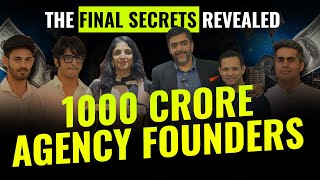
Avi Arya hosts agency founders who've built businesses worth 1000 crore, discussing how to scale, keep clients, and build personal brands. They share real entrepreneurship stories and the specific challenges that come with growing an agency.
Is it okay if the founder doesn't understand every aspect of every business?
Betting the success of his business by his understanding of certain business areas. That's not a very scalable business. What happened one day was JWT Diageo consolidated their entire business with JWT and that led to a 3 lakh rupee loss. I already spent off all my savings from the States. I had about six months of Runway because it just couldn't get far.
That's the fun part. Because there's a creative side, there's the technology side, there's a weaving in with influencers, there's a media side. I don't think there's a more exciting time in this business.
There was a RFP that we were going up. It was for the Ministry of Tourism. We were really rallying for that tender. We also figured out our economics. We really thought we'll be the lowest bidder. Kaam Bhuat Bharya Everybody loved our. And then. And that created a network for me for business like nothing else. You also have agencies that are actually business consultants. Right. Challenge agency is that model that you're in. You either get paid for the strategy or you get paid for the execution as consultancies. You'll see you. You get paid for the consultancy.
Right?
Right. And therefore consultancies are very smart in that sense. You know, they get paid for the consultancy and they have five companies who can help get the get the work executed or they acquire companies that can get things executed. This. Right. But in agencies we go and pitch ourselves as consultants. Right. But I think all said and done, you know when Harsh was speaking about making money like we are in this business and we should. We should make money. Absolutely. We are in this business and we should make money and we should get our work. I mean as talent we should go to where we are worth the most.
Appreciated, most appreciated part.
Does that mean.
Sorry, does that mean that you should be niche specific?
Being niche definitely helps you get a 23.5% higher premium.
Okay.
Okay. No two ways around it. So therefore you'll also see agencies pivoting to super specialize in certain, you know, healthcare area, for retail area. Specialize in this because that allows them to pitch themselves niche and get gives.
You that also the learning curve from the founder to all the way to the team.
Right. Like for example you have four, five years, ten years of learning. There is a way to put that into machine and create, you know, a decent output from the learning side. So human capital, intensive training and all of that was like you Know what took away maximum amount of the time and energy in running a business like this. But being able to leverage technology now in the right way and solve that problem. Yeah. So it will help solve that problem. Back engineer is understand the business and pitch yourself as per what the business requires and not that you are offering a 10,000 rupees. Right, that's right. Right, right.
So. So yeah, that's what. So can everybody understand any kind of business. Maybe the founder, scan, maybe somebody in the meantime. But like you said, there are strategies separated and for a reason everybody can't understand everything. Right. For me, I found myself now being able to becoming a customer of multiple businesses. I understand multiple businesses and from a consumer point of view and running an agency but I'm most comfortable with hotels, restaurants, bars, the whole hospitality gamut. So is it okay if the founder doesn't understand every aspect of every business and he can still have multiple listing or he should.
Absolutely. Meaning if the founder is betting the success of his business by his understanding of certain business areas, that's not a very scalable business because then you're required.
For all of this stuff.
So when clients keep asking for me in the room, I'm like okay, that's a red flag for them because you're coming here to buy my agency, you know, to be part of the agency and absolutely not my time. My time is I'm a specialist of running the industry, not your business. My people are good at running your business and I of course have niches in which I do a fabulous job out there. So we do pick up certain areas of industry and then try to develop capabilities around it. But you don't limit yourself to any part of it. And from your earlier question, I think we don't price ourselves basis what that guy's business is driving like. So if his business is driving way more, are we getting a chunk of that? That doesn't happen at scale because your price at what you know, you've got multiple customers so they know what you're pricing at. But the lens that we use is that either go to larger businesses because where there's more money, there's more money to pay or go to businesses which are way more dependent on digital marketing or advertising which is fmcg those kind of businesses or auto which are very dependent on those and they have a large portion of their spends on those. So extraction out there is going to be significantly more when you're the but having it's absolutely important. You know, early in the industry everyone just became a master of their craft. When you want to scale beyond a particular part, you have to become a master of your clients business. So you pick up those areas and.
You get broad based on it.
But you can't limit yourself with what you're with the founder, understand? Because how many people, how many brands will you give yourself?
That's a good point. Especially for me. That's a good point. So tell us any one story of you know like you don't need to mention the client sometimes you rally up the team, anything.
So in the first few years I was a serial entrepreneur. So I, I think non d the first few years I was a serial entrepreneur, you know it had grown where the great idea is suddenly great success. Start off one thing right when I started our energy management business and I started a 3D printing business. Five years in I had three businesses absolutely making no money, losing money. But I would tell people I am a entrepreneur. 30 years old. Yeah, about six and a half years.
That's the way people do. I come from that era, I'm the businessman.
No, it had turned to entrepreneur by then, okay. And I left a hundred thousand dollar job in the US which I had at 25 because I got so confident in LA.
Oh nice. You don't know what you do with.
56 I don't think. And anyways five years in we're running this business doing about 10, 3 lakhs of revenue every month. We had one last client used to contribute to earn 20% of our revenue. It's called Blackdog from the Diageo. And what happened one day was just like how network agencies go. JWT Diageo consolidated their entire business with JW Navajo. And while the clients were super happy with us, we found out and that led to a 3 lakh rupee loss. So I was breaking even and I would have started losing 3 lakhs a month. I didn't have any. I already spent off all my savings from the states and I had about six months of Runway before the business would, you know, get fucked.
We could take that off.
So I went down, I was really upset. I went, I called up my wife, she didn't know about this. So she came down. She's my co founder and I just needed a shoulder to cry on and instead she's like what the fuck is wrong with you? You're running three businesses, getting nowhere in life while people are out there building massive businesses, selling their companies, doing whatever that's out there. You really need to focus and wake up. So instead of you know, getting my Shoulder to cry on. I got a wake up call two weeks later. I'll cut down the other two business. I'm going to learn everything that there.
Is to know about this industry.
That was the wake up call for me.
I love that story. I had a similar story. My first ever client called 60,000amonth, 2009. Wow. And I called up a friend of mine who was a HR consultant. Now she's an hr. But I said, you know what? I built this thing on my own and nobody did it. Guess what they said 60,000 per month thing in my life. Humiliated by. Listen, nobody knows who you are and you haven't seen the results. If a brand like that is coming.
So then you need people to, you.
Know, show you the.
Yeah, yeah.
And so that was my first client. Second client, the same one for Sheraton. We got 60,000, 60amonth. And I realized that 60, 70amonth. And I need four rupees to be able to think in what I'm going to do. So the only mail would be 40, 50,000 per go for a chain. Then the third month, the first client was par. And he got par. Oh wow.
And in 2009.
2009, yeah.
That was too much money.
So I got everything we documented. January happened. It was a one year contact every time the review would happen. So it was used to be, you know like a lot more experience, you know, more lactose, malaria. You.
You know, like.
Okay, so gentleman. Good. Very good. So I said give me a rating system which we still have for a nine star rating.
Perfect.
Basically average room rate or any four rooms or if a banquet came in and you know, the ROI was completed, correct stories. Just hearing one story allowed you to, you know, either win a line or lose a client. Something, you know, from then you rally up your troops and say.
There was a RFP that we were going after. Interestingly, it was for the Ministry of Tourism.
Right.
Okay.
And we should have collaborated.
And we were really rallying for that tender. We did also, you know, figure out our economics and we really thought we'll be the lowest bidder. Everybody in the room loved our work, you know, so on and so forth. And then, and I think it was one month. It was something that would have taken us to the next orbit of our business. Right. 250 crore car.
Oh really?
Yeah, yeah, it was 250 crore top line, you know. Yeah. RFP. One year. 250 crore qualifications. So we were really there. So. So I am a business coach. I went to him and I think I was, I. I said, I just feel like.
You just don't know what.
To do after that. So. But then he gave me a. He said, so what? So I said, so what? I'm very heartbroken and sad about this. So he said, you know why you're sad? And I get it for a long time. What he said. Yeah, he said, you know why you're sad? He said, why? He said, because you've lost it in your mind. You think you've lost it and therefore you're sad. Stop thinking that you've lost it. You lost it.
They sent me an email.
I have a document.
But, you know, after that I went on to become a volunteer of the advisory board on the Ministry of Tourism.
Lovely.
Okay. Because they loved what we did. They invited us to be on the work and that created a network for me, for business like nothing else interesting. Right. And then we won the Marasha Tourism tender and stuff like that. Right.
So that's when we lost.
Yeah, just the context change. You think you've lost it. Fell for your sad. Now see what you can get out of this.
Ah, lovely. I like that.
Which is, I think quite, quite uninterest. What an amazing feedback and learning that I have.
I'm sure you share this with a lot of your team members.
Of course. Yeah. This is a story. I mean, the effort never see. I think universal law effort never goes waste. Okay. You think you need this for the effort that you put. Yeah, Trust and problems. The same effort. You try something else.
100%. No, no, I get it. I totally get it. And like he said coach, like, you know, in the universe also he called the coach. So we're just sharing stories of successes or whatever, you know, heartbreaks or failures you went through.
I have a win story from now next one from outside.
One more round.
No, but any, any story, like sometimes we rally our troops and we say any story you can also anybody story was of winning.
I enjoyed, you know, this one always. I like to push the teams creatively. So two areas if you can push the limit on the creative or the technology side. So one of the wins that I really enjoyed was something we pitched proactively and even produced proactively at our cost for Mumbai Police. So we had put on Dussera. We had put a Ravan, you know, we had made this film. One of the creatives had put a nice film that you have. Ravan has 10 heads. And most people don't wear a helmet. So helmet incidents are, you know, people. People losing their lives due to not Wearing a helmet is very, very high. So how do you instil that message to people across the country with partnering with a platform like Mumbai Police, which is very, very active on social media. How do you work with them on that? So we wrote a nice film where you have a Ravan getting ready and he is going on the road on his bike without a helmet and he sees a guy who's not worn a helmet and the guy is, Ravan is looking at the guy saying guy like. So there's this little, you know, tension between them and he's like. And it just ends with wear a helmet. So it's like, you know, just creatively edgy work really gives me a satisfaction. And whenever we get that opportunity to do work with clients, etc. So that kind of work is fun. Then now we are, I think as a setup we have now got most of the things Last eight years we have worked hard. Now we are heading for our next phase of growth to Almost some roughly 1200 people in our team is there and we have now good engine with respect to attrition levels under control, growth levels under predictable, you know, collection cycles strong. So next phase we'll have to really push the limit on, you know, making sure that globally we are seen and recognized as a strong player creatively and tech wise. So that's what we are focusing on.
I like that. See I'm a huge Biscuit fan. I told you about the Superfood, my dad's listing.
Yeah. Biscuit of the future.
Biscuit of the future. I was very intrigued. Biscuit of the future. Future of America.
It looks like a spaceship. The Jim Jam Pops. It's a new Jim Jam. So it looks like a Biscuit. So that's the first thing looks like a spaceship. Looks like the Apple headquarters. That was the first thing that was coming across to people and that was then built. And you know what's interesting about the business now also is that we are seeing a stage in the business where you can do like hyper creative stuff and you can do really good, strong tech enabled stuff. So one of the customers we work for, they are, they sell large cloud based enterprise. So for that kind of a business hyper personalization is really important. So you know this whole narrative around first party data hyper personalization. So technology platform that we have been able to string together using multiple tools for them is each sale is like a, almost a 3 billion, a $3 million sale, each sale. So therefore 3 million, 3 million. So you basically have to be able to really hyper personalize to that customer. So let's say, and this is a customer which sells infrastructure on cloud. So there the tech platform which is put together, enables you to hyper personalize at very, very deep level. So let's say you're coming from a company like Boeing. Then when you land on the website it says, you know, it only puts the white papers from aviation because you got a clear bit integration which talks about which IP you're coming from, which is mapped to which company you're coming from. If you don't have company, then you have region and if you have first party data, then it's further sharpened to your company, your role. So you know, that's the fun part because there's a creative side, there's a technology side, there's a weaving in with influencers, there's a media side. I don't think there's a more exciting time in this business.
I love it. I love what you said. So does having a $3 million product allow you to have. Because you can play. You can cost the acquisition to be $5,000.
Correct, that. Way more. Yeah, yeah, yeah.
I'm assuming it's a B2B client. It's not a $3 million product. $3 million sale.
Yeah.
Enterprise sale.
Way more. Yeah.
Just think of it like a highend. Flat selling. Flat selling. 2 to 5%.
Yeah. You're then your chatbot can also be very personalized because you have, you're talking to that person and interesting lot of this data then goes to the sales teams also because the team knows that which company people visited more, which company people engaged more, which company people downloaded what white paper. So the linkage between digital main sales, the ability to build brand, you know, lots of years back they were talking about is the cmos role relevant? So a lot of companies have now, you know, I see in companies CMIO or CMDO or cdmo. So you have now built. The companies are now building that. Yeah, like you basically tie the dots in digital or information along with marketing. So you build brand, you build business link with the sales. That's the fun part.
So in a project like these kind of projects, many of you are doing these kind of projects. Does that allow for longer client retention because it's easier?
Yeah, 100%. Because you see anything with technology, if you integrate inside the business, firstly to change technology systems is very difficult for companies. Now that's a bigger responsibility on the service provider more than anything else. Because if you have to integrate inside, you have to take every step very carefully. So gone are the days everybody Has a first party data pool. Everybody has a cdm, cdp, all of that. Everybody has. So now if you want to change and you want to come in A that's difficult. B if you come in and you have to be very, very measured with your steps once you're in. Unless you really mess up, you don't want. They don't want to change you also.
Yeah, makes sense. So just shifting gears a bit, you know. Role of. We start with you Viraj. Role of personal branding in running an agency.
Best personal brand. Viraj, you. You just please show in this video all Viraj's crazy tweets.
You know two, three. I know which ones to show.
No, so I mean I didn't know or I never re entered tweeting or being active on social media in order to build a personal brand that would benefit the agency. I was just waiting for fun always. Because back in the day it's very interesting story. The reason I met my co founder also was actually there's the involvement of Karan here. So Karan, his brother in law who's.
Got back from Africa yet. Yeah.
Rani was interning at.
Yeah.
So he had. It was good life back then. He had come to our college.
Hi guys, this is. I hope you're enjoying watching this video. Just to let you know that there are three ways to get in touch with us. Number one, there's a WhatsApp number over here. Click on the WhatsApp number, somebody from my team will get in touch with you. Second, there is a link in the description where you can fill up a form, tell us about your business challenges and somebody from my team will get back. And third, you can email me and my team directly and tell us about your business challenges. So there are multiple ways of getting in touch with us so that we can help you to be able to overcome your entrepreneurship agency, founder and coaching challenges. Enjoy watching this video continue or bye for now.
So he got Ranveer and he's like hey, we need to sell some courses in the college, can you come in? And Ranbir wanted two first years. Three. Two, three first year students from our batch. He was two years my senior in college so he didn't know anyone. He only knew me because I met him at the freshers party etc. He was hosting. I was one of the participants.
This is how many years ago?
2013, I think. 2013.
Yeah.
And that's how we met and we basically went back to my Facebook profile and he saw me put up a lot of Facebook statuses and I was Talking about like sports and politics and various things. And he's like, what kind of guy talks about stuff like this in the first year of college? So he's like, this guy looks cool. Let me write to him because I need two, three interns who can do this job for free for a certificate. So that's.
Did he start the message with hey bro?
Yeah, yeah, something hey bro. Only I think it was. So that's how we met. And then basically I met Ranveer actually through Karan. We interned together on the first project and that's how I continued my journey. I was like, okay, now Facebook isn't working, Twitter is working, let's start tweeting out stuff. And things just got picked up, honestly. Or, you know, also I have the benefit of being around already famous people. And also that was another part of the journey where I was being seen in multiple places or vlogs or you know, Instagram videos, etc. We were representing so many other people and we had a smaller team. So in many places I had to go to a lot of these events. So I was effectively that guy you see in like a lot of like upcoming or famous people's photos and you just don't know who the hell this guy is. So because of that function, yeah.
Actually digit, I've actually dug into the profile.
So it was just that when people got curious and you know, we came out because for the first two, three years I never branded the company. We didn't have a website because I was always too shy about the fact. So I, I never marketed us, it was just through the network what we built. And then I was always of the thought that once we do something we will start doing a marketing, pr etc, etc. So I feel like personal branding now is like super important. Like through his tweets, if he's able to sell like so many Tesla cars, honestly without going to any mainstream media to do any kind of pressure. There is some impact in having a personal brand, but it's also very thin line between, you know, one of his tweets also, you know, gets his stock down for his company significantly. So the question also is that where do you draw the line in personal branding? How much of your opinion impacts the company beyond a point if you're a bigger organization, there's just so many people that get impacted. There's so many people you have to be answerable to also. So it does help from a lens that it can help you get more business, more, you know, opens more doors for you team.
Also it helps Anita.
Yeah, it helps. Yeah, that's one of the key factors that helps with hiring a fair bit. You know we were really looking for some solid sales folks to get on our team and when I put up a LinkedIn post email queries but a lot of people that I knew from my personal network that I worked with were probably in other organizations or doing something else. They reached out that hey you know what, we'd love to try this out. So the more people you can also reach out to I feel like the less dependent you become on other sources like you know, you probably don't need to hire more PR companies or HR companies or you know etc etc you get. You build funnels for yourself for all kinds of things through the personal brand. So that's where it nice.
What about you ABHI Hamlok, Sabi Arya, Kei. We all care okay? Net net. So we all care.
There's the budding I see budding honestly he's everywhere.
Yeah, I can see that.
He does a great job of branding himself.
Absolutely. Without driving himself.
Thank you.
My upbringing okay. I come from a Tam Gram family. You're supposed to undersell everything in life. Okay. So all I started a marketing company but I until today have only believed that case study.
Soumya bought a cheap presentation independent digital agencies so she had given a very good talk. That's why I recommended that we should have Soumya on.
Yes. I mean I realized that it is so important you know it is just.
So important like he said like he said over the top.
I mean that's what I'm saying you can't be the marketing professor and not market yourself like that. I learned it the hard way like you know we. We operate in six countries it truly like you know I mean when I started the business also I was like you know multi country independent agency sort of was my vision but we just don't speak about it and. And that I think I've started to change now that is starting to change. That's why I said okay it was invitation I. I have a very high propensity to say no no but thank.
You I really appreciate it. See flew down like five minutes.
I think I mentioned you on the.
Flew from Pune to here no no, I flew Saudi. Okay. I was like okay that's privilege.
No but Pune flight is charging by the way.
I know, I know it's much more.
Efficient to take the flight to take the flight. Very efficient and of course water not bad but you still save about an hour it's especially on meetings closer than.
10 years. But that's also two hours. Right. For the most part. So we're talking about branding, you know, for agency founders.
I have a slightly different perspective on.
Not a different perspective.
I think I'm a very shy, reclusive person.
You don't see me seriously.
Yeah.
You won't see me in a lot of these kind of scenarios. Very often if you see my personal.
Brand, it's absolutely shit.
And for a period of time I did think it was almost essential to have a personal brand to build a business.
You thought or you didn't?
I did, I did think it is. And I think it's a great help. I think it's, you know, these guys do it fabulously and I think it's a great help to make it there. But just for the, you know, the people listening who might not be as open to doing it. I think there are enough and more examples of people who don't have great personal brands who also build fashion. There's Larry Elise, there's Sergey Brin and Larry Page, which we don't even see in the out there. So for a while I used to live with that pressure that oh God, I have to do this and then I just let it go. That boss, it's okay. It's not speaking to me as an individual, it's not who my personality is. So if you can do that and it's a good part of you and you enjoy doing it, I would absolutely, you know, suggest that you should do it. But also for the people that might not enjoy it as much. Don't think that that's the only way to get.
But brand the company. You may choose not to brand yourself in the process.
Yeah. And I always felt that people should know Kinect. It's not important to know Rohan or not because there could be other people running it and I'm happy that the organization has a better name. But more or less it's also my insecurities, which I don't. I'm not very happy being on social media.
So.
See, Rohan takes few good mug shots. He's a good looking guy so, you know, it works well for him.
Apnea marketing. We should see your fitness. That's a good one.
So yeah, for me what happened was this. I actually once I went on the Ranveer show, it was like I didn't know expect that, you know, random podcast with a dude who's just growing fast.
When was this?
It was 2020 January. We shot it, he released it in March. And then I had my co founder at Level Supermind Ayush Anand. He wrote to me because he saw me on the podcast. So from a talent perspective, you know, and I never had people from IIT write to me ever. So it was a like a big thing because my Instagram was also locked Instagram when I went on Ranveer's show. So actually when he released the podcast, I had kept my Instagram locked. I was not putting it out there. Then I got a lot of follow requests. I had to reject all. Then, you know, this guy wrote to me and then I opened it up subsequently after a few weeks, because I was like, okay, so many are coming because of the sheer magnitude of what's happening on that show. Then Aayush wrote to me, and because I never had somebody write to me from iit, I was like, chell, you know, you come straight. So I called him to Bombay. He was in Jamnagar at the time, studying in IIT Madras.
He's the one who I met in your.
Yeah, yeah. So he came down, we spoke, we started working together. He joined as an internal. Most expensive intern I've hired. And then we elevated him fast to co founder because he was super sharp. So I think, yeah, like, that's the advantage, I think, of having something out there and maybe having something out there, you want to actually find avenues. And especially for people like, you know, a lot of I would consider myself was a wasbe introvert. So I would not want to put in the effort to create a lot of content. And for me, the turning point was being on the Ranveer show because you don't want to put in that much, like crazy, like, let me build and let me put a lot of stuff out there. But the moment that show went out. So you may want to find yourself a platform which is visible, where you work hard enough that your company is giving you the ticket to walk into a platform like that and then you get visible and then the rest can.
What if it's a new agency founder? He just sits with few people, maybe a prospective client or whatever records an interview. And instead of getting access to a big show, which is difficult for most people, he just puts a lack of rupees and does Facebook ads and, you know, targets his own.
That could also. I think Ankur Variku built his brand that way. You know, you were seeing through 2020, Ankur Variku's videos on YouTube ads after that, such that he built a YouTube ad saying, hey, I'm that guy again. You know, so, like, I mean, but he's also Highly. You know, I respect him a lot in terms of how he's built the brand. And with any personal brand or any brand per se, it's about what you can contribute to the user rather than contribute and build about yourself. So that's something that I usually struggle with, which is, how do you build a personal brand just by contributing to people and not making it about yourself. So that's what.
But I like. Did you talk about your bike, the fact that you bike in Bombay? No, but for me, that was. Can I talk about it right now?
Yeah, if you like.
I just thought that was so fascinating. I didn't think, you know, I don't know, being from Delhi, you just think, when I went to his office, it's.
Been five years now, every day of riding a bike as a commuting and then bike.
You forte your bike with you.
Yeah.
That is not marketing yourself, but still.
Marketing yourself in a way that you resonate. I guess it's also like when you say brand, you know, there's element to brand. Right. Brand is about how you speak, how you think, what are the physical manifestations of who you are. So once you define very clearly who you are, then you can put out very clearly what you want to say. And yeah, like, I mean, I've just been doing this more content creation for the last nine to 10 months. Before that, I was not doing it because I wasn't very clear about who I was in the first place. So I took a lot of time to find out who I am, be comfortable with who I am, and then now I'm comfortable with putting stuff out there.
I think that's a very fair point because I think having your authentic self to actually go out and really be able to see is the most challenging part. Like many, my Instagram is still locked.
Okay.
And I think to myself, you know, my fundamental question starts with why is this important for somebody else to know about this thing that I'm doing? Right. And to that you're finding your core in a way that adds value to people.
Right.
Why are you doing.
To a certain subset of people who will find it way more valuable than others, maybe to a certain subset of people who may find it way more valuable than sometimes we perceive. Like, for when you talk about an agency world or whatever, or to a prospective client who you're working with, and you have two prospective clients, and instead of that, your message goes on to others who may or may not work with you, but they've got the value. Yeah.
See, also to the point, Rohan made Now personal brand can also be built through reputation and back channels. So like if you look at Phil Knight's story and you never, I mean till we hit Red Shoe Dog, nobody knows the depth of his story. And what a brilliant story. The guy was so well networked with all the coaches. You know, the guy Sonny Vokaro who's on air the film through him he was connected to every NBA player. So every NBA player probably knew who Phil Knight is, but the whole world didn't. So you can also, I mean I think it's a good balance to build a personal brand to be visible but also have a lot of power in the back channels especially, you know, like in the kind of businesses that we run.
It's 80 vanity and 20% business.
Yeah, like Harsha's answer was too deep about this that he, he had to understand who he was. For example. The thing is, I was effectively thrown into this, right, because my co founder was blogging every like quite regularly. He needed someone to be, you know, his friend on camera also. So I was just like, you know what, I'm just going to be myself like in my real self. I am always roasting Ranveer so that I'm not going to change that for a camera and for his YouTube channel when he probably has to look the hero, for example. So I was just like, I'm just going to be myself and do what I'm doing. That's what, you know, that's how it happened. So I think people love that kind of relationship we had about the fact that, you know, he's talking about stuff and I'm talking about something else. So besides that on Twitter also, like, I mean I have, I'm quite opposite to him in many ways where he's more about, he's more like, you know, for the lack of a better analogy, he's more like, I don't know if you guys watch football, but Zlata and Ibrahimovich, he wants to make noise first and then do things. I don't like doing that I will be like, you first build onto things and then if the noise has to come, it will come. So that's the approach. So that's what I have also always implemented feel like, besides that, just be yourself. Like for me on Twitter, for example, it was a lot more about my observations. I think 80% of stuff was about what I find amusing or what I find funny in life and 20% was about the industry that I'm in. So I would barely speak about, you know, content and influencers, etcetera etc. This 20% would get me the right audience. People, like the right people would follow me on Twitter. But 80% was then massive. It was just people that thought, you know, my content was funny or amusing or interesting. So I don't have advice for people on how to go about finding your voice because it's super authentic to each person. But I think beyond the point, it's also frequency of what you put out. I just tweeted relentlessly and found my voice that way.
So no strategy, no content is thing for your own channel. Like, this is what I'm gonna do Monday afternoon.
No, I don't schedule my tweets, I don't post. Put it at optimized timings, 15, budget, etc.
Etc.
Okay, if I have a thought, I will immediately put it out on the Internet and then try not to just keep evaluating what, like what did well, what didn't do well. Because you're not. It's not like managing the social media account of a brand because then you. You lose the fun out of it. You lose the authenticity out of it. Then you're just tweeting about things that you feel people need to hear from you.
So can I just sum it up by, you know, just. Yeah, so you're saying so on the organic side, do what you feel authentic. And if you really want a message to go out there, maybe just use ads to promote that particular.
Yeah, I mean, I've never used that, so I don't know how that works. But I have seen people who've used it and be super effective for them.
I would say if you're using ad. My personal views, you're using ads. Ad. Use it for your company.
I agree. Which is I feel like for personal branding, ads to me seem a little scammy. But if you are like promoting your business maybe at least through that, then that could help. But I still feel like if it's going through the company account, that makes a lot more sense. Because then you're trying to target a certain business, right?
No, but what I'm trying to. And anybody will answer. They say, for example, you have your own company around you, your personal accounting. You say, reach out to pharmaceutical companies. And so you have advice for pharmaceutical companies in the form of a reel every week going out. That's it. You're not asking for anything in return. And then when your company advertises for, you know, if it does, or any agency advertises, then they already know that this is coming from a valuable source which talks about pharmaceutical and now they're advertising to say come and work with us. Does that work?
It works. I my view on this is that see B2B is slightly different I think because what happens is even if I say in 30 seconds in a reel, I will not be able to capture the depth what the pharma industry needs. And when companies hire other companies, they are hiring for depth. So I don't know if you can win a big B2B mandate that way. Say.
Customer base, personal branding.
Interviews.
Social media is all about Instagram and Facebook.
It's directly consumer but as a agency founder.
Social media.
So reels may be both coming.
Frequency.
Come.
Then I'm directly podcast.
Perfect. So I think we just have almost done so thank you everyone. Hey guys, I hope you enjoyed this video. Now here are the next steps. If you want to book a call with my consulting team to be able to understand how we can help your business as a coach or an agency founder, you're stuck. You're not getting sales. There's a link in the description. Click on the link and book a call with my team. In that 30 minute call they'll understand what you need and accordingly give you the right resources and the right roadmap forward. Second, if you think that you're looking for the Avaria personal mentorship which I do very few of, but I do keep my thoughts open. Then again, click on the link in the description and speak to my team. They will understand your business and accordingly, if you and I are the right fit, then connect you and I on a 30 minute call and I look forward to talking to you. Thank you very much for watching all my videos. There going to be lots and lots of new videos coming up. Keep watching. Fill up the link in the description and I look forward to talking to you and having my team help you with your journey of entrepreneurship. Thanks a lot. This is Avi Arya signing off for now.
More from Avi

The strongest mindset doesn't begin with meditation. It begins at home. Before you conquer the wor

The strongest mindset doesn't begin with meditation. It begins at home. Before you conquer the wor

Your mindset isn't something you fix once. It's something you train every single day. Just like yo

Don't build a company just because your friends are. Build one because you're ready. A startup is

Everyone dreams of becoming the boss. Very few understand what that really means. The moment you b

Most entrepreneurs say, "I don't have time for coaching." The truth? You don't make time for what

Over hiring doesn't always solve problems. Sometimes, it creates them. Having a small buffer in you

"The highest-paid" isn't the goal. The highest-value is. People often ask why premium mentorship co

The founder will always be a bottleneck... at some stage. The goal isn't to pretend you're never th

People ask me how I stay consistent with my morning routine while traveling across countries and tim

People ask me how I stay consistent with my morning routine while traveling across countries and tim