The Real Shark of India - Ft Dr. Ritesh Malik | Founder of Innov8 | Avi Arya
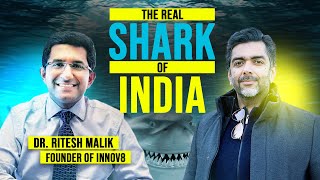
This is a YouTube video titled "The Real Shark of India - Ft Dr. Ritesh Malik | Founder of Innov8 | Avi Arya" featuring an in-depth interview conducted on February 25, 2023. The content is a detailed conversation between Dr. Ritesh Malik, an entrepreneur and founder of Innov8, and an interviewer discussing Malik's entrepreneurial journey, philosophy on family, innovation, AI, growth, and motivation. The discussion covers personal stories, business insights, and reflections on entrepreneurship and technology. Although the video involves multiple speakers, Avi Arya is not one of them.
There's no one on the planet who can love you more than your parents, right? While my parents never understood why I wanted not to be a doctor. But their intent was very pure. After health, the most important aspect of happiness is family. So my. My take on all the futuristic technologies today is. I'm very bullish on change. I believe the most important thing is darling Darwinism, which is Charles Darwin's theory of natural selection. It is not the fastest who will survive. It is not the largest who will survive. It is the one who changes according to the changing environment on a daily basis. Who will survive. Today, the Ajanta Hotel budget brand that you built. The only reason that you worked was the fact that you pivoted. You changed from distribution of offline distribution to online distribution. Hello Abi. How are you?
I'm well, thank you. Thank you for your patience. On 29 October, I turned 46, Ritesh. But the story that I want to tell you is. 18 years old. Born and brought up in New Delhi, India. All I wanted to do in life was to race street cars. My 18 year old head told me that I'm destined to be a street car racer. I thought I'm going to study that. My second passion was to meet people. And for some reason I had seen some videos and I thought I need to go to the Oxford University and get an Oxford blue blazer. So these were my two dreams as an 18 year old. But both my dreams came crashing down one day when my dad brought me to his office. I remember walking down to his office. New Delhi railway station. I went in, I walked in. I remember the event. He said, family separation. Cannot go abroad to study. I know all your friends are going. I don't have any money. As the eldest son in the house, you have to join me from tomorrow morning. Within 10 minutes he broke all my dreams. And I should have been empathetic towards his life story.
But.
But I became angry and I said, so all that thing happened. My mom spoke to me. Better sense prevailed. And the very next morning I found myself behind the reception of my dad's small 27 room guest house. An angry person wanted to get out of a situation. One day there was a foreign guest who walked in. And he paid us in Dutch gilders. And I converted the Dutch gilders. It turned out to be double the Indian rupees. And I thought to myself, I can I get all 27 rooms filled up with international tourists. But how do you do that in the early 2000s? Sheraton Hotel or British School Library Computers looking for cyber cafe partners Because I was one of the first people to contact him Char computer Now I had 24 hour access to the slowest Internet on the planet American companies were outsourcing to bangalore hotel.com India First Budget Hotel website Some people said start writing blogs blogs shooting in the dark. No YouTube videos, no mentors. Yeah but eventually things started happening. We started getting queries to. I started responding to the queries the 15th of December on the first date when I took a taxi when picked up the people from the airport got a team of four people and they came in stayed in one of my rooms and they paid me for $400 for nine days my first Internet income. This Internet thing works. I doubled down on this started filling up the 27 rooms area hot. So that was then 27 rooms long story today that is a 71 room boutique hotel in near the railway station. And then I with all this money I. I bought properties in Goa and I built a resort in Goa called the Tamarind. Both my resorts are boutique hotels done well 180 business coming from modern since early 2000s so that was story number one. Story number two was I got excited. I built multiple websites. I had a website called Cheap Tickets India we want to start an affiliate model with you. I didn't know what an affiliate model was. I was doing about 50 tickets a day which was about 30,000 rupees in net profit from my second business. I'm still in my twenties and this is the second business which is giving me 30 to 40,000 rupees a day. Lovely. Then came TripAdvisor, Google and Expedia came to India. They already had tied up with the large chains through America India head of Expedia was just there. They came to me and they said we heard that you understand this thing called Internet marketing. Why don't you become a brand evangelist for us? I started speaking at events and that's when people started coming to me and saying can you do digital marketing for us? I said agency. I had no idea how to open it. Finally with lots of confidence with a four member team started an agency called Intern mobiles. Went from 4 to 225 people in the next 13 years working with 700 hospitality brands today that's what we do. We only work with hotels. We're a digital company within this whole process. Ritesh I got married. My wife is an immigration lawyer. She wanted to go to Canada. We set up a house in Canada. We set up an office in Canada. My two daughters were born over There and then my thing started being shuttling between the family over there and the family and work over here. In between, we started creating videos and started reaching out to people. So me and my daughters made a project. We made a list of 200 entrepreneurs, billionaires, millionaires, Gary Vee, grant card, all of those people we wanted to meet. We created personalized videos which we were saying nobody will be able to miss and they will all watch. Only 70 people watch. 60, 75 people watched the video. 62 people said yes. We interviewed them, podcast, we created a book together. The girls sold about 8,000 books of that, of those work experience, the girls today have been applied for their college and they got into some of the best colleges in Canada just because they have their entrepreneurial experience. I keep shuttling between here and there. And in between this whole thing, there was also a short story which was that I was, you know, one because I was, I'm the one of the only companies in India, especially at that time if you're doing only hotels. One day there was a boy who came into my company and said, I want to meet you. So I, I didn't know we did not have an appointment. So unfortunately I had to make him wait and when everything finish. So total stranger, I didn't know him. We went home, we had a coffee. He told me that he wants to take care of one of my guest houses. So I said, you know, I don't know you, I can't trust you. He said, I like the person. He, we got along. I gave him one of the properties that I had, not the Delhi and Goa one, but I had another one. He started running that property and that was his second or third property. And we became very good friends and he started taking care of stuff and obviously he became, you know him very well, so lots of, you know. So I just said in the context of who I am and where I'm coming from. So thank you. This is great.
Thank you. Of course.
Awesome. I want to talk to you about many other things. Number one question, thank you very much for accepting to be over here. Many people want to know many things from you. What we and PR community want to know from Ritesh Malik is what is the role entrepreneurs, anxiety, stress. What is the role of a family? Because I see a lot of entrepreneurs leaving their small town, big towns trying to figure it out. What is your thing on when you becoming an entrepreneur? How important is to keep your family by your side?
I think, personally speaking, I think family is one of the most important aspects of one's life. And, and, and the dichotomy is that they might not understand you always. But one thing which is always certain, especially for your parents and for your spouse, is that there's no one on the planet who can love you more than your parents.
Right?
While my parents never understood why I wanted not to be a doctor, but their intent was very pure. They knew, they never wanted me to face challenges of a very wild route of career. So I think personally speaking, I think the kind of comfort and solace which you get out of your family, I don't think you will be able to get out of anyone. Because everyone else has agendas. Your family does. And, and family does not mean only people who are, are your blood relatives. It also means a part of your family which is value based. Which is based. For example, you have a lot of entrepreneurial friends, you have a lot of non entrepreneurial friends who become a part of your large extended family. Even in your blood relatives you have a lot of people whom you don't like and that's absolutely fine. I think typically the word family is very wrongly used. I think family is people with who you can actually share things and speak without thinking where the trust level is so high that you know that whatever you share for entrepreneurs, entrepreneurs are very insecure always because they're always scared. What if my insecurity is, is found by my investors? What if my insecurity is being found by my employees? What happens tomorrow? And, and, and if a founder is saying that he's not insecure or she's not insecure, they're actually bluffing. Every founder is actually going through their own, own mental challenges and being a founder is a very lonely job. You have, you have, you, you are answerable for everything. So I think typically speaking my, my, my, my personal take on family is that family is I think the most important part. And if you see happiness after health, the most important aspect of happiness is family.
Lovely. Lovely. So Ritesh, you know, obviously this whole, the whole world is talking about Shark Tank. So what is the one thing that you love about. I'm not talking about any particular individual, but what do you love about what's how the world is today? Indian audiences, which are mostly uneducated about the concept of business and their first introduction is this show called Shark Tank. So what is the one thing that you love about Shark Tank and what's the one thing that you feel they could have done better?
I think I love Shark Tank for the fact that they have actually democratized entrepreneurship in the Indian context. I was talking to a tier 3 founder the other day and I love the fact that she said that. So the idea of, of adding these kind of MSME may agar startup thought process, that is something which is phenomenal. Apart from that growth mindset for now, every businessman is actually thinking of revenue is actually but growth mindset. So I think it's a beautiful show to actually make people learn about finer growth skills and entrepreneurial skills. And I, I think every endeavor can improve things. Things. I think Shark Tank 2 is better than Shark Tank 1. I think there are a lot of things that can be improved upon. But I, I think I'm very optimistic on the show and I love the fact that housewives, I love the fact that at people who have absolutely no relation with entrepreneurship are watching it.
Right? Awesome. Ritesh, if you were a Bollywood star, who would you be and why?
It's a very tricky question, but I would always be Shah Rukh Khan. I, I don't know. I, I'm extremely from.
I'm not going to tell my editor to put Pathanka music in this section.
Because I'm a big, big Sarukh Khan fan. From the beginning, Bollywood plays a very important role. And as a child also for me I could always imagine myself he's a cult. So I think And Jabibi, whenever you think about romance, whenever you think about larger than life, whenever you think about that boy who's extremely docile and knows how to charm people, I think Shahrukh Khan comes and that's why I think Shah Rukh Khan is that witty person who knows us how to talk to people. He's respectful.
Right. Lovely. So you know, what is your Ritesh Malik's take on AI and all of that? Do we need this level of acceleration in this world? I mean there are so many things to already solve. Do you think that we could continue solving those things and making them better? Instead of saying resources, do we really need to go to Mars? Do we really need all of these things? What is your take on all this madness that's happening?
So typically speaking, abhi, I have realized one thing. It's not what we need. If it was what we needed, our air pollution would not have hit 500 to 800 in Delhi. It's not what we need. It is typically how humanity is unraveling simpler elements of the world. How as humanity we are trying to solve problems. And I think an idea whose time has come, I think that is very powerful. I don't think typically we need a lot of things that we are creating, but out of these, we will create it. Something which will become ubiquitous, which will solve problems which humans are facing. So my, my take on all the futuristic technologies today is I'm very bullish on change. I believe the most important thing is Darwinism, which is Charles Darwin's theory of natural selection, which is that the faster will, it is not the fastest who will survive. It is not the largest who will survive. It is the one who changes according to the changing environment on a daily basis who will survive. Out of 199.9% species have been wiped off from the history of animal kingdom so far. So I think life as such is very dynamic. All these technologies eventually if you see typically after a five to seven year disruptive cycle, we will see a lot of technologies which are going to finally work, are going to truly create impact. And I'll tell you a very simple example. Mission Impossible 1 was shot on a helicopter with a cameraman on the helicopter. Now the last Mission Impossible was completely shot by a drone. Now the whole idea of humanity is to remove redundancies. And in that I truly believe AI can solve so many challenges of humanity. In my opinion, AI can help us recognize challenges which we can't recognize today. I'm very bullish. I've always been in and, and for me, it's not the technology. It doesn't matter Whether it is AI, whether it is 3D printing, it is the application of the technology for solving grand challenges of the world. We run a philanthropic university called Plaksha. One of the key missions there is that our education needs to change. The challenge today is that we are training our students. Not for 2016, not for 2075. We are training them for 2023. We didn't realize that we need to train them when they will be in the workforce. We need to train them for that and for that. That's why I think content, what we consume needs to change. We need to teach them skills of the future. And whether we like it or not, AI is going to engulf every company eventually has to become an AI company. Today. The Ajanta Hotel budget brand that you built is not. It's. It's typically not. You would have seen so many budget hotels closing down. The only reason that you worked was the fact that you pivoted. You changed from distribution of offline distribution to online distribution. So I personally believe every business has only one thing constant and that is change. And for that, adapting to newer things which are coming, I think is the best way to do that.
Got it. Got it. Very beautifully explained. Thank you. Do you like the word for this change? Which word use disruption. You think it's, what is your take on it? Is it negative, evil or you don't think about it?
Honestly, I don't, I don't care about the word disruption. I think disruption is, is a word usually used by people who don't understand and innovation per se. 90% of innovation is incremental. 90% of, of innovation is incremental. If you go into that statement, you love that actually because typically speaking we very, very few of the times we have actually come out with an invention which is disruptive. Almost every invention comes with an incremental value. So in my opinion if we did not have Nokia, we could not have thought about Apple. I think you cannot just create an iPhone. You have to go through those cycles of smaller phone and then launching a palm top and then in thinking about another smartphone and then thinking about out the iPhone. So in my opinion almost everything is non disruptive and, and typically speaking if you see one failure in of one inventive failure leads to another positive invention happening world over. So in my opinion almost everything is incremental and whatever sustains is mostly incremental. If you believe that you will then start thinking about business in other ways. Innovation is not related to technology per se. It is related to continuously help your customers achieve their goals and while doing that, continuously help yourselves by decreasing the cost. If you are able to do that, you will be a good businessman and by adopting the key principles of incremental innovation.
Lovely, lovely. So you know I had read somewhere the youth is wasted on the young and there are many ways that you can decipher that, you know. So I wish I had that Josh now I think that that's what the author meant when he said youth is wasted on the young. But a lot of youngsters today with a lot of Josh YouTube channels or podcasts, this is a new language or and at the other side they like so disruption here I'm trying to understand for myself and I was hoping you could help me here. Is this coming from ego? Because there is an intention based entrepreneur conscious entrepreneurism you know coming out or, or needs to come out. But it's most of them are youngsters. So do these youngsters need to understand that whatever's coming out should come out from a place of wanting to change something for the better not to put a janda to say or set up disruption over disruption over here? What is your take on that?
I think first of all people who so motivation is short lived. You watch a video, you get motivated, you work for 48 hours and that motivation goes down. So anything which increases immediately also decreases immediately. So I, I think the most important thing here is that motivation is very short lived and youth today should not think about. What they should think about is what do I love doing? What is my passion area? What am I? Every human is different. Every human has a different DNA. So the whole idea is, can we create an ecosystem which fosters children and youth to understand what are they passionate about? And unfortunately in India we are not able to do that. Just imagine I'm a prime example. I thought that my passion was medicine because I scored well, right? My true passion was interior design. Just imagine two poles apart. I did my education, I'm a doctor, but finally I realized I'm a phenomenal interior designer. So the thing is that we need to completely focus, completely focus on, on one thing and that is discovery of passion for our youth. The day they discover the passion, then what starts happening is they don't talk. People who say these are those people who don't know, they are clueless and they just want to, they just, they don't know what to do. People on the other hand, were passionate about a problem, about a challenge, about working towards that. Once they find that they don't say these kind of things, then they focus on work. They have, they have bias for action. The word bias for action is so powerful that you don't think, you don't say, you do, you do, you do, you do continuously start building a small product. And the good part in today's day and age is building an MVP is a 48 hour job with the no codes of the world. So I think the youth should not be worried about, they should be worried about can I find something which I'm deeply passionate about and do till I die. So I think then you don't work for a single day.
You know, you have such philosophical plus new age 2023 logical answers to questions. I watched many of your shows and that's why, you know, we requested you to come here and thank you for accepting this. But did this come, Are you very young? How does all this come from, I mean you. I can't come from reading books. I mean, how does, how do you have the right answers for so many questions?
I think with experiences you develop a lot of gray hair. So while we think that a person who's of the age of 70, 75 is of 70, 75 people who are not exposed to a lot of difficult challenges actually never understand what they are capable of. I've been very fortunate that I took bias for action and left medicine and started my own entrepreneurial journey. The good part with entrepreneurial journey is if you start on a daily basis, you are fighting with everything demonetization. So you will have a lot of challenge. And that is why passion works. These are distractions. Once you are passionate about your work, no. You will be able to only sustain yourself if you are passionate. So that is why I think doing entrepreneurship makes you gray haired. It starts making you very, very mature. It starts making you understand and you fail very quickly on a daily basis because you are not used to. And the only thing to the young people at least is at our university, at the universities I go to give talks at is get out of your comfort zone. It's a very loosely used sentence. Everyone tells you get out of your comfort zone. But I think this is one thing which is so powerful and comfort zones are so comfy that no one wants to leave even, even at our age at times what happens is that you don't want to go out of your comfort zone. One and, and you should have matrix, matrix in your mind which decision to follow, which not to follow. And one thing which will always work out is bias for action. And subsequent bias for action that works out is showing up. I truly believe in showing up. Show up. I think there's nothing more powerful than the word showing up. You sleep less, you work hard, you sleep less, you work hard, you create something and show up. Be trustworthy and have the courage to show up on a daily basis. Be consistent. I think showing up is something a lot of people tell me and by just seeing their schedule for a week, I can tell you whether they show up or not. The question is showing up on a daily basis, are you, are you exuding trust? Are you ensuring that people can count on you? By the end of the day, it is the people who will make or break you.
Right, Got it. So you know when you reach 40, 45, 50, mind is full of crazy ideas. You know, you get as motivated as a 20 year old, but the body doesn't work as much. What, what is your message to the 50 year olds who want to start an entrepreneurial journey today or restart one more, one more innings?
It's, it's. I don't know because I'm still 33, so I, I still don't know what energy deficit is. But in my opinion, if you're passionate about something, no, age is just a number. Colonel Sanders is for kfc. Jagdish Khatterji from Maruti Corporation. There are, there are a dozen beautiful examples of late stage entrepreneurship. I truly believe age is truly a number. Truly a number. And I used to feel very insecure and, and I'll tell you after 25.
You don't want to age. Right?
And, and one thing which I've realized is age is truly a number of as long as you are able to take care of your health, age is truly a number. And I truly believe there's a lot of people ask me what is the best time to do entrepreneurship. I always tell this thing the best time to do entrepreneurship was yesterday. The next best time is right now. Don't die. And do you know ideas are everywhere. Everywhere. Like I'd meet my, my very close friends and they have a lot of ideas. Ideas are cheap, ideas are diamond dozen. Execution is magic. I think start somewhere and it's better to fail at something than to regret. So I, I always tell this that the best ideas in the world are lying in the graves because people don't execute. So I think bias for action is something which is actually the fourth core principle of Oyo. So I was just talking to Pritesh Bhai and he said that bias for action has taken him where he is today. I think bias for action is just something that is phenomenal.
You know, because you're in philosophy, you also read spiritual books and you also read business books and I think you. So there's a right person to ask this question. A lot of people say that the aim of life is to understand yourself through whatever karam you do. You know, you interact with people, you try to grow something. You said philosopher, entrepreneur, streetcar racer, co working space. In that process you become and you learn more about yourself. And the idea of life is to get closer to yourself by understanding yourself. And you use, some people use a job, some people use a business and that becomes a tool to understand yourself. Now if that is true then should I be going up after growth year on year 100%.
Number?
Yeah, it doesn't matter My beast percent Is that allowed? Like I want to know from you or is it the just crazy rush for growth? Because growth is everything. If you're not growing, you're dying. What is your take on this?
So a lot of people want to become entrepreneurs but actually that's the wrong way of becoming an entrepreneur. I, I just feel that entrepreneurship university may be interesting and that is we say that we don't want to build an E cell, we don't want to have an entrepreneurship cell, we want to have an innovation cell. Our goal is not to make entrepreneurs. Our goal is to make entrepreneurial mindsets because entrepreneurs, entrepreneurship means only creation of entrepreneurs. Innovation and entrepreneurial mindset means creation of politicians, creation of employees within large companies, creation of entrepreneurs, creation of NGO leaders, creation of world leaders who think different because that is entrepreneurship. So I think typically speaking the world by 2030 we are going to displace anywhere between 600 to 800 million jobs jobs displacement while we will be adding 40 crore new jobs. That is 400 million new jobs. But hame unkere skill loan changing. So entrepreneurship is this quick, quick unlearning and then relearning. So I think typically growth as a word is brilliant but growth should be balanced. We've all seen what has happened in the startup ecosystem. Growth should be balanced, it should be mindful, it should be profitable. At least it should be a win win for all the ecosystem players. That comes from your merchants to your vendors to your employees to your investors, to your or founders to your customers to your consumers, to your environment. Growth which comes, growth which comes at the cost of the environment. Is there, is that the right growth is my question. So I think sustainable large good businesses are built when there is growth which is sustainable across your environment, society, government and consumers. So I, I just feel that at growing without having the right emf it's, it's very easy to grow. I mean if I tell you KR, you take 10 rupees from me, go on my website and give me back 9 rupees you will do it a million times to make a million rupees. I will lose a million rupees on my website. I will have a lot of traffic. I will show my investors that I'm getting a lot of traffic. But the day I tell you that's the wrong way of growth. Growth is a very loosely defined term and very few people understand.
You meet, you know, the top entrepreneurs of India, close door meetings. So across the spectrum, without knowing or naming anybody.
Of course, everyone whoever president of United States. I don't think see fear is a very positive emotion. People think fear is a wrong emotion if someone says that they are either bluffing or they are maniac. I think fear helps you keep in check. Fear helps you recognize what is a risk and what is a gamble.
Fear.
Excitement. But I think, I think fear is a very positive emotion. Fear helps us avoid the Murphy's law. So truly speaking I, I am a big fan of fear because that helps us in check, keeps us humble and agar kisi. Agar agar kisi. Typically. So I think fear is a very, very important and a very interesting emotion to have, which helps you keep your emotions in check.
I have never, ever heard anybody say I'm a big fan of fear. I love it. So thank you very much because I'm a co founder in one of my projects with my two daughters who are 17 and 15. Ideas, entrepreneurship ideas, the family questions, the question, the questions on disruption, the questions on EQ and all of that. So thank you very much for answering all of these questions.
Thank you very much.
More from Avi

The strongest mindset doesn't begin with meditation. It begins at home. Before you conquer the wor

The strongest mindset doesn't begin with meditation. It begins at home. Before you conquer the wor

Your mindset isn't something you fix once. It's something you train every single day. Just like yo

Don't build a company just because your friends are. Build one because you're ready. A startup is

Everyone dreams of becoming the boss. Very few understand what that really means. The moment you b

Most entrepreneurs say, "I don't have time for coaching." The truth? You don't make time for what

Over hiring doesn't always solve problems. Sometimes, it creates them. Having a small buffer in you

"The highest-paid" isn't the goal. The highest-value is. People often ask why premium mentorship co

The founder will always be a bottleneck... at some stage. The goal isn't to pretend you're never th

People ask me how I stay consistent with my morning routine while traveling across countries and tim

People ask me how I stay consistent with my morning routine while traveling across countries and tim