Turn What You Know, Love & Do Into Recurring Revenue || Membership Expert || Stu McLaren 😎 || IMOTW
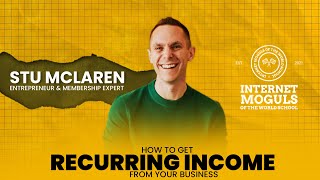
Stu McLaren explains how to build recurring revenue from what you already know and love. He covers membership site strategies, business growth tactics, and the mindset shifts needed to scale.
The reality of building a successful business is that problems and challenges don't disappear just because you have more success. And in fact the problems and challenges, they get bigger. I think micro videos are a great way for people to get a taste of who you are and a great way for people to, you know, get a little a nugget that hopefully creates a spark in them to want to do something differently or move forward. And I think in today's day and age, the micro content is more of what people are consuming versus long form content. But we gotta again take a step back and just think about the purpose of what we're producing. And the purpose of micro content is really to cast the net as wide as possible. I think in two ways. One is first to exercise patience. You know, you know from experience that successful business doesn't just happen.
I'll give you a bit of a background on who we are, how we got started and then we get into the questions with you. So I'm 42 years old. When I was 18, born and brought up in New Delhi, India, all I wanted to do in life was to race streetcars. My dad used to go to sleep, I used to take his car out, race it in the middle of the night and then organize races, make some money out of that. I thought that's going to become a profession. Obviously dad didn't like it. He called me one day, we had a serious conversation. I got two options. Join my business from tomorrow morning. B, get out of the house. After a lot of deliberation, I joined his business and, and that deliberation lasted three hours by the way. Joins his business, a very small hotel in the middle of Delhi. It was a new phenomenon called the Internet. We got onto the Internet first movers by miles. So to cut the long story short, dad took 40 years to build his first hotel. After I joined his business. Next five years we outright bought four more hotels. Everything changed for us. Now we have four hotels full of customers from all over the world. My mom joined me, we started a travel company and everything on the Internet, marketing space happened with us, affiliates, all of that. We were the first to try it. Expedia, Yahoo, all these companies, none of them had come to India by then. That's when a lot of people started coming to us and saying that why don't you start evangelizing for us? So TripAdvisor, all these companies, I started speaking for them on stage. People came and said, why don't you help us do what you did for yourself? Started a four member team called Internet Moguls. And today, after 10 years, we're a team of 250 people working with 700 clients in 10 countries. Once that happened, my wife and I said, let's travel around the world. She wanted to open an office in Vancouver, Canada. We fell in love with the place. That's where these girls were born. So now we have two bases, the girls and their mom. They live in Vancouver. I travel back and forth between the agency here and the home in Vancouver. So that's a little bit about us because I travel so much and we don't get to spend as much time as we want to. So I tell them bedtime stories around entrepreneurship. So we just thought we'd make it a project. We put it into a comic book format, and we launched our first daddy daughter project called Bedtime Stories for Tomorrow's Entrepreneurs. So that was the first project. We went around schools in Canada giving talks. We're $450 profitable on the Internet right now, on Amazon as the first project. And the second project is what we're doing right now. We're traveling and we've been meeting people on Zoom, only the people whose journeys we've been following for a while and inviting them on this and putting together a very nice colored coffee table, kind of a learning book. We're calling it the Internet Moguls of the World. And we define Internet mobiles as somebody who we feel is able to generate business from the Internet, live a freedom lifestyle, and be as close as possible to the family. So that's our project. Thank you very much for being part of this project. It really means a lot to us. And our first question is from my co founder, Raya.
So I follow you post like I, in fact, were just looking at your Instagram today. And I love how happy you stayed to it all and how you really put out that positiveness. So how do you deal with stress? And how do you really train your mind to be happy and relaxed? Because some people, even I, struggle with maintaining my thoughts and believing in myself. So how do you deal with that?
It's a great question. And the reality of building a successful business is that problems and challenges don't disappear just because you have more success. In fact, the problems and challenges, they get bigger and there's more at stake with the more success you experience. So that's often a misconception about business, is that, like, my problems will all go away when my business grows or when I have more success. That's not true. The reality of it is that what we are experiencing now. The problems we are experiencing now are equipping us to be able to handle the future problems that we are going to experience when we have more success. So I think, like for me, when I'm facing challenges, when I have stressful moments in my business, I remind myself of how far I've come, what I have endured, what I have overcome in the past. And that creates the confidence in me that this too shall pass. We will figure this out. We will get through this. The other side of it is that as entrepreneurs, we're idea people, we think of solutions. And so any problem that we are experiencing is really just one idea away from being solved. So instead of wallowing in the energy, the negative energy of oh poor me, this sucks, I'm in this, I'm experiencing this, I like to just shift my energy to what does this make possible and what can we do to be able to solve this problem or challenge now? And what that does is when you start asking your brain the right kinds of questions, it turns your brain on to find solutions versus asking negative questions which only compound the negative feelings that you're experiencing. So for me, I just get excited about ideas, I get excited about finding solutions, I get excited about progress and. And at the end of the day, we're just one idea away from being able to solve a challenge or problem and move on.
Perfect. Perfect.
Okay, so my question to you is, when did you start your entrepreneurial journey? Like which age and which age do you think people should start their entrepreneurial journey?
It's a great question. If I trace it back, it was probably around 12 years old when we got the first insight that I was not going to go down a traditional path. It was a moment when I was around 12 years old and I realized my parents, they were two very hard working parents, but yet we weren't the most financially successful. And so I knew at 12 years old that hard work doesn't equal financial success. Because if it did, my parents would have been two of the wealthiest people I knew. But they weren't. And so there was a moment when my dad was building a deck outside of our house and he asked me, he said, hey Stu, come here and let me show you how to do this, because you're going to need to learn how to do this one day. And I said to him, actually, it's okay, dad, I don't really have any interest in learning that. And if I do need a deck, I'm going to make enough money to be able to pay somebody, to be able to do it for me. And so I think I had that mindset early on. And then I always, I always loved working. I worked in. When I grew up, I lived out in the country, so I had corn on one side of me and cows on the other. So I was working on farms from a very early age. And when I think about what age do I think young entrepreneurs could start working, I say as early as possible. To give you some context, my 8 year old daughter has started her own little business and I'm sorry, proud of her because she is a very good reader. She loves reading books. And so she's got a voiceover job where she's reading kids books. And she started a little business where she gets paid for every kid's book that she reads. And it's awesome because now she's realizing the opportunity that we all have. And so she wanted a new Instax camera. And, and with the camera and the case and the film, it was like $180. And I love, as a parent, being able to say to her, when she asked, can I get that? I love being able to say, yes, of course you can, but you got to earn it. And then for her to realize, like, okay, how many books do I need to read and record in order to be able to earn that? And she did, and it was this great moment. And now she wants like the. An Apple watch. And I'm like, yes, you can get that, but, you know, you got to earn it. So she's like, give me more books. I wanted to. You know, she's so. I love that she's in that mindset now at an early age of like, she can get whatever she wants. She's just got to earn it and create it. And so for me, entrepreneurship starts, you know, the earlier you can start it, the better because I think it's more about mindset than anything else.
That is just brilliant. What's her name, if you don't mind Just asking.
Marla.
Okay, excellent. Yeah, my turn. So, you know, Stu, a lot of people, including myself, you know, you run agencies and you realize how crazy an agency can be.250 people and managing and all of that. And then we say, so then we get agency people, freelancers, entrepreneurs in the digital marketing space. We get into online courses. And then we realize that is not an easy business because you need to do a launch after a launch of however successful a launch, it's still just one launch and you need to do more. And then I came across your information and I think I've seen every video of yours four times over. I can sort of almost rehearse it in reverse. And so you said that you spoke about membership sites. So we recently started a membership site for the 600 people who are in our community. I was very scared. I was like, first I need to grow to 600,000 and then I start a community. And then you gave an example of somebody with 324. So between digital marketing agencies and all of that, a lot of people I see get entangled in the web of doing everything. And so from trying to simplify their lives, they're now doing online courses, membership sites and all of those things. What is your advice to them? How do you keep it simple? Because when you don't get enough people for a membership site, you launch a course and then you have people to teach there. So it just goes all crazy. How do you sort of solve all of that and keep it simple?
I think in two ways. One is first, exercise patience. You know, you know from experience that successful business doesn't just happen, you know. And I think in today's world there's this expectation that because you release a course or launch a membership, it should be an overnight, instant, you know, multi million dollar success.
Right.
The reality of it is, is that like, it is like any other business and we have to keep it simple in our minds in terms of how we are growing and building this. The way I keep things simple and I have a very simple brain. This is why my team loves it, because they're the geniuses and then they run it through the simple STU filter. And if Stu gets it, then pretty much everybody's going to be able to get it. But essentially for me it's like, okay, what, what's our front end? What do we want to become known for? Like, this is the most important piece is like, what do we specifically want to become known for? And based on that, like, what is the best entry point that we want to focus people toward? So oftentimes when people have all these other elements, they've got the courses, they got the membership sites, they got the coaching and the consulting and the services. And a client comes to them, the client is confused because they don't know what the first step should be. The business owner doesn't know what the first step should be. So they don't know where to direct people. And this is where the problem starts to be created. What I would say is that what's really important as business owners is to get clear on what is the primary entry point for People that you want to serve and on the front end you focus your energy on getting people into that and then on the back end you have the other offers once people are in your world. But on the front end you want to be known for something very specific, solving a specific problem and you want to have a very clear path for your customers to take in order to do business with you.
Can you run us through a path that you use? If I was a customer coming to you and saying I need help, what's the path that you would run us through?
So there's one entry point for me and that is tribe. And every year we release tribe one time a year. But what happens is that like throughout the year of course we have all kinds of people who are are sending us messages and saying, hey, I want to join tribe, I know it's closed, but can I join? Because there's nothing else that people can buy from us on the front end. But what happens is that this creates this pent up demand and by the time we get to that date, and I always mention the date way out in advance so it may or may not be relevant for you with this particular project but our next date is April 23rd. April 23rd, I am mentioning that date so far in advance and that's the entry point. And then once people come into our world they realize like, oh my goodness, it is awesome doing business with Stu and the team and they want to continue doing business with us and we have our high level mastermind, we have our high level coaching and membership and we have our live event, we have our software that's coming down the pipeline and but on the front end it's one focus and that is tribe. All roads lead to tribe now. Yeah. So that's an example of our flow.
And that's once a year thing. You know, I must commend you on that. It's a scary move for most entrepreneurs to say I'm going to keep my doors closed for 11 and a half months. But you pulled it off.
It is if you don't have it is if you don't have recurring revenue on the back end. So this is the difference. A lot of people who don't see the business model, they only see that front end piece. But what they don't realize is on the back end we have recurring revenue coming through with our membership and with eventually later this year our software. So for us as a business we're always looking to add recurring revenue streams. And I joke, we're like the hair club for Men. Not only do we teach people about membership sites, but we use them too. It's very true. We every year are looking to add additional recurring revenue streams and that's what keeps our business safe. That's what keeps it afloat, that's what keeps it healthy. If a launch doesn't go well, it doesn't matter, doesn't impact us. But what that does is it creates freedom for us to be creative with our launches because our business is not dependent on them. Does that make sense?
Yeah, it does, it does. Stu, is there a particular. You know, the first video I saw of yours was when you mentioned that somebody has a membership site talking about corsets somewhere in Europe, you know.
Yes, corsets. Yeah. Her name's Kathy Hay.
Every time I spoke to my mother or my wife, I said if there can be demand for those kind of things, they can demand for everything. So when it comes to a membership site, somebody. Is there a formula, is there something that you've learned over the years to say this is how you should price your site in the beginning, 10, 20, 30, 40, $50 a month? Or is there a formula for that.
For pricing your membership? That's right, yeah. So there's, there's two main types of membership sites or two ways to think about a membership site. There's a front end membership site and there's a back end membership site. A front end membership site is the purpose of it is to definitely generate revenue and to bring people into your world and to teach them a lot of new concepts, new ideas, new materials. And generally a front end membership site is going to be a lower price point in the range of $10 a month, up to probably a max of about $100 a month. The goal with a front end membership site is obviously to get as many people into the membership as possible. So that's a front end membership. And when you're pricing a membership you always start lower than where you expect to end up. So if you want your price point to be, let's say for easy math, $50 a month, then I would probably recommend you start at $37 a month and then you raise it over time. Now the back end membership is different. A back end membership is generally a much higher price point. It's generally going to be on a low end, $100 a month to a high end, as high as thousands of dollars a month. But generally it falls in the range of, you know, 250 to $600 a month. And the purpose of a back end membership is Different. The back end membership supports people in implementing what they have already learned from you. This is why a back end membership is perfect for somebody who has a course. Because if somebody comes through a course, they learn a lot from you in a short period of time. The reality of it is, is that very seldom have people mastered what you've taught them during that course period. And so at the end of the course they want to continue working with you because they want support and help in implementing what they've learned. So they've learned it, but they haven't implemented it yet. And that's where the back end membership really creates synergistic fit in a business.
So back end membership is a backend membership course or. Because in my head a membership is something which lasts for 12 months and of course could be finished in three months.
No, a backend membership. There's no time limit on a back end membership or front end membership. They can continue on forever. And so yeah, the reality of it is that when people join your membership, they're going to be at different stages of progress. This is something we call the success path. And so our goal as membership site owners is to help move people along that success path and help them continuously make progress in whatever we're helping them achieve. Go ahead.
It's a good idea to have a rotational membership, which means there's no beginning, no end. You can join anytime, but invariably you will learn all those. So if it's 52 weeks, 52 chapters, doesn't matter what stage you join in at, you will eventually cover the whole course because a lot of people think otherwise. How will I have multiple launch dates?
Yeah, there's definitely ways to do that. That's like a drip style membership. But again, the focus of the membership is different based on whether it's a front end membership or back end. What you have proposed there sounds more like a front end membership, but either way it's less about just teaching them material. That material has got to move them through making some kind of progress. And that's where I would encourage the membership site owner to really focus their attention. It's less about giving them a whole bunch of content and more about how do we craft an experience that moves people along that path, that success path to helping them make progress. Because your business, my business, all of our businesses is dependent on the results that we're able to help people get.
Got it. Makes sense.
Okay, so yeah, my next question is. So personally I follow your account as well as Gary V. And I love just giving people little Like, I love the short video that he makes, the micro videos. And what do you. What is your take on micro videos? Like the type, how Gary Vee will give someone little advice, inspiration. What is your take on micro videos?
What is my take on micro videos? Yeah, I think it's good. I mean, I think micro videos are a great way for people to get a taste of who you are and a great way for people to get a little nugget that hopefully creates a spark in them to want to do something differently or move forward. And I think in today's day and age, the micro content is more of what people are consuming versus long form content. But we got to again, take a step back and just think about the purpose of what we're producing. And the purpose of micro content is really to cast the net as wide as possible. And by casting the net wide, we're still, we're trying to bring people into our world. And as people come into our world, we go deeper and deeper with the relationships that we form with them. And that depth will not only come from micro content, that depth has to come from content that has more substance. It has to come from longer form. Content has to come from, you know, lives, it has to come from interaction, it has to come from in person meetings. But the micro content is a great way to initially get people into your world. But if you want to go deep with people and you want to impact people, you have to think about content that has more substance than just the micro content on the surface.
Makes sense. We have two minutes.
Okay, so, yeah, my last question is. So we were talking about like our definition of an Internet moguls, but my question to you is, what is your definition of Internet moguls?
Oh, good question. Put me on the spot. Let me think. I think, I think an Internet mogul or a business mogul and is somebody who is committed to their clients and their customers, you know, and at the end of the day, if you and I just stay committed to what we do as a business owner, which is solve problems for people. People pay us to have a problem solved, to have something in a more convenient way, in a faster way, to get results in their life. And if we just obsess about that and helping people make progress in their life, everything else gets taken care of. One of the things that I think is really important as we build businesses is to obsess over the results and the progress that our customers make and obsess over the type of business that we want for our lives. Why are we starting this business? Why are we building this business? Is it for. If it's. Is it for money? Because there's a lot of, a lot of ways to make a lot of money that none of us would be interested in.
Sure.
Is it. Is it to create more freedom? Okay, well, what did. What does freedom look like? And how is that showing up in our lives? And is the business actually creating that freedom? Is it to spend more time with our family? And if that's the case, is that a priority? And are we making that a priority? Because it's very easy in business to have success and get swallowed up in that success and lose sight of why we're doing this in the beginning. So for me, when I think about an Internet mogul or a business mogul, I think about somebody who is obsessed about helping their customers make progress and equally obsessed about building a business that serves them and their lives and why they got into it in the beginning.
SAM.
More from Avi

The strongest mindset doesn't begin with meditation. It begins at home. Before you conquer the wor

The strongest mindset doesn't begin with meditation. It begins at home. Before you conquer the wor

Your mindset isn't something you fix once. It's something you train every single day. Just like yo

Don't build a company just because your friends are. Build one because you're ready. A startup is

Everyone dreams of becoming the boss. Very few understand what that really means. The moment you b

Most entrepreneurs say, "I don't have time for coaching." The truth? You don't make time for what

Over hiring doesn't always solve problems. Sometimes, it creates them. Having a small buffer in you

"The highest-paid" isn't the goal. The highest-value is. People often ask why premium mentorship co

The founder will always be a bottleneck... at some stage. The goal isn't to pretend you're never th

People ask me how I stay consistent with my morning routine while traveling across countries and tim

People ask me how I stay consistent with my morning routine while traveling across countries and tim