What it Takes to be a Successful Video Creator | @SalvageFilms Motivational Story | AskAviArya Show
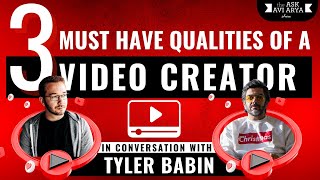
Tyler Babin from Salvage Films talks about his journey from a small Florida town to working with Gary Vaynerchuk. He shares what it takes to succeed as a video creator: passion, discipline, and getting past the fear that stops most people from starting.
The shortest distance between two human hearts, my friend, is always a story.
Going to school and things like that is a great way to guarantee getting yourself closer to what you want. I don't think anything's a failure. If you're learning from it in any way, it's not a failure.
Hey, guys, this is Avi Arya, father of two girls, six dogs, husband to a superwoman, a streetcar racer, turned hotelier, now social media marketer and founder of Internet Moguls. Welcome to my channel. So, guys, my name is Avi Arya, father of two girls, six dogs, husband two superwoman, a streetcar racer, turned hotelier, now social media marketer and founder of Internet Moguls. And I'm happy to announce and introduce Tyler Babin to all of you. Tyler. Like I always say, the shortest distance between two human hearts, my friend, is always a story. So before we begin, would you like to tell the audience your story?
Yeah. Yeah, absolutely. My name is Tyler Babbitt. I'm 27 years old. I grew up in a really small town in North Florida. It's called Tallahassee. Usually people only know it from the show the Office, which was not realistic at all, but it's a great place. I was always just interested in creativity ever since a really, really young age. I remember getting my first camera, and I became really obsessed with coming up with stories to tell. I would come up with skits that my friends and I would make. You know, in our neighborhood, I loved filming my friends riding their bikes and skateboards and things like that. I was into magic tricks when I was young, and so I use a camera to document all of these things, and that was. It was the thing that just connected with me from a very, very young age. And so I knew that one way or another, I needed to figure out a way to make my life and my living with a camera. But growing up in a small town and being the time period, the idea of being a YouTuber or a content creator, these things didn't really exist yet. They weren't real jobs at that point. So my friends and my family, they were like, look, you have great hobbies. It's amazing that you like to make videos with your friends, but you have to be realistic. You have to come up with a real job. And luckily, I never really listened to them. I always stayed locked in on me, wanting to figure out my own thing. And so throughout middle school and high school and the tiny, tiny little bit of college I went to before I dropped out, all I was focused on was creativity and making a living with a camera. And luckily I stuck with that for long enough that I got an opportunity to move from my little town in Florida to New York City. When I was 22 years old, I took an internship at an advertising agency with Gary Vaynerchuk. And then within about six months of that, I had worked my way onto Gary's team and I was specifically working as a designer and a videographer. And I did that for a handful of years where he and I were able to travel the world together and make lots of videos. And I really got to, like, hone my craft and my skills as a storyteller, as a creator, as a filmmaker. Um, and then as I sort of worked through Vaynermedia, different aspects of the agency. The next opportunity came around, which is from Adobe. And Adobe offered me a creative residency where basically they gave me a year to work on projects with them, work on projects of my own. Basically it was a year of me being able to pick whatever direction I wanted to pour my interest into. And so I did that. Got to sort of develop my own YouTube channel, my own podcast, things like that, continuing just that, following my interests and creativity and making videos. And then that wrapped up at in May of last year, which, funny enough, it wrapped up right at the peak of sort of crazy pandemic in New York City. And so my life switched around a whole bunch and I went from traveling full time and making videos full time to just being inside. And that kind of pushed me into finding new ways to be creative. And so. So the Nike video you mentioned was, how can I make the best, most professional content possible without leaving my small little 500 square foot apartment in the middle of Manhattan? We did that for a while and then at the end of 2020, with sort of so many unknowns, I decided to kind of escape the city for a while. So I packed everything up. I moved to the West Coast. So I'm in Portland, Oregon now, and I'm continuing every day to just work with brands, work for myself, and try and make every day about making the things I want to make.
So, Tyler, that was a fantastic story of Florida to Manhattan, Gary Vee's office, traveling around the world with him, Adobe, and now back to Portland and being on your own. So tell us. So you. I love what you said that. Glad I didn't listen to listen to anybody. And I stuck to saying your dream was let me make a life out with my camera. And you did. But tell me, from wanting to do something which is passion, to actually studying for it, what's Is there a, you know, tell our audiences? A lot of people just take their passion and jump in to the workforce. Is that good idea, internship route, all of that learn on the job? Or do you think for a craft like yours you need studying, you know, going to good schools and all that? So what's your take? What route would you suggest people take?
Yeah, I think that so much of it depends on how you learn and how. What your work ethic is like. I, you know, I dropped out of college and I don't have any formal education in photography or video yet. I've made my whole life about it yet. I get messages all the time of people saying, oh, should I drop out of college and go figure it out. And I always say, like, no, don't do it. Because I think that going to school and things like that is a great way to guarantee getting yourself closer to you want. Being that you can do it without, like, taking on tons of debt and things like that. Especially here in the States. But there's so many unknowns. Like whenever you. When you take the decision to drop out of college, like, I'm sure that there's tons of aspects of my life that I got lucky. I was at the right place at the right time. I basically had no life throughout my 20s, my early 20s, because all I did was I was at the office 24 7. So there was a lot of things that had to go in the right direction for me. That being said, I think that school is. Can be kind of tough because the speed at which things are moving, like school historically is there systems. You have to have curriculum, and it's got to be tested, and they have to know where the value is. And sometimes the real world moves a little bit too fast. Like, I don't, I don't think any film schools are teaching how to make content on TikTok right now. And that's unfortunate because that's like a real thing. It matters. And so it's always like, I think that there's tons of value that come from a traditional education and learning of these skills. But making sure that you're also taking that time to educate yourself, find those internships, and work in kind of the real world, because that's where things are happening.
Okay, got it. So, Tyler, they say hindsight is 20 20. I love the clarity. You're 27, and it's very clear the way you explained what people should do. And I'm all for it. A school is a place that gives structured learning, and people recognize whatever you call It a certification, whatever, people recognize it, it gets you closest to your dreams. Like you said. Also the alumni aspect of it, people, you know, you're the net. You're the net sum total of the five people you hang out with. And all of that, you meet many of these people. Airbnb, Uber, all of these people they met in university, they had an alumni thing. So what you're saying is they are pros and cons, pros of doing this. But at the same time, I chose differently, but I had a different work ethic. I had to work 24 7. I had to make my message felt and known and heard. So. And that took time and relentless effort, so very clear on these two steps. I love the way you did it, and I just want to recap it for people to digest it. When it comes to, you know, you, you, you got an op, you got an opportunity to work with somebody who was known and somebody who's always on. But a lot of people might work with somebody like a Gary Vaynerchuk and say, this is not for me. I'm getting burnt out. So how does somebody find the person they need to work with? Do you need to relate to the person or you to be completely poles apart? How does that work?
I think that everyone's different. And I mean, using Gary as an example, I think he would say test things like, I don't think there's anything wrong with, you know, if. If I had worked for Gary for six months and I was like, ah, this is not for me, I could have left and I would have just found the next person to work with. I would have found someone who had similar interests, that I did reach out to them and offer to work for free. And if it didn't work out for that person, there's nothing wrong with six months later saying, I don't think this is working, and then move on to the next thing. I think people can't be afraid of changing their mind. You know, the idea of making a decision and saying, oh, no matter what, I have to stick with this and I can't change my mind. That's just not realistic. Like, there's very few things in life where that. Where you make a decision and you can't abandon it whatsoever. So, yeah, I think that when it comes to finding someone, that there's no secret sauce. Right. I wish there was a website where you could go and say, I want to work for that person and. And then that was it. Like, you sealed the deal. But it doesn't work that way. You have to, it's, it's almost like dating in a way. You have to like spend time with that person. See if you guys work well together. Does it mesh? Does it not mesh? And if it doesn't, then that's fine. Just be okay with kind of stepping away from it and finding the next thing.
Again, very interesting topic. You're 27, in your early 20s. For people who are watching this in your early 20s to be able to have the guts to tell yourself three internships, six, six months each, they all didn't pan out into two year or three year internships. They didn't get into full time jobs the way I was thinking or maybe I didn't learn the way I thought I should. My learning curve should be. And all that should not be termed as failure. It is all still okay and part.
Of the learning process, especially in your 20s. Like those 10 years should be riddled with failures and experiments and like, like those are your years to figure it out. So yeah, I mean I don't, I don't think anything's a failure. If you're learning from it in any way, it's not a failure.
Lovely. When you, when you work with a mentor, with anybody, because this is the whole world Today, even a 40 year old person comes up and says, what do. I'm feeling lost. Hey, do you have some money to support your family or. My wife takes care of things. Absolute great. You, why don't you go in and turn for someone and see how that works out for you, you know, and stay close to the sun. You'll get heat and light both. You know, you'll get pressure because you're close to the sun and you get clarity because you're close to the sun. But a lot of people are afraid of being close to the sun. So they join a company, they'll take that leap of faith and they stay 60 yards away from the boss or the main man. And so how. Share with us what. How life would have been different if you were one of the 700 at VaynerMedia versus being right there with Gary Vee.
Yeah, I mean it's funny because that's when I moved from Florida to New York. I knew that I wanted to work for Gary, but I didn't actually know how I was going to make that happen. So in my mind I was just going to do this internship. I was going to hopefully get a job at the agency. I would work for a handful of years, hopefully my work would stand out for itself and then eventually I would be able to work with Gary, I ended up skipping all of those middle steps and I just went from intern to directly working with him. And it's hard for me to even imagine how my life would be different. Because the thing I always say that if you would have told me my first day going into VaynerMedia, you know, if you would have shown me the future two years from that point and said this is what your life is going to be, I would have said absolutely not. There's no way that all of that's going to happen. It's just not possible. Like there's. Those jumps couldn't happen. And so I think that's the thing that I kind of hold on to, is that if you are, if you can get the confidence and the guts to go put yourself as close to the sun as you can, oftentimes your life will become something that you can't even imagine because it's so far out of reach of what you think is possible. So if you really, really want to be one of the handful of people that get to get to move and shake the world around a little bit, you've got to be willing to, to skip all those middle steps and put yourself as close to the sun as possible.
Lovely. Lovely. And when it comes to do, you have to have a similar. Tyler, if you don't mind me asking you, are you and you know an out there Gary Vee kind of guy or you're more personal and quiet and.
Very, very like close. I'm like Gary, super extroverted. I'm very introverted. I'm not. I'm good at speaking and you know, I put myself out very publicly, but if I'm not in that type of situation, I'm very, very quiet and very to myself.
Lovely. So when that happens. So tell us, how should is. Does that, does the clash or opposite, is either of that a strategy or should there be a strategy when you're looking for a mentor?
I don't think there has to be a strategy. I think for me it worked really well being with Gary because I was able to just be a fly on the wall like whenever I'm traveling and stuff like that. If I was super extroverted and I wanted to be the center of attention, that wouldn't have worked well because I wouldn't have done my job to, to tell the story of Gary and what Gary was doing in those moments. And so I think that, you know, not to take that as like if you're naturally an extroverted person, that doesn't Mean, you shouldn't go beyond whatever you want to be. But for me, like, it worked out really, really well and it didn't. There was never a moment of clashing or it didn't feel, you know, awkward at any point. It just felt like we were able to vibe really well together.
Got it, got it. Now shifting gears to. We learned a lot in this section, Tyler. You know, a lot of people's lives and perspectives have changed when you said, this is not a failure. It's fine to be able to do that. How to find the right person. Staying close to the sun. Super valuable point. Deeply appreciate you. You sharing so candidly everything that happened in the first few years. Now shifting to Tyler Babin. Tyler, I remember meeting you at Gary Vee's office when you had this DSLR camera and you were super focused on getting some shots, right? I was super excited to meet Gary for the first time. But later when I got a message from you saying that you had featured me in episode 128 and all of that, that's when I saw you. That's when I saw the shots and you were laser focused on work. How do you develop people who want to get become creators and tell stories? And stories could be sometimes when you're thinking of something else, a story could be, you could miss a story. So you seem like somebody who's like almost meditative in the process when you're doing that. What would be your advice to creators on how to capture stories in the moment?
Yeah, I think I'm actually, I'm working on a video right now that's kind of like my advice to aspiring content creators. And the first point that I highlight in it is the idea of fall in love with principles, practice. Because I think that if you, if you really, really love what you're doing, especially being like a photo video type of creator, you have to, to love every single second of it. And whenever you're in that moment where you're, you know, filming a meeting or whatever it may be, you need to be locked into that moment and be okay with doing that over and over and over again. You know, we did DailyVee for like a hundred something days where we never took a day off of filming. And if I didn't really, really love filming and really love telling stories, that would have been a painful hundred days, like, that would have not been a fun experience. But yet, like, I look back at that chapter of my life as one of my most fond memories. Like, I really love that chapter because it was the opportunity where I fell in love with practice, like, every day. I didn't look at it as, like, okay, this is my job. It's like, wake up. And I'm practicing my craft today, and I'm just, you know, it's like the basketball player who just does like, a thousand free throws before the game. Like, that's what I looked at as my time with Gary. Like, that those were my. My three throws. Like, every single day was practicing the craft. And so I think that is something that you can't get away from. Like, if you want to get good at taking pictures, take a lot of pictures. If you want to get good at making videos, make a lot of videos. Because those are, like, the reps you have to put in. And then at some point, like, you. If you want to continue that, great. If not, you know, put in so many reps that you can go create your own stories and. And figure out your own path. So it's just. It's just doing it all the time. And you'll find that, like, really quickly if you actually enjoy it or not. Because being, like, being a content creator and a photographer is cool now. It's like something that kids want to go do. Like, they want to be that. That wasn't how it was like, when I was growing up. People thought I was weird when I was in school because I was, like, the weird camera guy, you know? And so making sure that you really, really love it for the right reasons. A massive amount of work, but it pays off because it's a pretty incredible job.
Fantastic. Tyler, tell us one thing that I am pretty sure all of us have learned from watching you on DailyVee and watching Gary V on DailyVee. Gary has a team that does everything. I'm not sure how much he knows about editing and the basic. He has good people and they do the work while he does what he's good at. When you do what you're good at, what are the things that you keep close to your heart as a content creator while you're talking to content creators right now and what should be outsourced in the creating process?
Anything that you're not the best at, Right? Like, you really have to do an audit of where your skills are and if there's anything else, be okay with outsourcing that. So, for instance, like an example for me, um, I. I script a lot of my videos, right? So I'm. I'm. I'm always writing things, but I've come to learn that a lot of times the thing I'm Envisioning in my head when I write it out doesn't make as much sense. So I use editors. Like, I bring on actual writers to take the scripts I'm writing and reorganize them and make them flow and make sense. That's something that I'm not great at. So I outsource it. I know that I'm good at filming and I'm. I'm good at talking naturally, and things like that, but when it comes to getting my thoughts out of my onto paper, there's something gets lost in translation. I could do two things. I could really work on refining those skills and trying to become the best writer that I can, which naturally, over time will happen. Or I could take all that time that I would dedicate to becoming a better writer, pour that energy into the thing that I'm already good at, which is making the film and the lighting and talking and things like that, and have an editor or another writer come in over the top and do the thing they're really good at, which is help me get that work up to. Up to the rest of it. And so that's. I mean, I think that whatever doesn't feel like your natural strong suit should be outsourced, like, as quickly as you can. Or if it's busy work. Like, for instance, you know, if I'm doing a podcast every week and it doesn't have a lot of editing that has to be done in it, I shouldn't spend my time, which is like valuable editing time, on something that's sort of just busy work. So, like, in that situation, I would find another editor. I would say, cool, you do this edit while I work on a bigger project that's going to lead to either new business or a bigger portfolio piece or something like that. So it's just like the actual time spent and your strong suits. I think those are the two things that you really should look into. Outsourcing pretty. Pretty early on in your career, if.
You can, or pretty early on in your career. Got it. Excellent. So then, so I'm not making money and you're saying I should outsource all of this in the beginning. So you're saying outsource in the beginning so you have more time, and you use that time for maybe business development and sales and all of that to start making the money. So.
And, and it's also, you got to remember, like, if you were in a creative field, everyone else around you, your peers, they're also in a place of trying to build their own portfolios and stuff. Like that. So if, if I'm working on a video, and let's say in this example, like, I've written a SC and I need a writer to help me polish the script up, that becomes a piece of portfolio work for them too. Like, they can get a credit on the piece of work I'm doing and maybe that builds into a more collaborative relationship in the future. So don't look at it as, like, I mean, there's been so much of my life where I was making no money as a content creator. Like, I mean, it's taken so long to get that ball rolling, yet I've been collaborating with people since day one. So don't feel like that. Just because you're not making money on a project, that means you can't find people to work with on a trade basis. Or like, even if you're just buying someone lunch or something like that, you have to, to get creative in how you're working with people.
So build your resume. Are you saying, Is that what you're saying? Because I'm talking on behalf of the young content creators. Why would I work for free? Yes. Because I have to. Nobody knows me, all of that, but also because I'm creating my resume and my body of work with, working with different creators and practicing, like you said. Is that why you. I'm working for free?
Absolutely. Yeah. Like, so let's say even. Even at this point, I mean, I have a. I don't want to say I'm super successful, but I have like a business that's rolling and I'm creating things on a regular basis. But if I got a call right now and someone said, we're directing a TV show for. Or Steven Spielberg's coming out with a TV show, he wants your help on it, but he's not going to pay you a dime. I will close this laptop, get off the phone and go do that for free and not make a dollar on it because I know that's valuable for me. I'm going to learn new skills. It's going to add to a portfolio, to a resume, and it's going to help me build work into the future. And so, yeah, absolutely. Never be afraid to build the work to do the work for free that you want in the future. That's something like, you have to, you can't just wait for the phone to ring and someone offer you tons of money to come do a project. Like, you have to pay a lot of dues in this industry, even if.
You, even when you found success. The greatest of the Great. Say what you just said. Find opportunities to work and collaborate and the money will follow in a different project. You don't know which door you're knocking and which one opens. So lovely. I love the. And I wish I had the kind of clarity when I was 27, man, it's just fantastic. Do you have, like, very, very proud parents? Like, are they.
I think so. It's super funny because growing up, like I said, I mean, you know, my aspirations and the job, career I wanted to, didn't make sense to my parents and to a lot of my family. And so I remember, like, the first, you know, even though I'm 27, but I. This year marks 10 years since I started making, like, money doing a job, like, actually working. But I started making videos when I was 10, so it's been my entire life. And I think that it's really cool for them to now see that it was actually able to build itself into a good living and a good career and things like that. So I think they're. I think they're excited.
Excellent. Let's talk about sales and business development. How do you get all these amazing clients?
Relationships? I mean, I, at this point, have never spent a dollar on advertising myself. I don't have business cards. Like, I have no traditional route of getting clients. The thing I've done is put all of my energy into working and making really great work and building relationships with people. And naturally, work has always sort of found itself to me and that comes in waves. Like, sometimes there's more work than what I can possibly handle at this point. It's. What are we talking? It's March 8th. I've only worked on one project this year, but I worked so much at the end of last year that I'm good. I'm taking time to sort of do more passion projects and work on the things I want. And then I know at some point, probably it could be tomorrow, another wave of work will come in. I think that if you stay focused on developing your skills as a creator, then the work is one of those things that naturally just kind of comes from that because. Yeah, I mean, I've never pitched for a project. I've never sent emails of people that I wanted to work with. It's sort of always just found itself to me because I've put all the energy I possibly can into becoming the best, best creator that I can.
Fantastic. Fantastic. What would be the one advice that you would give to Tyler five years ago when he started shooting DailyVee? How would you shoot it differently if you were to do it now, oh.
How would I shoot it differently? There's, there's two. There's two answers to that question. So from a technical, like, filmmaker perspective, I would have treated each day like its own documentary. I think that there could have been a lot more like, storytelling that happened throughout each day of, like, interviewing other people around Gary, or even the way I was telling stories. And, like, the focal lengths of the lenses I was using. Like, I shot everything close up with a wide angle lens. I wish that I would have shot everything from really far away with, like a telephoto lens. That would have been an interesting visual. Um, but also I think that I would have tried to push Gary a little bit further in the. The types of questions that I was asking him. So instead of me saying, like, okay, what was that meeting about? Just give me like a recap. I would have, like, narrowed in and been like, okay, there was this one point where you said this one line to someone. Give me just that little detail. Because I think the. There were so many days where we sort of told the same story in, like a really high level way. I wish I would have really, really focused in on those small details more in the day to day.
I love that. I love that. And for all of you watching, we have not done a preview. This is the first time we're talking on this interview. These questions are fresh and new. It almost seems like Tyler's got everything down pat and he has it on his own accord. We have not discussed this. Going. It's going so according to plan is not even funny. Thank you so much. And, you know, because you're a content creator, you know, at the end of every question, you pause, you give our editor the time to sort of time, cap it, edit it. It's just going fantastic. When it comes to gear, yes. There is one school of thought saying, don't overstress the gear. Your phone has everything and all of that. At what stage can you. Till what stage can you use the phone? And at what level did you say, no, no, man, you need to. You need. You need the whole nine yards.
It's tough because it's different for everyone. I still use my phone for lots of stuff. Like whenever I'm. When I'm traveling or I'm in between moments, I film tons of clips on my phone and add those in. I think that you have to ask yourself, like, what the value of leveling up production quality brings to you. So for me, like, I have more expensive cameras because. And more expensive lenses. And different lenses, because those help me tell a visual story. That being said, if I can't get rid of everything and do the same, at least tell the same story with just a phone, then I'm kind of wasting a lot of energy. So once I think once you've mastered telling a story on a phone and you really, really, at that point, still feel like there's things the phone can't do for you, that's when you can start investing. But I think the worst thing you can do is decide you want to make videos tomorrow and then go buy every piece of gear you can afford to start telling those. To start telling those stories. Like, master the gear you have before you start expanding and investing in all of this different equipment, because you can make the visuals look better, but the real skill set is developed whether you're using a $10,000 camera or a broken iPhone.
Lovely. You know, many people around the world follow you and drock and your model of saying, we'll follow an entrepreneur's journey, make short clips out of it, and create a social media calendar accordingly. When somebody has this kind of. You already said this is a great passion to have. It's a great career, Work on it, you know, and eventually stay close to the sun and all of that. But now, say a content creator watching this says, I am going to get a job or position myself as somebody who can come work with you for a week, take 10, 15 videos, make 30 videos out of that. Do I need. Would I still need just a phone, or will I need three different camera angles to tell a story and all of that? So I'm just going slightly granular. You know, how if I get a project of telling a story, can I still walk in with my phone, or would I? You know, because different camera angles will give a different story, different perspective. Two people sitting, two shots, and all of that. And what would you say there?
Yeah, I mean, look, I'm a filmmaker at heart, so I'm always gonna say, like, if you can shoot a project with three cameras, shoot a project with three cameras. But remember that other things come with that. Like, the more cameras and more gear you start adding, the more complex things become. Like, we're having. You and I are having a really great conversation right now, and everything's sort of taking care of itself. Like, the computer is running everything. However, if we both had, like, multiple cameras on both sides and we're recording audio, like, it becomes so much more complex that I think our conversation, which would suffer, we wouldn't be getting as much value out of this conversation. So there's a weird balance that you have to play. Yeah, absolutely. If you've got the money and you've got the people to throw it it running gear, absolutely. Go for it. There's. It's not going to, you know, it's not going to be a bad thing, but kind of the same thing that I said at the start is like, if you can't produce what you want to produce with just a couple of phones, then you have to take a step back and look at your actual story that you're trying to tell and make sure that you're. You're not just trying to create a pretty picture that has no substance.
Got it, Got it. Excellent. Tyler from. You spoke about your story of finding the son to work with. Things worked well. You worked very hard. Must have been difficult to leave and see how a new project pans out. That project happened. Then Corona happened. You're on your own now, managing your own time. Everything. Your parents are proud of you. I'm very. I always say, stay close to the router. You know, can stay connected. Those. Those guys love you and they tell you so much about yourself. I always say, going out in the world and looking for a mentor, go home and ask us somebody who really cares about you. You know, hey, dad, what do you think I'm doing wrong? He might not know exactly what you do, but he'll tell you because he knows you like no one else. But having said that, when it comes to. So you've been, you know, at 27, you've been through so many roles, you know, 500 square feet, apartment, did everything over there, moved to a different city, different times, all of that independent from. From. From a long time. What still. What still scares Tyler Babin?
Ooh, that's a good question. What scares me? Lots of things. I think it's easy to look at the moves I made in my life and career and be like, oh, he's not scared of anything. But, yeah, I think it's natural to be scared and, like, have insecurities around tons of stuff. And I still have moments where I doubt and my work, and those are things that I struggle with all the time. I think the thing that scares me is standing in my own way of potential. So being that right now my job, for the most part, is creating content around myself, so I have my own YouTube channel, my own podcast, things like that, my biggest fear is that I will subconsciously sabotage whatever project I'm working on. So that way, if it fails, at least I can say I'm the reason it failed. And that's, that's something that is not good and not healthy. And I'm really, really working through how to, how to get around that because I just want to be able to create and lean fully into my potential and just let things flourish as they naturally will and not kind of sabotage myself. And so that's the thing that if there's anything that keeps me awake at night, it's that making sure that I'm, I'm not getting in my own way of my own potential.
That is an a crazy level of self awareness at 27 to be that I said, you know, it's only two weeks ago I was writing in my journal of I'm 44 and where all. And then I started researching and every human being has a self sabotage mechanism, you know and we've so we're struggling with ourselves, you know, at all times like this. This was fantastic. My respect for you has gone up 10 times how you just said it so candidly. And you know, more Importantly, there are 129,563 people as of yesterday in our community who get an email with every video that we shoot. This is a new video. Watch it. 20% people watch the video. That's still 25,000 people. About 6,7000 of them are going to be creators. And even if 100 of them get the guts to say it like it is and be that much less fearful and that much more fearless, this is going to be an interview that changed lives.
So.
This is fantastic.
That makes me really happy to hear and I think kind of what you said is like the sort of becoming a little less fearless in certain moments. Once you understand what your kryptonites are, you can, you can better work with them. Right? Like if I didn't know that I was self like subconsciously doing these things, I would probably have a lot more like weird failures and things like that. But now I understand like that this is, this is a problem I have. I know that I'm doing it so now I can put energy into it to make sure that I'm like course correcting as much as I can and so being okay and being like welcoming of those fears and insecurities I think is, is something that will really set you apart and make it make sure that you're not competing with anyone else like you're competing with yourself to just make sure that you become the best version of yourself that you can.
I'm right now as I'm thinking to You I'm distracted because I'm like, I want to take this recording and show it to my two daughters and, you know, say that this is normal. This is absolutely normal.
How old are your daughters?
My daughters are 15 and 11. And they're the ones who, you know, send the video. And reached out to Gary and then we went out for. And my daughter was almost interviewing because she was not a fan when she met him for the first time. She just wanted to make him, to see, why does daddy make this guy a big deal. And at the end of the five minute conversation, we've got a YouTube video on When Avi Met Gary 1, When Avi Met Gary 2. So like that. So, and my daughter is featured in that. And she's looking at him like that, you know, what the hell is this guy talking about? And at the end, Gary leans in and tells her everything that's going on in her head. She's like blown away. And then she becomes a fan after that. So pretty neat episode. She's 15. My younger one is 11. My elder one wants to become weightlifter, CrossFit, then acting, singing, dancing, all of that. She's doing filmmaking, create. She's a creator. She does YouTube videos on self love and, and anti bullying. And that's the crusade that she has. And she wants to change the world. And my younger one is like, just wants to have fun in life with lots of horses. So two different girls.
I love that. That's amazing.
Yeah. So, you know, we've got six minutes left. I'm going to be respectful of your time. So for all those people watching, getting inspired, getting less fearful, more fearless after watching this, I know I am, I know my kids will be, I know all of you will be at the same time. I'd like for you to tell them in the next two minutes, I got two, three more questions. What is the discipline that is needed to reach the level that you've needed? I mean, passion is good, all of this is good. But I'm sure there's some ritual, some regime, something that you follow, you know, even if it's not every day, whatever, that allows you to sort of say that I made it work for myself.
I'm going to be honest. I wish I had a better answer in terms of like, this is how I schedule my time. This is when I'm working, when I'm not working, I pretty much just work all the time. From like when I wake up to when I go to bed. I find in my pockets where I spend time with my Girlfriend and I play with my puppy, and, you know, stuff like that.
Sorry, what's the name of the puppy? Very important for us.
It's Chauncey.
Chauncey. Okay, got it.
Yeah, he was. When I moved. When I moved to New York, the first street I lived on in Brooklyn, my first apartment was on Chauncey Street. And I remember getting out of the car, looking at that street sign and saying, like, one day, I'm gonna have a wiener dog named Chauncey. And then five years later, we made it happen. So, yeah, he's like my best friend in the world.
I was having afternoon vodkas at a friend's wedding, and I was walking. I was going back. He got married at a farm, and I left his farm. And I'm. You know, I'm in the backseat. You know, there's somebody who's driving me, and I. And I saw a beautiful farm with daffodils and, you know, all of that. And I'm cursed down, and I'm in a beautiful space, and I saw this beautiful farm with flowers, and it said the name of the farm was Aviana. And so my younger daughters.
Amazing. Love that.
Oops. I think we froze here for a second. All right. Okay, so my second last question is, Tyler, what's that one thing that Gary learned from you and became Gary's? And what's the one thing that you learned from Gary and became yours?
Oh, man, that's a good one. I honestly have no idea what I would have taught Gary, except I probably. I think one thing I always would do was I would have Gary kind of recognize when, like, funny moments would happen or if he would have, like, moments of struggle, and then I'd have him highlight those. So I remember there was one day where he was being featured in a commercial, and normally, Gary's always just, like, goes off the top of his head. He never reads scripts, and in this. This day, he had to read a script. And it was, like, a big struggle for him. And I remember, like, pushing him to be like, no, talk about this. Like, talk about the. It humanizes you to, you know, recognize that, like, you have, like, random struggles, just like everyone else does. The biggest thing I learned from Gary is kind of similar to what you were saying. Like, I didn't know any of the questions you were asking me, yet it seems like I have, like, a locked answer for all of them. Gary was. One of the things he always said was, like, just be yourself and be really, really honest. Because if you're yourself and you're not Trying to put on a show or act like a certain character, you're always prepared for instances like this. Because no matter if I answer this question now or if I answer it in five years, it might change. But as long as I'm just being myself and I'm telling you the honest truth, there's no need for me to have to go through and prepare a bunch of answers and, like, know exactly what I'm going to say. So the PR is right and all that stuff. Like, if I slip up on my words right now, I can just go back and, like, fix that, you know, like, it's. It's okay as long as I'm being myself. That's the most important. So that's kind of the biggest thing I took away from Gary.
Love that. Love that. Second last question. Ten years from now where what two roots, two things can happen in life, what is that one thing that you're like, it's never going to happen. And what's that one thing? What's that one? Moonshot. You're like, this may happen.
That's a good one. I don't know. Like, I have a. When I was growing up, I really wanted to be an actor. Like, that was, like, my thing I wanted. And it just, you know, my life, it didn't make sense. Like, how was I ever going to be an actor? Right? Like, I was always behind the camera. So I have, like, a weird feeling that at some point, hopefully in the future, I'll be able to actually explore, like, the acting side of things. And I want to be more on camera, so that might be able to happen.
And once that happened, guys, don't forget you saw him first on the Oscar.
Absolutely. And then I. One thing that I think will, like, never happen is I would love to go to space. For some reason, like, I think making a film in space would be crazy. Probably won't be feasible in my lifetime, but I'm sure that there will be a vlogger in space sometime in the next hundred years or so. And that would be cool if it was me, but I don't think it will be.
Lovely. Lovely. Awesome. And like I said, guys, none of this is scripted. We're talking after AJ We've been connected for many years, but we haven't spoken. And this just seems so seamless. My last question is an emotional one. Many of our. Let me tell you, many of our guests tear up when they hear this question or they want to answer it. And if you feel that this is too personal and you don't Want to answer it for whatever reason, you can choose to decline. And, you know, we'll just delete this part. You ready?
Yep.
So it is emotional, and, like I said, so who's your favorite and why?
Oh, man. I was. Really?
I didn't warn you.
I was worried about this. Look, you know, there's some things that I just would love to keep private. This might be. Not kidding. I'm Iron man all the way till the end, I think. Yeah. I mean, I remember, like, watching Iron man growing up and everything. It's one of my favorite series of all time. And unfortunately, I do think Iron man is better than the Hulk.
There we go. There we go. And that wraps it up a beautiful one hour. I had so much fun. My editors are going to have fun because we're an agency, and most people would love to know what Tyler is doing. And like I said, your last video we played on the big TV for everybody to watch. So everybody knows you in the office. They love this. Also, like I said, thousands of people are going to change their trajectory just by one, one degree. And that will change the eventual outcome of somebody's life. That's how you make a dent in the universe, by staying true to who you are. So I deeply appreciate what you did. And thirdly, thank you on behalf of the editing team because they have a little work to do, because you get the right pauses, right answers, everything, you know where they're going to cut the interview and make it happen. So all of you people, whenever you're watching this on YouTube, on Facebook, any of these channels, click on the link below in the comments. Let us know the one big takeaway that you have. And we're going to give you one free book, like we do every time at the end of every episode. One free book to one winner. Put on the comments. What's that? One big takeaway. Let us know in the comments. And for all of you people watching live at any given time, big thank you to Tyler for giving us his time. My dad always says the most expensive thing you can ask from people is not their money, but it's their time. Tyler, thank you for your time, ladies and gentlemen. I hope you enjoyed this. The man who's not going to space, the man who loves Iron man, the man who made it on his own, has proud parents and is telling you all to be fearless. And if you do get insecure, that too, is fine. Tyler Babin, for all of you people, ladies and gentlemen, thank you very much. This is Avi Arya, father of two girls, six dogs. Husband to a superwoman, a streetcar racer turned hotelier, now social media marketer and founder of Internet mogul. Signing off for now.
More from Avi

The strongest mindset doesn't begin with meditation. It begins at home. Before you conquer the wor

The strongest mindset doesn't begin with meditation. It begins at home. Before you conquer the wor

Your mindset isn't something you fix once. It's something you train every single day. Just like yo

Don't build a company just because your friends are. Build one because you're ready. A startup is

Everyone dreams of becoming the boss. Very few understand what that really means. The moment you b

Most entrepreneurs say, "I don't have time for coaching." The truth? You don't make time for what

Over hiring doesn't always solve problems. Sometimes, it creates them. Having a small buffer in you

"The highest-paid" isn't the goal. The highest-value is. People often ask why premium mentorship co

The founder will always be a bottleneck... at some stage. The goal isn't to pretend you're never th

People ask me how I stay consistent with my morning routine while traveling across countries and tim

People ask me how I stay consistent with my morning routine while traveling across countries and tim