Google Ads vs Facebook Ads - Which One Should Your Business Use?
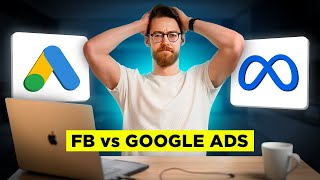
Austin LeClear explains when to use Google Ads versus Facebook Ads. Use Google Ads for high-intent searches like plumbing services where people actively hunt for solutions. Use Facebook for new products or B2B SaaS where search volume is low and you need to build awareness first. Check Google Keyword Planner: a few hundred to several thousand monthly searches means Google Ads will work.
Chapters
So I wanted to have a bit of a discussion, a bit of an explanation for a question that comes up a lot, and that's basically, should your business use Google Ads or Facebook ads? Well, that is an interesting question, and it should be the first question you ask when you're considering to spend money on ads. You know, the first thing you need to be thinking about is actually the strategy behind the ads and the logic behind that strategy in terms of reaching your potential customers. A lot of the times people jump in, they start spending on ads, and then three, six, 12 months later, their ads aren't working, and we have a conversation, and all of a sudden I explained to them, hey, actually, you probably chose the wrong ad channel. So this is a really crucial discussion to have with the rest of the people on your team and to figure out exactly which of these two major ad platforms is going to make the most sense for growing your business. So the first thing you should start to think about when you're deciding on using Google Ads or Facebook ads is, do people know about my service or product? Are people actually out there that are aware of this thing that I'm selling, or is it the case that nobody knows what it is that I do and that they're not actually out there looking for it, but if they heard about it, then they'd be curious and. Or interested? Well, if you're the type of business that you're in, kind of a commoditized market, and there's an awareness out there that the service exists, and there are going to be people that are actually needing this service, those people are probably going to be searching for providers of that service in Google, and that's a strong indicator that you should actually be advertising Google to get in front of people looking. A good example of this would be, you know, a local service business like plumbing, for example, Right. It's kind of an urgent service. If you need it, if you need it, you're going to be needing it urgently and search for someone to provide it to you. But if you don't need it and you saw an ad for a plumber, you're probably not going to be contacting that plumber because you don't actually have a problem for them to solve. So that's a good example of a type of service where there is awareness out there. There's often some urgency maybe about it. And you should definitely be advertising at Google to reach people who need that service. Right now. Facebook would be a waste of time in that case. What about if you are selling a product that is new, that is innovative. Maybe you're a SaaS company with an interesting, maybe you are a service business, but you're providing a service that doesn't really already have a market because you're solving a new problem that hasn't existed until recently. Well, in these cases, Google is often really not the best place to go. I see this a lot with, with, you know, very complicated like B2B SaaS products. Sometimes I see it with, you know, startups, technology companies, they start thinking that they need to be in Google when there's no one in Google that actually knows about them, that's looking for them. And they actually need to focus on driving awareness. And that's really where Facebook has its strengths. It is good at getting in front of people. It's probably still one of the best ways. Even though I know there's a lot of bad press about Facebook, it's still one of the best ways to get your message out there to get in front of people and basically tell them about what it is that you do. And either do it directly by, you know, explicitly promoting yourself or doing it indirectly by talking maybe about the problem that you solve and attracting people that way. And often it's the case that businesses that do well with Facebook don't really do that well with Google. So if you're advertising on Facebook and you're thinking, okay, maybe I should expand to Google, well, think about, are there people actually out there looking for you? If the answer is not really, then probably you should do Facebook. Now those are some two very clear cut examples. Now we've got a technology company that no one knows about that people would be interested in if they heard about it. And we've got, you know, a plumbing company which people are only interested in if they need it. And if they need it, they're going to be looking for it. Those are the kind of the two extreme ends of the spectrum. But what about if you're in the middle? What about if, you know, maybe there are some people looking for my service, but you know, are there enough people looking for my service or product? And that's really the case where you want to go to Google. Keyword Planner. So Google Ads has a tool called Keyword Planner. You can actually find it inside of the interface. I've just pulled up an account here and if you go to Tools and Settings and Keyword Planner and click on the light bulb and click on Discover new Keywords here, you can put in the terms related to your product or service and just see what's out there, see how much volume there is. And if there are, you know, a couple hundred to a thousand, ideally several thousand searches a month, that's enough to start advertising Google and the people actually looking are going to be the most likely people to, to want to buy something because they have high intent. They're searching for a solution. And you're probably the solution that they're looking for. You just need to get in front of them. So that's a situation where if you, if you came in and you saw the search volume, you would actually probably consider starting with Google Ads because it's going to be high intent, it's going to be more likely to convert. If you came into this keyword planner and you put in all these terms related to your service and you just see nothing, you see maybe like 10 searches a month, 50 searches a month, very, very low volume. That would be making me start to question, is there actually any awareness for my product or service out there in the marketplace? Do people know about what it is that I do? Not just do they know what I do? Do they have this problem and are they actually looking for a solution? Or maybe they just don't know that a solution exists for the problem they have. In which case you have an awareness problem. And that's really where jumping across to Facebook, it makes a lot more sense to start to get in front of people and create awareness through a platform like Facebook slash Instagram. That's where you can actually have an ad that talks about the problem, that tells them that the solution. And that's going to drive interest directly from clicks to that ad on Facebook. But it's also going to drive Google searches that are going to come through to you either organically or potentially with paid ads later. But in each case, you're really prioritizing the channel that's most likely to work for you out of the gate. So it's really not advisable typically to chase multiple new ad channels at the same time to start up, you know, Google Ads and Facebook ads and TikTok ads and, and LinkedIn ads all in one go. You really want to bite off one ad platform, get it performing consistently, then potentially go to the next one, or conclusively determine that that channel just doesn't do well, and then cross it off your list and then go to the next channel and give your full effort and attention to the new channel to see if you can get it to perform profitably. So that hopefully gives you some idea of how to think about which channel you should choose. There's definitely a lot more to this discussion that we'll probably be talking about in future videos. But at some basic level, again, ask yourself, do people know about my service? Are they looking for this service? Or are they looking for a solution to a problem that this service solves? If not, I would recommend testing out Facebook and potentially YouTube, because those are channels that drive awareness. Otherwise, Google is really there to hit people that are actually looking for a solution, that are looking for a service, that are looking for a provider. And that's where you should be if you are a service that has a market that's out there, that is aware that they need a solution to their problem. So hope that helps and I'll see you in the next video.
More from Austin


Google Ads Negative Keywords: The RIGHT Way to Find and Add Negatives in 2026








