How to ACTUALLY Optimize Google Ads (Ultimate Checklist)
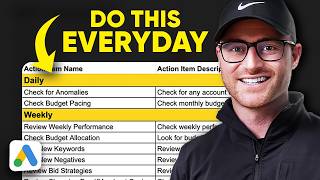
Austin LeClear walks through a checklist for optimizing Google Ads campaigns. The video covers actionable best practices and specific optimization steps to improve ad performance.
Chapters
All right, you have your Google Ads account built out. Your campaigns are built out, they're running. You've done everything set up wise correctly, especially if you followed my training videos on this YouTube channel. Now what? I get asked all the time, Austin, what are you doing on a daily, a weekly, a monthly basis to manage and optimize Google Ads accounts? Well, I have an entire checklist for you today that I will be going through. Now, does this include every little thing that you should be or could be doing inside of a Google Ads account? Absolutely not. That would be like a thousand row sheet. However, I built this with the 8020 rule in mind. This checklist, if you go through these tasks and checkpoints, you will be optimizing and managing your account at the highest level. I can guarantee you that without needing to look at a bunch of tasks that ultimately you don't have to always be doing. So I've tried to compile this list in a way that makes managing an account manageable. That way you don't have 5 million things you have to go look at. So this won't include everything you could be doing in a Google Ads account. Some of the real nerds might hit me on that in the comments, like, hold on, you're missing this or that. I have built this in a way that's easy and manageable for most people who are managing the accounts themselves. And you're hitting the 8020 of what I believe are the big movers within optimizing and managing a Google Ads account. So I've got this entire checklist. I'm going to go one by one through it in a real account. That way you get true practical advice on not only what the task is, but how to go complete and do the task inside of real account. So let's go ahead and dive right in. Right. I have the checklist pulled up here. You will notice I've got it split by daily, weekly, bi weekly, monthly and quarterly. Now everyone's going to be like, where's the download link? I'm not giving it to you. Okay, this is available in our school group called PPC Copilot. It's a part of the group, it's a part of the resource section. So if you want to get your hands on it, then you're going to have to go join the group. If not, I'm giving you all of it on this video. So just go build it yourself. It shouldn't take that long, especially if you use chat GPT or something. So I do not have a download link. So if you ask about that, I'll know you didn't actually watch this video because I'm mentioning that. Shame on you. And if you like really just want this exact sheet, then go join the school group where, you know, I have my training videos in there, do weekly Q&As, live group coaching, calls, all of that. It's a great community. So go check that out. All right, so in the sheet I've got, starting with daily. Now, remember, this is built around the fact that you've already built an account out in the correct way. So if you're just starting, like, well, I don't know how to build the account out. Go watch my other videos on doing all of that on this YouTube channel. This is for people who already have accounts built out. They have correct structures built out within their campaigns. They just need to make sure they're keeping an eye out and doing some of the fine tuning with the correct structured accounts that they've already built. So task number one on the daily, I'm checking for anomalies. So I'm going to hop into a real account now. I'm going to, I'm going to go one by one through all of these and I'm going to show you how to actually do this inside of a real account. All right? So when I am checking for an anomaly in an account, this is a daily thing I'm literally are just looking for. And listen, all of this, the campaigns are going to be blurred out when I'm going through a lot of this to keep things confidential. But all I'm doing is making sure I don't have any real crazy, like hiccups. Right? So was there like any weird dips within the account you Usually I'm looking at like last 7 days of data or recent data. I mean, you're doing this on a daily basis, right? So I'm just looking at like a lot of times yesterday's results and then sometimes I still will pull back if I need to. Hey, you know, does this line up with like the historical averages of my daily. These dips that you see here are on the weekends. That's very normal for this account. So that doesn't, that doesn't make me concerned at all. So all I'm doing here is making sure. Are, are the campaigns good? Are there any like weird disapprovals and are, is there any weird, you know, anomalies going on within it? Like if I'm averaging, you know, 20 to 30k a day from this PMAX campaign and I come in here And I'm seeing this at 10. Oh, something's off. Right. So all that check is is to make sure does do things look consistent within the account. And by things I mean the performance and the metrics of the account. And if not, I then go explore what the heck just happened. Right? Did the feed get disapproved? Did an ad get disapproved? Did conversion tracking break? You gotta go through all of those steps. But all I'm doing on a daily basis if I go in and check the account is, is anything weird or look out of place compared to what a normal day looks like. And again, usually I'm looking at very recent data. In most cases, all I'm pulling back is, is yesterday's data while checking what happened yesterday. Okay, daily action number two, check budget pacing. So most people are going to have a budget. All I'm doing here is making sure you know, right, right now we're in July, so I'm going to look at July 1st through the 21st and I'm going to look at, you know, this account so far spent $45,000. I actually have no idea what the budget is on this account. So you here, all I'm looking at is am I pacing to my budget? So if my budget was like 50 grand and I'm, it's the 21st of July. Oh, I'm, I'm spending way too much, I gotta pull back. Right. And so this is all that is, is making sure we don't overspend the budget. Especially here at Grandma Ads. We are an agency. Most of our clients do have budgets. Not all of them. Some of them just have performance goals and they have basically infinite budget. But, but if you run an account for a client or even yourself, you don't want to overspend if you don't have the money to do that. So you must make sure. Are we pacing on budget? I like to look at that from a daily standpoint. Now to give you a glimpse into what we're building here at Grow My Ads. This left side will be blurred out cause that's confidential like client names. But we're actually building a tool internally here at Grow My Ads, where we've actually got all of this in software that we're building that does budget pacing for us. Now it doesn't change the budget, but it allows the team to make sure that we are on pace, especially our director who's working with the teams. So here I have like spend performance and month progress. Again, this is in beta right now and still being developed, but this allows like, okay, hold on a second. We are overspending on this account. Why are we overspending? Why you are, what's going on here? And this is just an example and we can catch that before an account gets overspent. So this allows for us to monitor budget pacing in a very efficient way. But for most people you don't need to do that. You can run it in just like an Excel sheet or you can use other tools such as Optimizer. Like if you go to I always forget how to spell Optimizer and I won't click the red. But yeah, Optimizer, if you're utilizing like a tool like Optimizer, they'll have budget pacing a part of their features there. But I, for the most part in my career just would manually do it in a spreadsheet. And it was just a part of me checking my accounts daily and making sure I was on budget for my clients. I can confidently say I've been doing this for over 10 years. I've never overspent a client's budget and that's because I just kept track of it on a daily basis for my accounts. And now I've got cool, nifty tools because I have a, you know, in house developer team. But before then I just manually did it. So most of you just put it in a spreadsheet and check the budget every day and you'll, you won't overspend your client's budget then. Okay, weekly tasks, number one, review weekly performance. So all I'm doing here, so I'm going to hop back into that account. All I want to make sure is is my week so far normal or am I trending up? Or in the worst case scenario, am I trending down? So all I'm checking, and you'll notice in this checklist, a lot of times I'm checking different time frames that, that gives you a very good pulse check of the account. Because if you silo yourself into only looking at yesterday's data, you're going to miss, you know, time horizons that matter. And, and so I'm always checking different timeframes and on a weekly basis I just, a lot of times I'm pulling back last seven days now, you know, if I'm doing this on like a Friday or something, I may pull like even just that week. So I don't make decisions by the way off of like four days or five days in most cases. But I'm just kind of looking, hey, is anything odd this week compared to last and then I do a comparison. So I came in here, I just hit last seven days, and I'm hitting compare to previous period, and I'm just kind of looking, all right, do things look normal? And here we're actually up 18%, but my cost is up 18%. Right. So in the last seven days, we spent $3,000 more, and we were able to achieve $26,000 more in revenue at a very similar roas to the previous 90 days. Cool. This looks really good to me. Right, so is this exactly what I want to do, that I want to spend 3k more that week, or am I overpacing now on the budget? So that's it. I'm just kind of looking at what happened in the last seven days compared to, you know, the previous seven days. Are there any issues that I'm seeing within the campaigns? Are there any campaigns that are higher than others, lower than others? Should I allocate budget then to those campaigns that are doing better? And do I need to now go investigate those campaigns that aren't doing as well? It's just a check, but this check will allow for you to know if any campaigns are suffering or if any campaigns are actually starting to do quite well and should get more of your attention and potentially more of your budget, depending on, you know, weekly performance. Weird things happen in a weekly timeframe. One time I was working with an account. A movie mentioned one of their products. And so they're a reseller of products, right? So it wasn't their specific product, but that product went from like three, I forget, like normal sales to skyrocketing sales. And boom, we caught that right away because we. We were doing these checks. We were able to capitalize on that. That campaign with that specific product did not have enough budget to capture the volume increase from some random. It was like a. It was a movie or show. I forget this was a long time ago, but a movie or show mentioned this, and it skyrocketed the volume for people searching for that. So. So we had to then now capitalize on that. Otherwise if we would have missed that. And let's say we just only checked accounts here and there, like once a week or something. We would have missed out on so much revenue because that product was living in a campaign that was capped by budget, basically. And so we had to pivot the strategy of the account and how we were managing it. And thankfully, we were able to catch that. We actually had no idea it was mentioned in this movie or show. We just caught the volume increase and then investigated why is this happening? Sure enough we found through that investigation why it happened and we were able to capitalize on that. So that's all I'm doing in that sort of weekly seven day check. Okay, weekly check number two, check budget allocation. This is just nothing more than am I spending money in the correct spot? So here I'm looking at, you know, where's most my revenue being made and am I hindering myself by spending budget in other spots? So I'm actually going to look at like this month as a whole. And what I'm seeing is this PMAX campaign's doing quite well. And then if I look at like some of these other campaigns, not as well, 5x, there's a 1x and it's not massive amounts of money going to them. 400, 400. But it's enough to be like, wait, does this even make sense? And so if I'm limited by budget like on this PMAX campaign, I'm going to continue to try to allocate as much to that as I can. It doesn't matter what campaign type it is. It could be a standard shopping campaign, it could be a standard search. Whatever's ultimately making you the most money though, why don't you maximize that? So how. That's how I'm always looking at it. And I always know when I do an account audit, if they have no idea what they're doing. When I see 20 different campaigns and they're all limited by budget because I'm like, okay, is there a reason you have budget allocated to 20 different campaigns? If you, if like two of them are minting 90% of the sales and it's usually like, oh, well, we just wanted coverage on all this stuff. Who cares about coverage? I care about making money. And so if I can make more money by allocating more budget to the campaigns that are making me more money, why wouldn't I do that? Because guess what? If I do that, I end up making more money. Guess what happens when I make more money? I can spend more money on ads. Guess what I can now do? I can now start expanding into those campaigns again that I had to move budget away from and, and see if I can get those to work and make me more money. That's how you grow. So I'm always looking at proper budget allocation. I believe I did a video on this. If I did, that will be in the description below. If you want to go further through how to allocate budget correctly as an optimization tactic. Okay, weekly task optimization, task number three, add new Keywords. So here all I'm doing is looking at are there. And this is usually through actually the search term report. All I'm looking at is are there any keywords here that are doing well? I'm gonna have most of this blurred out so because some of it gives up client information. So here I'm gonna make sure I've got my correct. Normally I have these saved, but this isn't actually an account of mine, so I'm just using it for the purpose of this video. But here all I'm doing is looking at. So by the way, you saw me just do all those metrics. Normally I have that saved so I don't have to do that every time. But here, like I see this search term square steel tubing, this seems to be doing well. And so I'm just gonna go look, hey, do I actually have this added in my search campaigns? Yes or no? And so all I'm doing here is looking at the search term reports. I also look at performance max campaigns if I'm running those and I'm looking at the insights. So this will show the search terms as well. They they lump it under search categories though. And all I'm doing there is seeing am I missing anything? Or are any of these search categories or terms something I'm not bidding on in my standard search campaigns? And so there I'm. If I'm. If I see terms that I don't have added as keywords, I go and add them as keywords to continue expand on terms that are doing high performance in performance max shopping or even in my standard search where one of my match types of my other keywords was able to pick those search terms up. Okay, then I've got add new negatives, right? So here instead of adding positive keywords, I'm looking for adding negative keywords. So it's the same thing. I'm just going through the search term report. There's scripts that can do some of this for you. I don't usually like having a script add terms or negatives for me, but I use, you can use scripts out there in order to help with sort of like the engram analysis and things like that. In our school group, I have some of the those resources for available for people. But here all I'm doing is then finding are there any keywords here that I need to add it as a negative keyword because it's not something that's relevant to my business, product or service and I do not want to show ads on. And then I go ahead and just add those as a negative keyword. So let's say just going to make something up. But let's say the word used was in here. I'm literally then just going to go into my campaigns where I have, you know, my negative keywords and I'm going to add. So here it's inside of a universal list. I'm just going to go ahead and add, you know, used as a negative keyword, if I can even spell it. Boom, there. And now I don't have to worry about showing an ad unused. If you want to know more about adding negative keywords, I have an entire YouTube video on negative keywords. So I will have that video in the description below. So if you want to go further down the rabbit hole of negative keywords, go check that video out. Okay. Weekly optimization, task number five, review bid strategies. So here all I'm doing is making sure. Do my bid strategies make sense? Are they aligned with my goals? Do I need to make bid adjustments? So for example, if I had a campaign that was not quite hitting the goal, right? So let's see what this PMAX campaign set to. I think this is set to. So this PMAX campaign is set to a 640 ROAS. Now it's, it's actually doing better than that. It's doing a 687 in the last 30 days. So this shows me actually this is like going back now to budget allocation. This is limited by budget and it's over performing. How is it over performing? You're asking it to get a 640, you're getting a 680. I would keep spending budget. I would keep increasing budget little by little Here can continuing to try to find my profit peak essentially. So that actually going through this task allowed me for now to actually look at another optimization there which goes back to proper budget allocation, which we already talked about. Now my goal here, it's doing all right. And so it's hitting my goal. It's going, it's actually achieving higher than my goal and I'm limited by budget. So that created this like whole other thing for me to go look at doing, which is like the budget allocation piece. But what if this was underperforming, right? So let's say I'm asking for a 640 and in the last 30 days I'm getting like a 500% ROAS. So I'm like kind of off, right? Well then I, I need to go investigate that. Does that make sense? Do I need to actually lower my roas? Target to allow the machine learning to operate in a way for it to have some success. And then I work on optimizing my way back up to like a 6, 4 goal. Or is that campaign riddled with and this is a shopping campaign, is that or sorry, performance max campaign. Is this performance max campaign riddled with low performing products? Do I need to go now investigate the product performance? And usually in those cases, if you're hitting low roas or not hitting your ROAS goals, I need to go investigate why is that taking place. And so this is not just a bidding task like do I just go change bids? You end up figuring out and looking at why am I not hitting the goal? And then now you have to go investigate and do further optimizations from there or what you might find yourself in, you know, in some cases, let's say this shopping campaign which had about 20 conversions in the last 30 days, let's say this campaign was not set to a target roas, right? Let's say for whatever reason it was being manually bidded or something. And I'm looking at the volume of this saying okay, hey this has enough conversion volume. We should be moving to smart bidding now and why aren't we? So I'm just going through reevaluating. Does my bid strategies or do my bid strategies make sense for my campaigns, my goals and the current performance I'm getting? I have more videos on bid strategies. Those will be in the description below. Okay. Weekly optimization task number six, review shopping feed and merchant center. Okay, this is huge. Everyone forgets to do this and sometimes Google does a terrible job at showing you errors. So here you're going to hop in to your actual merchant center account if you're in E commerce. If you're not, you can skip over this. But here all I'm looking at is do I have issues? So look, I'm inside of this one, there's 7,000 products that are not approved out of. So if I go 7.5 thousand not approved, I'm going to go hit few more. This seems to be an issue. Wow, look at that. And unfortunately a lot of this is going to be blurred out because again, confidential. But look at all these not approved, right? So huge issue. I have a total products of 12,007.5 thousand are disapproved. Now I need to go fix that. Most people, what happens is they get their feed set up and in merchant center is a separate account that you log into and then they just don't really look at it and then they don't know if they have an issue until the feed goes down. Well, how do you know the feed went down? Usually they know because like their shopping performance drops. The problem is a lot of people today are using performance max campaigns. What happens if the feed ends up getting lots of disapprovals and you're not aware of it? But performance max will just spend on other placements, search, display, etc. So you might not catch that right away because you're not going to see a significant, significant drop in the performance max campaign because it will yield to spending more money on other placements. If you're running a standard shopping campaign, you'll catch it faster because that only runs product ads. And if the product ads get half disapproved, you're going to see a huge, significant decrease in in clicks and impressions, which by the way is checkpoint on the list. Number one, checking for daily anomalies. Right? So we would catch that if you were actually following the checklist, especially in a standard shopping campaign. So here all you're doing is making sure weekly you're checking your merchant center account, checking the feed. Do you have issues that you might have missed or might not have been alerted on? I can't tell you how many times there's feed issues that happen and people just totally miss it because they didn't get an email from Google and they simply didn't check. Okay, weekly optimization task number seven, review impression share of top campaigns. So what I want to do here is take a look at my top campaigns. This gets a little harder on performance max, but especially like on your search campaigns, shopping campaigns, but a lot of search for sure, I'm looking at my impression share metrics. Okay, so I'm looking at my top impression share. This is how often you're in the top ad spots and then absolute top impression share how often you're number one. So if you have some king maker search campaigns or even shopping, but this is, this really resonates with search campaigns, then I'm just making sure am I losing any coverage there? Right? So if I have a campaign that's just absolutely crushing for me and then I start seeing slippage, hey, I used to be in. Unfortunately these campaigns all have very low impression share because there's not a whole lot going on these search campaigns. But if I were, let's say 80% of the time in the search top impression share for my search campaigns that are killing it for me. And then I look and I'm looking at the last seven days and then I'm like seeing, oh hold on a second. I'm now only 70% top impression share. What's going on there? Right. So now I'm going to go investigate that. Did a new competitor step up? Do I need to bid a little more aggressively? Is performance down? Right. Why am I losing a significant decrease in my top impression share or my search absolute top impression share? So there I'm just making sure my kingmaker campaigns, especially on search for impression share are maintaining high impression shares, especially in the top spots. I do not bid for impression share. I do not bid for top impression share or absolute top impression share. I bid for performance. Right. However, I, I use impression share metrics as guiding mechanisms or guiding metrics in order to know if something is off. So I've had where competition steps up, right? And they get really, really aggressive and my exposure, my impression share starts decreasing in those top ad spots because I'm no longer bidding aggressive enough. Now I have to make a decision from that, right? Do I bid more aggressively to combat that and get back up in those spots or, or can I not? Because I have to preserve margin and I have to operate that campaign at a certain efficiency levels within whether it's a T row as CPA in cap mer, whatever metric you're using. Right. And so this allows me to just catch any oddness if that happens. And so to me, impression share especially the top and absolute top and overall impression share are highly looked at for my kingmaker campaigns. Those campaigns that are crushing it and making tons of money. Right. I'm looking at that on a weekly basis to make sure there's no significant movements there. If there are, then I do investigating, then I reassess strategy. I have videos on impression share and reviewing that. That video will be in the description below. Okay. Bi weekly checking auction insights. So I just talked about looking at impression share metrics, right? Well, let's say in one of my kingmaker campaigns I, I had a significant decrease. Well, I want to make sure then do I have a competitor that is increased significantly or not? So here you just go to insight reports and you can do this at a campaign level. I'm just checking auction insights. Right. I'm seeing. And these are all going to be blurred. Sorry, but I'm looking. Are there any significant changes you can look at search war shopping. Are there any significant moves by my competitor within the impression share metrics or auction insight metrics that they give you? Now I have a full video that breaks down how to go through all of this because it gets in the weeds a lot of Times I use report editor, so I don't want to make this a four hour long video. So if you want to know how to like go build these reports that I like using or how to actually read these metrics, I have a video for you on all of that if you want to go down that rabbit hole. But I am looking on a bi weekly basis at my competition for massive accounts where I have like shark competitors that were like butting heads all the time. I'll do this on a weekly basis, but I am making sure I'm keeping an eye out on any major swings in the auction insight report by my competition. Okay, bi weekly. Task number two, review monthly test. Okay, we have also a testing sheet we use. I actually have a video on this testing sheet. I think I give you this testing sheet for free in that video. So that video will be in the description below. But here, if we're running any tests, we're like little scientists and we like to look at before and after. So here's before the test. Whoops. Here's after the test. What are the results? Right. So on a bi weekly basis, I'm just making sure what test do I have running and making sure. I'm kind of looking at the before and after data there to continue to pivot, make changes if I need to, or conclude the the test as successful. Can't tell you how many people just make changes in their Google Ads account. Forget about it. And then you're like, why are you running this? Oh yeah, well we were testing this and just kind of forgot. Right? Be a scientist, write down your tests, use software, do whatever you need to do. But if you're running a test, make sure you're, you're actually writing this down and checking on those tests and analyzing the data. So that's all I'm doing on a bi weekly basis. If I have any ongoing tests and if I need to make any necessary adjustments to those. All right, bi weekly. Task number three, review ad tests. So if you don't have ad tests, go start doing some ad tests. If you have ad tests running, go look at those ad tests and analyze the performance of the ad test that's going on. Sometimes this will be within a testing sheet. If you like are using the testing sheet, like, hey, we're testing this macro test within our ad copy right now we're, or we're testing this landing page, whatever it might be. Or if you're just inside of the account and then you go into like a search campaign and you're looking at you know your ad test again here, there's only one ad actually running. Sorry again, this will be blurred. But let's say there were two ads in here, which there usually should be. I would be looking at the performance then of those ads. Is there any major difference? Should I pause one of these out? What ad copy's working, what ad copy's not? So this is something I'm looking at usually on a bi weekly basis if I'm running ad tests and if I'm not running ad tests, this is a reminder. Hey, go in there and go do some testing. Right? All right. Monthly task number one, Google recommendations. So here, all I'm doing on a monthly basis is looking at what Google's recommending. Most of the time I have a YouTube video, so that will be in the description below. Most of the time I, I do not do what Google recommends. However, I do go through the recommendations on a monthly basis and if I don't like them, okay, so like this one, finishing adding site links to a campaign, I would actually go investigate that. Wait, hold on. Why is there no site links on this campaign? But if I would go, so create a new video reach campaign like this means nothing to me, then I go in here and I just dismiss them or dismiss them. Why is that important? Well, if you're an agency or you know, a freelancer, or even if you manage your own account and you're just sick of Google reps, if you have. Here's the hack that I have found. If you have a high optimization score, you're. You will hear less from your Google rep. So I make sure to have a high Google high optimization score by essentially dismissing most of it. If I need to like, listen, I. This is one I would go investigate. I'm just going to dismiss this. So it's a 96 point because I know about it. So I'm gonna hit dismiss. Boom. Look, I'm now 97.6, right? So this allows me to make sure the optimization score stays high to get annoying Google reps off my back or my client's back. And then also, Google recommendations sometimes point out things that you actually truly did miss. And I want to actually review that and make sure, did I miss anything in the account. So monthly, I am reviewing the Google recommendations. Okay? Monthly task number two, quality score. All I'm doing is checking quality score fluctuations. Unfortunately, qualiscore is very hard to control in today's Google Ads world. There are scripts that can do this for you. Okay. And so if you go to. I'll. I'LL try to have this link in the description below. I. This, I have no affiliation with this. This is me just sharing the love. But there's C safeguard.com there's a quality score dashboard here and here will allow you to see your average quality score and I believe it allows you to see any fluctuations within, within quality sc. So this is very important, especially on keywords that are again what I would call like your king makers or your, you know, high performing terms that are just crushing it. And so if I come into one of my search campaigns, this is something I'm just going to look back from a long time frame here. You know, this is something I'm looking at. Do I have any poor quality scores here? We don't. It's lots of tens and eights, right? Right. But let's say I'm on average doing tens and eights and then now they're dropping down to fives. Something happened. Right. So I'm just keeping an eye out on quality scores mainly at my high performing campaigns and then I will also look at my low performing campaigns and see if there's quality score issues there too. Now again, quality score is hard to control today, but it is something I like to just kind of keep an eye out on and make sure I don't have any major issues because like if I have super, super low scores I will go investigate on landing pages, ad copy, the structure, everything. It will get my attention to see what I can do about. Used to be years ago you actually could control quality score. You could set up skags and keyword stuff ads and blast up your quality score. That doesn't seem to be the case today. The way Google behaves, especially with smart bidding and now utilizing like broad match keywords, things like that, it's a bit tougher but it is something I do check and keep an eye out on a monthly basis. All right, Monthly task number three, monthly performance. So during this checklist you've seen me go through daily, you see me look at weekly. Now look, I'm looking at monthly performance and there, and especially because we have clients, right. Monthly is going to get reported on in most cases. So here I'm just looking at usually how did my month do compared to like previous month? Was there any major fluctuations in performance and then also how did I do year over year? So if I, if I pull back year over year in this case, you know, we actually did about 20% less. Ooh, right. And so you're like, why is this 20% down year over year for the same cost. Okay, that needs to be investigated. We've lost basically 100,000 in revenue compared to where we were at last year. Where is that taking place? What's going on here? And this one, again, this is an account I run. You can see brand is down and PMAX is like at about the same or 10% above. Also this search campaign's down 13. This search campaign down 10,000. So there's actually leakage across all of this. Could this be a macro thing? Could this be an issue with pmax pretty much taking a lot of these conversions but now it's doing it inefficiently. So now you've seen a loss and I've had issues with performance max like that. So this just needs investigated. And so I'm looking at year over year and then I'm also going to look at usually previous period or the previous month. So I'm going to actually go back and pull just May and just see, hey, how did, how did June compare to May in this account? And so here we're about, about the same. So 6% difference there nothing major. Things seem to be fairly normal. But I am looking at monthly performance year over year and usually compared to last month. Now when you're working with clients or it's your own business, you're going to know if there's any seasonal fluctuation or anything like that. But this is something a good keep an eye out on, see if there's any upswings or decreases. Where is it coming from? Do you need to go investigate further? That's all I'm looking at. All right, monthly task number four, campaign structures. So this, you're just reviewing campaign structures. Does it make sense? Sense to split or combine? Like consolidate. Right. I have multiple videos on account structure, like how to build search campaigns the right way. That video will be in the description below. In any other video I have. There's a lot now in regards to talking about structure, I have some. I know I talk about consolidation, why that's important. So I'll have some of that in the description below. All I'm doing there though is does my account structure make sense? Do I need to consolidate? Do I need to, you know, do I need to pull anything out? Are low performers stealing from top performers and shopping campaigns or performance max campaigns. So I'm looking at all of that. Remember, ultimately I'm trying to maximize my ad spend dollars and so that's all I'm trying to do is look at is my structure. Does my structure make sense? Is there Anything here I could be doing to better improve that. When I look at this account again, I actually think like, hey, you've, you're getting super high performance out of a couple campaigns and very low performance out of the rest. And they're all limited by budget. Why even then have the budget limited? Why not maximize the budget on those campaigns that are doing really well and just pause the low performing stuff if you have to right now, however, if that wasn't the case, and this is an account that wants to run all of this, I'm looking at the search campaigns. They're all very, very low volume. I would be asking the client or prospect, I would say, hey, you know, none of these are getting enough volume to make me like feel good about the consistency of how smart behave. Smart bidding would behave. I tend to like to see at least 30 plus conversions in a 30 day timeframe at a campaign level to have some confidence level in it to make sure, hey, it's going to be consistent. Smart bidding will behave well. And I can continue to have, you know, consistency out of it, not finickiness. And you know, in this case there's, there's several search campaigns here. If I just lump these together, I can actually get more volume out of it or maybe I move them into a portfolio strategy. Right, but that is something I would be looking at on this account is the. Does the structure of splitting all these search campaigns make sense when none of them are high volume? What if I just lumped them all together? Is there any difference in those products? Is there a difference in margins and bidding goals? If so, then fine, maybe we have to keep them out. But if not, many cases you're like, actually yeah, it'd be fine if we consolidated those. Cool, let's consolidate those. Get more volume. Conversion volume into one campaign versus fragmenting it into three and see if we can get better performance out of it. All right, monthly task number five, reviewing top sellers. And so here, this is top seller products in performance max or shopping. All I'm always doing. I mean if there's one thing I'm always doing, if you get a theme out of this or a pattern, I'm always looking at what's performing well, what's not performing well, the stuff in the middle. I actually heard this, this is years ago as like sort of an analogy. It's kind of like herding sheep. So you've got, you know, the sheep and I've never herded sheep before, but you've got sheep in the front, you got sheep in the back. If you can keep the front controlled and the back controlled, the middle will stay fine, right? You don't have to worry about a bunch of sheep leaving from the middle. They'll follow the leaders up front. And then if you can keep the back from not going crazy, the middle will stay compact and tight. I look at that same sort of concept with my Google Ads accounts. If I have close attention to my top performers, whether that's products, whether that's keywords, whether that's campaigns. But if I'm paying close attention to my top performers and close attention to my low performers, where I'm making money, where I'm losing money, and if I focus there, the stuff that's kind of in between, which by the way is a lot, but the stuff that's in between, usually it will work itself out, right? Like over time, I'll still be optimizing that stuff. I'll still be getting some keywords or products that rise up. Keywords or products will also become losers over time too. Those will show themselves in time. But if I maintain the top stuff and then I maintain the stuff that's losing me money in the present moment, usually I'm doing very well at maintaining the performance of the account then. And so that's why, you know, 80 20, right? You don't. I see people try to optimize campaigns that like do one conversion a month. That makes absolutely no sense. So there, it's a strategic thing you want to be thinking about, not a tactical. Let's get in the weeds of this campaign. We've got one conversion. Let's, let's do some ad test. What's an ad test going to do? You get one conversion a month out of it. And so I'm always looking at the top. I'm always looking at the losers here. Every month I like to look at what products are crushing it for me. Right. And are there any variations in that? A lot of people will have again, 8020 rule there. Usually it's like 90 10. A lot of people will have products that do really, really well for them and then those products just maintain to do really well for them. So there I'm looking at, hey, are my top products still my top products? And do I have any products that are just sucking money from me? But I'm always making sure my top products a aren't being hindered by budget. I've got correct bid strategies on them. They're in the correct campaign structures. And I'm, I'm doing everything I can to maximize my exposure and My return from my top products. And then ultimately I'm also looking at loser products during this timeframe as well. But here you just want to keep an eye out on your top products, top product categories, brands, however, you want to look at them from an aggregate level of data and just make sure you've got the correct structure and budgets and bidding in place to maximize the performance of those top products. Okay, I just mentioned top sellers. I do the same with poor performers. So I'm not going to go like too much in there. But here I'm just identifying what products are doing poorly. I look at different time frames, then 30 days, 60 days, 90 days, six months, a year. Are there any fluctuations with those products? And then here I look at, should I test them in an isolated test, can I actually get these products to do well or should I exclude them completely? These products prove to be losers time and time again, so I'll exclude them. But I'm always looking at monthly top sellers, poor performers. All right, monthly task number seven, DSA campaigns. This is just dynamic search ad campaigns. If, and it doesn't look like anyone's running a dynamic search ad campaign here. If they, if the account is running a dynamic search ad campaign. By the way, I have a whole video on dynamic search ad campaigns that will be in the description below. But if I'm running a dynamic search ad campaign, what I'm looking for in that dynamic search ad campaign is if there's keywords that are doing well for it because the dynamic search ad campaign is going to behave like a mining tool, then I'm just making sure, hey, do I have these search terms that are doing well, my DSA campaign? Am I adding those as standard key keywords inside my standard search campaigns and testing them in the standard campaigns where I can try to maximize my exposure on them and then also checking, you know, are the search terms coming from this DDSA campaign relevant? DSA can pull in lots of irrelevant stuff. Do I need to exclude anything from this campaign? Whether that's URL targets or search terms like adding negative keywords. Again, I have a full video that goes into how to set up and optimize dynamic search ad campaigns. So if you get to this task and you are running a DSA campaign, go watch that video. It'll be in the description below. They'll give you literally every setting and detail to go through on how to do that. But in this checklist of optimizing, I'm just making sure I'm keeping tabs and an eye out on my DSA campaign if it is running in the account. Okay. Alongside that I also have. So there's DSA campaigns but then also DSA targets. So this is. You're just reviewing the targets of your dynamic search ad campaign. Again, if you don't know what that is, then go watch my dynamic search ad video. That will be in the description below. All right. Monthly task number nine, GA4 account. Review your GA4 account. A lot of people will set GA4 accounts up and never look at them. I actually don't like GA4 myself. So if you utilize any other analytics tool, fine. But actually go monthly look at it. If you haven't looked at your GA4 account. Right. Make sure does anything look odd here and review the data. Right. And so this is just. And you're going to have to understand GA4 a little bit to probably do this. But you know, on this account I found there's an issue with the tracking on it. And so this account is not tracking correct revenue. It was going after a bunch of. So if I go and I believe it's E Commerce purchases. Yeah. Items added to Car 1 million. That's not true. And so here it's like, wait a second, ding, ding, ding. And this has really nothing to do with my Google Ads account. I'm not using GA for for data or like tracking inside this Google Ads account or in most of my clients Google Ads account. I will link them so they talk to each other. But I'm not using GA4 as my tracking. You'll know that if you go through any of my like account setups or conversion tracking setup, videos or training. But I do review GA4 usually on a monthly basis to make sure there's nothing odd going on with other traffic sources. There's maybe products that are doing well organically for the client that I might be missing in my ad account. So I'm just looking for those type of gaps as well or if there's issues. So like for this account, hey, there's an issue with your Items added to cart. Your developer needs to go fix the GA4 code. Please go do that. So that's it. I'm just checking, making sure everything's good with the GA4 account. Making sure I'm not missing anything inside the data of GA4 that might help me on the Google Ads account. By the way, you can Also instead of GA4 account, if you have backend access to your client, this could also mean changing or looking at, you know, their Shopify account. So literally go look at the entire Shopify account, look at all of the website data, all of the website revenue, look at what products are selling and making sure, hey, am I actually advertising all these products? Because this, this seems to be doing well for them on the back end. But I don't really remember this in the ad account. So you, you're finding gap analysis like that. All right, monthly keyword research. I will actually look through what keywords am I advertising on my standard search campaigns. Am I missing any gaps? Right. So I go usually through some keyword research analysis here just to make sure there's no gap analysis or there is no gap within my keyword coverage. A lot of times I'm looking at what's doing well for me here, like adding new keywords right there in my weekly tasks that we already went over. But I will sometimes do a full monthly sort of keyword research and I have a full video on how to do keyword research. So that video will be in the description below. I'm not going to go fully into that. That's a, I think a 30 minute video itself. But I'm just making sure. Am I missing anything? I can't tell you how many accounts or clients that I've worked with where they. I'm like, guys, you've launched this new product like three months ago and you've, you have zero coverage of it on your ad account. What's going on? It's like, oh yeah, we just forgot to add that it's very easy when you have a Google Ads account that's dialed in to just autopilot yourself into it. I'm always looking for missing gaps. Can I expand? Can I do more? Am I missing something? So this keyword research is a task to make sure I don't miss anything. Okay. Monthly task 11 review PMAX products and insights. So here we're just analyzing the performance of Performance Max products and taking a look at the insights. What terms are showing? Is it good or bad? Do we need to move out some poor performers from Performance Max? I have an entire Performance Max course and that is for free. So go check that out. The link to that will be in the description below. I have that in YouTube video format as well. So I will have that somewhere in the description for you to go check out. I talk about building PMAX campaigns, optimizing PMAX campaigns. All of that's there. So again, a lot of this, if you want to get into the nitty gritty, into the weeds of doing it all, I've got pretty much full videos on most of this stuff. However, all I'm doing here is making sure like is this thing still operating how I want my performance Max campaign to operate? Right. And so I'm just looking through the search term categories and again, I'm going to have some of this blurred out because it's going to give some information away. But just like I do, like with adding keywords, I say go into the search insights. I'm looking just at the search insights too, in general for patterns, for negative keyword additions, new keyword additions. I'm looking to make sure that my products are performing and asset groups are performing in the way that I want them to or how I've set this up. So I'll review like asset group performance. If I'm running multiple asset groups. And you can do that sort of, you know, you go into asset groups again, you're going to see this blurred out. These are the asset groups. I have to blur it out because it's giving up too much info. But you over here to table and then you can actually see performance here. So I'm looking at, you know, the performance of these asset groups. Does everything look good here? Is there any differences? You know, we'll see. This asset group has a five row as these all are really high. This one's a5.5 as well. Okay, why is this a5? Why does this only have eight conversions? The conversion rates are really bad compared to the average. So this asset group, I'm going to start investigating further. I would have known that if I didn't actually dive in and look into it. So that's all this is. You're just diving in. You're analyzing the pmax campaign further. It's just a good optimization check to be doing, looking at the products, looking at the asset groups, looking at the search insights, making sure everything's behaving how you want. Okay, monthly checkpoint number 12. Review landing pages. So this one is easily forgotten. And boy, it's. Some people forget like all the time. But I'll go through and I'll go through like my ad campaign, like search campaigns. I'll even sometimes click around on products. This doesn't have to be a long process. Like you don't need to go check everything, but I'll just go check like especially again, top performers, low performers. I'm checking in those areas most often. But I'm going to go check the landing pages. Are the pages. Do the pages still make sense? Is this where I ultimately should be sending traffic? Especially like on search campaigns. I'll check page speed, load times on Pages. I'll do that, you know, every so often. This is just a part of that check, which is a monthly check. This just gets you back on the client's website reviewing pages. Why? It's very easy to get stuck right here just in the account level in all this nerdy data and then you never actually are on the client's website. It's very simple to do that. Same with like the GA4 account or their back end website if you have access to it, like if they're on Shopify or something, which I've discussed. But this just gets you on the site again. It gets you checking the pages. Does everything work correctly? It will blow your mind how often you'll get on there and you'll be like, oh, I didn't know they added this. Oh, I didn't realize they're doing this now. Oh, I didn't even see this. That sometimes is all this checkpoint is now it really is about am I sending traffic to the right place and making sure you're analyzing that and reviewing that. But it actually is just getting you on the site again. And because it's very easy to just run the account and actually never like go on the website and just click around and this gets you back in there and. But again I'm there to make sure, hey, do these pages make sense? Do they work correctly? Is there anything broken? I can't tell you how many times I've been on a product page by doing this process and I'm like, oh, there's a link that's broken or an images that's broken and. And then I'm sending that to the client. Do you know how great that makes the client feel? Like, oh wow, like they're sending me updates have nothing to do with the ad account. Just like page stuff on the website. They're finding they must be doing work, they must be doing their job because they're finding stuff on my website. Right? So you'll find stuff like that. Ultimately you are just trying to understand do the pages still make sense? Are the speed times fast? Have they slowed down since last time I checked and are there any issues with the pages? Right, that's all it is. Again, you don't need to go through and click and check every single page. Just start with where your top performers are and check on the low performers on search ads and even product ads. See if everything's good, go from there. That's all you got to do. All right, the last monthly check point number 13, review scripts and auto rules. So here All I'm doing is just making sure scripts and auto rules make sense if you're running any right. So here you go to bulk actions, you go into the scripts and you're just making sure. So like this is running micro PMAX script. It looks like I'm just going to go check. Hey, does this still make sense to be running? Is it working correctly? And actually like the frequency set up. I don't even know if this is being used because there's no frequency set up here. Then same with rules. I'm going to have to. Some of these are probably. There's going to be some blurred stuff going on here because it gives up some info. But these look like old rules. So there hasn't been a rule that's been set up since July. Actually this looks like it just ran recently. Looks like some keyword thing. Again, I'm not. This is my account so I'm not really sure what's going on there, but making sure. Hey, does this rule that's enabled make sense? And is it scheduled right? Like is this. Is this actually like a schedule to this thing? So this thing seems to run daily between 8, 9am does this rule. So this is actually a perfect example. Does that actually make sense? Do I want this rule to take place? It's like increasing CPCs by 5% with like an upper limit. Now this is on a brand campaign and I think it looks like it's just trying to make sure search impression share still quite high on this brand campaign. So it's auto trying to like adjust it and you know, it does look like they're running a manual CPC bid strategy on brand which I'm actually okay with on brand. So actually no, it's target impression shares so that that rule doesn't make sense anymore. Right. So there again this is. You might pivot the a bid strategy of a campaign and forget that there was a rule set up that now works against that. And that's a perfect example of that. And so just checking scripts and rules every month to make sure nothing's out outdated, nothing's broken. Does all of this make sense? People forget because it lives in the background. This is just a checkpoint on that. All right, Quarterly check number one, review account strategy, evaluate what worked and what didn't. So you. This again, this is a quarterly checkpoint, right over the last 90 days, what worked, what didn't. And a lot of times this is reviewing the testing sheets. If you're a client of Grow My ads, we work in like roadmaps quite a bit and so we've got sort of 90 day roadmaps usually mapped out. And it's like, hey, here's what worked, here's what didn't. Here's the test that show promise that we're currently in. This is what then the next 90 days could look like. Which by the way goes right into planning the next 90 days, which is quarterly check number two, plan and develop the next three months. Right? So this for us, we like to work in three months sort of timeframes with accounts. It doesn't always work perfectly. You can have a roadmap action plan for the next 90 days and it goes sideways on you. Week two, right? That's how Google Ad campaigns can be. And you just pivot the strategy. But usually, you know, our 90 day plans, we can kind of follow along. It doesn't mean it's to a T, but usually on a macro level where we're able to operate with what we're trying to achieve each month in that 90 day plan. So all this is, is hey, let's review the last 90 days, what worked, what didn't. And let's develop now. Cause this just goes right into the next point of planning the next 90 days. Let's review and then let's plan for the next 90 days. This is strategic level. Not necessarily like in specific tactics of like little ad groups and keywords. This is more of a strategic level thing. But this is what continues to grow accounts. It's actually the thinking and the strategy, right? What a lot of people do. And if you're a business who's hired an agency before, you probably have felt this. You hire an agency, they bring a lot of momentum and energy in the beginning, and then three months later everything's just quiet and on autopilot. And they may send you an email with a report. And then like another month or two goes by and like, okay, you know, you want new momentum, you want new, new eyes, fresh minds on it, because you don't feel like you're getting that anymore. This prevents that. So whether you're a business owner running your own account, a freelancer, an agency, doesn't matter. You should be strategically planning and thinking about your account always, but minimum at a quarterly basis. Otherwise it's very easy to just get stuck in the day to day of the account. And you just kind of let you know, hey, I'm just in there optimizing day to day. But then, you know, three months goes by, six months goes by, and I'm like, what are you trying to achieve? And you're kind of people will sit back and like, well we're just kind of want more sales. Right? All right. And that's what I know. Like, all right, you guys, you don't know. You don't even have a plan. So this forces you back into that thinking stage where you were at when you first started ads. And you should always be thinking strategic, high level moves. That is what's going to dictate what you actually do then at the campaign level. Right. This is very important. One of the most important pieces is account strategy. This must be reviewed at bare minimum quarterly. It, you can obviously do it as often as you like. It doesn't make sense though to sit there and like change account strategies that often. But on a quarterly basis I would be looking at what's working, what's not and planning out my next 90 days. That's what works for us here at Grow my ads. That's work what's worked for me in my entire career. So that is a part of our processes here and that's why we continue to do that quarterly. All right, quarterly check number three, review devices. Okay so here we got review devices. Check is for search partners. 5 is ad schedule. 6 is geo, 7 is audience. All right, this is now getting into kind of like nitty gritty stuff that can be forgotten. So here you're going in, you're looking at your campaigns and you're saying hey, does everything actually still make sense? Right. And so we're looking at, and I'm inside their shopping campaign here, like where ads showed. I'm usually going to look at at least a three months time frame when I'm doing this, not 30 days and I see they have tablets at minus 75% which they're on T row as bid strategy. So ultimately I don't think that does anything. I have a whole bid strategy video by the way, so that will be in the description below. Eh, it's actually doing okay here. So Google's doing a good job on the smart bidding we do. See mobile's converting at only 1 compared to desktop at 2.5. But you know, it's, it's fine. I don't, I'm not seeing any major issues here. Although tablets did eke out some revenue. It's like so minor to me. Over a hundred thousand. Sometimes I still just, just exclude tablets. Right. But like the only people I know who like use tablets are and I know this isn't everyone, I'm generalizing, but kids and then people on planes watching movies again. I know I'm general, I own a tablet, but I actually barely use the thing I did it for. I bought it just to do YouTube videos, but then I just end up using it to watch movies on planes anyways. So tablets is one thing. I'm always like just hack it out until you and then mature the account. Let the smart bidding live off mobile and desktop and max that out before bringing it back. But here I wouldn't actually make a change. This is totally fine, right? And so here we're looking at on because I'm skipping through all those points together. This is where you start looking at just kind of nitty gritty stuff. So I'm looking at the devices, right? And then we wanted to look at oh, is Search Partners on yes or no. And you're like oh, okay. So I haven't done this in a quarter. So again I'm usually looking at a three month time frame. And then here you just go to segment network with Search Partners and you go through do. Does the search partner still make sense for us? Yes or no. And here you've had two sales from your shopping campaign on Search Partners. I probably would actually just shut that off. Yes, the performance of those two looked fine, but what's the point? And then why? Because again, sometimes I'm looking at it from a variable of the target roas Smart bidding has to think about search partners. Now I want to remove the thinking so it only focuses on Google search. And I only had a hundred clicks in 90 days on search partners for this up here. Sorry, 78 clicks on search Partners for that. It ultimately is not a needle mover for me. So in this case I probably would just remove it on the search campaign level right here. Search Partners for this search campaign over the last 90 days has a 2.67 conversion rate. Search Partners has a 1.8. Ultimately yes, it eked out some sales. It did okay, but again not like high volume enough for me to truly care about. I would probably look at hacking it Search Partners. Just a lot of junky traffic for the most part. I, I believe in using it when you max out a campaign on regular search. I'm just not a huge fan of it when it's low volume like this. Some people would say well those are two sales you would have never gotten. Maybe not. Or maybe it just would have happened on the search network. I don't know. But it, this isn't going to change my business if two sales from a search partner campaign. So sometimes I just would rather remove it out of the whole machine learning thinking for the small smart bidding, which I already discussed. So if I come down the line, let's listen. None of these search partners, campaign or search partners being on in any of these campaigns is causing any true harm. But it's also not a lot of volume. So I'm just scrutinizing that. I'm just looking at that and that's it. That's all I'm doing. And so people forget though, that's one of those settings people forget about on search partners. And this is just making sure you're, you're looking at that data again. It's easy to forget. So on a quarterly basis you just go ahead and take a look at it. Then we have like ad schedules and geo targeting, you know, does that still make sense? And for this account, they're probably running 24, 7. They are now they did hack it up by like six, six hour increments it looks like. But they're running 24 hours. That makes sense for this business. I wouldn't change anything there. And then same with geo targeting. This campaign is going to probably be looking at the United States. Now they've done it from a state level, that's fine too. I don't think there's, you know, there's no case here, especially when you're using smart bidding, that I need to make any geo targeting changes. Right. Okay, why are we checking that again? Things change. I can't tell you how many times people forget that. Oh yeah, we actually changed the ad schedule in this campaign but forgot to move it back. Or we actually excluded these states for this reason but forgot to include it back. This is just kind of a double check, quality control check if you will to make sure everything still looks good. And that's why it's just a quarterly check. You don't have to do this all the time. Same with audiences. Just reviewing the audiences. Hey, do our audiences, are we utilizing the audiences? Do we need to update our audiences here? So you just kind of go into shared library. You go into your audience manager. This account has GA4. They're using audiences for the Google Ads tag. They're using audience for. So here it's just like, all right, is any of this actually being used? Should we be using any of it? I don't know. If I see a customer match list. So this is one I'd be like, hey up. I would be uploading a customer match list. Why? The customer match list A can train the smart bidding on what your customers look like further and then you can actually even use it for other purposes within your campaigns too. So here they're missing that. So I immediately would be recommending, hey, you don't have a customer match list. Let's get that going. That is something I would never have seen unless I went and checked their audience manager. And again, it's, this is a place that's easy to forget while you're just inside of your accounts in the weeds all the time. All right, then. Not just the audiences, but I like to go check the tags themselves. So I'm going into data manager. This Google tag, it'll be blurred because it's the client's name, but I'm checking the Google tag, right? And here I'm just hitting view stats. And here I'm just making sure, hey, does this Google tag make sense? Well, oh, here's what I'm finding. This is an E commerce business. You see this PR id, Prod id, product id, there's zero hits on this. That means that their tag is not set up correctly to pull in the product id. So the remarketing that's taking place, the dynamic product remarketing that's taken taking place for them, it has no idea what visitors actually looked at because this is not being sent back. So look, the product ID perimeter allows you to your dynamic ads to show people the exact product they view. There is zero hits because the tag must not be set up correctly. So when you see your dynamic product ad, at least with this account, Google's going to randomize what products it's showing you. It doesn't actually know what you looked at because there's zero hits because this data is not being sent back to Google because the tag's incorrectly set up. So boom, there we go. I easily would have not looked at that if I wouldn't have reviewed through my audiences. And then here I went into the audience tags themselves, which would be that Google Ads tag. Here, I found an issue with this account and their dynamic product ads for the remarketing purposes will not be working correctly due to this having zero hits. So something I found just through one of the checkpoints on the list. Okay, then we've got add assets to check. So check a review ad assets. Right? So this is something, you know, I have a full video on how to set assets up. These are, you know, images and business logos and site links and headlines and descriptions, yada yada. This is another place that's easy to forget what you've set up in the past. And here I'm just making sure everything Makes sense. I'll go check pages. Do the pages still make sense here? Just kind of like how I check ads themselves. Do I need to edit any of these? I can't tell you how many times I've found people who are using. So like for example, this is a search campaign. They're. This campaign's not using the price extension. But I've, I've. And so here I would say go add the price extension. So here this is missing. But I can't tell you how many accounts I've done audits on. And I look at their ad assets and it's like they have price ad assets on and none of the prices make sense anymore because they set it up like a year ago and they've just never checked on their assets again. So. So I'm like, you guys are advertising prices that don't even exist anymore in that price asset. So these get stale over time. So it's just good quarterly to be looking at a. Like there's no call out extensions here that are being used. There's no. Well, they do have structured snippets, so that's fine. Is the call tracking set up correct? Well, they don't have calls on here, so that's missing. You know, do the. Are they using images? Nope, no image assets. So I would be adding that site. Sitelinks need updated or do site links need updated? They look okay to me. Right. But I would go double check all of that and then yeah, you're just kind of checking. Are you using, are you utilizing all the assets you should be and are they stale, outdated and need to be updated? So I'm checking usually that at the campaign levels, quarterly. Okay. Quarterly check number nine, look for expansion opportunities. Right. So compare account versus website and identify potential categories or products for expansion. This just like I talked about earlier on reviewing landing pages and I said, hey, sometimes you're just there to like actually get you back on the client's website looking for expansion opportunities. This when I'm training my team on this task, it's like, hey, I want you to think about the account just like you think about it here on the account strategy. But this goes into this account strategy piece where how could we continue to expand? Is there gaps anywhere on from what like their website has to what their account is advertising? Are we not advertising specific services or products that we should be for whatever reason? If not, why could be a budget constraint. Could be. We've tried in the past. Didn't work. Right. These are all good things to review and look at then I'm looking at, you know, competitors, which by the way goes right into point number 10. Review competitors. I'm looking at, hey, have competitors changed pricing? Have competitors added new offers? Have competitors added new products? I'm looking for a gap analysis there as well. You'll notice that's a big theme in a lot of this gap analysis. Am I missing anything? This is allowing me to just review the account again, review the client, if it's a client's website, review the offerings, review everything. Am I missing something Now? I'm also reviewing my competitors. Am I missing something that the competition's doing? Is the competition using new language now? You should be reviewing competition more often. Right. Which we did create as a checklist in reviewing the auction insights bi weekly. So you're looking for new competitors or major changes quarterly. Though this is a bit more of a in depth research on the competitor level. And you're just looking at top competitors. You're just making sure, hey, they didn't do anything significantly different than what they've been doing in the past. And by that I mean on their website. Usually like offers, pricing, are they testing anything different that we haven't found before? I look at their ad copy a little more. Just seeing what they have going on. Right. So in most cases doesn't bring up anything. But every once in a while you will find a little golden nugget doing these things. Two, just thinking about these two and just kind of doing some research here. And you'll find, you know, potential for improvement within your own account just by thinking of expansion opportunities, looking into it, getting on the website. Same with competitors. This, by the way, doesn't have to be that crazy. I'm not kidding. Some of my best thoughts that turned into very successful tests resulted in me spending like an hour or two. And you can go to a cafe and do this or wherever you're comfortable. And I just kind of, I literally will just click around on a client's website and I'll just kind of click around the campaigns. I'm like doing it in a way that's aimless. Okay. I'm not trying to find anything. I'm just aimlessly looking through their website. Aimlessly looking through their account. That sounds crazy, right? What's the point? The point is I'm shutting my mind off on trying to achieve something and, and I'm just analyzing. I'm just going through the website, observing, observing the account, just kind of clicking around. Believe it or not, that is where I've had some of the best Ideas ever. And it's not because. It's because I wasn't stuck trying to do something where I have like a specific mission or task that I'm trying to accomplish. I'm actually just thinking. And in many cases I'm not thinking, I'm just on their website, browsing around. And then you'll be like, huh, wait a second. And you'll have an idea because you went on their website like a customer would, and you're like, ooh, this could be improved. Or actually, I didn't realize they had this offering. Or wow, look at this great review. A customer left. I had no idea that was a feature of Benefit customers liked. Let's bake that back in the ad copy. There's an infinite amount of things you can find just doing that and in many cases nothing. Sometimes I'll do that and like, all right, no new ideas this quarter, whatever, move on. But at least I'm doing it. And people who don't follow this or don't have a sort of template or checklist they're following, they will forget to do these things. They'll just get caught in the cog of the machine of basically operating and managing an account. They'll do all the, you know, best practices and they'll move on. But the reality is strategic thinking is the most important. And sometimes strategic thinking just comes from looking at competition and, and literally thinking and looking into expansion opportunities. So this is a quarterly thing. You don't really have to be too much in the weeds of the account. This to me is one of the funnest parts of it all. And it's really you just kind of reviewing the site. You're reviewing their products, you're reviewing what customers are saying on the product reviews and site reviews and everything else. And you're reviewing the competition. Okay, so that leads us into check number 11, which is decide on new test, determine what has not been tested in the last 90 days. Now we need to go make some new tests, right? So this all feeds into right up here planning the next 90 days out. But everything we just did here. So some of these probably should be moved up, right? We could, we could probably move these up here and then have this at the bottom. But whatever, who cares about the order as long as you're doing it right? So here we're deciding what new test do we want to go after. And this is going to just be baked into our three month plan that we're setting. Again, if this is your own business or own account, you don't necessarily have to like build a roadmap. Roadmap out. But you probably should be thinking on a macro level what you're trying to achieve over the next three months and what new macro test you would like to test and go after. So this is kind of going through all of this research and analysis on this quarterly basis and now you're deciding. All right, here's what. Here's some of the needle movers we want to go after over the next 90 days. Check number 12 for the quarterly tasks feed optimization. Here we will be reviewing the shopping feed for any optimization opportunities. You know this again, this is just something that people forget to do and I can't. I have to blur out a lot of this unfortunately. So. But anyways, I'm looking at their products right here. You can go inside merchant center too. Remember you should be checking the merchant center account weekly for any issues. But here I'm just gonna. I usually do a quick glance in the account but then what I do is actually go inside of the merchant center. I make sure everything is correct. Are the titles good? Is the Google product category set up correctly? Is the brand set up? Are product types make sense if there's a G10 like this has no G10 is it. It's missing a G10 do. Is there a G10 number that can be assigned to this? I have an entire video with a cheat sheet on how to optimize product product feeds and what the needle movers are there. That video will be in the description below. Again, that's a big number. Like it's another 30 minute video but comes with a cheat sheet. So here, analyze, review your product feed quarterly and then make changes.
More from Austin


Google Ads Negative Keywords: The RIGHT Way to Find and Add Negatives in 2026








