Why Your Google Ads CPA Increases When You Raise Budget (Even With tCPA Bidding)
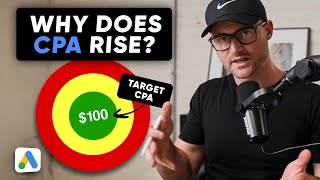
Austin LeClear explains why Google Ads campaigns see CPA rise after budget increases, even with Target CPA bidding. Smart bidding first captures cheap conversions in a limited auction pool. Expanding the budget forces the algorithm into new auctions and audience segments, triggering a learning phase where average CPC rises and conversion rates fall. Scale budgets gradually, about 20% at a time, to let the algorithm adapt.
Chapters
Okay, you have a campaign, it's dialed in, it's hitting your CPA goal or ROAS goal, and you want to start spending some more money on it. So you increase the budget. However, once you do that, the CPA starts rising on you or ROAS starts decreasing. Why is that? I'm going to show you exactly why in this visual and what you can do about it. Let's dive in. Okay, so smart bidding will yield to the lowest hanging fruit first. So, so that's why in the beginning, if you get a campaign dialed in, maybe you're spending 50, $100 per day, you start getting some conversion volume, you're able to tap into smart bidding, and you hit your goal over time, right? When you're spending lower amounts of daily spend, you're usually going to be in less of the overall auctions that are available for those keywords or product ads. If you're running shopping, the smart bidding knows where to get the lowest hanging fruit in order to hit your goal for you. Right? So here I have a beautiful visual for you, right? This we have. We have CPA over here. And so here's your line. Let's just call this. We'll call this $100 CPA then. So here you're in your little. You're like in this sweet spot right here. So this is the money zone that you're currently in. But we also have. So as CPA goes up, we have budget here, too, right? So as your budget increases, your CPA is likely to increase as well. It's not linear. Okay, so here you're in your, like, little sweet spot zone. So you're hitting your $100 CPA right here. Now you want to start increasing. Okay? It doesn't just mean spend more. Hit this $100 CPA goal. That's not how it's going to work. In fact, more than likely, this is what starts happening. You start to increase, right? And it's going to look like this. So now your CPA is more like here. Okay? So you've probably risen depending on what your budget increase is. So now this could be 150, right? And you're freaking out and you're like, all right, we're stuck. We can't do anything. Well, that's not entirely true because a lot of times what can happen is you kind of. You give the machine learning the time to work within this parameter here. Okay? So you've spent more. Your impression share has now gone up. It's learning now from all this new data. So these blue Little dots are all new data points for it, right? What happens is if you give it enough time, it can start to do this. So it's coming back down to your goal now. Not always, but that is what potentially is happening. But as you go up, right, you're entering more auctions. The machine learning now has to collect more data. So let me give you another visual. So here is our bullseye target. This would be. $100 CPA, right? And we've got it dialed in. So think of the machine learning as this bullseye ring, right? It is now dialed in. So when the campaign budget is constrained, the smart bidding knows how to cherry pick conversions to hit this $100 range. So it's in this money zone, right? It knows exactly how to get that for you as you start to try to expand, right. So again, this visual here, as you try to start to expand, you're going to start coming out, right? So you're entering these new zones. The algorithm now has to find additional conversions beyond the cream of the crop, the easy low hanging fruit here. So it has to enter new learning periods of audience segments, times a day, placement devices types, sorry, device types, search queries, et cetera, right? So now it has to go learn from all of this new data. It can't cherry pick, right? And so that is why you start to get this increase in the cpa because it has to collect more data, it has to go through a further learning phase. Now ultimately what you could do, right, is you come back here and you just decrease your budget back. So you, you take these, these red lines, this red line here of your, your spin going up now you, you just kind of work your way backwards and you go right back into your money zone. Because it knows in this cream of the crop area, this is, it knows what the cherry picked down there. But if you ever want to scale and grow, you have to allow the algorithm to, to learn from that further data. You can almost look at it like sometimes I like to do a reverse, let me do a blue line here if this makes sense. So we all know like what a traditional, you know, sales funnel can look like. It's usually upside down triangle. Here's your buyers, here's middle funnel. Here's top of funnel right up here. So this is like the 3% ready to buy. These are people kind of in the messy middle. And then up top is actually the bulk of usually a marketplace, right? They may or may not be aware of your product or solution. So usually most people in Google Ads are hanging out down Here, these are people searching for like men's size 10, 9. Nike, Nike free running shoes. People up here are searching for running shoes. Okay, so this is where a lot of people fight each other in Google Ads. And it's the lowest percent. Now obviously it's not always 3%, but it's the lowest percent of the overall market. Okay. But as you go up, okay, for your search terms you're going to, then, so this is like that triangle. So here inside of your bullseye target of the $100 CPA. In this scenario you're at the bottom of the funnel traffic. So the machine learning knows how to cherry pick this. Then you start to go yellow zones, probably more middle of the funnel. Red is going to be, sorry, red is going to be top of funnel stuff. Right? So all of this is new data. It might not be possible to actually even hit your $100 CPA goal because usually if you enter a higher market, right, your average CPC will go up. So average CPC down here in this green zone might be $1. Average CPC up here might be $5. Right, but you're getting more of the overall impressions. So if you're all the way spending on this side and you're getting basically this whole thing, that would be like 100% impression share. Okay, well you have to pay top dollar to get that. But you're, when you have a constrained budget, you're going to enter less auctions and the algorithm is going to cherry pick those auctions for you. So here you might only be at like a 20% impression share, right? But you can't go to a 100% impression share without spending more money on that $5 bid. Okay, now again you can go up and increase and eventually the algorithm can learn from all this new data and you can actually see then your CPA over time starting to decrease back down because it knows how to optimize off of that, but it has to go through that learning phase. Another visual for you is like here is the, if we just draw a line, okay, this would be, we'll just call it 20% impression share, $100 CPA. But in order for the algorithm to go up and again this is like your money zone here. So this is where easy, low hanging fruit, right, that it's able to pick up. But as soon as, as soon as it starts to go up, right, as soon as you start to get into this zone here, we'll go black line again. Well, that's a red line, black. But as soon as we enter more of these Markets, right. So we're going to go, we're going up further. This is no longer low hanging fruit, so it's going to cost more in order to start entering that. And now you have to figure out like how do we actually even get some of this data? Or the algorithm has to learn from all of this new data that's further up in those auctions. Okay, so here's some key factors then on why CPA increases as your budget increases. The algorithm now has to compete in auctions. It previously didn't, right, because it was in the sweet zone here. Now as the algorithm is doing that, usually that means you have to, your average CPC increases, okay, to get more of your ads in the ad auctions. So if you're at 20% of the auctions and you want to get up to 40 or 50, usually that means average CPC is going to increase. You see that as you enter more auctions and costs are going to go up conversion rate, typically as you go further up and get more auction share, usually you're going to see efficiency decreases. So your conversion rates are likely to start decreasing the more impression share you get. Why is that? Because out of 1,000 people per day searching for a specific term, let's and this is just an example, right? But let's say there's 1,000 people per day searching for Nike Men's size 10 free run running shoes. Okay? Out of 1,000 people, only a certain percent of those people are ready to buy today, right? The other percent, which is usually going to be the greatest percent, they're not ready to quite add to cart and checkout. Even though they search the same thing as someone who's hot and ready to buy today, it's still very qualified traffic. They actually might come back and purchase from you at a later date, but for whatever reason they didn't quite go and check out. Well, you're now buying some of that traffic and they're not quite ready to buy today. And so you're paying more for that because you're now entering out of that 1,000 searches you're now showing up if you go high up to potentially 100% of those searches. Now that's very rare for a non brand search term, but it can happen or at least 90% if you're a big spender. But the more you go up on those searches, the less likely that traffic is actually ready to buy, even though it's the same search term. Now if you can hit your performance goals, I always say maximize the impression share, you can get Right. So if you're hitting your CPA or roas or MER or whatever you're tracking, then get as much as you can for what you can get. That's why when someone comes to us as a consultation and they're like, hey, I want to increase our impression share, I would say that's the wrong way of looking at it. What you want to do is maximize what you're able to do for your goal. So if your goal is a hundred dollar CPA, figure out how do we maximize our exposure at $100 CPA and optimize around that. If you optimize around an impression share metric, it's a good metric to guide you. But if you optimize around an impression metric, you're ultimately no longer operating your account based off of a performance metric. So you then you can start losing money and efficiency and that's more of an ego play at that point. So there's a learning phase of all that new data and you're also paying more average CPC to get there. So that is why CPA will increase on you for a while, but eventually it can come back down. So how do you manage this? But honestly, I have no clue. Well, if you watch any of my other videos, I have a video on bidding and some budget stuff. I always recommend gradual budget increases. I typically don't like to swing my budgets more than 20%. So if I was at $100 per day budget, I may go to 120. That would be the maximum I'd be able to do. Now if you're a low, low spender, let's say you're spending 20, you are fine to go from 20 to 40. The larger you start spending though, those swings become bigger. Right? So from $1,000 per day, said 1200 is a bigger swing than 20 to 40. So you have to think of it in those terms. If you're already spending big money, then 20% like a good number to live by. So what I do is I'll increase by 20%. Usually I'll start feeling some of that increase in CPA or decrease in ROAS. But I didn't go too crazy. And machine learning doesn't like huge swings. And what happens then is, is I went up 20%. So if I'm back in my little messy drawing here, if I just go up in budget. So again, if I'm currently, if I'm currently spending here and I just go increase of 20%, I'm not, I'm not going too wild in the increase now of the Auctions. That is going to be new data for the machine learning to go to. If I went crazy, right? And I want a budget increase of like 100%. Now the machine learning has to learn all of this. Instead I'm just giving it a bite sized chunk to learn from and try to optimize from. And that's how then eventually you'll see sometimes it may operate inefficient for a week or two, but after like a week or two it's you start to see your CPA starting to decrease back down to where you were at. And that's because it went through a learning phase. You just have to give it time to actually learn. Listen, I hope that makes sense and isn't too confusing. This is a tough topic. That's why I wanted to use some visuals. But just remember, Google may tag your campaign and say you can spend more and you're hitting your goal and then you give it more and your goal no longer starts to get hit. It's not magic. You can't just give it more and you're going to immediately hit your goal. It has to now enter more auctions. As you enter more auctions, there's going to be some inefficiency and new data for the smart bidding, the machine learning to learn off of. Right. So it can take time through that learning phase. Also, the marketplace of those auctions might not allow for you to even hit your goals due to the math no longer working in your favor. Right. Conversion rate may decrease as you get more of further up the the auction share and CPCS may increase as well and you may not the smart bidding machine learning may not be able to dial in at your goal with that high of market share that you're now trying to get as you increase your spend. So now you have to look at that and does this make sense for my company at this point? Okay, we know we can't really maximize share here for this campaign due to these reasons. So there's a lot of moving parts. Hopefully this visualization though gives you a better understanding of how these parts all work into play as you try to scale. I hope you got value from this. I have somewhere on the screen a video where I go into a masterclass on bidding. I highly recommend checking that out. If you haven't seen it already, I go through all of the bidding strategies. Why is this important? Because if your bidding strategy is set up correctly, then this piece of scaling gets a little easier. So highly recommend you check that out again. That's somewhere on the screen. If not, no worries. I'll see you on the next video.
More from Austin


Google Ads Negative Keywords: The RIGHT Way to Find and Add Negatives in 2026








