Valuing Helplessness
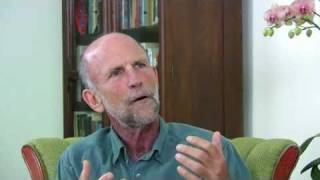
Robert J. Strock worked with schizophrenic young adults, terminally ill patients, and juvenile delinquents. He learned that helplessness—not knowing what to do—is essential to real caregiving. Accepting what you cannot fix lets you stay present with someone's actual pain instead of your need to solve it.
In your experience of being at Beverly Wood, which is the place we worked and had a program for the schizophrenic young adults and the helplessness that comes with working in that population and the seeing outcomes fall apart soon after. Many times insights happen, they fall apart. How did that prepare you? How did that affect you? How did that impact your personal life and your relationships, friendships, intimate relationships with women, things like that.
And the list goes on. Because spiritual life, relationship to trying to figure out life and death, the impact really became greater long term, even more so than short term. Because I didn't realize it at the time because I was so trying to create healing or trying to make contact. The long term benefits of grounding what was at the time a bit of grandiosity, feeling like I could just be a healer. And it helped balance my character structure to where I realized that in spite of having good intentions and dedicating myself to making contact with the people, I'm in touch with that so what I mean, that's nice, but it requires not only two people to do it. But I don't even know necessarily what I'm doing at one level. And I'm giving them my best shot. And that perspective of keeping some degree of self doubt and recognizing that life is so complicated and that helplessness is actually a friend, that actually being able to realize that being in a state of not being sure of yourself is one of the best ways to make contact with everybody on the planet. It's that sense of surety that really is a turn off. And I know, for example, when we worked together with people that were dying and here we are trying to figure out, gee, are we going to try to represent, oh yeah, don't worry, we'll see you in heaven while they're on their deathbed. That we both felt this pit of utter helplessness. And it became clear that the helplessness was part of the compassion and caring and identifying with what they were going through. And if we felt anything but helpless as a significant part of our experience, the people that we were sitting with or next to would feel like we were patronizing them.
Why do you think when you look back, schizophrenics, death and dying people who were terminally ill after that, dependents and juvenile delinquents in a boy's home. What was it that attracted you to those really difficult, hard to reach for many people, they would consider them hopeless people to reach. What drew you to them?
I think that at one level.
All.
Counselors in the field start with the hardest to work with people because circumstantially they're the ones that are available. And you start off as rookies and the rookies get the harder people to work with. I think at another level, I did sign up on a voluntary basis to deal with death and dying later on. And because I identified in the core of my being with feeling helpless and with not knowing and being in this existential human dilemma of, gee, I'm in this body, I have no idea what my long term future is after I die. And it's so wonderful to be with people who are authentically in touch with that. And so to be in that empathic experience with another human being who's feeling helpless, who's feeling openly insecure. There was something very relieving about the lack of performance, the lack of having to be together. And so it was nurturing in a certain way and humbling to be with people who were in an authentic state of natural helplessness and natural insecurity. And I remember so many times that we'd walk together afterwards and we'd say to each other what a gift it was to be with them and how humbling it was for them to be in the even more real experience than we were in, because here they were actually facing their own mortality.
So one of the greatest paradoxes in life is each of our experience of helplessness. It seems that for anyone that wants to be of help in this world, that it's an absolute mandatory experience, that.
We go through helplessness.
That because we're living in a world where we have life and death, we have war, we have pain. And those of us that want to be helpful in supporting people that are dying or want to support people to have less pain, we're certainly going to need to experience the helplessness. And one of the great challenges that we go through is to see that helplessness is really a badge of honor. Especially when we continue to have enough faith and trust and courage and perseverance to want to help those around us. And that mixture of I really want to help and be of support to the world and oh my goodness, it is such an impossible challenge to create transformation with any reliability. And seeing that that resultant helplessness is the human byproduct of this deep desire that we carry in the very best parts of, of our soul. In working with people that are dying and sitting by their side and wanting to create a sense of ease or trust or peace or faith, and sensing in many of them a certain kind of helplessness, the body's failing many of the people that we've sat with, that I've sat with, didn't know where they were going, what the outcome was going to be. And so one of the things that was a sign of caring was I wanted to help them, but realized no pat solution was going to be satisfying. And so that left me in a state of helplessness and a desire to help. So it's like the helplessness and the kindness were coexisting. And my experience is that that's just about as good as it gets, because the person that I'm sitting with knows that I'm with them and that there is kind of like this prayer of wishing peace and trust and ease for them. And each of us, as we look at our love relationships and we wish for a greater love or greater ease or greater similarity in our partner, and they're not quite the same as we are, we're going to feel helpless. Maybe they want to communicate more or less or they're more emotional or less emotional, or they have more faith or less faith, or they're more sexual or less sexual. We're going to have some feelings of helplessness. And if we want to stay positive and we want to try to be helpful to the relationship as a whole, then we're going to be in that perfect combination of I would really like to be helpful to love you more. And of course, I recognize I'm going to also have to have some vulnerability and feelings of helplessness as well. Helplessness is truly an ally when we open our hearts and our souls at the same time.









