Building the next-gen Employee Management ecosystem I Warp Podcast

Ayush Sharma, founder of Warp, built an AI platform that automates compliance, payroll, and hiring for startups by using LLM agents to navigate government portals and fill forms. The company raised $24-25M total, including an $18M Series A led by Sound Ventures, and plans to triple headcount in 2025 while handling half-billion-dollar payroll flows.
Chapters
Ladies and gents, welcome back to another Engineer's Podcast. This week, I'm buzzing to introduce Ayush Sharma, founder and CEO of Warp. Warp are building the next-gen AI-native employee management platform for fast-growing companies. Today, we're going to dive into Warp's journey, why they're tackling the employment management space, and more importantly, the how behind their journey. It wouldn't be an engineer's podcast if we're not breaking down the product and engineering challenges behind this. And Ayush does have some strong beliefs on the product side, which we're going to explore. Ayush, thanks for coming to join us.
Yeah, great to be here.
Give us a bit of background on you. What a unique journey. Give us a few minutes of you, where you come from, and how you came to be today or a few years ago building Warp.
Yeah, great question. So I actually grew up in India. All my family's there. And when I was about 17, I decided that I wanted to go to MIT to study physics. That was a lifelong sort of childhood passion of mine, and I thought that would be a great idea. And so that's basically what I did. It inspired me to apply to the world's best place to study physics, which is MIT. One thing led to another, and there's a fun story there, but I'll keep it brief. But I got in and was one of the first students out of the state of 250 million people to get into MIT for undergrad. It almost cost of like got put from this corner of the world to this like small town in India to Cambridge, Massachusetts, where I spent about 5 years going through MIT to study computer science, physics, and math. I ended up specializing in machine learning and more specifically large-scale machine learning distributed systems. And this was about 2018, 2019. So kind of pre-LLM, pre-transformer, really taking off, but I got an early look at that and it was really exciting to be at MIT at that time because this thing was just sort of happening and you could— we're kind of in the eye of the storm in some sense. So that was a phenomenal experience. And fast forward today, I'm the founder and CEO of Warp. We are, as you mentioned, building an AI-native employee management platform for fast-growing, ambitious companies. And we believe fundamentally that the way companies run themselves and their people operations is going to change with AI. And the next-gen platform there is waiting to be built, and we're the ones doing it. That's a little bit about my background. Let me pause there.
Talk to us a little bit about the problem space and Warp's mission. Like, we had an incredible conversation offline about all the things that you just mentioned, large-scale machine learning, distributed systems, which we're gonna be talking about, and the problem space itself. But there's no one better to set the scene than you on the problem space, how you identified it, and what you're building at Warp. Yeah.
So, I'll give you maybe, like, a brief tour of the space itself. And then I'll kind of situate how we came about attacking this specific problem space, right? But the reality is that there's an entire world of companies, incumbent legacy players in the space that we are building a new product in. That space is sometimes called as like the world of HRM companies. So if you know, like CRM, right? Customer relationship management, everyone's kind of heard that word. There's a version of that in the kind of people management space called HRM, right? Human resource management. Put simply, it's the software and the platform and the tooling that a company uses to manage their company and people operations. And that is something like I— it's most people might not realize this, but one of the biggest companies in the space, ADP, was started back in almost 1950. So it's, they've been around a long time and obviously they might make a lot of money. They're really big, but I think the world has changed so much in just really like the past 5 years since AI and GPT came out. But even then, I would argue that the last like 20 years of software have been all trending towards more and more automation, more and more complex workflows that get absorbed into automation as opposed to just some kind of software UI where you still have to kind of crank the wheels yourself as the founder or the ops person or the HR leader, and you're making it do things, but the software is not doing it sort of automatically for you. And that's really the fundamental difference between why And how we're building Warp in a different way than all the other companies existing in this space is their view is that the software is there for you to go in and do things in. And our view is that the software should just do the thing for you. And in order for us to be able to build that, of course, like AI had to come on scene and GPT had to like get good enough. But this is where kind of interestingly, my personal background and interests sort of converged about 2 years ago when we started Warp. Is I had worked as an engineer. I'd worked on these large-scale machine learning systems. After school, I'd gone to work at Yelp, where in their core machine learning team, I was one of the youngest hires on that team powering the company-wide applications of machine learning, of which back at Yelp, which Yelp, you probably know, it's like one of the original crowd aggregation review platforms for restaurants.
Yeah.
how it started. Now they do a lot of things, they're a public company, but one of the first applications of people and sourcing from people, the photos, the menus, and extracting that data and making it accessible to everybody. And in that, I got to see just working with large datasets and applying these machine learning algorithms and AI towards that. But I also personally was realizing over time that Working as an engineer, just building one thing in a large company was not going to be like the most productive use of my time. I just wanted a lot more ownership. So I moved to New York. I ended up joining this startup that had just raised their Series A from Founders Fund and Google and Thrive. And I worked in that for about a year, basically just doing everything that I could like get my hands on, right? Growth, product operations, some hiring. And one of the things that stood out to me when I tried scaling and hiring people is this fact that how much of government portals and workflows were still being manually handled and left to the employers to do. And that's— that problem is really massive because if you're in a fast-growing company, it's like the last thing you want to put your time on, mind on, is trying to figure out the specific New York code for like workers' comp and when and when, how you should file for that by And turns out if you do figure it out, actually you still have to do it by going into some really annoying .gov portal. And I did that enough personally. I was like, okay, I'll do it. Right. It just needs to be done to realize just how horrible and terrible it was. And in some ways, like we thought that this is really backwards. There's so many tax jurisdictions. There's about 700 tax jurisdictions in the US between state and local places alone. And that was the initial starting point for us to start thinking about Warp. So fast forward to now, we have built Warp as the singular AI-native employee management platform. And the core kernel of that is almost this underlying automated compliance engine that handles all these government filings and workflows using AI, way faster than any human would, way more accurate than a human would, and it happens automatically for you. So let me pause there.
No, I think that was an unbelievable whistle-stop tour of how you came to be today, how Warp came to be today. We probably haven't given Warp maybe some of the credit that you actually deserve in terms of the amounts that you've raised, some of the people that are actually advising you and And importantly, why you chose those people as well, because they form your beliefs of how you want to be category-defining and building your own version in the employee management space. So I'll pass that back to you. Talk to us about the funding, the people that you've got involved, and the why behind that.
Yeah, absolutely. So if you look at our cap table, what's unique about that fundamentally, I think, is if you just look through our cap table, you might think we're like a technical AI infra company. And then people sort of see that we are actually helping employers simplify their payroll, hiring, and onboarding. And turns out, like, that's my belief from day one has been that that's the right approach, like a fundamentally product and engineering an AI-driven approach is what's needed for us to solve this problem for ambitious, fast-growing companies. So to that end, we have raised about a total of $24-$25 million to date, including an $18 million Series A just a few months ago, which was led by Ashton Kutcher's Sound Ventures alongside YC, which was from the very early days part of our kind of founding journey. They doubled down in the Series A. And then we've had folks like Balaji, who's the ex-CTO of Coinbase and partnered with Andreessen Horowitz as one of the first early investors. He's one of the smartest people I've known, and he was basically one of the first investors in the company. Then folks like Amjad, who's the CEO of Replit, is one of the fastest growing AI companies right now. And then folks from Dropbox. So founder and CEO of Dropbox, Drew Houston, as well as the CTO and co-founder, Arash. These folks are kind of like the part of the cap table, a bunch of people from MIT, people building really technical products, really engineering-driven products. And to tie it back to my earlier point, I really do think that nobody in the space in this category has push the boundary of like what you can make happen if you take a very product and engineering driven approach as opposed to starting with like a sales DNA, which I would argue is the state of the companies and incumbents today. They're very like almost, if you look at the personas and the founders and the early team, the DNA is very sales-led. And I mean, it's worked out well, right? Those companies are valuable, they make money, they solve problems. credit where it's due. But I do think that the next generation version of it will not be built by the next great salesperson, it will be built by an engineer.
Yeah. And talk to us about those engineering parts, because cap table might reflect technical AI infra. You were talking about your convergence of experience, machine learning, distributed systems, We spoke offline about machine learning, language models, fault tolerancy. For the engineers listening, get us into some of the juicy details. And it's great because you're a super smart technical founder. Get us into some of the juicy details of what you're solving as a team today.
Yeah, so I can talk about maybe one or two things. That are really important technical problems that we have solved and we are continually improving on. I think the first part is this underlying compliance automation engine that we built. And what that means is imagine, like, as I mentioned, there's about hundreds of these tax agencies in the US. So an example would be like Nebraska's Department of Labor. Turns out the only way up until Warp to interact with that agency is by going into the Nebraska Department of Labor website and/or by either calling them or emailing them or mailing them directly. And you go to the website, there's going to be some very janky UX there waiting for you. Like you imagine like the worst like government website you've ever been on. And then you're supposed to come in, you're supposed to come and fill out all your business information, employee information. when somebody started, how much they're getting paid, their SSNs and all these things. And it, it's a very, very demoralizing experience to have to do that even once. And what actually happens is if you're a fast-growing company, you have to keep doing that all the time. And there's compounding exponential sort of complexity the more you scale the company. So this becomes a full-time job. Like we've spoken to companies where their payroll or HR people have like quit and left the job because they were so stressed about just like handling this. Because you get really annoying tax notices that are very scary. You can get penalized, fined tens of thousands of dollars, which can be really material for small and early stage companies even, right? And so what we built out is, well, first the challenge was, hey, there's no API to interact with these Disparate hundreds of tax agencies, right? And in fact, there will never be an API. And that's very problematic. So how do you actually go and solve this somehow? So one thing that became clear to me about 2 years ago is that, and by the way, just for context, like 2 years ago, AI agents were very early and they were mostly not working. So it was a bit of a bet. that we made that I think this thing is improving fast enough where if we build that, start building our infrastructure to point these LLMs towards these government sites, we can get them to like basically browser use, computer use the website forms. And because we're a platform for these companies where they already have all the— we already have the company data, the employee data, the payroll data, taxes and everything. We can just put that through these government portals, make these filings, and keep businesses compliant automatically. So this was the first big important problem that we set out to solve, and we've built out a version of this that is really, really great. And we have another thing that we had to solve was this is a very high-stakes thing, so we want to be able to have Almost like layers of validation, layers of checking and cross-checking, and also just like an ability for a tax expert on our team to just go in and see, okay, this something is flagged to me, and so I should go and review it and then make sure it's correct. So that's how we built and engineered that system, and that's been one of the key things that we solved. One other example that I can talk about Is right now, I think we are starting to see more like larger companies. So it used to be that maybe a year ago, 2 years ago, we were primarily the major customers, the power users of Warp were early stage companies. And that's evolved to a point where, A, all those early stage companies are growing. And it turns out we are very proud to support some of the fastest growing startups of today. Companies like Reducto that has raised like $100 million in less than 18 months since YC. Paraform, similar story. Blind AI raised over $75 million, I believe, Series B within something like 12 months from founding, something insane. And so we are seeing companies go from like 5 employees to 50 in like 8 months, 9 months. And that has forced us to continue to build the platform in a way that scales with these companies. So the challenges that we are now spending more time on are challenges of these growing companies and they're supporting their scale. So an example of that for— is as you grow and like when you have lots of people and their pay and payroll is changing month over month because there's a bonus or a commission, or maybe they took some unpaid time off that needs to be deducted, we have talk to companies where a human is basically going in and reviewing all the changes and double, triple checking, spending hours and hours a month manually going through, still like getting all these questions from their employees. Like, why did this change? Why did that change? Can you help me understand why my pay is lower or like higher? And so we are building out an engine there to reconcile and review using LLMs, using AI, in something like 1/10 of the time that it would take a human to just manually cross-check these things. And the advantage that we have that we realize is because we're built from day one with this AI-native mindset, we have the right primitives to be able to build the right workflows. And we have the customer base that's like ready to adopt that kind of new approach, right? Because if we, if we tried going to some like Fortune 100 company and they're like very set in doing what they do and it'll take them 9 months to like maybe adopt a new AI-driven process. That's gonna be a long time for us to like get a feedback loop going on. But our customers, they just can't wait for these kinds of improvements to like get their hands on. And that's what's really powerful about where we are in our journey today.
That is really powerful. What's it like being a AI-native CEO founder that's still technical today? Like, what are those feelings, experiences? Like, walk us through that.
Yeah, this is actually a— I love this question because I've been thinking more about it recently. It used to be the case that if you were a CEO and you were technical and you were an engineer, which I am, and that's my background. That's my first love and interest. You were kind of forced to step out of the code base and making technical and product contributions almost in a way that was a little bit sad and disappointing, right? Like, I think if you talk to really technical founders and I mean, you know, I I think lots of, plenty of examples of great MIT graduate founders or MIT dropout founders like Drew Houston and so on that who really love to code. They're very good at it. But unfortunately what happens is that if you're a CEO, you just have too many things that only a CEO can do, which just leaves very little time. So you find somebody who who's really great as their CTO and a partner in this journey in building. And obviously we have that, we have Adam, who's one of the best engineers I've ever worked with as their CTO, who's running an entire team and some amazing people on the product and eng team in general. But here's the key thing that is different about this now than maybe like even 2 years ago is that I can go in and make interesting and useful contributions in our codebase with tools like Cursor and Claude Code. And I love both of them. Cursor, yet another MIT success story, of course, one of the fastest growing companies of all time. And I really see, I can see why, right? Like for me to be able to go in, like the other day, I'll give you an example. We have, I'll give you a very concrete example actually. So we have this, we have a lightweight expense management system built in Warp that we shipped like a year ago. And what that means is employees can go in and upload a request for an expense and reimbursement, and the employers, they can come in and review it. Once you approve it, it gets paid out as part of the payroll. So it's a full end-to-end, neatly tied-in experience. And so one of the things I improved there recently, and I just like, all I did was fire up like Cursor and just start building. And this is something that I wanted to do it for a long time. But I know that, you know, engineering team is really busy with making these very important like infrastructure and really big product things. And I had this, I like internal, like I knew that I could improve this flow if I just had some time. So like at some time last week or like kind of late evening, late night, I had some free time and I fired up Cursor and I built an improved version. I just kind of refactored and built an improved version. where all you have to do is you just upload the picture and it extracts all the right information like amount, vendor, date, category, and you don't have to enter a single thing. Then you press enter to send it out. Once it's approved, it'll get paid out. So, and then I had someone actually, so we use Warp internally at Warp to run our company because, right, of course. And then one of the new employees on my team, she requested an expense off of that like sometime after. And she was telling me like, oh, that was so easy. Like I just put it in a picture. I didn't have to type in anything. It was so, I really liked that. And I was like, yeah, let's go. Right. So this is the kind of difference today being a technical CEO than maybe 2 years ago.
I was gonna say, and you reeled off a number of different names. People want to be contributing, and I think the accessibility of tools, technology right now, you can, but you probably also need to be, just with how fast things are moving and changing. You need to be close to—
Absolutely.
What's being built, how your team are building, because you need to be able to understand Where's our product going? How can I add value? So that doesn't surprise me. You're able to parachute in, look at something, build it, ship it, and get people enjoying it straight away.
Yeah. In fact, this kind of goes to something that we chatted about offline, Elliot. I think that there's been a shift, I think, in the last really 2 to 4 years where technical founders are back. Like engineering founders are back. And what I mean by that is, I think maybe from like 2010 to 2020s, we were in this like decade-long lull period where it seemed like for that period that the advantages and the biggest companies were going and were getting started by these like older, very like domain expertise or very sales-driven founders. And there was a reason for that, right? Like the early technologies like cloud and mobile were sort of maturing. And so the advantages would go naturally to people that have deep vertical domain expertise, or they have some kind of like sales network or sales chops or like teams of connections and relationships when it comes to sales and distribution. And I think that quietly changed sometime in the last 2 to 4 years. I haven't seen many people talk about it. where it— I think you, you need less of that. And all of a sudden, like, the average age of the YC founder has started like coming down back again. You of course have like Aman from MIT at Cursor who's like maybe 23, 24 and is now like a billionaire, right, within 3 years. It's— and that kind of story, you just didn't have that in between 2010 to 2020s. And that's why I'm really excited about like Applying ourselves and applying myself and the company towards this problem space. Like I wasn't a payroll expert by any means when I started this, I quickly became one because I had to. But the advantage is if you're highly technical, as to your point, you can see the future when there's a new technology and you can be the first one to like pull that ahead into your platform and build something like insanely great. Whereas the larger companies, the incumbents, like, it just takes them too long to figure out that something fundamental has changed in the world.
Yeah. And I think this is very much credit to you spotting an opportunity in payroll employee management, that it's such a big space dominated by incumbents. How can I apply technology to actually fix this. And of course, there's a level of timing and luck and fortuitousness there, but you applied it. Someone has to. I want to come on to some of your beliefs and meta points around AI, LLMs, next couple of moments. But you were speaking about engineering team working on infrastructure, large-scale product challenges, changes. Talk to us about that and maybe the culture of Eng for people listening that are potentially interested in hitting the apply button, talking to you guys. Like, what does product and Eng look like on a day-to-day basis?
Yeah, I love that question. So first off, we are hiring engineers and product and designers. Like crazy right now. It's the biggest, single biggest important thing that I'm spending my time on is finding exceptional engineers and product and design people. And the reason for that, like, it's a funny story almost that for context, we have tripled our team size in this year. So in 2025, in the current year, we went from something like 6, 7 people at the start of the year to now almost 25. And I think we're on track for another 2 to 3x team size next year as well. And one thing that I saw shifting sort of in the last 3, 5 months when most of the new hires we made is that I think we sort of had to change our mindset from being a very small team that is constantly just like heads down building and shipping. to sort of emerging out of that a little bit, especially me as a leader and a CEO, and thinking ahead of like what a kind of org structure and company and team we will need for the next 6, 12, 18 months and do that. And so one of the things became clear is that I think we were— it's okay to be, to have like individual 10x, 100x engineer early on. And that's like who our team is today. We're a handful of small team of engineers and product people. I'm very involved in all things product and design especially, and I trust Adam to run all the engineering and infrastructure work better than I could. And that works really well. But I think, I think at some point, like, you, as you continue to grow, and we've been growing really fast, our customers are just like violently using the product, pulling things out of us. as fast as they can. And we just have so much to build. And look, we have a very exciting roadmap of all the problems we could be solving here. We're taking an approach where we are— we try not to use third-party vendors and try to build in-house as much as we can, which means we get to control the entire stack. We get to like have a deeper, vertically integrated, better experience. And so that's the kind of work we're doing. It involves a lot of deep infrastructure. One data point is like we are almost handling something like half a billion dollars a year in terms of people's money and are on track to do about a billion to $2 billion in the next year. And that means, you know, you can imagine all the problems of like money movement and scale. Like we will start to sort of get into that too. So the challenges here are really massive and there's very fun, interesting engineering and product problems to solve. And that's why I think we are really focused on hiring. Now, in terms of what that looks like day to day, how we work, how we operate, as I mentioned, we're a small team still. We will probably double the team size in the next like 2, 3 months likely. But I think the key thing for us is we like to move very fast. We call it internally our number one value, company values, move at warp speed. And that just means like we're somewhat impatient with things. We're like, why can't this be done today instead of tomorrow? Why can't this week instead of next? And I think that is a massive advantage in just sort of how we've been able to get so much done so much faster than any company in this space that ever done. And we want to keep that. So we'll move very fast even as we expand the team. will care deeply about quality. So that it's almost like people think that there's a, there's some like trade-off between speed and quality. And I think one of my contrarian beliefs here is that it's, it's a, it's, it's not really true. And I would almost argue that I think people who try to tell you that there's a hard trade-off between speed and quality, I think they're somewhat mediocre people. So this is kind of like my, Hot take version of— this is my hot take version of that for the episode today. But it's very true, right? Like I wrote this document internally for the team and one example, 2 examples I included is like Steve Jobs and Tony Fadell shipped the first iPod just 290 days after the initial product was proposed. 290 days. It was in the hands of real users. And this is Apple, by the way, which you people imagine is like the most perfectionist visionary company. And then another example is, which I love, is Newton discovered all of calculus in under 2 years. This was during the plague. He had a lot of free time and he basically discovered the entire field of calculus in under 2 years. And I think the larger point here is the faster you can move, the better you can compound learnings, the better you can have feedback loops, which for us means getting things in the hands of users, caring about quality, making it really good, and then seeing how people are actually using it. So what that means for the team, for the day-to-day, is like, for anyone listening, is we are very obsessed with getting things in the hands of real customers. And we have no shortage of those customers wanting real things to use, which is a great position to be in. And then we talk to them, okay, what's working? What's fric— what's high friction? What can we improve? What's broken here completely that we should fix? And because we do that very quickly in closed feedback loops, that means the engineering team gets to learn very, very quickly and develop very quickly. So that's the culture we have. Move fast, care deeply about quality, and don't assume that there's a trade-off between speed and quality. Actually, we can do both.
Love that part. I love that part. For people listening, you should definitely go and check out Ayush, Gabriella, some of the team, Adam, what they're building. They're doing some excellent stuff. Contrarian beliefs. Are there any more hiding behind there? And also, we do want to talk about meta points, beliefs, around AI, LLMs, and potentially where the next 6 to 12 months look like generally in the sphere, or whether that's for Warp. So to break that down, contrarian beliefs, any that you want to throw out there, and then some meta points around AI and LLMs.
Yeah, I I think maybe to set the tone here, I think we're at a really critical inflection point in the world in general, where I think most people have sort of— I think especially on Twitter, especially on like engineering circles and people who are like really sort of day to day keeping up with AI, I think they've sort of seen how magical this stuff can be and how important this is going to be. But I think even then, the majority of people who already know about how important this is and how magical this is, they're still underrating the impact this is going to have, like LLMs and AI. And what that means is we're not fully extrapolating all the way to all the consequences of just how much work will be automated. And there's, there's like real implications for that in general that like more almost like broader society level, right? This is a big shift. Um, like what happens when Waymos start to roll out? Like one of my favorite products I've ever used in the last few years is Waymo. Um, and the first time I tried it, I, I told someone, I'm really sold.
LA in the summer, I was like, what? It's taken me this long, obviously, but I was like, this is nuts.
Yeah. I, so I had, I remember I was on the early invite list back in SF when they were, when they were rolling out and I tried to get, sit in one as quickly as I could. And I told someone after my first ride is like, I would imagine, like I was in India when the first podcast, I'm sorry, when the first iPhone launched. And I was like a broke kid in like a poor family. So I didn't really like get to get my hands on the first iPhone, but I'd imagine that's like the taste of future is how it would have felt. You know, like being in the Waymo for me was like that level of an experience, how I have heard people talk about the first iPhone or the, you know, that sort of thing. And so I really think, I mean, that's magical and it It's only a matter of time that Waymos will be everywhere and just how much that will shift the economy, our city infrastructure, what happens to the infrastructure, how will that need to adapt when you have a fleet of autonomous vehicles all driving at all times, doing deliveries, transporting people, services, and goods. That one thing alone is a massive, massive thing. And that's just one of the 10 things that's happening right now. Another big thing that's happening is, I mean, I think I was just reading how Harvey— You're bullish.
Yeah, I'm very bullish.
I'm very bullish in the sense that it's almost like the original promise of software can finally be realized. And it's Do you know the concept of— it's like if you're in a— do you play video games at all?
Yeah, of course.
Okay. So in like any video game, you have like a skill tree, right? And the skill tree is like you gotta unlock something for the next level to unlock, and then you unlock that thing. So it's like maybe you can, you know, in order for you to like unlock the flying skill, you have to first learn how to like the running skill or the sprinting skill, right? Something like that. It's kind of a made-up example. You get the idea.
No, no, I get it.
But it's almost like we had to build the first version of software systems and then we had to network them all together. That's the internet. And we had to like run the internet experiment for like 10, 20 years to generate enough data, enough good high-quality data that you could feed feed and use transformers so that they could learn, self-improve, and finally you get LLMs. So it's like to unlock the LLM tree, you had to go through the early— there's just no way you could do LLMs.
Yeah.
There's just no way you could do LLMs before the internet because that's where the data came from, right? So you needed the data. It was like an important step. It's like a stepping stone step. And I think that in some ways, like if you want to be somewhat grand and poetic about this, which I think is a fun exercise to do in itself, is it's almost like it was all converging towards AI and we just had to get through the intermediate steps. And so what that implies— go ahead.
No, I was going to say that what a beautiful outlook that is. I've never thought of it like that, but that it's a really interesting outlook.
Yeah. And so I'll finish this point really quickly, basically, but I think the original promise of software was true automation so that humans can be free from repetitive, tedious, boring work. That's almost like the original promise. And I think unfortunately it didn't come quite true up until maybe AI starts to get good enough. And so we are now in this like window where people are figuring out all sorts of use cases to free humans up from repetitive, tedious work, which I think is a very noble cause, right? Like, I think, look, you and I, we both have a short amount of time on this planet, on this earth. And look, we just have one life.
Yeah.
And wouldn't it be great if we could not spend most of our waking hours dealing with tedious, repetitive work and we could apply that limited time we have to being creative, solving problems, building interesting things, putting interesting stuff? And I think it's possible for us to finally work towards that in a real way with AI. And so in some funny, like, but really real way. We're doing that for companies and ambitious entrepreneurs and founders and ambitious execs and leaders and people to do that in the— at their companies and move faster.
I can definitely see how that feeds into your speed, quality, how you want to build things culture now that you're so bullish on You feel that there's a promise of an opportunity here that we've been building up to over the last 30 years, and you've watched so many other peers at MIT go and build phenomenal businesses quickly. I understand your views. I feel I do, at least.
Yeah, that's why we're fired up.
Yeah, exactly. Before we leave, Warp next 6 to 12 months. What can we expect from you guys and girls apart from the internal growth and no doubt more feature building? Just as a way to wrap up, what can we expect?
Yeah, I'm spending, I mean, this is almost end of year, right? 2025 wrapping up and It's always a great time to start thinking about the year ahead and all the plans and goals we have and where we want to be by this time around next year. So I was doing that exercise over Thanksgiving while being with family, and it's a really exciting time for us because as I was mentioning, we about 3x'd our team headcount this year. And there's almost like a phase shift that happens in the company when you go from like under 10 people to, I would argue, maybe definitely by when you're above 15. And I've really felt that. And I'm just so glad that we are as a team, as a company adopting really well to going from a, like an early stage pre-product market fit, small scrappy startup to now thinking about The scale and the responsibility that we almost have now. It's like we've built something incredible. Users love it. They give us great overwhelming positive feedback. They tell us all the things that they want us to build for them for the near, medium, future term. And it's a, it's an immense responsibility. We make sure people get paid on time. We make sure that their businesses are not having to spend time dealing with all these compliance mazes and obstacles, and that they get to build incredible things, right? Like we have companies that are media companies and biotech companies and AI-driven new products that are quickly taking like, like sort of rocket ships. And it's a big responsibility we have. And it's almost like, I love, I love this line that I read somewhere that if you believe you have an incredible product, It's almost your moral responsibility to make sure that you get it in the hands of everyone, right? So next year for us, 2026, is about true scale. It's about building the company and the org and the culture in a way that we can go from now, as I was mentioning, about under $1 billion in payroll to now several billion dollars. That's the scale we are aspiring towards. That's the trajectory we're on. And as part of that, I mean, more concretely, I think we'll likely go and raise an amazing Series B in 2026. So for anyone who's listening as an engineer, this is a perfect time to join right before that, before your stock appreciates 4x in the next year. And so I'm spending most of my time, at least right now, thinking about it. I think the challenges ahead are of a slightly different kind than the ones we have solved in the past. And that's what makes it really exciting. That's what makes it fun is that being part of a startup, you're not solving like the exact same things every single day. And that's what I love about it. But I think one or two things concretely that we're thinking about is how do we make sure— this is a very concrete thing. It's like people love our customer support and customer service and how obsessed we are with feedback and our users. And I want to make sure that as we go from our current scale to even 10x that, 100x that in the future, how do we maintain that culture, that obsession on our customers? It can definitely be done. There's companies that have really done it, but most companies drop the ball on it as they continue to grow, right? They sort of start treating their users as like second-class citizens. Maybe they start treating their board or employees or or like investors as their first-class citizens, but I think it should always be the customer and the user as the primary focus. So we're going— I'm thinking a lot about how do we maintain that, right? How do we codify the values that we have today so that everybody, like all the 50+ people that will join us in the next year, they're all on the same page, right? So it's the meta point there is almost like, how do we scale the phenomenal culture we have? And make sure that everybody that we are finding, that exceptional people that come and join us, they are aligned on that vision, that goal, and that mission.
Love that. Retention, just as important as new customer acquisition, by the way. Acquisition's a lot more expensive, and the culture that you're driving internally— I know with you, some of the others that I've met, at the helm with your passion, with your views, I know that you're going to go and execute. I'm really looking forward to seeing what you guys and girls get up to over the next 12 months. We'll continue chatting, but I'm rooting for you. I know that Warp is going to be a name that I continually see.
You'll definitely see us more.
Love it. Keep smashing it. And if you're listening, you're an engineer, designer, you're in the ML space, whatever it might be, careers page is below. You should definitely go and check these guys and girls out pretty soon. Pretty soon.
And I would add that if you've made it this far, if you made it this far and listened to us, then I will throw in my personal email for you, which is ayush@joinwork.com. Feel free to email me if you're interested in a role, and I will get back to you. Love it.
There you go. You've been an absolute delight. You've been a phenomenon. So I want to say a massive thanks. Thanks from everyone here at Engineers. The likes, subscribership, all that good stuff. Keep doing that. Keeps this little ecosystem going around. Ayush, team at Warp, thank you. Keep smashing it.
Love it. Thanks, Elliot. Take care. Bye for now.
Hey guys, thanks for watching this episode. Massively appreciate you listening and checking in with us. If you want to find out more about us and what we're doing, please check us out on social media. What we're trying to do at Engineers is build community to drive knowledge sharing and experiences. On Twitter, we can be @founderengineersio. It's no underscore. We've also got a website which is engineers.io. These links will all be posted in the description. Any feedback and comments are massively appreciated. We're always looking to improve on where we can. Thanks, guys.
Thanks, guys.
More from Ayush
The Subtraction Economy: Why the Next Great Companies Remove Work with Warp + Sound Ventures
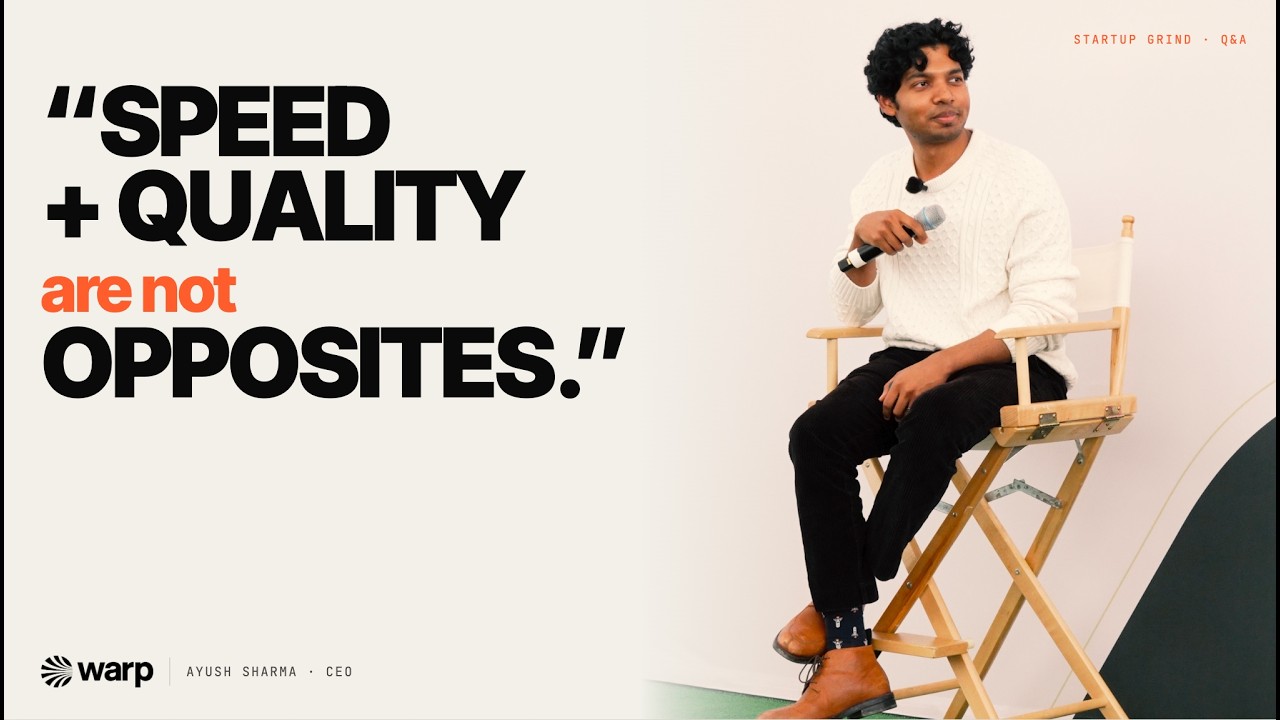
"Speed and Quality Are Not Opposites" | Warp CEO Ayush Sharma at Startup Grind

Building an AI Startup After MIT: Fireside Chat with Warp CEO Ayush Sharma | MIT Startup Week
NachoTips: AI in Product Development - Warp CEO Ayush Sharma Gives His Perspective
