The Subtraction Economy: Why the Next Great Companies Remove Work with Warp + Sound Ventures
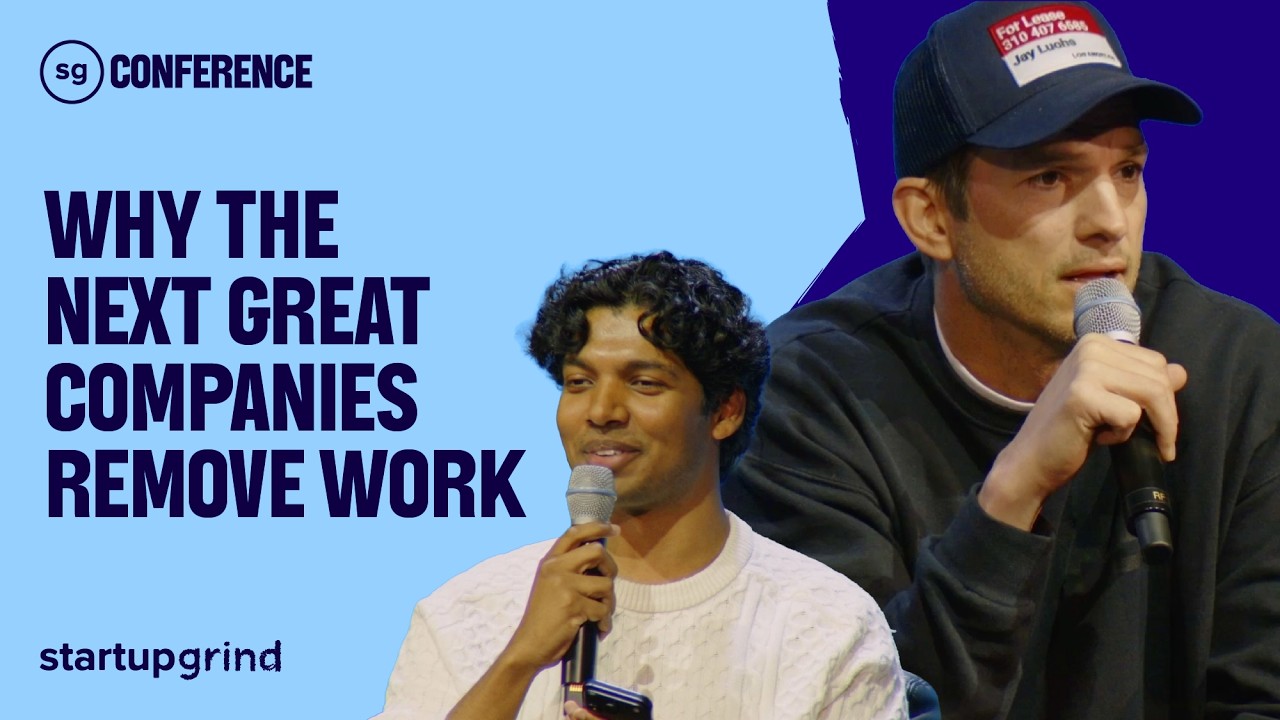
In this interview, investor Ashton Kutcher and Warp founder‑CEO Ayush Sharma discuss the emerging "subtraction economy"—the shift from adding layers of software to removing tedious manual work through AI‑native, agent‑based platforms. Kutcher explains his investment thesis, emphasizing a contrarian belief that deep verticalized AI agents will become the true moat for future companies, much like the iPhone’s architecture did for Apple. Sharma outlines Warp’s mission to rebuild employee management (payroll, tax compliance, onboarding, benefits, IT identity and device management) from the ground up as an LLM‑driven, permission‑controlled platform. He describes how Warp’s architecture lets them launch new products rapidly, achieve massive efficiency gains (reducing 10‑20 hours of manual work per employee to a few minutes), and operate with a tiny internal ops team (1.5 FTEs) despite serving fast‑growing AI startups. The conversation covers hiring for the AI era—seeking adaptable, tool‑savvy engineers—and the diffusion challenge of getting enterprises to adopt workflow automation. Kutcher and Sharma also address the critical issue of error rates in high‑stakes compliance, detailing human‑in‑the‑loop validation and continuous model improvement. The dialogue ends with a forward‑looking view that while full automation is not yet achieved, the subtraction economy is rapidly delivering more work done with fewer people, reshaping how companies are built and scaled.
Chapters
Hi guys, how's everybody doing? This is awesome. This is really cool.
Great, great to be here.
Super excited. Gang, this is amazing. And I just want to say that I'm really honored to be here. I love startups. I love the idea that you could take something and you take an idea in your head and you put it in the world and you can make the world a better place for other people. And the ecosystem that supports that happening in this world is not to be underappreciated because there are very few places in the world that have an ecosystem like this that supports that. And it's the reason why America is the greatest place for innovation in the entire fucking world. So props to the people that put this together.
Cool. Well, Ashton, it's great to be here and doing this. Well, you might not in the intro, but do you want to introduce a little bit about why you decided to invest in Warp, how you think about the space, and how you're broadly thinking about investing in AI companies today? Maybe we can kick off there and then I can talk a little bit about going from there about Warp.
Yeah, awesome. And then maybe you can tell people a little bit about yourself 'cause your story's incredible. So I've been kicking around investing in startups for almost 2 decades now. And I think the one thing that every startup that we find or invest in has in common is a founder that has shared moral values in what it is that the world should look like and what their vision is for what the world should look like. A shared desire to make life better for people and generate enduring happiness in the world. And then, you know, there are a lot of people in this world, when they come to an intersection, they think about going right or left. And then there are a few people that when they get to that intersection, they see up as an option.
Yes.
And Ayush is one of those people. When you sit down with him and you talk about the ecosystem, when you talk about employee management systems in general, when you talk about how to make companies better, more resilient, and stronger, the way that he thinks about problems that he has within his company, but problems that other companies have within their companies, he sees Up as an option. And there've been these moments in time that we've experienced and invested through, like when the iPhone arrived, and all of a sudden there was this smartphone in everyone's pockets, and everyone thought, well, this app ecosystem, there are gonna be some small companies that are built in this app ecosystem, But the real companies aren't going to be these app companies. And then turns out that there are a lot of these app companies that we believed in early days that turn out to be the companies that are driving the markets today. And then when this AI revolution happened, and 3 years ago we invested in OpenAI and Anthropic and these other companies, a lot of people said, well, there's going to be this ecosystem that will exist. On top of these AI agents or these LLMs, that on top of these multimodal models and leverage these things. But the real companies are gonna be these companies that happen. And we just have taken a contrarian belief to that and believe that there are verticals where there are needs for deep verticalized agentic innovation. that touch human beings and the touchpoints for human beings, that there is a true moat in that product that gets created. And so when we met a founder that matched the profile of a founder that we were interested in, that was going after a problem that we were very familiar with, we've invested in this space before, we realized that there's a moment in time that is now, That people who understand how to build on top of agentic infrastructure and are going to build from the ground up on top of agentic infrastructure are going to be the people who have the leverage to build the best products for the customers. And that's what Warp is, and that's who Ayush is.
Well, thank you so much. That's a very flattering description, by the way. I really appreciate it. I think quick background on myself. My name is Ayush. I'm the founder and CEO of a company called Warp. As Ashton sort of set the stage for me, they invested in us about a little less than a year ago as part of our Series A. But really, quick background on myself. I grew up in a small town in India in this very normal middle-class family. I didn't know a single person who had gone to the US. So obviously, I decided that I wanted to study physics at MIT. behind the backs of my parents and teachers and peers. There's a fun story there, but long story short, I ended up becoming one of the first students out of this state in India of about 250 million people to get into MIT for undergrad. There I studied computer science, physics, math. I ended up specializing in doing research in large-scale machine learning systems. And what was fun about this, this was like 2019, 2020, right before that pre-ChatGPT moment had come out. I quit my role when that happened and decided that I think we wanted to take a stab at one of the hardest problems in the space. Even though back then the agents were quite brittle, we could see that we could use them to go after one of the most complex tax compliance, deep employee management workflows where HR finance people are spending a ton of manual time today. So we took that bet. It was fairly contrarian at the time. A lot of people told us to not go down this one. It's too hard, too messy of a space. But we sort of kept building. And so fast forward today, we're about 50 people based out of New York growing quickly. We serve some of the fastest growing AI companies with all of their employee management needs. So whether that's payroll, deep tax compliance, onboarding, benefits. We recently just launched our IT product suite, so all things with identity access. We wrote our own device management software. We're taking this very deep approach to engineering-focused, product-focused on a space that's just been untouched by AI. I think to Ashton's point, we fundamentally believe that the last generation or the last 2 decades of companies You can't reorient them to be completely AI native, to just bolt on top. And that's where we come in as fundamentally from day one, what does the LLM agent native platform look like with deep permissioning controls when the stakes are this high, when you're dealing with taxes and money movement and so on?
The thing that I would point out relative to that— so given the foundation of what the company is built on and the way it's built, You heard all these products that just get dinged off that have been launched, and there are more products that are pipelining that are coming. You can't do that under the old architecture. You can't just crank out the next product and the next product and the next product under the old architecture of company building, but under the new architecture, you can. And that is a core differentiator. And so if you really believe, and there's a lot of conversation around moats, which I think is important to talk about. So when you look at these companies, you look at companies that are being built, one of the biggest things investors are looking for all the time is, where's the moat? Given that anybody and everybody can jump on Clogged Code and spit out the software, where's the moat? And it's a hard question. And a lot of people are like, well, it's brand, or, no, no, no, it's taste, or what is it? No, it's the architecture with which you're building that allows you to iterate on the frontline the fastest. The true moat is the product. It's actually your ability to service your customer better than anyone else. We've seen lots of people, let's just take the iPhone as an example. The architecture of that product and the precision of understanding the customer and servicing the customer need is what made the iPhone continue to scale out. And you can argue, look, when Airbnb came about, it was like VRBO existed, it was called HomeAway at the time, but the care and the love and the attention to the consumer experience and the ability to iterate product at the time in the way that they did in order to service the customer need is what the differentiator was. You will not be able to keep pace if you don't have and you're not built on top of this new architecture that allows you to drop that many products in a year. That's the differentiator.
Yeah, I think one, that's a really great point. I think we often joke internally that we're this very horizontal platform with lots of these products interlocking onto each other. And we joke internally that the number of products we have, they're almost independent several billion dollar companies doing each one of those products. Whereas for us, I think we've done that with a handful of engineers, with a small, much more elite, but a really small team. And I think that just wasn't possible before. And so me, I think I really found the last decade as I was looking to start a company, I think the only reason I got really excited is It's almost like if you're a technical and product-minded founder now, the best time to build something is today. Whereas the last decade almost felt like you were in this late game, end game of SaaS software where the only opportunities were these very narrow point solutions because all the budget was taken, all the things for surface area were taken, and there was nothing new that you could actually do. So I genuinely feel like pre-AI, I just wouldn't have been this excited to build a startup and build a company. But I find that very exciting.
So when you think about building Warp and you think about your customers that you need to service, what you need to give to them, how do you think about— and it really is like a new way of first principles thinking to some extent. As you're architecting your company, what do you go, well, I can strip that away? One of the greatest, The whole sort of idea of this conversation is in a function, like, do more with less, right? But this has existed, this simplification has existed forever. Like, Coco Chanel, one of the great designers of all time, would line up the models to go out on the runway, look at them, and take one thing away, and then go, okay, now it's perfect, now you can go. The idea, like, in studying Steve Jobs to play Steve Jobs, I played him in the movie in case anybody ever saw it. But one of the things that he did, to these engineers and folks, one of the things he constantly did is like, what can we take away from the screen? How do we simplify this? How do we simplify the user experience? When you're building your company, what do you think about taking away?
Yeah. So as we were thinking about the title for this talk, I think we sort of settled on this unusual phrase, the subtraction economy. But really what we were thinking about is if the last generation, the last couple decades of software were about adding more dashboard software tooling vendor that humans still had to manually hand crank. I think the next generation is going to be about how much of the tedious manual operational work can you just completely remove from the picture. So we started with one of the hardest areas in this space, which is in the US, thousands of tax jurisdictions and state, local, federal tax compliance, very high stakes, very low fault tolerant. And we just pointed all of our energy towards solving that. And what we're finding is this entire category of the finance and HR suite that is running manual reconciliations, manual work, we're able to just remove that, drop down from 10, 20 hours a month for one person to a couple minutes. And that's leading to this new kind of generation of companies, the fast-growing companies we see, they were able to do with one HR superpowered ops generalist, let's just call them, what typically would've required 15, 20 people teams in the past at the rate at which we're growing. So I think we're really excited about that.
So this is a trend that we've seen as investors as well, where it used to be, all right, the humans are going to input information in, the company is going to aggregate data, and then we're going to create dashboards that tell the humans what to do or what needs fixed next. And then what we're seeing now is the humans are putting information in or some AI note-taker is putting information in, you're doing your data aggregation, then it's coming and saying, hey, we need to fix this. Are you good if I fix it for you? And then it's actually running. And so the human in the loop is actually just permissively driving the agent to make the change. Like we've seen it in ITSM. We have a company called Servile that we invested in. that's like an ITSM ticketing solution that just delivers it. Whoa, whoa, whoa, whoa. There's a little whistle whistle. And it basically says, all right, here's a ticket that needs resolved. This is the way you can resolve it here. Now it's resolved, and now you just move, and you move through that flow much faster. We've seen it with CRM. There's a company called DayAI that we invested in where the last thing sales professionals want to do at the end of the day is update the CRM. and pound a bunch of information into it so that it can do it. It actually just does that for you. It does all the data entry based on your conversations and flows. And so it's taking that next step and it's going, what did the dashboard used to prompt you to do? And now we can do that for you as well, which extends out the scale of the product.
Yeah, it's almost like if you assume that the job of software, like truly the true promise of software was to free humans up from tedious manual work. I think we're finally able to kind of do that with AI and agents because this exact point of around like, how can we just do that in the background for you and use and reserve human input and human judgment for that very like tie-breaking, for that the exact context that the execs or the CHRO or the CIO holds in their head, only bring them in whenever needed, and the system kind of runs in the background. Uh, I think there's like a funny tweet the other day. It's like, uh, finally we can just, uh, let the agents run and just go take a walk to the park. Um, so I think it's, it's really just, I think we're approaching that point soon.
We're not there yet, but we're getting close.
We're, we're getting close. Um, in the meantime though, I think we're just getting a lot more done, and I think that's really fantastic.
So when you think about architecting the organisation inside Warp, and you think about scaling out the structure of what you're building, are you hiring less people? And is there a certain profile of person that you're looking for and capabilities within? How are you determining, hey, this is a good team member for Warp because They're going to understand that next level of efficiency?
That's a great question. I really think so. We were just about 10 or so people up until a couple months ago. And everyone always used to think it's like, this must be a much larger company because of all the products and like the customers, how many they have. And we've now come up to like very quickly 40, 50. And I think we are scaling the team, but I think the kinds of people we are now really wanting for are very different from pre-AI, pre-agent era where I think we're just much more focused on high-slow people now. Can you just really quickly adapt and use these tools to orchestrate the amount of work that previously would have taken several days to now you can actually do that in maybe an hour? That's what's really exciting maybe on the engineering and product side. I think we're seeing that on operational side as well. For a company like us, what we're doing, the public comps that we have, we don't need to name them, but often if you look at their headcounts, they're like 30, 40% of thousands and thousands of people that are staffed in support, tax, operation function. And because we sort of built from day one to try and automate that fundamentally with software and agents, we have 1.5 person on our internal ops and tax teams. One person is part-time, that's why I say 1.5.
See, it's funny because you think about them as a competitive set, and I, as an investor, I'm not sure that I think about the other companies that are doing similar functions as a competitive set. In so much as I don't think that Steve Jobs looked at Sony Walkman as a competitor for the iPhone. I don't think that Steve Jobs looked at Nokia's handset cell phone as a competitor for the iPhone. I don't think that Steve Jobs looked at all the other functions that an iPhone— I don't think he looked at any of those incumbents as absolute competitors. I think it's like category defining in a way. And I think, look, there's still gonna be companies that are existing enterprises that may not want to transition or maybe just are uncomfortable transitioning into an agentic world or an AI world, that those companies are gonna have tons and tons of customers to serve. But I think there's just gonna be a different kind of company builder. And I think you're built to service a different kind of company builder that actually wants those and needs those tools within their organisation and wants the people that are in human resources to actually be interacting with humans. instead of interacting with a bunch of labor that is in some way, shape, or form servicing a human. But I think that human-to-human contact is gonna become more accentuated inside of those orgs as a result. The other impediment that we're seeing a lot is truthfully just employees having a willingness to automate their workflows, where they go, wait, if I automate my workflow, I'm not going to be useful to anyone. And you go, actually, no, if you automate your workflow, you're going to be more useful because you become a person that knows how to automate workflows, which creates a more efficient organization overall and on a go-forward. I think that right now the tools exist to do this, but what we're faced with is a diffusion problem. where the adoption of those tools is not happening at the same rate that it— at the rate that it could and should to create the efficiencies and the outcomes?
Yeah, this definitely will take 5 years, 10 years, 15 years, 20 years to really kind of play out and diffuse. That's just like the lesson from the last big platforms change, as always. And to your point, I think we internally sort of phrase this as Warp is built for Purpose-built for ambitious companies. And what we mean by that is our customers, we've seen customers grow from 10-person companies that just signed up when they were really young and getting started to now 100+ in a matter of 9 months. So that's a 10x headcount growth all on Warp within a very, very short period of time. And all that time, what we're able to see is they have maybe 1, 1.5 people on their finance, HR teams. And because they're so leveraged on these systems that are automating large chunks of that manual work that they would have to do. And I think there's just this like K-shaped variance happening in the startups as well and the companies that are just growing a lot faster today. So I think like the— to your point, I think that those larger sort of mid-market or enterprise companies that are not as amenable to this new kind of workflow, this change, it will probably take a long time. And in the meantime, there will be great companies serving them as well.
Okay, I'm gonna throw you a curveball and you don't know this is coming. At all, so get ready. And I the big the big knock right now that a lot of people have, a lot of enterprises have, a lot of market companies have on using AI-based infrastructure for their company is the error rate. What does the error rate look like for the outputs inside of your products? And how have you dealt with it and how are you reducing it over time?
Yeah, this is the number one thing that we thought about actually when we were starting Warp is we have to be, because we're in such a high trust, low fault tolerant, high stakes problem space where, hey, if the taxes are not filed correctly on time, the IRS is going to come knocking, and that's not going to be fun for anybody. So I think what we sort of— from day one, we were very, very thoughtful on how can we have these evals and validations and human-in-the-loop systems where we can pair world-class domain expertise in tax, finance, accounting functions with our AI systems. So the error rate question, what we've seen is as the models keep getting better, we've gotten a lot of free benefits, but also the more compliance workflows that we complete, the more edge cases we handle, that all feeds back into our systems and we just improve continuously, right? And so this was why I think more people should be thinking about these things very long-term. We've done this for now 2.5 years to get to a point where we're ready to start going this full throttle, but it took us a decent amount of time just in the grind mode trying to figure out all these nuances with let's say Ohio tax department and Arizona labor registration system. But that's all finally coming together now.
It's really funny. I was contemplating this the other day because everyone's like, well, it's only 70% reliable on blah, blah, blah, blah. And I was like, yeah, but I remember reading a Malcolm Gladwell book and being like, well, that must be a fact. And then years later being like, Well, actually. And then Malcolm Gladwell coming forward and being like, nah, I was wrong. Or reading like, you know, Good to Great and being like, well, that must be how you grow a company. And then going like, how are those companies doing today? And realizing that it wasn't true. And it's funny because you can go, you can search something on Google, you can search something on, and you can find a lot of misinformation on your Google results or people just trying to sell you things. And you could read a book and find out years later that in fact the marshmallow test isn't accurate when you've built an entire framework for hiring around a marshmallow test. And thousands of books quote it as a factual piece of information. And so, so much of what we know and believe in the world has doubt built into it. And the pursuit to build something on top of a system that is already extraordinarily reliable but will only become more reliable. It would seem to me that that is a persistent challenge that we all have to face as we continue to build on top of this ecosystem. Cool.
Yeah, I think we're at time here, but it's really great to be here or do this conversation. Thank you so much, Ashton, for sitting down. Maybe any— right there.
Thank you.
More from Ayush
"Speed and Quality Are Not Opposites" | Warp CEO Ayush Sharma at Startup Grind

Building an AI Startup After MIT: Fireside Chat with Warp CEO Ayush Sharma | MIT Startup Week

NachoTips: AI in Product Development - Warp CEO Ayush Sharma Gives His Perspective
