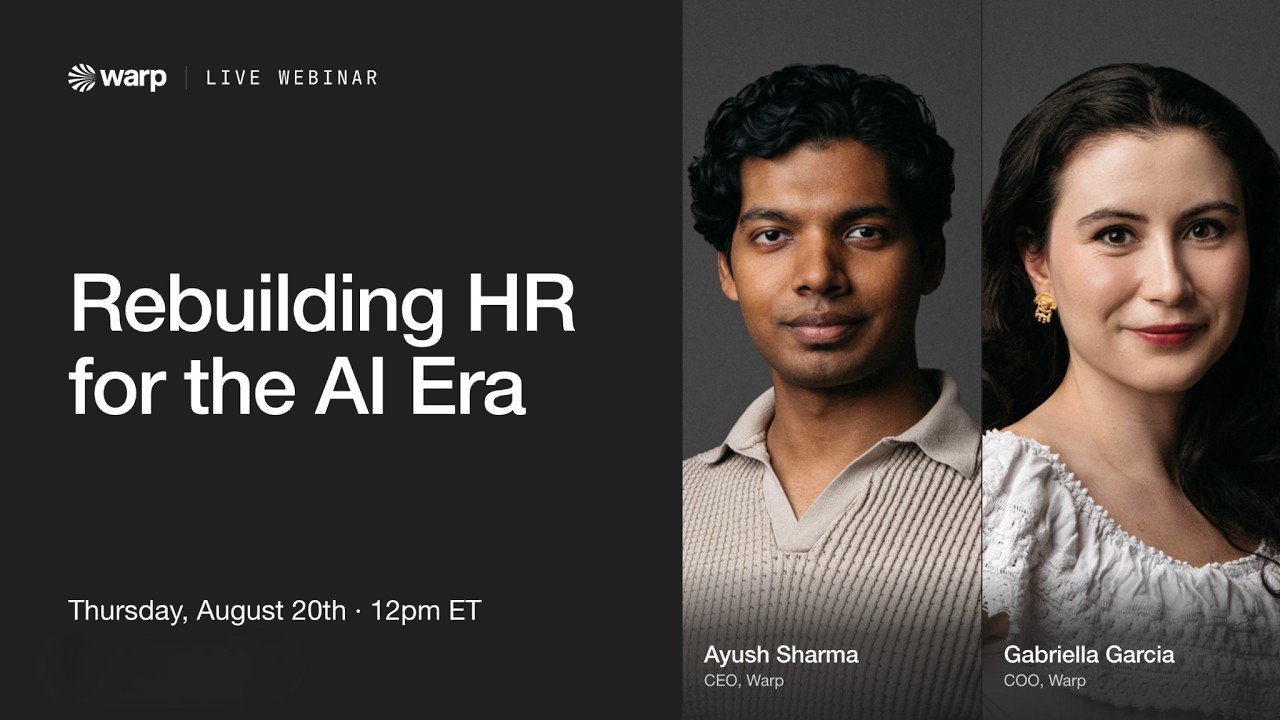
This content was created by Ayush Sharma. This content was uploaded by Ayush Sharma. This is a YouTube webinar titled "Rebuilding HR for the AI Era" (published August 21, 2026). The content is a recorded webinar/presentation and discussion led by Gabby (Warp’s Chief Operating Officer / Chief People Officer) with Ayush Sharma (founder & CEO of Warp) as the featured speaker. They discuss AI adoption in HR—why HR lags other functions, where AI is already used (notably recruiting), the difference between digitalization and full HR transformation, the need for unified data infrastructure and end-to-end HRIS/payroll/compliance platforms, and the role of agentic AI (background agents vs. prompt-based chatbots). They cover safety and compliance concerns (when to use human-in-the-loop), product and UX design choices (permission sliders and guardrails), leadership buy-in, KPIs and people well-being, and Warp’s product approach (building a unified system and AI agents to offload repeatable work). The talk includes audience Q&A and practical anecdotes aimed at HR and people leaders evaluating AI-native HR systems.
Chapters
Great. Hello, everyone. Happy afternoon. Great to see so many amazing people on today's webinar. My name is Gabby. I'm the Chief Operating Officer and Chief People Officer here at Warp. Really excited to have everyone here. Quick introduction on myself. I've been at Warp for the last year, and before this, I spent my career as an engineer working as a software engineer at companies like Facebook, Apple, Google. Very excited to also introduce to everyone here our founder and CEO, Ayush. I'll send it over to him for a quick intro on his end.
Awesome. Thank you, Gabby. Yeah, great to be here and doing this. My name is Ayush, founder and CEO here at Warp. My background real quick, you know, I grew up in India and became one of the first students out of a place that has like 250 million people to get into MIT for undergrad. Uh, which is where I studied physics, computer science, and math. Um, I ended up doing research in large-scale machine learning systems. So this was 2020, right? Like pre-AI when this whole thing really started taking off. And then about 3 years ago started, um, this, you know, company by, you know, we got into YC called Warp, and now we are here as a Series B company based in New York, um, growing quickly. So we'll pause there.
Fantastic. Well, Ayush and I are both really excited to discuss today's topic on rebuilding HR for the AI era. Before we kick started, wanted to talk about a few housekeeping things. Number one, questions are welcome throughout. Please drop them in the Q&A section. We'll take them at the end. In addition, this webinar is being recorded, so we'll share the webinar with you afterwards. Before we get started with that, we would love to kick off a poll. Talking about, and you can click on that poll. Oh, Rachel, can you switch, switch to the other poll? Great. Perfect. So please answer in the audience on how much of your AI usage is for HR-related tasks. Great. I'm seeing a bunch of answers trickle in. Fantastic. Looks like walking through the results, 0% of you guys say you use AI for almost all of your work. About 13% of you guys said for more than half. And by far and large, over 50% of you guys answered that you use AI very little in HR. Not a surprise, you know, for us. If any of you guys saw some of the recent research published by OpenAI, OpenAI's economic report, they published a really great article on how people actually use AI at work. And the responses were pretty split. Pretty, pretty surprising for us, especially in the HR profession. For HR professionals, only 10% of all of their AI usage goes to HR-related tasks. The other 90% goes to marketing, engineering, finance, legal, even customer experience. We love that the HR function is so cross-functional. However, it's not a good sign, you know, that we're, we're, we're skilling up across all the other functions except for HR. So I think one big topic topic that we'd love to kind of get started today with Ayush and I is really thinking about why aren't HR and people leaders using AI in HR? And what does that 10% of usage even look like? So maybe let's dig in to some of the research on what's actually happening today. Number one, the most adoption in HR is actually happening in recruiting and hiring. As the Chief People Officer at Warp, I run our talent function. And we've been experimenting with a ton of tools every everything from Juicebox for outbound emails, Claude for personalizing outbound. We've doubled our team at Warp in the last quarter. And so it's the only way that we can grow quickly while also keeping our talent team lean and empowered. It also makes sense why people are using AI in hiring because it's easier to implement. Overall, hiring is high volume, it's very modular, and overall, like low stakes. A lot of this is also verified by some of the data that came out by Insight Global finding that found that 99% of hiring managers say their company uses AI in hiring in some way or form or another. The second big thing here is on like, what has this looked like historically in terms of usage in AI? And we now have, you know, 20 years of data showing that across 20 years of data showing that HR tech has pretty much answered every new layer of complexity by adding tools, but never subtracting work. So more dashboards, more point tools, more integrations here and there, more checkboxes. And so for a lot of talent and people leaders who are implementing AI, they're just implementing a chatbot that's getting bolted on to a bunch of workflows that are already breaking. The good news is, is most people and HR leaders think this needs to change. Gartner found that 72% of HR leaders think their work flows need to be rebuilt, not just decorated. SHRM, which is the national institute here in the United States for HR leaders, found that 87% of CHROs expect more AI adoption in HR this year. And the data is even coming out from Google Search. Search terms for HR digital transformation are up almost 2,000% year over year. Even agentic AI in HR is up 1,000%. What's amazing is that None of these are incremental increases, right? Like HR leaders aren't asking whether to automate. They aren't asking whether they should use AI. They're asking how. So the interest is there, but the infrastructure isn't. Maybe I'll send it over, you know, to Ayush for, you know, like some comments on, you know, what he's been hearing in terms of interest in AI and HR, you know, across the people leaders that he talks to. Yeah, I mean, I think that's a great point.
Yeah. One really exciting anecdote that I think is super relevant is if you look at the really sort of upmarket enterprise end of where true people leaders are actively at the forefront of AI across other things, and they're very clearly thinking about what they should do in this function within people, within HR, within performance management. It is very interesting to see how they think about it. And so I have this, like, I had this interesting conversation a couple of weeks ago with, um, a VP of people at a really large company. And one of the things they, that I think conversations gave me is like, how much of this is, you can kind of divide the work of HR function, people leaders between the operational end of everything, which is, you know, things that have to run or other things start to break, right? This is going to be your payroll, your taxes and tax compliance and making sure that, you know, like COBRA coverage is being met for offboarded employees on time. They're getting those like election notices within the election windows, or, you know, you can incur a fine. So these are the very operational end of things. And the, you know, the reality is that if you're a really massive enterprise, you've got an army of people that are taking care of the operational stuff for you. So for those folks, you know, they, they're thinking a lot more actively about the people side, which is the, the strategy of, of Being a people leader, you know, being an HR leader. And tho— those are going to be things around talent and retention. And are we measuring performance, you know, the right way? Are we rewarding the right kind of people? Um, the, uh, like, or, you know, like there's a lot of fun conversation around right now on token usage and token burn. And it's like, okay. Like, I know, I think Coinbase came out saying, um, they saw their token-based usage just like really rapidly rising up and had to kind of step in and be like, oh, are we actually Like, are folks actually doing this the right way? So being able to measure these kinds of things is going, is very top of mind for these folks. But I do think that if you look at companies with several hundred employees and above, kind of like, let's call it the more mid and upmarket segment.
Mm-hmm.
There, it's very interesting because the operational is a little bit more upfront for them, right? Like when operation, they've got the operational running for the most part, but when it, if and when it breaks, let's say, you'll, you know, if a payroll gets delayed or some taxes aren't filed, correctly, it really damages the relationship between the company and their employees. And that can be really detrimental, right, to the employee sentiment overall. So where I think that those are some of the things that I'm hearing, I think we'll, when we get to the section of like how, what our point of view is and how, where this is going and the next generation of software, we're happy to touch on that. But that's a little bit of color on what I've seen.
Absolutely fantastic. No, I completely agree. I think when we first started the company about 3 years ago, it was still quite contrarian and very non-obvious that people were going to be using AI in HR. And it's been amazing to see the adoption of ChatGPT and Claude. And then overall, you know, now the search terms becoming much more focused on, on this user base that deserves better tools. Now, maybe talking about, you know, like section number 2 of this talk, which is really around the theme of what even is HR transformation? Why do most of these efforts stall? So first, what even is HR transformation internally? And this is what we believe at Warp is HR digital transformation is the process of fundamentally redesigning how HR operates, not just digitalizing existing processes like the last 50 years of software, but really rethinking what HR should and shouldn't be doing at all.
Yeah.
So this expands technology, roles, workflows, data infrastructure, right? Like even organizational design, right? I'm sure a lot of, you know, the conversations that you're hearing, Ayush, are also thinking about this, you know, like in that matter. And so as a result, like we think that difference matters, right? So digitalization means converting a paper process, sending out an offer letter and signing it, you know, to a digital, to a digital one.
Yeah.
But transformation is actually questioning whether that process should exist in its current form, right? And so at least in practice, and this is what we implement, you know, here at Warp, especially as an organization, you know, that runs on its own product, and I run our payroll, is HR digital transformation typically covers automating those administrative and compliance taxes. Right? So payroll processing, tax filings, benefits enrollments, like you said. I think the next big category is actually moving from a system of record, right? So kind of thinking of your HR as a CRM, right, to thinking about it as a system of intelligence, right? So where data informs decisions rather than just storing them.
Yeah.
I think in your conversation, you know, with that, with that public CEO, CEO, he mentioned this as well. Do you have any good anecdotes about that, Ayush, around thinking about moving from a CRM-like view to intelligence?
Yeah, I think that it is helpful to just, if you want to understand the future, I know, look, my background is deep technical engineering and I didn't start out being a payroll HR expert building this, but I certainly have become, if anybody wants to Quiz me on, you know, one-on-one on any, like all the tax codes and what have you.
Drop it in the Q&A section.
Drop it in the Q&A section. But I think it's super interesting if you wanna understand where a future of a lot of these functions and role is going. If you just look at how engineering has changed in the last 2 years. And the reason I say that is, look, engineers were the first early adopters for ChatGPT when it came out, when it was a toy. Like if any of you remember when early ChatGPT-3 released, that really went viral. What was the viral use case? It was actually just like a bunch of engineers tinkering with it. And it felt like a toy at the time. And here we are, I guess, 3, 4 years later, and it's certainly, it's like trillion-dollar industry and it's massively growing and all sorts of debates about existential risk and whatnot. But all that happened very quickly. And what we have seen internally, we're a very engineering and product-focused company here at Warp, but we are seeing just a complete rebuild of how an eng org and product org even runs. And it really is astonishing how quickly we normalized this whole thing that as an engineer, your job is to write code. From that to pretty much like, I think all engineering teams, including Warp, have moved to, as an engineer, your job is to orchestrate agents to do the things that you want them doing within right guardrails and permissioning and systems that make sure that it's aligned with your goals. And so why do I say that? I think because what I believe is going to happen in the next 12 months or so is that kind of rebuild is going to seep into all these other functions. And you can kind of see the trend lines already, right? But kind of where this is headed. But take finance, right? I think finance is very quickly, it was historically thought as like a very conservative segment of folks, like finance folks aren't necessarily adopting all the cutting-edge tools. And yet what's happening, it's just one of the most exciting areas, is like a lot of finance leaders and CFOs have really warmed up to just like, what does the AI-native ERP look like? And what does the AI-native close process look like? And my sort of hot take or my sort of riff on this is that maybe HR is like 3 to 6 months behind, but not far off, right? And 3 to 6 months in like today's timeline is actually really, really fast. Um, and so we can surely expect like the HR folks to start adopting a ton of these AI tools and agents.
Mm-hmm.
Um, what is lacking is a system where they can actually do these things, uh, within the right context, within the right data model, within the right guardrails of compliance and permissioning. So it's no wonder that the recruiting or like Juicebox or what have you, or like ATS type stuff is the first area that they're trying to use it in because it's a low stakes area. It's like a point solution thing. And where this is headed into is like a whole HR function built out, everything from onboarding to—
Yeah.
learning management to performance management and comp, and your entire thing is headed this way. And so, yeah.
Absolutely. I completely agree. I mean, Johnny Taylor, the CEO of SHRM, actually a couple of days ago had his keynote address where he was really talking about how HR is in need of this revolution, like you said, right? Like a rebuilding the same way as the HR, as the engineering function. We are, of course, immensely optimistic about that. And then maybe before we get into that, I also think it's important to touch on, you know, why historically have most of these efforts failed or stalled, right? I think like fundamentally, number one, right, most transformation is just decorating a process rather than rebuilding a workflow, rather than rebuilding an organization, rather than rebuilding even an org, right? McKinsey recently published that only 1 in 5 organizations have actually rebuilt work processes across the AI they've deployed. And reporting features and chatbots are not the same thing as driving value and intelligence. Most HR tech really sits at that like reporting later layer. So a dashboard that tells you what's wrong, right? Some tools may have a recommending, you know, functionality, or this is a flag, something that you should look out to. But very few of them actually take action, right? Or recommend an action. And so for us, we think about that as a system that just thinks about solutions rather than just highlighting a problem. And what has happened is that the, just the last generation of software was really about adding more dashboards, adding more tools. And what we believe is the next is about removing work entirely. I think the next big thing around why most HR transformations have failed is they've really not taken a people-first approach. We fundamentally believe that And this is actually validated by some really great data that came out from Deloitte, is that organizations that are taking only a technology-first approach are almost 2x more likely to fail. So buying an AI chatbot, pointing it at a broken workflow doesn't actually solve the workflow. And we believe that the key is really taking a human-centric approach. And you guys will hear us, you know, saying that a lot today is that human-first, human-centered approach, which is redesigning workflows, redesigning these roles and ensuring that even decision-making is delivering meaningful work and results, right? And I personally think this is more important than ever. A lot of my community are these like people technology leaders, people leaders, HR leaders. And the fact is, is HR professionals are experiencing burnout at way higher rates than ever before. And higher also than the employees and the people that they support. Lattice recently published their 2026 State of People Technology— State of People Strategy Report showing that 48%, almost half of all US HR professionals are considering leaving the field entirely because they're facing these— the emotional toll of managing employee issues, feeling undervalued, and really feeling that collapse of work-life balance. What we believe that what is driving this is that when you add AI, when you add tools, that's not actually helping the people involved. It's just another job. Giving a group that's already experiencing burnout and additional duties, additional tools to manage is not actually helping the future of that function. So maybe what— maybe passing it over to you, to you, Ayush, I'd be curious to gain your perspective. What do you think building this in the correct way actually looks like?
Yeah, that's a, I think it's like the key question, right? It's like the question that we need to be, uh, constantly like internalizing here at Warp and debating and thinking about it. And we feel a great sense of like responsibility in some ways of being at the forefront of what does the AI native employee management platform of the future you know, that will be with us for decades to come is going to look like. And I, you know, certainly have very strong opinions on product and the shape of products and like, what do great tools allow us to do? And I'm very, very inspired by, of course, and it might be slightly clichéd, but, you know, the early Steve Jobs example of like how he thought of computer as the bicycle for the mind.
Mm-hmm.
And it was less about like, do all these like spreadsheets here, right? Which was what Microsoft's like take, by the way. Uh, do all the spreadsheets here and do all this like data entry and, uh, how, look how cool it is. But Jobs had maintained this point of view and philosophy that it is a bicycle for the mind. It is a tool for humans to do amazing things with.
Mm-hmm.
Um, and I think the translated perhaps like that to today on how we think about building AI-native employee management is You're right. Like, I think babysitting AI and just like Claude is yet another job, frankly, right? It's like, okay, I've got, um, on top of everything that I'm handling, you know, stressful employee issues, interpersonal things, and the upcoming comp cycle. Um, I've also got to now like babysit Claude because, you know, it can go off the rails and make mistakes and invent things at times. So it's just yet another thing. And you're, you're sort of the decision maker Uh, in that sense. And like, just good decision-making is that which is scarce in companies. And so guess what? Now you're like, you know, previously you could actually like do the work and now all you're doing is just like decision-making, decision-making. So that's why I think generally working with agents can be fatiguing if you don't do it the right way.
Yeah.
So I'll, I'll give you maybe one example of how I, we believe the right architecture for this looks like. Um, and the right architecture is, The difference between prompting an agent and having background agents that run themselves. So what do I mean by that? What I mean by that is it's in engineering, and this, once again, I'll keep coming back to perhaps the engineering metaphor here, is early on our engineering team was very much this single-threaded on, okay, we're going to build this feature, so therefore I'm going to hand off this task, describe it in plenty of detail, and write out this linear ticket and spec this out meticulously. And then I'll hand it off to Claude Code and it will go build it. It will ask me questions and it'll prompt me and I'll QA it myself and I'll test it and make sure it's not messing up. And I'll write these test cases and the guardrails. That's a lot of work. It's very, very tiring. And you are still the bottleneck and the ultimate decision maker in the process. So maybe you can get 20, 30% more productive this way, but you're never going to be 100x productive this way or 10x productive even.
Yeah.
So what is the difference now? And I think in the last few months, what our team has really moved on to, at least certainly some of the best engineers have, is it has become a lot more about handing off a full set of parameters to the agent and just have it go run on its own in the background. And it like, the agent should be the thing that's like determining the plan itself, breaking it down into tasks, and eventually sort of like leading this thing on its own. And yes, like you wanna, so what's really important about this is you wanna have very clear permissioning guardrails and North Star, because that's what agents are really good at. That's what computers are really good at, is if you give them kind of like the parameter space and you give them the North Star and the KPIs, they're very good at just finding their way to it.
Yes.
And so it is a really interesting example, and I think that's where this is headed. At Warp, we're very much thinking about not just giving you another chatbot, but it's more about what can the Warp agent just complete for you end to end. And yes, the progress here will be somewhat incremental in the same way that engineers also went through a curve with like, oh, this is a toy and I really like the toy to like, I can prompt it to do cool things. And then now I have agents themselves running and coordinating with each other. That's how we're approaching the architecture and the model side of the Warp AI agent.
Yeah.
It's like this should automatically run in the background, make decisions for you, actively offload work, and surface the right things to The people leaders and the admins using it.
Maybe functionally speaking, right? Like, for to really enable this, you need to have systems that actually connect and talk to each other, right?
Right.
Ayush, I think most companies, whether they're a small SMB, they're a mid-market company, even like a public company, do have different systems for ATS, for payroll, for HR, for benefits, for compliance, for performance management, right? Even for the state accounts, right, that each of their employees, you know, sit in. So I'm curious how you think about, right, given that movement, and like, how do you actually enable agents to do well? Do you need like a unified data infrastructure? How do you think about making this right for companies?
For HR work, you absolutely do need this to sit within one system. And yeah, I actually would go so far as saying it is not sufficient to like come up with their own agents that can stitch together information from different systems. And potentially like coordinate things across different systems because the tolerance for mistake is very low. Like this is a high, like once one thing goes wrong, uh, someone's pay— payroll is delayed. One thing goes wrong and your entire tax calculation's messed up. Um, and when you have that kind of environment, I think you, you want like this very high degree of reliability. And that comes from having a unified system together.
Mm-hmm.
So at Warp, you know, obviously like Our strategy is from day one has been we are going to be the full HRIS, payroll, compliance, IT benefits platform, and we'll go both wide and also deep into those things. And so it's very much like a boil the ocean kind of strategy, which used to be ill-advised in the past eras of building, but it is now the right kind of modality for Or if you're really AI native and are able to build so much more than ever could before. We've always taken this more ambitious approach of building together these pieces on the same architecture such that your permissioning and the guardrails of who has access to what, all of that lives within one system, which allows the singular Warp agent to go and navigate these things with all the context of the company, with all the context of all the employees and like how they're performing and what's the headcount and where this is evolving and so on and so forth.
Yeah. And then, you know, for non-Warp customers, right? I think it's been interesting to see the evolution and the creation of, have you seen this as well as people technology orgs, right? So internal, HR leaders, people leaders that are really defining that idea of like a unified platform, right?
Yeah.
In a sense of procurement, and then even like having engineers build deep integrations, right? Like across those systems. I think like first is because, as you said, the tasks are so mission critical, you need to have a unified data infrastructure to even begin. Maybe one thing that I would love to also get kind of your point of view, Ayush, on is we've talked a lot about you know, automating work and automating some of the deterministic, repeatable work. So how do you really enable a person, a human, to take judgment calls? Right.
I think this is a product design problem, basically, which is one operating in a high-stakes space and you want to have an AI agent run through, an LLM run through and like do tasks for you and actively reduce work for you, reduce the amount of time that you're spending on things, while giving you leverage on the parts that you enjoy and care about doing more of, right? The people side of HR.
Yeah.
And the strategy side of HR, for example. It is a product design question ultimately, which is how do you kind of instill enough trust with people where the—
Mm-hmm.
I know at all times that I'm in control and the guardrails that exist, you know, within this system around like things around compliance boundaries and permission boundaries are really, really solid. And the agent will never take a destructive or mutative action, uh, without you explicitly like reviewing and confirming it. something. And so that's where I think it's almost like a UX and product design thing that we get to be at the forefront of. If you imagine, if you go into Claude Code or something, you'll see that there's different modes, right? It's like dangerously skip permissions, or at the very end, the opposite end, it's like, no, always ask.
Yeah.
So it's kind of like that slider. And I think we have to be more on the conservative side of it and more on the permission side of it. And eventually, I think where this is going to go is, look, some of the tasks, the success rate will be so high and so repeatable and reliable that people will just set that to configure that to this thing. We just have, okay, always you can go ahead and do this, which is if you need to move someone from a, let's say, time-off policy based on their state.
Right.
We know that we can pretty reliably do that, you know, and then maybe you don't need to like do that permission thing every single time.
Actually, this is a great note because thank you so much for one of our attendees in the audience sent over a question on this topic, which is, does automating compliance introduce risk if the AI gets something wrong?
Yeah. You want me to take a stab at it?
Yeah. Yeah.
Okay, sure.
Yeah.
So obviously that's the hard part of what we are building and solving this sort of problem of how do you rebuild, uh, an entire like compliance, HR, uh, payroll system and tax system for agents, um, and for this like new way of operating. And so we take that very seriously and I think it starts with that. Um, and then number 2, The hard work that we've sort of like put in for about, you know, now grinding at this problem space for about 2, 2 and a half years kind of gives us a really, really good understanding, like historical data on what the success rates are like. How can we keep driving them down? And the models themselves have gotten really, really better, which obviously really helps.
Hmm.
Um, I, and then, then ultimately it kind of goes back to this design problem of of when you are using pure third-party agents, you know, whether you go on Claude or ChatGPT, um, that thing is, you know, obviously doesn't have full context of your company. It doesn't have full context of your employees. Uh, and so it will default to just like giving you an answer. And that's, that's the incentive design for like Claude is whatever, it's just kind of give you the answer and keep the chat going.
Yeah.
Whereas for us, I think we can bake in the right level of controls and kind of really dial it within our infrastructure. Be like, look, these are the tools that you can access. This is the permissions that you have. These are the overall compliance regulations and rules. And then these are the company policies. And all of that context that exists is the safety measure for creating a really, really good good, uh, agentic system where you can actually like reliably use it to like automate a bunch of tasks and have it do for you, but knowing that it's not gonna like take an action that will like come back bite you, you know?
Um, yeah.
And so, 100%. I, I don't know if there's a magical answer. It's actually a lot of hard work, really good product design, and getting all the pieces and information in one place and being able to act on it securely.
Yeah, I would say also, a lot of traditional finance or even traditional compliance, think like state tax registrations, filings, a lot of these are just like gather a lot of rules on like what works where. And AI and even traditional machine learning has always been very good at these like rule-based systems, right?
Yeah.
X, then do Y, right? I think, like, to that point, as you said, right, like, these are, these are spaces in which you can't be wrong. I think understanding when to bring a human expert in the loop is really important, right, for that aspect of oversight, right?
Yeah.
Which is why, you know, here at Warp, we do have an incredible internal tax operations and tax specialist team. We say when our AI can't automatically solve One of these, one of these filings, we have our AI Ace, Ace Intelligence. Ace is our head of tax here at Warp, jumps in and solves it for us and for the, for the companies. And so I think ensuring when to bring in humans in the loop and human experts in the loop is really what ensures, you know, we are driving more compliance and more, more safe solutions for our clients, you know, overall, and for companies that are on other systems as well. I would encourage you to talk to your vendors around, you know, do they have, you know, humans who can solve those long tail of problems?
Yeah.
Great. Maybe one question, you know, for you, Ayush, is I do think one large aspect of having successful AI transformation in HR and in the workplace is really ensuring that leadership is visibly bought in. in, right? Not just approving a new vendor, not just like a budget line, right? If the CEO, if the CHRO aren't using AI-native systems themselves, nobody's going to trust it across the rest of the organization. And so I'm curious how you think about— and as you're chatting with a lot of these leaders, really seeing being that model for the rest of the organization with using AI and having that aspect of leadership.
Yeah, I mean, it is so clear to us that first, like, we're very fortunate here at Warp to serve really awesome AI-native companies of the world and, you know, some really fast-growing companies that we have seen that are, you know, dead center building like AI infrastructure or AI applications. So they kind of get it from day one, right?
Mm-hmm.
So this is going to be companies like Serval, Blab, And companies that are like, we've seen folks go from 10 people to 150 in like less than a year. And that's the kind of growth where typically you'd end up having to add an entire like role and division for a lot of these operational people ops things. And these folks we're seeing, they are instead keeping those kind of orgs very flat and very sort of efficient and are relying a ton more on automation. And I think for them, it's sort of in their founding DNA, right? And I think, so we're very lucky to get to serve and like work closely with these very AI-native founders, execs. And the pattern that we see is very much like, I think these folks are generally more technical. They are willing to build internal toolings, build custom toolings, and then hook that into Warp's API and MCP and our agent to like—
Mm-hmm.
build up these great automations for their own team. And as a result, I think they are just like going really quite farther than kind of like your average company. They're growing quickly, their revenue's skyrocketing.
Yeah.
And it's just awesome to like kind of see that firsthand. But at the same time, right, I think we're seeing these larger orgs and more traditional kind of like mid-market, upmarket companies come around to adopting and being more open towards that sort of usage and using AI and building these automations on top of Warp as well. So I think it's just like an evolution thing overall and how like any new thing like that will seep its way through. And to your point, kind of, you know, tying it back to the overall question.
Yeah.
It does very much start with just like the leaders of the company, the founders, the execs, and kind of how they model it. And yes, it comes naturally to the AI natives of the world, but there are really good examples of folks who weren't maybe AI native to begin with or as they were born, but now they are very much— they've come around. They're just curious about technology. So they end up trying things out and using a ton of Claude and agents themselves. And they're like, oh, interesting. This is really cool that we can bring that level of power, uh, what I'm seeing, like what I can get done in like Claude to, into my entire company's like payroll system and HR and performance and all that. So I think it's really fun.
I totally agree. And then, I mean, I am definitely a very non-traditional, uh, chief people officer, um, coming from an engineering and a product background. But fortunately I have an incredible community of, um, of other people leaders, Katie at Harvey, Maya, um, at Vanta. And it's been just incredible seeing, you know, the tide turning in the HR profession with a lot of these leaders really having that appetite and that feeling of empowerment, you know, for really wanting to drive their function, to upskill themselves, to upskill their teams, and to really, at the end of the day, drive a better outcome and a better culture for their company. And so, I think And I think it's been really exciting to see, you know, that continue to grow. Now, as we're kind of wrapping up towards the end of today's session, I'd love to maybe just answer, or we can take a stab, Ayush and I, at answering some of the questions in our Q&A section. Maybe I'll start to— I'll begin with answering auditions. Adish asked, I'm curious to hear how organizations are thinking about people well-being, leadership growth support, capturing qualitative KPIs, and what's your approach with Warp on delivering on that front beyond just HR workflows? Maybe I'll send it over to you, Ayush, because you have a lot of discussions on, right, like, what does ROI look like? And in this, like, new model, right, like, what are these leaders Really looking to drive in terms of outcomes?
Sorry, which, which question? Because I'm seeing a bunch of these questions that are really interesting. Which one do you want me to tackle?
I just sent it to you personally as well, but it's in the answered section.
Okay, I see.
How are organizations thinking about KPIs, well-being? Yeah.
I mean, like, it's going to be different, like what stage of the company you're in. Look, we're a startup. We move really quickly and we don't have time, like infinity time to wait around on things. It's just like culturally, we, the way we think about it is you want to get these things right early and set the foundation of your culture and how the kinds of opportunities you can provide for people to grow and make an impact. Once you set the foundation, if you do it well in the early days, it kind of sticks with you as long as the company leaders are constantly mindful of it, reinforcing it culturally. And then the KPIs and metrics, I think those are the things that I think that that, I've developed my view more so on just like, just pick the right direction and like the right top 3 to 5 things for the company, for a team, for a function, and just like meticulously track those and make them go up and improve. And so when you think about like a people org, what are they for you? It's like gonna be a question for the company and the people in there and the leaders in there determine for themselves with no like prescriptive formula and run towards those and like really instill a culture where this like, it's as high priority.
Yeah, I think what I'm also starting to hear from other people, leaders, is just an emphasis on retention and employee experience. Really creating that culture is increasingly important, especially as AI is essentially being implemented across most parts of most organizations. And so the bar for talent is very high and keeping amazing talent is very important, right? And so—
Yeah.
What does layering on additional pulse surveys or even like looking at the data across how people are performing and like knowing in advance, right, on where additional mentorship or additional upskilling in classes can be implemented? I'm hearing a lot a lot more often. Maybe I'll send it over to you, Ayush, to pick one of the open questions in the Q&A.
Yeah, so there's 2 questions catching my eye that seem really, really good. If I had to pick, I think the question that's like, how does your team move really fast in a space that is heavily regulated? This is obviously something that we've had to be very intentional about from day Um, is first, uh, I, I think it's like a cultural thing where you take, uh, certain things very sacred and, and seriously.
Mm-hmm.
And, and it's, it's worth investing, like getting so invested into those things and like getting those right that you lose sleep over it. So it's certainly like I've had my fair share there and the, um, you know, if you talk to our engineering team and product team, like they'll tell you the same thing. So when it comes to things like, you know, people's money movement and the rules around that and taxes and just the ever-evolving landscape there with regulations coming in and out, those are the things you have to take very, very seriously. So that's the first part is like, you can, you, there's necessarily, there isn't necessarily a trade-off between like, oh, you have to move fast. And therefore we're going to sacrifice the quality on these core things. And it's almost like if you should approach this as an infrastructure company would, which is, if you look at early Stripe, I mean, the company culture was really sort of move fast and get things quickly, but they knew that they were sitting at the infrastructure layer where certain things were sacred. So you had to maintain a very, very high bar for quality. And so they developed a really great culture internally that is now famous. Obviously you can read about it in books and Claire, you know, the CEO of Stripe actually got invested in our Series B a couple weeks ago. So, and she's written a great book about it, which I encourage people to read. I think it's called Scaling People. And the written culture they developed, the very high quality, high throughput communication style they developed ended up allowing them to keep the quality bar while still being really fast moving as a company. So I think it is a very hard thing. You'd have to put in a lot of time and effort, but if you are in a space like us and, you know, it's worth taking that time and balancing that with, uh, it's, or not, not balancing, maybe that's not the right word. The right word is sort of like keeping these 2 values.
Mm-hmm.
both in front of you where you want to move very, very quickly, but maintain really high bar for certain things.
Yeah, I think another aspect of it is also building a company in which we have a really good mix of where people are coming from, where a lot of our engineering talent is coming from Stripe and Palantir and Ramp and a lot of organizations that really emphasize product excellence. And at the same time, balancing with hiring experts coming from Justworks and Nava Benefits that really have a lot of that expertise in the HR space and creating a company that values both. I think a lot of companies fail at implementing, you know, these like really rebuildings of their function by not having an appreciation for the industry themselves. And I think as someone, you know, who's hired most of the folks at Warp, I think, you know, we're working really hard on finding that balance. balance, technology first and then HR first experts. Maybe do you want to take one more question and then I have a favorite one as well that I'd love to answer.
Okay, cool. One of the questions I see that seems interesting is around, you know, you mentioned that you're at the conservative end of the permission slider and expect that to evolve over time. What's the evidence for it? How do we decide when that should move and who's actually deciding? So I think the short version of this is that ultimately you have to give users the control because this is not a— you'll never have a prescriptive thing that will fit everybody. So when it comes to— that's the shorter version of my answer is you have to put control in the hands of users ultimately. Definitely. That being said, I don't think us, you know, here at Warp, we don't see ourselves as like completely opinionless either. We are opinionated on product overall. Like we think that there are certainly like better ways of setting up your HRIS payroll system. And so that like it, that you'll allow you to move faster and get more done and perform better than there are worse ways of doing that too.
Yeah. Yeah.
If anyone who's gone through an 18-month Workday implementation, I'm sure they'll have some thoughts there. And I think that for us, we will continuously just like, we're in the habit of monitoring and testing and writing lots of tests and evals internally of like, when is the right time? What performance threshold do we actually need? And that's something that we're It's like constantly looking at that.
Mm-hmm.
And being able to kind of set the defaults that are going to strike this sort of balance the right way, but still giving the ultimate control to the user. So it is this sort of like mix of, I think we have a role to play by, because we work with, like we have all the data across all these companies.
Yeah.
We get to see how companies are operating and hear from every one of them, not just one person or one company. Uh, so we have a position of kind of like a center in that sort of spoke. Uh, we can synthesize a lot of those learnings and like make that better for everyone. Uh, and ultimately get this in the hands of the, the end user and let them see if it makes sense for them or if they'd like rather tweak it than, you know, like go configure it according to your company policy or like your risk tolerance, you know? Yeah.
100%. I totally, totally agree. Maybe final, one of our final questions to kind of wrap up on. The theme is, in essence, HR has to deal with so, so much cross-functional, so many cross-functional groups internally, but also externally, right? Whether that's your benefits broker or a national insurance carrier or even state-specific office. So how do you see the future of HR tech breaking through some of these institutions that they need to collaborate with in both the medium and the long term? And maybe do you want to take a first stab on it on like the compliance and maybe integrations and partnership side, and I can talk about the benefits side? Yeah, for sure.
So the, the big question is, you know, what are the barriers to adoption? Put another way, the question's like, because you touch a lot of these like real-world institutions often at times, so that might not be as friendly in terms of like, or as tech-forward. How are you going to handle that? So this is where I think I have a slightly different take, which is, Hmm. It is interesting to think about, like, for the longest time, you just, the cost of getting anything done in a legacy space was very high. Like you had to spend a lot of your time, but turns like, guess what is very good at like, you know, spending time is actually agents and AI. And I think there's a fun anecdote here, which I, I'm not telling anybody to do this, but like, look, if you ever want to try get a refund out of some United thing, well, first of all, there's no United support rep anymore. It is an AI. And if you're going to be a human, the AI will always outwork you. But actually, you can counter that by using AI. Once again, not telling you to do this officially, but you can use your own agent and have it talk to the other agent and figure out, let's see, you'll probably be much faster in getting the outcome you want. So there is an aspect of AI for the first time giving this evening the field where previously you just were against this Goliath that was immovable. And now you can have an AI or an agent go and talk to that agency on a phone call or message them or keep writing them the email and figure out exactly the right kind of wording And like, how do you structure the, the, the comms to actually get the outcome you want? Um, and like people, some people have, were always very good at it, or like people who knew the insides of the, how these institutions worked. Uh, there, there's some funny stories there, but if now, like you, you can almost, uh, substitute that, like that insider knowledge or whatever, by having an AI that can actually do that for you. So this, this is kind of like my, I would say somewhat like, you know, countertake here that AI actually allows you to go fight back in some ways with these legacy institutions in a way that previously was very like impossible to do. Like the resources, the time, the cost didn't make sense, but now it does. And I'll leave it at that.
And maybe on the other end, because no matter what, there will always be organizations organizations, institutions that we have to, you know, work with. The IRS, right? Like state compliance organizations. I think on the other end is, especially thinking about the HR tech landscape, most HR leaders now have the ability to choose actually who they want to partner with, right? Whether that's selecting a more modern, you know, benefits broker. Let's say, you know, like a Sequoia or a Benne or what we're building here at Warpenshare.
Warpenshare.
services, right? And then even on the other end, right, with accounting and seeing all of the growth in these like AI-native companies that are tackling a lot of these very hard places, very hard industries. And so I think what it becomes is, as you're thinking about procurement, as you're thinking about, you know, building out your tool stack, you know, for the companies, you will be able to have more options. And you should think about ones, you know, that are really thinking about the future and are really thinking about being product in AI first in both the medium and the long term. And so maybe with that, I'd love to send it over to Ayush for some quick closing comments.
Yes, I think, you know, to close, first, it's super fun. Gabby, thank you for organizing and all the people who joined and hope to do more of these. And the quick mandatory plug that I've been told by our team to do is that we are Warp. We are an AI-native employment platform. We do everything ranging from the HRIS, payroll, IT compliance, and benefits. So if you're looking for an amazing AI-native platform to partner with as you think about the HR transformation and the strategy inside your company, would love to talk. So don't hesitate to reach out. And once again, thank you for joining.
Fantastic. Thank you all for joining today, and I hope you guys all have a great rest of your Thursday. Thank you.
More from Ayush
The Subtraction Economy: Why the Next Great Companies Remove Work with Warp + Sound Ventures
"Speed and Quality Are Not Opposites" | Warp CEO Ayush Sharma at Startup Grind

Building an AI Startup After MIT: Fireside Chat with Warp CEO Ayush Sharma | MIT Startup Week

NachoTips: AI in Product Development - Warp CEO Ayush Sharma Gives His Perspective
