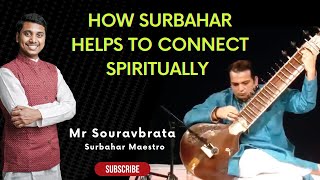
In this YouTube interview, host Badrinath Gella speaks with Surbahar virtuoso Souravbrata (Mr. Saurabh) after a live performance at the Smaran Mahotsav in Bhopal. Gella asks about the instrument’s deeper purpose, and Souravbrata explains that the Surbahar (also called Surbhaar) is designed to draw listeners inward, focusing on the pure frequency of a note rather than virtuosic display. He traces the Surbahar’s lineage to the ancient Veena family, noting its blend of Veena, Dhrupad, and modern sitar elements, and emphasizes that breath control in playing mirrors yogic practice, creating mental peace and spiritual healing. Souravbrata shares his personal journey—how the resonant sound of the Surbahar captivated him in the late 1990s, leading him to study under Ustad Imrat Khasar and later at Tansen Sangeet Vidyalaya—highlighting how the instrument chose him as much as he chose it. He outlines the pedagogical path for aspiring players, stressing that prior sitar training (2‑6 months) and an understanding of Veena techniques are essential, and that Surbahar instruction is distinct from sitar. Finally, he provides contact details (Facebook, Instagram) for students interested in learning, and acknowledges Gella’s calm demeanor as a result of yoga practice.
Chapters
Hello viewers, today I am with Mr. Saurabh. He is Surbhaar Maestro and I am interviewing him. I am asking him few questions to know, like I have seen his performance in recent Smaran Mohso happened in Bhopal. I found it's very soulful music, the music of the soul. So I felt very connected inward rather than outward, the moving our body or external. Inward I have connected so much. So I wanted to know him, know from him, like, like what is the philosophy behind this? Like how is it helping to heal ourselves inside? And why I felt this, like inside there is some change in my, like working on my soul. And going inwards. I didn't understand, like, could you please explain? Like, this is the first time I had a live performance of Saurabh Bajar, and I'm not much aware, even though I am from India. We are from India, so I come from South India, but still I know about this instrument, but I have never been to any programs. So today I am with Mr. Saurabh. He is one of the famous artists from India. He coaches also the Surbhaar. So if someone wants to learn, you can leave comments below. So I wanted to ask you, Mr. Saurabh, like, could you please give some insights about Surbhaar?
Yes, Surbhaar is an instrument which connects you inwards to your soul. There are many instruments in India popular instruments, but sitar is most popular, we know. But you see, these all stringed instruments comes from the family of Veena. Veena means, actually the terminology Veena means stringed instrument, all the stringed instruments. So Drupada Singhi has been perpetuated in Survarna playing and also Veena playing. So we get Some facets of sitar is also there. So it is a mixture of rudravina and some facets of modern sitar and some facets of drupad. Because in sitar you cannot play drupad. Although in Ravi Shankar ji style some bass strings are there, but you see, in drupad style we focus much on the frequency of a note. Rather than playing or showing off, frequency is most important. So you have to somehow, I can say that you have to focus on sur, means somehow you have to go inwards. Inward you have to go. So in that respect, philosophy, Indian philosophy is very important. Because Indian philosophy is also telling to, they say, for example, Indian philosophy, according to Indian philosophy is like, for example, soul culture, breath control. Like if in Survar or Drupad, if you want to complete a phrase, a musical phrase, you should have tremendous breath control. Si Vendas breath control is equivalent to Yog Sadhana. So everything is related. That's why when you are listening my Surva recital or any good artist's Veena recital or Dhruva recital, you get inwardly corrected. And that inwardly connection leads to mental peace. Yes. That much I can explain.
Yeah, yeah. That's very great, right? So there are various techniques available to really walk on our mental health or working involved. So like, have you, like, have you heard this from anyone else before as well?
Or like, yes, actually for me also it's a healing experience.
Okay.
Because sitar I had practiced a lot. Sitar is actually, it's, it's a, it's like a quicksilver. Like you can compare is like They say, 'Oh, this is crackers.' So after 30 seconds, 40 seconds, it is finished. But surbar is, you can compare with the scent of agarbatti. That lasts for much longer time in your mind. So there is a difference between crackers and other bhakti. So in this way I can explain.
So last question I have is, out of many instruments, why did you choose surubhar?
Because I should not say that surubhar chose me or I have chosen surubhar because I had the urge to, for that, those frequencies to play which calms our mind. Because I am from a family which is located in city area and much mundane disturbances and etc. So whenever I used to listen Ustad Imrat Khasar Surbhar, I got it actually, I am talking about '97, '98, at that time I was starting floating. I was almost deep, that sonorous sound always captivated me. So in that way, that was my goal in life to achieve those frequencies. So later I came here. As when I came in Tupper Sangstan, I was already a player, but the real nuances and some how to give a performance on the basis of these frequencies I have learned here. And that has— Tupper Sangstan is a great place for me because it— here my life actually If I have to say the truth, my life changed. In that, so thus I went rightly, not, my answer is little defocused, but you can say that.
Yeah, it's a transformational.
Yes, that sound chose me and I chose my instrument.
Wow, it's very interesting to know that like Because people just attract because of something, but you have a great story of knowing this. And thank you, thank you so much. And could you please just give a, like, little information on how people can approach you?
Yeah, and I teach a lot. Surbajar, people plays, but plays like a sitar. Because if you are sitar player, you can strum the strings of Surbajar. You can strum that string strings of guitar, but sitar will be sitar, guitar will be guitar. So only sitar playing will not do. You have to learn separately surbhar if you want to really work on it. And surbhar thought process is very different than sitar. It is like more connected with veena.
Okay.
Actually, veena playing, there were many problem with Indian musicians. Like veena playing, they don't— previously I'm talking about 19th century or 20th century, that time people do not teach Veena to external students. They used to teach Surbhaar because Veena was like a king instrument. So it is a concept, I should say. If you want to learn Surbhaar, you have to learn Veena simultaneously, but not that you have to learn Veena separately and Surbhaar. So your Surbhaar teacher should know Veena. Vina is a concept, even Bhrupad singing, if you know vina, you can adopt and assimilate those techniques. I teach sitar mainly. You have to play 2-3 months sitar if you want to play suryabhag. 6 months sitar training is necessary. And I teach sitar and one, there is an instrument named sur singer. It is a bigger instrument of sur. Same thing. So like, uh, cello. Okay, you know, you can compare cello with surda. So I teach in that way. I teach vocal music also. So interested people connect with me with Facebook and Instagram and these nowadays amenities. Yes, in that way I'm— I became famous. I know, I should thank them.
Okay, thank you. So yeah, sure, I'll leave your contact details or Facebook details. For my viewers so that they can contact you through this platform.
Thanks a lot.
And thank you for your time and explaining our viewers about—
You are a great yoga practitioner, I know, because you are so calm always. Without practicing yoga, you cannot be calm. You know, one thing I should say, you actively calm and calmly active. Both you have to be.