Breathing for Knee Health: Insights from Orthopaedic Surgeon Dr. Ankit Agur
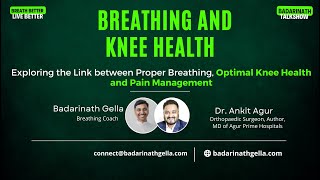
In this podcast episode, host Badrinath Gella interviews orthopaedic and paediatric surgeon Dr. Ankit Agarwal about using breathing practices to improve knee health. Dr. Agarwal shares his personal journey from a conventional medical background to a holistic approach that integrates physical, mental, emotional, and spiritual dimensions. He outlines the primary causes of knee pain—injury, age‑related degeneration, inflammatory arthritis, and stress‑induced cortisol elevation—and explains how chronic stress impairs the body’s self‑healing capacity. The conversation delves into the physiological pathways by which pranayama and deep breathing benefit the knee: increased nitric oxide leading to vasodilation and better nutrient delivery, reduced oxidative radicals, higher antioxidant levels, and lowered cortisol. Dr. Agarwal also describes how emotional tension, poor posture, and subconscious mind‑body messaging create muscle tightness, postural imbalances, and “memory” of pain that exacerbate knee problems. Practical recommendations are offered, including regular low‑impact walking, strengthening quadriceps and hamstrings, ergonomic sitting/standing, a diet rich in antioxidants, quitting smoking, moderating alcohol, regular breathing/meditation practice, nurturing relationships, and aligning work with personal purpose. He emphasizes the need for the medical community to adopt an integrative mindset and anticipates future research validating meditation and breathing as adjunct therapies. The episode concludes with a call for balanced, holistic living as the foundation for long‑term knee health.
Chapters
If you see, right, knee pain is also very common in people with high levels of stress. So basically, knee degeneration happens when the body loses its ability to heal itself. When we practice breathing practices, the nitric oxide level increases, because of which there is expansion of the vessels. So when the vessels expand, the blood supply increases. And the tissue gets more nutrition.
I have seen many people who come to my classes, they look very fit, but inside they are suffering so much. They are not healthy. Hi, hello everyone, welcome to Breathe Better and Live Better podcast. So today we have Dr. Ankit Agar. So Dr. Ankit Agar is an experienced ortho pediatric surgeon, and managing director of Agar Prime Hospitals. Dr. Ankit specializes in arthroscopic surgeries and knee pain management. He has co-authored two bestsellers, studied Indian spirituality and Western thought for 15 years, and embraces the power of healing beyond physical illnesses. Join us as he shares his wisdom on elevating all the aspects of our being, a true healing So today's our topic is mainly focused on how we can use the power of breathing to solve some of the, like, to manage your knee pain. So Dr. Ankit is going to discuss about different aspects, why we are getting knee pain, what are the precautions you should take, and how to manage the knee pain, and how the breathing techniques going to play an important role in managing your knee pain. So I welcome you, Dr. Ankit Agarwal. Thank you so much for accepting our request and coming to this session.
Thank you, thank you so much for the invitation. And it's, it's a topic, something which is very close to my heart because as doctors, most of the— even 99% of the doctors just focus on the physical aspect of the pain. So it is my pleasure to share what I do and what I've discovered, where I add in not just the physical but also the mental, emotional, and breathing aspect of the pain.
Yes, yes, yes. So my first question is this, like, when I saw your profile, I was very surprised because whenever I discuss with— like, I have been to doctors, like, because of my asthmatic problem or anything. So doctors only want to eliminate the symptoms. Right? Most of them only treat in the physical level. They don't really know how to consider the emotional, spiritual aspect, or like mental aspects of it. So when I saw your profile, you also learned about Reiki healing, and you have mentors like Sri Sri Ram Shankar and Vishal Lakshmi and Robin Sharma and many more. So what really motivated you to learn these aspects of life? Right, so I, I— if you can share some aspects to it.
Yes, so, so I've been someone who was very good in academics since my childhood, who's very intellectual. Like, my father is a doctor, my family is a family of doctors, so, uh, from my intellectual perspective, doing amazingly good. But, uh, you know There came a time where I was not fulfilled within, not happy inside, and I suffered from asthma in childhood for very long. I had severe asthma. I was on inhalers. In fact, I used to carry inhaler in my school bag daily when going to school. So in 2005, in the first year of MBBS, I went on a search for something beyond just the, you know, just the material world, you can say. Then I discovered spirituality. I discovered teachings of Sri Sri Ravi Shankar. I went on, I started meditating at that age. So it's been like 18 years since I've been doing my meditation and all those things. And I'm glad to say that I haven't had asthmatic attack in the last 12 years. I haven't had any asthmatic in the last 12 years. And then I slowly realized the that, you know, as human beings, we are just not the body. Yes, we have the emotions, we have the intelligence, intellect, if you can call it, the mind, the breath, the spirit, and the soul. And if you see, uh, you can't just separate the body and say that I'll treat the body and not the other aspects. If you really, if you really care about the person whom you're treating, you can't separate the body from the other aspects. In fact, I am also a student of Dr. Demartini. I'm a Demartini Facilitator, and I've realized that, you know, the physical symptom has deep-rooted cause in the mental, emotional, and spiritual imbalance, if you can call that. Yeah, so, uh, that's why I was fascinated by a human being as a whole. Not just the body, because my BBS and MSR is taking care of the body, but I had to go and learn from other people to understand how to heal the mind, emotions, and all.
Wow, it's very, very inspiring to see that, uh, like you are treating the patients holistically. And also in, uh, yogic sciences, we say it as panchakoshas, like we all made up with high layers of the body, like physical body, like energy body, emotional body, and intellectual, as well as the soul, like which you are mentioning. Like we call annamaya kosha, pranamaya kosha, manomaya kosha, vijnanamaya kosha, and anandamaya kosha, the bliss state. When you fix all these layers, you are already bliss, but these layers are not really allowing you to see that bliss and experience that bliss.
True.
So it's, uh, very, very interesting, like, because understanding the scientific aspects of it and integrating into your practice is like very, very interesting. So as this session is mainly focused on knee pain, like, so this— the mental, emotional aspects play in different role in different aspects of our diseases and different aspects of our problems. But today we narrow down to knee pain. Let's really understand because this is one of the biggest issue many people in India is facing at this moment. And many of them are looking for the knee surgeries and by the age of 50, like, they were unable to walk. So everyone are like, they are taking pride in that. Like, I got my knee surgery, I got my knee surgery. Some people are taking pride out of it. So, uh, like, what are some of the causes of knee pain and injuries?
See, knee pain mostly happens in the younger as well as older population. In younger population, because of them being active, them playing sports, and they having injuries while playing, or it can be accidents and all those things.
Things.
And also in the older age group, because the knee starts aging, so the knee starts getting degenerated, right? But, but nowadays we are seeing that the degenerative changes or the aging changes are happening even in the younger or middle age group. And besides that, there's also few, uh, few conditions where the inflammation of the joints increase, like rheumatoid arthritis, or gout, and all those things. So they're called inflammatory arthritis. So from a scientific perspective, from medical perspective, these two are the most common cause of knee pains— injuries and degeneration. Besides this, if you, uh, again, from a space of just going beyond the physical aspect, if you see, right, knee pain is also very common in people with high levels of stress. So scientifically, scientifically speaking, people who are under high stress, they tend to have a lot of hormone called cortisol, right?
Yeah.
This causes increase in the inflammatory, uh, inflammatory chemicals in the entire body actually. And so basically, knee degeneration happens when the body loses its ability to heal itself. Okay, right. So, uh, continuously, each and every day when you're walking, when you're doing work, then knee keeps getting, uh, degenerated as well as regenerated. So the cells keep dying as well as new cells keep forming. But when the cells die and the new cells are not being formed, that is when the regeneration starts, right? And because of the stress and because of the increase in the inflammatory mediators mediators, the body is losing its ability to heal itself. So because of the body losing its ability to heal itself, that's why most of the people start complaining of knee pains even in the middle age or younger generation also.
Okay, okay, wow. This, this aspect is not very much explored, like not many people know about it. Like, so we always think like because the knee is the problem, like we have— we want to treat the knee. But again and again the problem is coming back. So we don't really understand the root cause of the problem which you are mentioning today. Like, so until unless we have that strong foundation, strong roots, I don't think we can really find a solution for this problem, right?
Yeah. Yes, great.
So, but how can individuals determine when there is a knee pain or injury requires medical attention, such as like imaging or specialist consultation?
So, um, any acute injuries, any pain caused due to injuries like due to a fall from the steps or any accidents, or because of playing football or cricket, any twisting of the injury, twisting during dancing and all those things. So any such event causing knee pain needs immediate attention, medical attention. And because it can be in X-rays and MRIs, we see if there's any fracture in the bones or if any ligament is torn or any meniscus is injured. So we have to rule that out. Once we rule out any, any physical injuries, any injuries to the bone or the tissues, then it can be taken under medical management. But if there is any severe injury like a bone fracture or ligament is torn, then you'll have to go for surgical management. These are the, these are the things which you need to immediately come to the doctor for. Okay. And also there are some conditions, like I said, inflammatory arthritis where the knee swells, just very severe pain. The swelling, the swelling of the knee is severe. And also they're not able to walk, they're not able to sleep, they're not able to sit properly, they're not able to get up properly. So all these things also require medical attention immediately.
Okay.
Now leaving these two things, the third thing where there's a gradual onset of pain, slowly you can, you can see that, you know, there's small, small pains here and there, though they are not so severe as to cause your normal day-to-day activities to be disturbed. Those things you can for a few days maybe manage at home with rest. But I strongly suggest that any pain which causes discomfort, better take at least one opinion with a doctor.
Yeah. Yes, I do agree with that aspect. Otherwise, because people wait until it becomes serious, by the time, like, uh, there is the chances of treating, that is, becomes very low. So I think, uh, that, that is what that awareness has to be developed. Like, whenever you have some, some difficulty in your body, like, you must go for a consultation, or you must know know, like, how to really, like, uh, treat that element or that discomfort. Yeah. So, and, uh, coming to the next question, Dr. Ankit, so as you know, I am a breathing coach. Like, I have been doing a lot of research in the space of breathing, and also you yourself practice breathing techniques and practice through the Shakti and many other techniques. So my question to you is like as a medical doctor, as you also gone through other aspects of life. So how can breathing techniques or pranayamas impact in knee health?
That is a very beautiful question because not many focus on that. Not many focus on the connection between the breathing and just knee pain. So See, it's on two levels. First one is a direct benefit of breath on the body, right? So when we take in a lot of oxygen through pranayama and all this, all this breathing exercise, we're taking a lot of oxygen. The number of oxygen-free radicals that decrease in the body, and these oxygen-free radicals are primarily, uh, the they damage the tissues anywhere, right? So there's a number of oxygen-free radicals in the blood, they go to the knee tissues and then they damage the cartilage. So, and increase inflammation, right? So first one, there is decrease in the chemicals which damages the knee joint directly. And the secondly, secondly, the antioxidant level is increased in the Thirdly, because of breathing deeply, the level of stress hormones is decreased. Cortisol is decreased, and because of that, again, the damage to the tissues decreased. And fourth, there's more blood flow. There's a chemical called nitric oxide in the blood vessels. So when we practice breathing practices process, the nitric oxide level increases, because of which there is expansion of the vessels. So when the vessels expand, the blood supply increases and the tissue gets more nutrition, right? Wow. So these are the direct benefits of breathing. And the second benefits is through the emotional aspect, right? So All of us, if we just observe our body whenever we are stressed or whenever we're tensed or whenever we're thinking, you know, some intense thoughts, if you just observe your body at that point of time, you can feel that your neck muscles become tight or your shoulder bones become tight, or involuntarily you'll be tapping your foot, or your knee muscles will become tight. Right, so prolonged tightness in any muscle, be it the knee, neck, shoulder, anything, they causes the spasm and they causes imbalance in the posture, like while standing, be it while walking. So they cause imbalance in the posture. So because of the imbalance during the long, long duration, it causes damage to the knee. So doing this breathing practice, breathing exercise, your body tends to become more relaxed, more in its natural state. There is less misfire of the muscles. And we also call this knots, right? So you find in particular points, they're like tightening of the muscles and there's a pain there. Knots and all decrease. So Breathing, through the chemicals and through the changes in the physiology, it decreases knee pain. And secondly, also by keeping your body relaxed and in its natural state, it helps in knee pains. And thirdly, if you go deeper into it, right, uh, I strongly believe, and now science is coming up with this, um, new data, that each and every body, each and every part of your body has a memory. Right, so, uh, see, knee pain— knees actually are associated with mobility. Okay, so if subconsciously there's something bothering you which is stopping you from getting up and going out, you're doing it— suppose, for example, I, I had a patient who came in like a few months back and he He was a young guy, like 25-30 years old. He had severe knee pains and he had no history of injury, no inflammation. His blood tests were normal and, and he is not too old to have that knee arthritis and all those things. So, and he's been showing it to many doctors regarding the pain, still didn't decrease. Then I just Asked him, so how is it going on at work? Work is very stressful. Then I, then I said, but are you going to work? Like, yeah, I have to go to work. But do you really want to go to work? Like, no, I don't want to go to work, but I am forcing myself to get up from the bed and go to work because though I hate it I have to do it. Then I asked him, so that's what you're telling your knees? You're telling your knees that I don't want to go, but you are forcing it to get up and go. So that the knee is basically listening to your subconscious mind and it's creating the pains so that you listen to the pains and don't go to work.
Wow.
Right, yeah. Then I simply do one thing, uh, if possible, if you can, uh, change your vocation or change your, um, you know, work profile or job, or start loving yourself through some affirmations and all, saying that I love my work, I love going to my work. And I think I spoke to him after, after one month or so. He is doing a lot better than before. So, okay, like I said, everything is connected. The body, mind, emotion, that is connected. So we spoke about the emotions, we spoke about the chemicals. Now let's speak about the mind, right? So people who are in so much of stress that they don't want to move, they're telling their knees that, no, you don't work, don't work. So then knee automatically will give signal that it has pain, it has this thing. So most of the fibromyalgia, we call it fibromyalgia, so chronic knee pain. It's very important that we can— we are also aware of these conditions in the mind too.
Hmm. Wow, wow. It's, it's a bulb moment for me. I can say like the memory part of it, like that's truly like I'm just recollecting some of the memories like then people were saying these excuses. For example, like, consider, uh, you have a birthday of your baby, but you work so hard, like you wake up early and you, you want— you work more than your limitations. But the same time, like, the same knee pain, even though you have knee pain, like, you will do that. But, uh, when— whenever you want to go for your work or go for your job which you don't like, I am not saying exactly the job, but the things which you don't like, your body doesn't really support you to do that work. So yeah, that's very, very interconnected. And yes, that aspect has to be understood. Like, this cannot be proved in medical sciences, this cannot be proved in the scanning or anything.
So because in fact it can be proven, only thing is that, uh medical community has to be open-minded to explore the different causes because we are too caught up and we are too caught up in our own intellect, right? Body chemicals and all these things. But beyond the body, we have to be open. And thankfully, nowadays the medical community is becoming aware of it, and there are some studies being done in AIIMS and other premier institutions regarding this. So maybe in a few years we will be seeing proof, and I will be getting papers which asks us to, you know, prescribe meditation twice a day daily as in addition to the other medicines. In fact, I started doing that. So I write the medicines and then meditation twice daily, at least for 15 days.
Wow, wow, that's very, very inspiring. We need more doctors like you who really work on the holistic level of their aspect. Because, uh, like everyone nowadays, like earning money become easy, but like, uh, with the cost of our health. At the end, like all the money is going for maintaining the health, with along with maintaining the health, the suffering. Which we go through during the process is like horrible aspect of it. So this is very, very inspiring, uh, Dr. Ankit, to hear from you about these elements. And also I wanted to understand, like, is improper posture— because the posture we are sitting nowadays due to the jobs like we are taking up, uh, the body alignment also impact on knee joint?
Obviously, uh, absolutely. See, uh, in, in the world, everything is in balance. Everything is in balance, like day, night, hot, cold, summer, winter, everything. Same thing is in our body, right? There are some processes which kills your cells so that, uh, you don't be, you know, you don't become healthy. There's some process which creates the cells. Right? Any imbalance in the body will create some more other diseases, right? In the same way, like whenever we stand or whenever we sit, most commonly, mostly, if you see, we tend to stand on one leg or the other unconsciously. So 99% of the people who say they have pain in only one knee If they can go back and try to understand what is their posture or how they are standing and all, they'll realize that they'll be standing more on that knee. So it's very important to be aware that whenever you stand, you stand in a straight line and, you know, stand in such a way that you don't lock your knees. So a little bit bend and stand consciously with Basically, and in the work side also, it's very important to see that when you sit, right, you just find your spine erect and sit in a straight position with all the computers being at the eye level, your shoulders relaxed, and your elbows 90 degrees and all this. So, uh, any— imagine, suppose if you will tend to sit like this, or if you see, or if it's even most of the auto drivers, they tend to sit on the side and they'll bend that spinal nerve. So I see a lot of people coming with knee pains, especially younger population, when they don't follow this workplace ergonomics. So that awareness needs to be given in the workplaces to have these kind of, you know, furniture and practices basically.
Yeah, true, true. I do agree with that element. Uh, but you might have covered already, like, but what are some of the tips for maintaining good knee health as we age?
First, number one tip is keep it active. Keep your knees active. Walk at least, uh, 20 minutes to half an hour a day. And walk not on hard surfaces but on soft ground or grass. And if possible, wear proper shoes which gives cushion— walking shoes. And if you have knee pains, you can even maybe walk for 10 minutes 3 times a day. It's not necessarily that you need to walk half an hour. At a stretch. So number one thing is walking and keeping your knees flexible and strong. Second thing is keeping your thigh muscles strong. So they are called quadriceps and hamstring muscles. So quadriceps are the muscles which are in front of your thigh and hamstrings are in back of the thigh. So keeping those muscles strong— where, when you keep those muscles strong, right, the— when you walk or when you stand, the majority of your weight can be distributed to those muscles instead of the joint. So that also will help you for the— for your knee health. And third thing is to eat a proper healthy diet, right, which is full of antioxidants like fresh fruits and vegetables. And I strongly suggest to completely avoid cigarettes, cigarettes smoking and all, because they're one of the major causes of damaging of tissues. And alcohol can be taken in moderation, uh, if required. And also, if you— more nuts, which has antioxidants, and regular exercises. Breathing practices, breathing practice and meditation. See that your levels of stresses are within your control. And I also, uh, tell these things that it's very important for a person to have healthy family relationships or relationships with their friend so that they are at a proper healthy mental space, because of which the knee pain can also be avoided. If you see most of the elder population who don't have that family support, they have a lot of pains, be it knee pain, be it shoulder pain and all. So it's very important to have a healthy, uh, family relationships and relationships with your friends and all. And one thing which I always tell people is to find, do something which you love. If you are, if you are in some work, like I gave you the example of this guy who didn't want to go to work knee was paining. So I always tell people to do something which they love, or love what they're doing, right? And they can even maybe pick up some hobby which they enjoy.
Yes.
So all these things together will go a long way in decreasing your knee pain. At the same time, seeing that you don't get pains in the future.
Yeah, that's amazing, that's amazing. Like, it's not just about the, like, taking the pills, it's about also fixing all these elements in your life so that, like, you will really find relief to your pain or to keep your optimal health, to maintain your optimal health for your long term. So that's very, very inspiring. Thank you, Dr. Ankit. So at the end, like, uh, what tip would you like to give to our audience? Like, they all just— they wanted to work on their overall health. So what tips would you like to share with our audience at the end?
See, I, I always believe that it's very important for us to live a balanced life, right? Um, so take care of your health. Take care of your mental status, take care of your emotions, take care of your, uh, you know, your purpose. Like people say, right, they are not in alignment with their purpose and all that also affects your health. So do what you love. Yeah, be healthy. Health is not only inside but also outside. So I say have healthy relationships, be healthy at the workplace, and automatically that will reflect in your body. Yeah, so be balanced and be healthy all around.
Great, great. Be healthy, be parents, everyone note it down. So thank you, thank you, Dr. Ankit, for coming here and sharing your wisdom with us. Like, it was very, very inspiring, and the country, the world needs more doctors like you. While I was in Europe and teaching yoga and breathing Across the world, many doctors from abroad, like in Europe, also joined my sessions. They also feel there is some, some elements missing in their medical science, like people are not finding, like people are not happy with them. Like if you consider especially like problems like asthma or thyroid and all, we have to— there is no, uh, like solution for this. We just have to manage them, and sometimes it gets very difficult for us, uh, to like to have those symptoms and to manage them. So I think like every science has its own limitations, but as Dr. Ankit mentioned, I think we have to work on all the dimensions of our life. We have to fix on all the dimensions of our life. We have to grow holistically rather than only like physically. So when people focus on physical health, when they focus on building their muscles, they, they overfocus on only on building muscles, but they forget on mental and emotional aspects. From outside, he looks very fit. I have seen many people who come to my classes, they look very fit, but inside they are suffering so much. They are not healthy. As per World Health Organization, the definition of health is a state of mental, emotional, physical, and spiritual well-being. If you are not well in any of these dimensions, you are not well. So as a medical doctor— like, I am not a medical doctor, but that is the reason I am bringing these medical doctors to really talk about the limitations of the medical science and why we should really work on the holistic dimensions and sustainable health, which is very, very important. Health is fine. Like, we all are talking— we all of us are talking about sustainability nowadays in every sector. Even in healthcare sector, we need this sustainability. Like, whatever, uh, like, we are following, whatever we are following, we need to maintain like sustainably. So I hope you all found so much value out of this session. Again, thank you so much, Dr. Ankit.
Thank you, thank you so much.
More from Badarinath





How Conscious Breathing Transformed My Health, Family & Career | Inspiring Success Story

International Yoga Day Celebrations 17th to 21st June | Morning 6 AM | Evening 7 PM

30-Minute Breathing Exercises | Reduce Stress & Improve Lung Health | Yoga Day | @badarinathgella


