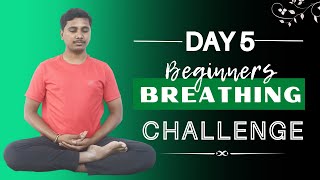
In this 20‑minute instructional video, Badrinath Gella, founder of the Conscious Breathing Hub, wraps up a five‑day beginner breathing challenge. He begins by congratulating participants, then explains the ancient Indian concept of prana – the vital energy present in all living things and distinct from breath itself – using simple analogies of leaves, trees, and fruit, and situates it within the yogic model of the five koshas. He proceeds to guide viewers through a basic inhale‑hold‑exhale rhythm (6‑second hold) to stimulate the parasympathetic nervous system, emphasizing slow, capacity‑based breathing and proper posture. The core of the session covers two pranayama techniques: (1) Anulom Vilom (alternate nostril breathing) performed with the right‑hand Nasika mudra, described step‑by‑step and linked to autonomic balance, concentration, stress reduction, and sinus relief; (2) a humming‑bee (Bhastrika/Bharamari) practice that generates nasal nitric oxide, with instructions on ear‑closing, nasal humming, and recommended repetitions. Throughout, Gella stresses the need for consistent practice, integration of previous days’ techniques, and invites viewers to join his community, attend free workshops, and share feedback. The video ends with a call to subscribe, like, and comment.
Chapters
Namaste. If you are coming to this video before completing last 4 days, I am very proud of you, each and everyone. I really appreciate you for your commitment completing this 5 days challenge. By these 5 days, I hope you will see lot of changes in your breathing and also lot of awareness about your breathing. Today I am going to introduce one of the important topic of breathing, one of the ancient topic of breathing. Especially Indian yogic tradition, we call this as prana. The prana, vital energy, the vital force which regulates in our body. For prana, prana is not the breath. There is prana inside the breath. So the pranayama helps to regulate that prana within our body. So the practices of pranayama designed so much that it helps to change the biological aspect of our body. So to make you understand what exactly prana is, for example, I have taken two leaves. One leaf is dried and fell down. One leaf is still in green color, is still alive. This has prana. For example, if you see the trees here, this all has prana. But this lost the prana, that's why it fell down. Same with if you take a banana, even the prana exists in fruits, prana exists in trees, prana exists in animals, not just in human beings. If you consider a dead body along with me, so what is the difference between the dead body and me? Both of this, both of us has the body. That is where we have to understand we are not just body. As per Indian philosophy, I respect your views. So we are mixture of body as well as pranamaya kosha. We are 5 koshas, pancha koshas comes here itself. So I hope you understood the concept of prana. So the pranayama means regulating this vital energy is known as pranayama. So today I am also going to introduce one of the important pranayamic technique, one of the ancient important pranayamic technique, and at the end of this video. So please complete this video so that you will be completing your 5 days, so that you will be empowered with various techniques and tools to integrate into your lifestyle. So let's start. Hi, my name is Badrinath Gella. I am the founder of Conscious Breathing Hub, where all like-minded people join together to work on their oral health. If you want to be part of our hub, do not hesitate to contact me. So let us practice the breathing which where we are inhaling, holding, and exhaling. So now today we are going to do inhale for as per your capacity, hold for 6 counts, and exhale for as per your capacity. So I hope you are clear. Inhale as per your capacity, hold, and exhale as per your capacity. So let us begin this. Back straight, neck straight, your chin perpendicular to your body, your shoulders relax, your neck relax. So place your both hands on your knees, on your thighs, palms facing upwards. Focus on your breath. So inhale as per your capacity, hold 1, 2, 3, 4, 5, 6. Exhale as per your capacity. Inhale as per your capacity. Hold 1, 2, 3, 4, 5, 6. Exhale as per your capacity. Inhale as per your capacity. Hold. 1, 2, 3, 4, 5, 6. Exhale as per your capacity. Do it slowly, as slow as possible. The more slow you do, the better results you get. So it helps you to stimulate your parasympathetic nervous system, also autonomic nervous system, which is not in our control. So do it slowly. Do it for 2 more times. Inhale slowly and exhale slowly. Inhale slowly, keeping your eyes closed. Observe the changes. Gently open your eyes. So now we move to pranayamic techniques. One of the important pranayama as per yogic sciences is Anulom Viloma Pranayama. It helps you to balance our energies, balance our energy system, also activate the Kundalini energy, which is very, very important energy for our body. So let us see how to do this. For this, you can either come on this pranayamic mudra, or else you can also use these two fingers. So I am closing the index finger as well as middle finger. Okay, so with the thumb finger, use your right hand, do not use your left hand, use your right hand. With right hand thumb Close. This is also known as Nasika Mudra or Nasakara Mudra. Also we call as Pranayama Mudra. So close your right nostril with the thumb and exhale completely from left. Inhale from your left. Close your left nostril with your ring finger. And exhale from your right. Again, inhale from your right, close your right, and exhale from left. Inhale from left, Close your left and exhale from your right. Inhale from your right, close your right and exhale from your left. Repeat for 2 more times. Inhale slowly. And exhale slowly. This is also known as alternative nostril breathing. Inhale and exhale. Focus on your breath. This helps you to balance your autonomic nervous system. It improves your concentration, reduces your stress, anxiety, depression. It corrects your breathing patterns. It stimulates your abdominal muscles. It reduces your heart rate. If you have any sinus or any problems, migraine, this is one of the important breathing you should integrate into your lifestyle. Slowly release your hand, keep your eyes closed, observe your breathing, and gently open your eyes. So how did you feel? As I always mention, by just watching this video you are not going to benefit anything. You have to implement. You should practice along with me. I trust that you are practicing along with me. If you haven't completed last 4 days, please go back and complete them so that you can do this practice more effectively. You can get more out of this practice. So everyone practices, but few, few people get very less out of this practice. Few people get more out of this practice. To get more out of this practice, you should practice past 4 days techniques. So now, last and final breathing technique of this day 5 beginners breathing challenge we'll do is humming bee sound, which is also known as Bastrika Pranayama. To practice this Bastrika Pranayama, we have to make that humming bee sound from our nose. For that, we have to close our little ears from our sides. This can be practiced in various ways, but this is a beginner's way which I am teaching. So you have to make the humming sound this way, hmm, from your nose. So we'll do this for 3 times. This also produces more nitric oxide. For your body, which is very, very much responsible for your organs. So let us practice this. Keep your eyes closed, close your ears. Inhale deeply.
Mm. Inhale. Mm. Inhale. Mm.
Observe the vibrations. Release your hands. Observe the changes. Gently open your eyes. So because I am recording the video, I am doing less number of times, but if you are practicing by yourself, At least do this for 15 to 20 times. Same with the Anulom Vilom, like alternative nostril breathing as well. So I hope you found these techniques videos useful. If you found these videos useful, please do not forget to subscribe to our channel. Please like the video and share your experience in the comment box. If you want to be part of my community and if you want to attend my live sessions, I am also doing free workshops and webinars. Do join my free workshops and webinars. You can practice on live along with me. So I hope you liked this challenge. If you want, if you have any specific questions, please comment below. And if you want me to cover any of the topics related to the breathing, please let me know. So I am happy to share it with you. So until we meet next time, see you again. Thank you. Namaste.