Dealing with Anxiety, Stress and Fear | Interview with Mr Abhishek Srivastava
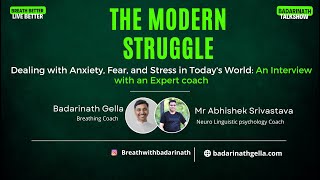
In this YouTube interview, host Badrinath Gella welcomes Dr. Abhishek Srivastava, a certified NLP practitioner and director at Rising and Coming, to discuss the modern epidemic of anxiety, stress and fear. Srivastava shares his personal journey from a middle‑class family in Uttar Pradesh to a 18‑year career in training, coaching and experiential technologies, explaining how early family dynamics and mentorship sparked his interest in human programming. He identifies the primary drivers of contemporary mental distress: profit‑driven work cultures, fragmented social support, ever‑growing material desires, and the pandemic’s job insecurity, health anxieties and forced home confinement. The conversation moves to the double‑edged role of technology and social media, which can both inform and dominate attention, turning devices into masters rather than servants. Srivastava emphasizes the inseparable mind‑body system, illustrating how posture, breath and kinesthetic cues reveal emotional states, and offers concrete, low‑effort techniques such as deep diaphragmatic breathing, yoga asanas, and body‑based awareness to alleviate anxiety. He links lasting stress reduction to aligning with one’s purpose, passion and ikigai, advocating minimalist living and self‑reflection. Finally, he outlines his coaching offerings – the Art of Asking Questions program for trainers, the Love & Life couple‑fitness program, and one‑on‑one mental‑health consultations – providing contact details for listeners. The interview concludes with a motivational reminder to live one’s true calling.
Chapters
Hello all, welcome to Breathe Well and Live Well. Today I have Dr. Mr. Srivastava. Like, he came here to talk about the modern struggle, the anxiety, fear, and stress. So let me introduce you all to Dr. Srivastava first. So Abhishek Srivastava is a leading expert in the field of neurolinguistic psychology. He is a wholesome director at Rising and Coming, a firm dedicated to improving the performance and productivity of individuals and organizations through innovation and development of experiential technologies. With a background in a middle-class family in UP, being the youngest of 5 siblings, Abhishek has faced personal and professional hardships that have shaped his unique perspective of self-development. He is a certified practitioner, master practitioner, and trainer of NLP, Neuro Linguistic Programming, from the National Federation of Neuro Linguistic Program of USA. And he received personal trainings from Dr. William, a world-renowned authority in the field. Abhishek has 18 years of experience in the training and development industry, has conducted over 500 workshops. He specialized in communication, relationships, group dynamics, teamwork, leadership skills, rapid personal change, experiential spirituality. He is also actively involved in senior executive coaching, counseling, mentoring, and training. He works with middle class and senior level management in a group coaching format and supports learning by providing one-to-one householding support. His clients include Indian Railways, IFFCO, BPCL, FASAI, CAG, and many more. I welcome you, Mr. Srivastava Ji. Thank you so much for accepting our invitation and coming here to enlighten our audience about the modern struggle which we are facing today, like one of the biggest struggle which is anxiety, fear, and stress. I welcome you, sir.
Thank you, thank you, Bhavna. Thank you so much for inviting me. Let me express my gratitude and thankfulness to you for allowing me to come and share my thoughts, right? So I'm indeed grateful to you for bringing me here, and it's such a wonderful opportunity for me to be talking to your group and your people. And thank you very much for inviting me back once again, right?
Thank you so much. And, uh, like, uh, we, we, we know each other from past 6 years to 1 year. 6 months to 1 year, sorry. So the best part, like, uh, Abhishek Ji, like, he used to directly answer your questions, like, he don't go here and there. So the first question I wanted to ask you, sir, so what really motivated you to choose this profession? Because I asked this question to every, every guest who comes to my talk show because I wanted people to understand that there are different professions available apart from engineering, apart from doctor. So I wanted to tell us like what really motivated you to choose this profession.
Yeah, thank you, Madhuri, for asking that pertinent question. So, uh, means I would like to ask few questions before I begin. So how many of you feel that the real power lies of the nation lies with its people, right? Everyone knows that people are so important. And it's not just the ability to have great ideas, but the ability to execute them that set us all apart. And every kind of change was always first inside a person and then outside, right? So when I, when I was growing up Being the youngest, you know, you don't have influence that much. Your powers are clipped, you know, by so many elders around you. So I was with the 5 siblings, you were 5 siblings and parents, and my father was coming from a big family of having 7 uncles, right? So had so many seniors, right? I was the tail end of my family. So when you get to the tail end of your family, you get to observe a lot, right? You observe a lot. You don't have to say much but observe what things are happening and how things are happening. Both good events, bad events shaped myself, right? And I realized that, see, that working with people and connecting with people was the one that gave me the biggest sense of achievement and ability to serve people. No, it was very direct way of bringing the change in the people. So I was really fascinated, you know, when I had great masters in my life. I came to— I was fortunate enough to have great masters in our life. And when I could see that just merely communicating and being with them in a way, giving them an unjudgmental environment to the people they interact with, and how few minutes of conversation can bring about deep change in people, that excited me really too much, you know. That excited me really good. I, uh, you might be seeing that today we are operating on the world of computers, isn't it? Yes, we heavily depend on computers. Now human beings are also programmable. That an idea came to me. It's not given to us, right? If we are not happy with some aspects of our life, we can still program them, or we can still change our habits, no? As the routine programs which a computer operates and helps and goes on and make us calculate any kind of calculations just like a second, so we can also put ourselves into new kind of programming if the things are not working for us. So the issues of modern-day life which is related to basically dealing with stress because the high targets and expectations that an employee has to set in and work, right? So many times we get to the flip side of it, which is that developing bad habits of fear, anxiety, depression, loneliness, and all those kind of stuff that get around it, right? So that's a, that's a negative programming. I would say that's a negative way of perceiving and looking at the world. But anyway, we are all susceptible to it. And we get it somehow, you know. Nobody is an escape to it, and this is the reality of the modern day-to-day life. So it's, it's important to know that what are the tricks and skills that people can learn and cope with, and so that they can better off themselves in this modern world. We cannot let ourselves be, be exposed to vagaries of the environment and be a mute spectator around. We have to be— got to be evolving as well as human beings, as species. And that is where this role comes to play. And this is what really fascinated me over the, over the years. And especially this particular field of neurolinguistic programming helps me to understand the excellence. This is a science of modeling excellence, right? Okay. Yeah. So if you want to achieve something great, what is it that runs in our beliefs, habits, behaviors that makes that also results. This fascinated me completely, and I dealt with it before taking it into a profession. I've worked for 2 years helping people and learning this, and finally I decided that this is for me, right? That's how I went into it. Thank you for asking this wonderful question.
Wow, it's very, very inspiring, sir, to know about your journey and how did you choose this. So as you touched upon, like, the modern struggle, so So the one of the interesting aspect I wanted to know, so what are the some of the common causes of anxiety, fear, and stress in modern life?
Okay, so this is the age of profitability, right? So we have to get things done in such a faster manner so that we can reduce our cost of operations and we can be more profitable because we are in hurry to produce more in less time with less people if have to be survive. That puts so much of pressure on the people to outperform, right? The kind of a social support system— now look at this— the kind of social support system India was once known for, joint families. Now we have majority of individual families, lack of people. And remember the fact that both the partners are now working couples in most of the cases, right? So when both of the people are working and the stress environment, the targets that you are given, the personal kind of, you know, there were never too many opportunities in life to spend your money on. If you take 25 years back when our fathers were there, then they had only to think of food and clothes and little shelter. Now you have so many things to do, right? Are you having a color television? Are you having a mobile? Are you having that car, this car? Which clothes to wear, which party to watch, which club to join, which books to read, which training programs, and the list is endless, right? This kind of expenditure that has come a burden— we have to send our kids to institutions to prepare them. We keep so much of money with us so that we are able to fund their education, still do conduct the marriage ceremonies of our sons and daughters and prepare something that will last us while we are no more in a position to work, right? Or remember that this is tremendous pressure. This is tremendous pressure on the person's psyche, right? And to be present every day, being responsible, accountable for your work done, getting things moving, though it creates so much of pressure on the outside that many times any average person is likely to collapse. And every likely person to give in to this, right? So lack of social support, extra competitive environment, no real bonding and connection between peers, right? Excessive of challenges both at home front and the office front, and little time the person has for himself. Okay, very little time got to very little me time that you can think about yourself, right? That leads to all this stress that we are seeing that accumulating, right? Okay, that's the reason why we call this, uh, this is tremendous explosion of, uh, this stress, anxiety, and depression in our modern world.
I can also say like it's growing desires. Whatever you have mentioned, what I understood is the more desires we have, like even in the philosophy of, uh, yoga, like we say, like it's about growing desires are the causes of your stress, anxiety, anything. So it's keeping them in control will really give you a peace, happiness. So even like, even though our standard of living, life, life standard of living is going up, the quality of living is going down.
Yeah, absolutely agree 100% with you on that. Yes, yes. And in order to beat this, there are new philosophies of living and life is coming, like minimalist, minimalistic living style, right? Where people start to get only what are the minimum things that I need to have, all right? And that spending and that time. So that kind of cultures are still coming up and people are adopting it. So that, you know, Steve Jobs used to live in a single room apartment where there were no furniture. He used to sleep on floors, right? Okay, so when a man who is the richest in the world in terms of technology and all can live approval like this, how not adopting? How about people like us can adopt that as well, right? Yeah, right. So this is the one.
Yeah, yes, go ahead.
Yeah, so, uh, you see that desires are one that makes the life running, right? It keeps the economy kicking and running, but it should not be at the expense of our happiness. That's it. It's a delicate balance we have to all strike out, right?
Along with it, we should not be attached to that. Like, so it doesn't mean that if it is not fulfilling, you are not going to live this life. So there is many other options which are available for us. So So leading to that, my next question for you is, how has the pandemic affected people's mental health in terms of anxiety, fear, and stress?
Right, thank you. Such an awesome question, right? So immediately you see, as the pandemic struck, people started losing their jobs, right? And you realize that your respect at home is directly proportional to how much you earn, right? Yeah, true.
I, I experienced, right? Like, people ask, like, they just wanted to take a moment here. People ask, like, uh, how much do you earn? That is the only, like, major question you get in when you go out. So rather than how much happy you are, like, it's the question should be how much happy you are rather than how much you earn.
Yeah, exactly, exactly. So this is, uh, what means the basic ego, you know, that we are something or someone is from our jobs and the money that you bring home. That got threatened. That's a very delicate balance. You know, hundreds of questions open up. What will my spouse think about me now? What else? How will I afford my child's education now? What about the pending EMIs that are on my shoulders? What new talents I can now— what do you expect me to— what new talents I can open? Never prepared for this life. You are never prepared for that kind of life, you know. Right. And you know that because our systems— that because every person gets some time to go out and work, the home kind of interaction is— even if a couple is having a tough time together interacting and exchanging with each other, that got magnified to the next level, right? You had to have spent time with people who are somehow— you got to— you adjusted with because You are not that comfortable, and that home kind of a situation become so terrible, right? Because you have to live with your, you know, the person who you somehow manage with. Now you have to be in 24/7, right? Someone has said you are free yet bound, bound yet free, right? You are free yet bound, bound yet free. All right, so you You got free from going to the job every day, but you got bound to something else that you had to spend the entire day in home, right? Yeah. And had its own dynamics and its own dynamics to it, right? So this personal and the news of people dying and who— and the kind of ostracization that you felt that if someone had COVID symptoms, your routes were blocked, you know, the entire compartments of the— all this was kind of giving a sense of feeling that anything can go wrong, right? Anything can go— this led to a generalization that now this is crippling, this is getting out, this is getting out of hand, now what next?
Yes.
Okay, so when people started asking this question now, okay, what if, what if I— what if my health deteriorates? What if my wife has— what was my father's death? What if I don't have money to— means you can have emergency once in a time in your home, but you cannot have emergency if all the people falling sick at one time. So what if this happens? The question of what if, what if, what if this goes wrong, this goes wrong, this was wrong, this wrong, created a kind of anxiety in the people. Now I had many people coming to me for this kind of anxiety, you know, and these was so deplorable. I can— I share with you that some of the people who came to me had their feelings of such an anxiety kind of a disorder that they were getting kind of electrical feelings, some shock kind of a— some kind of feelings in their body with these situations. That was the thing that this pandemic created. And see, there were good things also at that time. Hardly we will get that long holiday, you realize, right? Ever in my life, nobody would be ready to giving us that long holiday in our life. Nobody would be giving us— we will never get that quality of time we have, can get to spend with our spouses. No, but no, never in the life we will get that opportunity to understand, to show that we love for each other. It was so great. Never we don't get opportunity to help our spouses in kitchen. Right, because you are so busy with this. There were so many positive aspects. There were never the time that you can sleep as much as you want. Yeah, right. Watch television that you want, listen to your songs that you always wanted but never had the time to do it, right? How about a long bath, listening to a long classical music and all? How about connecting to a friend over a video call? You know, the possibilities were basically infinite on both ends, right? Right, okay. So how you shape yourself, how you— where you look at, that creates your reality. Okay, so, so the people— it's not that in any situation there is good and bad both. Now, when— where you look at, where you take your energies, is entirely depend upon who you as a person are, right? And that is what, uh, what it was good for some and it was worse for others. That was what it is, right?
Yeah, great. Yes, yes, that's completely true. Like, also it depends on the perspective of the person. As, uh, my next question, like a question which I wanted to ask, like, because you said there are so many opportunities which we can create a better life by just staying at home during the pandemic. So, but we are living in an instant age, insta age, I can say. So Instagram, like, you can see everything is instant. So how, how does that social media and technology can contribute to these factors like anxiety, stress, and fear?
Yeah, so there are, there are good aspects to it, bad aspects too as well, right? You cannot sleep on time if you go with onto your bed with your mobile in hands because something or the exciting will catch your attention, right? The technology is so built so that in artificial intelligence it will know that what your interests are and what is the top news or the top video that you should watch on that interest topic. So it will not give you some— if supposing you are interested in some music, right, some kind of music, your video, your YouTube video will be loaded with that kind of music only. It will not balance you as a person. Not— we have watched enough of videos on music, now better look at some yoga videos, or like better listen some of soothing music, right? So what you want that you are given more of, that completely throws life out of balance, right? Okay, it's the, it's a, it's the age where we have to look, even when you are calling, your phone being picked up and exactly what is it that you need, right? You will find that if you are discussing some topic over a phone and lo and behold you will be getting YouTube advertisements coming to you straight away on the topic that you are talking on phone. That, that is, that is what is happening. That is what is the science of artificial intelligence. Now the point to realize is that, are we in control? The point to realize is, are we in control? The question to ask is, is it this the life that I want to live, right? Okay. The question is, what is it that I can do in the now that can I can make myself better off by doing what I am doing? Right? Yeah. How about, how about using that technology to connect yourself? You know, with the, uh, with the pandemic coming, the technology is a servant, you know, it's never a master, right? The problem with technology comes as it becomes your master. It starts to dictate you what you do. This is what you should, and you become compulsive to it. You become a habitual servant. To it, right? So we have to always remember that we as humans will always keep technology as our servant and never be as a servant to them, right? That they should make our lives easy. Now we can learn a lot of things in the day. You know, people who wanted to learn, they learned a lot of things using these technologies. They came to know about so many things that the world is happening, both good and bad. Right, so it's, it's, this is what, you know, there's so much of importance in there to learning the science of yoga, to learning the science of breathing, to knowing about the cultures, know the ancient cultures we are coming from, how it served us, right, and still serving us. Providing reality, giving it the time, right, we are providing to little importance, no. Right? If we make it important, then perhaps that will also make us feel important about ourselves. Yeah. First of all, we have to be good humans, right? Okay. Then anything about technology and all, at a functional level, is our body and mind in sync and soul is in sync with who we are, right? What are the purpose that we are born with? What is it that we are living our lives for? What it is that I will leave when I will leave this place? Right, so these kinds of things and situations, these kinds of reflections will make a person reflect that, okay, I will always, always be in command. Use technology to help, you know, help your health, right? Help in your health. Listen to music, relax, get information, and never be subservient to technology. So The point to be taken out here is that technology can be a good servant but a bad master. True, true, right?
I like nowadays, like, uh, uh, the Facebook, Google knows more about you than you. So we do not know more and more than— like, Google knows more about us rather than us. Like, we never self-reflected, but it's reflecting every time. Whenever you search some keyword, whenever you search for some video, it knows all The whole personality development today, AI, I think AI can give better answers than you. Like, tell me about me something. If you ask some that question to AI, AI can tell better than you. I feel like technology development which is happening. Yeah, so we are giving our own power. Like, being born as a human being is the biggest gift for everyone to have that, but we are giving our own power to something else rather than —using it.
Yes, yes. So, uh, I mean, so there are, there are different aspects of your personality, you know. And there is one aspect is that you don't know about some aspects of yours, but others around you, everyone knows it, right? You don't know, others know it, right? There's other aspect that you don't know and others also don't know. So both are in ignorance, but there are certain aspects that you know, other don't know. So there's a kind of an entire— this is a matrix, no? So the— what these technologies are helping us discover is what we think we do not know and they know about it. That is what we get aha moments. Okay, this is what we are getting. I never knew about this, but this is what I'm getting is because it's the age of customer delight now. And what is the way to delight your customer? The way to delight your customer is to give them, serve them that thing that they never knew they wanted. And actually, they never knew, but actually they wanted, but they never knew they wanted. If you serve with them, they will be completely delighted, no? That, oh God, I wanted this. I never knew I wanted it. How did it come? He knew this, that I wanted this. And that's what the key is to all this happening around us. Right? So this technology is coming. Yes, true. That's great.
So coming into my next question, so how does anxiety, fear, and stress impact our physical health? Like, because in even in our philosophy, yoga philosophy, we say the root cause of your 80% of your diseases is your mind. The stress is the root cause of many problems, many health issues. So as per neurolinguistic like psychology also. You can tell us like how does this impact on our physical health, physical elements.
Yeah, so I'll tell you a way, a beautiful way of understanding is that we are a mind-body system. Okay, we are a mind-body system. Our mind is intricately connected with what our bodies are at that point. I'll give you an example now. Just look up, look up like this and start feeling bad. Try to cry. You will not perhaps able to cry. Have you ever seen someone looking up and crying? That is not possible. You have to look down and then cry, because when you look down, you assess your kinesthetics. Kinesthetics means the feeling state in your body. All right, when you look up, you are disconnected, so you cannot cry looking up. Are you seeing? The mind, what you can think and what you can feel, is connected to the postures that you are taking, right? So just by looking at the physical posture the man is taking, his breathing rates, the way his color, this earlobe's color, the changes in the facial blood capillaries, how they, their breathing rate, their tone, you can sense a lot, all what's going in their mind. Right, you have to attune to it and listen to it. You know, just, uh, if you are, if you are a good, uh, if you're in a good shape, then your mind is also fit and your body is also fit. So the— this is not two separate things. This is one thing must heal one another so beautifully that if both the systems are running properly, you will perhaps, you know, that state of nirvana, you You know, if it's all right with you and you are living a blissful life, the blissful life is something you will never feel I exist, right? Yeah. How do you come to know that you have a headache, that you have a head? Only when you get a headache. Otherwise it doesn't feel so, it doesn't feel that way, you know, you have a head. So completely. So the thing is that this mind, you know, what I say is that sometimes what happens is that because of this modern-day stress, we become slow. What does, what does, what does a depression mean, right? I'll just explain you a little bit about how does— what does basically depression mean. Depression means depressed action, okay? So if you slow down, if you slow down and you are not doing activity, your activity is curtailed, Because you are making images in your mind which is not attractive, which is gloomy, which is dark, which is, uh, full of borders, which is containing you, then what do you think? Your body will slow down, right? You will not feel excited. You will feel, even though I try, I'll not get it. No, because not— this is coming as a result of making bad images about the future that may be coming for you, right? Okay, similarly, that is how you will put into depression. No, there are bad people in our society, you know, who are doing bad things. Those people need to be depressed. And the good people who are actually good, wonders, and they are doing great, they need to be getting out of depression, right? So all these moods have a role to play, right? Understanding that how does anxiety build up. You see one thing, one incident can happen I'll share with you, explain you with the, with the case that I happened in my, one of my clients, that during corona times his brother-in-law had a massive heart attack and his arteries were all blocked up. He was immediately taken to the hospital where he was performed this bypass surgery, was performed. That particular event That took that, that the client of mine was such a shock and pain that how can a person who was so healthy in all my interactions, in all my meetings, could land up into such a situation like that. And that particular instant and this particular pain inside him that how can this— he attached a great pain to it, right? Yeah, this instant. And in his mind, he kept on repeating number of times, number of times, how could this happen, how could this happen. Happens. You know, you always feel that, okay, bad things happen to the other people, bad thing never happens to our people. Okay, that's the psyche that runs. So this time, with this incident, he was also emotionally more vulnerable because he was a kind of more sensitive, kind of inclined person. He took it so deeply that he started getting into this feeling and seeing and feeling mode. And then many others were dying. This led into kind of anxiety, you know. That feeling. Any bad thing, you don't know what, you know. So anxiety is a very interesting feature, you know. You know, when the root cause of fear is dislocated, you don't know what you are fearful of, right? You don't know what you are fearful of, then it becomes anxiety because it's a generalized— it becomes a fear, gets generalized. No, it's not that one particular thing that is causing you anxiety, right? It can be anything. Everything becomes bothersome. Bothersome, right? And that leads to your situation where you start to get anxiousness. No, you don't know which is the source of next perturbation would be. Yeah, that is what happens. And fear is a little bit easier to work with, right? Fear is, you know, the cause. You know the cause. In anxiety, you don't know the cause, right? You have a cause and you are trying to avoid it, right? When you get fearful, you try to avoid it. Rather than getting the other state of courage. Now, courage is needed. The state of courage is needed to neutralize fear. Okay, so rather than developing courage, coming face to face and challenging it, that I am here, I can deal with you, I can survive, I can beat you up, and there is a victory. If I defeat this fear, will help control the fear altogether, right? So this is what the entire depression, anxiety, fears This is how it is all linked. So the better, if you are feeling anxiety, try to locate it to what, what are you fearful, what was the beginning cause of your fear, fear that started, what was that working to convert into fear, and then improve the state of courage, act on the courage, help build the person moral and boost their systems, right, to, to get it done. Now, very important aspect to be noted is now Look at the person. If you feel like that their mind, in spite of your working with them, they are not able to use their mind, the good tip is to use their body. All right, work it from the start. Working from the body means a morning walk, yoga, exercise, breathing will do wonders in getting a good mindset change, right? Wow. So this is, this is something, you know, many times you will work with people and you find very difficult trying to explain your point of You'll say, because see, but it is easier to say something, no, suggest something. It is even more difficult to accept it and even more difficult to implement it. Yeah. Yes. So there are 3 level changes, no, that a person has to go once he has heard the information. You have to acknowledge it, then he has to accept, and then he has to implement in order to get some results. Now if you are not getting with your suggestions, then the thing is The beautiful point to see is to start working with their bodies. Yeah, some yoga, some asanas, some japas, some kind of mantra, something that they can move with your body. That, and when your mind is completely sucked out with the kind of an obsessive kind of a thought, then it's very easy to work with the bodies, right? So that is how the mind-body system integrates together. And when you work on your breath, breath is very good Breath is very good for controlling anxiety. Wow. Instant— I'll see instant result coming. You know, whenever you feel like anxious and nervous, what you do is sit down, take a back seat, make yourself comfortable, unzip your, uh, your any kind of a tight clothing, just make yourself comfortable and take a deep breath. Allow the deep breath to fill into your stomach. Right through your nose. Hold it for a while and blow it through your mouth, right? And do it for 5-10 minutes. You will see that all that anxiousness coming down and down, and you're getting more control. This is such a powerful technique that any person going through any kind of situation will start to get more control. There's a direct control, direct relationship of breath with mental mental health and this, right? Many times you can just look at the breath of the people and say, okay, yeah, this is what is happening. A person who is very nervous or fearful will take very short breaths. Yeah, right. They'll perhaps not be breathing, no, altogether, right? The head will be so heavy. The head will be so heavy. Just ask them, sit down and breathe, right? Give them a good massage, a neck massage, you know, all these All these histories, all these memories that come along with us are stored in our muscles. Just by interacting with the person, and I just— I sometimes I ask them, okay, where do you feel in your body? You are telling me, where do you feel in your body? And to tell you the truth, they know it exactly. They will take their hands, okay, I'm feeling it here on the top of my chest. Okay. Now you have to— means your feeling comes in association with that muscle memory. Yes, that your histories are stored in your muscles, and then when you work on relaxing these muscles, those feelings slowly, slowly— yes, this is how intricately the mind and the body systems are so well connected. And this was so well understood by our rishis. This was so well understood by our rishis in all the deep sciences of yoga, that how different asanas and different mudras And different kinds of yogic practices can give you a lot of relief in any kind of mental situations as well.
Yeah, it's more like, even though they are invented with the— in the age where there is no technology, but it is completely applicable to the age we are living now. So I think they have invented for this century.
So just imagine, just imagine today He has so many things to do, right? Go 1,000 years, don't just go 500 years back the line. Nothing much to do. Just sit down, gaze stars at night, feel what's happening inside our body. If you have nothing to see outside, wherever you'll go, you'll go inside. Yes. It's a test. Internal is more interesting. So, and those are just going 1,000 years down the line. When there's nothing much, you won't bore by seeing every day what you're seeing, the trees, the plants, the everything kind of that. The more interesting thing is to go inside and see how different shifts are happening, right? It was easier to go into meditative state at the instant, right? I feel like that, okay? So, and remember that our DNA is basically the same. We are getting the same copies passed by, passed by, passed by, passed by, one after the other, after the other, after the other. So basically, uh, the progress that human— humans have made in the last 300 or 400 years is so great that we have— our DNA has not been able to cope up with that space, right? So still our DNAs belong to that primitive age where dinosaurs were perhaps living, right? Okay, because, uh, our— if you take our environment is so safe comparatively in what used to be 500 years or 1000 Dinosaur age type of— where will you get that? So it's still too early for the humans in the evolutionary age because they had not developed that fast, right? Okay, in the modern world. And that's, uh, it will take some time to cope up with the change that we are bringing in, right? Our DNA has to include ourselves more. That's how it's happening. Yeah, yeah.
But sometimes it wonders, the more progress we are the more struggle we are facing. Rather than it should go down, it's going up. That is the saddest part, uh, like of this century, I can say.
Yeah, see, uh, especially if we talk in India where people are never encouraged with what is this that you're calling in, in this life, okay? We never connect with, okay, what is it that we are born and supposed to do in their lives. What are our basic values? What is the purpose? What is the ikigai, rather? What we are born to live for, doing what, right? Never the kind of, you know, ordinary— I'll say most of Indian families is that I will make him such so that he will be better able to earn himself, right? That is where you can get more money. That is the whole— this still the survival state that this life is somehow to survive, otherwise never— no, have no bread to eat, no clothes to wear, no medicines to purchase. For that kind of mindset is still pulling us down. Rather than looking, holding our children with loving eyes and just go that God has sent this man or a child to me, for what purpose? Let me explore it out, right? It's the God's creation in my hand and I'm just a gardener in my— in— and I'm trying to help this child out. You know, you will always get help according to your parents' terms, but rarely does it come at your terms. Yeah, really. So that is the reason, no, you are pushed into something which you don't understand, right? So you see that the word passion is not— what do you mean by the word passion? Can I ask you this question?
Passion, I can say like it's a purpose also. Like, I mean, what I like, uh, is my passion.
Okay, if you go to the dictionary, you will find it. Passion is something that you will do in spite of getting hurt. Hmm, okay, okay, wow, that's true, right?
I can— I agree with that. Like, even like I get hurt with whatever I choose, if I like that, I'll do it.
Yes. So that is what passion is all about, right? So if the competition is so high, and the demand on the person is so high, then if we are connected to our passion, it will give us an ability to survive regardless of the competition. Right? Are you seeing that? Because we'll be ready to accept that challenge, we're ready to accept the pain that passion brings to us, right? And we'll do something great Because even if in our loss, we are feeling we are moving ahead, right? We are getting that thing that the way we wanted to, and we're ready to survive, and we're ready to take on any blows that is coming on to us, right? So once this system is connected, you know, knowing what you are made for, knowing what your values are, if you— if the people connect with that thing, Then I feel that the modern-day stress life will be reduced to a very significant percentage. Or so it will be just— because if you are given a work that you love to do and you enjoy to do, that is the purpose, you will feel— wherever it will be a pressure or a pain to you, never. It will never bring you pressure. It will always bring you happiness. It will always keep you excited. It will always keep you on the vigilant and you're ready to take all things when the things go out of your hand or things get out of your control, right? So that is the way forward. That is the way forward, that when you do this, then, then a person will always feel connected, always feel I'm making a significant contribution. And that is the way, that is how you can completely reduce your stress quite a much, right? Yeah, it's a fulfillment also.
Like, there is a fulfillment that like we are doing something.
Yeah, means, means when you leave the world, you will ask what is the most important question when you leave the world. Yes, what is the most important question when you leave the world?
The most important question: what am I leaving behind?
No, okay, but you basically ask yourself, was it a fulfilling life, right? Am I happy with what I lived, right? Is it, is it, is it something that satisfies me, right? Yes. Okay, do I live a fulfilled life? That is the question that will be there at the top of your mind, right?
Or still, instead of waiting, as, as you brought up this question, I— people who are viewing this video, like if they are viewing in YouTube or anywhere, ask yourself if you are at the age of 30 or at the age of 10 or at the age of 50 or 60, ask this question which Mr. Abhishek Srivastava is mentioning. Like, so again, can— could you please repeat the question so that like people can self-reflect themselves? Like, so instead of waiting, you go to the deathbed.
Yeah, you can ask that. Am I living a fulfilling life? Is it— is it by living the way I'm living, am I— am I being fulfilled? Am I being satisfied? You know, fulfillment and satisfied— satisfaction is the biggest criteria when it comes to our satisfaction, right? It's a— it's a— am I living a fulfilled life? That's the biggest thing. And then if you direct your mind and effort, you will see that the God is slowly guiding you, right? You are slowly— the ball is rolling you down the slope that you deserve to live in, right? It's a slope. All the things that you see as resistances in your life are actually not resistance. They are just a little bit guidance by the God to shape you in the right way that you should go. You are getting that. It's the gravity that is pulling, and let it allow, and you will find a place will exactly match you. You will be in right place at the right time with the right people if you allow this. All right, this life comes like a gift, no? It is packed, it is not open. So you just really slowly open it and discover what it is about. Yeah, yeah, true. So if you— if that kind of life, uh, but then you will realize What do you think? Will it take away all the stress and all the pressure and everything will be more fulfilling than what we feel like, right? Okay, that will take away all the mental stuff, all the struggles of life. Perhaps even the pain will be also pleasurable. That was all passion is about.
Yeah, absolutely, absolutely. I agree with that point, like, which has to be given like very much importance in our life. That many people miss out to ask in the right time these questions. I think absolutely, if somebody is going through this program, like this podcast, which I can say truly, like you will see like, uh, the many self-reflection questions which will— you can ask yourself and lead a fulfilling life. So by going through the next question, sir, like because we are also timing— time is going up. So what are the resources available for these people, or do you have any programs are you running for people who are seeking help with anxiety, fear, or stress?
Yeah, so, uh, I do one-on-one with people who are too critical, who need critical support. I do one-on-one with them, and, uh, because they need individual attention, as well as I am teaching trainers and coaches into the art, and I'm teaching them to have how to develop a fresh pair of eyes so that you get to respect the person coming before you, right? So that you don't fit him into boxes, so that you give them their complete attention of what people are going through. I'm doing a program by the name of The Art of Asking Questions, right? So there's an art of asking questions as well, because merely by asking a wrong question, you can put a person back in on onto a back foot, right? So the art of questioning has to be so subtle and so powerful that you need to bring that person completely out so that he can trust you, so that he can share their deep life struggles with you, so that they feel that this environment is something which helps me to be myself. I am not judged, and at the same time, I am helping my coaches and teachers to develop an attitude so that they don't bring in their particular experience to decode someone else's experience, right? So that they don't meddle with their understanding of the— their client's understanding of the world, so that they reach their clients at that position which they are. So I'm developing that. That's a very important training that is going on, the art of asking questions. That can come. And I'm doing another program for couples, right, which is by the name of Love and Life. All right, I have taken— because see, whether you see any Hindi song, you see, you will see the heart and mind connection going together. Let's say you see famous Bollywood songs like Dil To Pagal Hai, Dil Dilwana Hai. So with Dilip, we had this so well connected with each other, you know, that mental fitness also requires great relationships. And when relationships get compromised, it directly affects your mental well-being, right? And your mental well-being directly affects your relationship. So also, I work as a couple coach, and I have helped a number of couples who who come to me, resolve their issues, make their families back again, and created them into such awesome families back again that it's with— after 5, 6 years of my working with them, they're still living good lives, right? I have taken people out of the courts. They were into divorces and all kind of situations. Ask them, create, solve the problem, and put them back. That's how I am affecting the lives of the people around, right? So mental health, couple relationship, and coaching for the trainers and leaders of the world for tomorrow, that's what I'm doing, right? Wow. You can reach my website by the name of www.abhishekshrivastava.com, and you can also join my The Art of Asking Questions program where I will share with you, uh, the— my— you can take my number Uh, and you can just WhatsApp group, I think, WhatsApp number. Uh, you can take my WhatsApp number. Is it all right if I just say my WhatsApp number?
Sure, sure, you can tell your number to our audience if they have any issues.
So my number is 98388-21677, right? So my number is 98388 2-1-6-7-7. So just add me and just say hi and connect me in WhatsApp, then I'll connect with you and put in the appropriate 3 groups that you may likely to fall. Either you are a teacher, instructor, coach trying to help other people where the art of asking questions would be relevant for you, or either you are having issues at home with your relationships or with your child or something where I can put you the group of, uh, Love and Life group, right, which is about couple coaching and fitness. Uh, Badri, I am doing an awesome program which is about— see, many years ago, uh, 300, 400 years ago, you did not have a concept of gym. Yeah, right. Okay, now the concept of gym is so popular now. Everyone needs to go to gym to build ourselves, right? They need to have Now, the thing is that in order to be a brain surgeon, you have to have an SSC certification, right? If you want to be a chartered accountant or a cost accountant, you need to have a certification. If you have to be allowed to drive the vehicle on the road, you have to have a driving license. But if you want to marry someone, there is no license required, right? That means that our culture rests on such understanding, that is given to us uniquely. And I strongly feel that before entering any, any kind of serious relationship, or even if you are into a relationship, your relationship fitness program is also very much— it is actually in parlance to the body fitness that you are so well aware of. So I am doing that program where I am teaching couples what are the fitness— that what are the tricks and what are the ways of keeping your relationship fit, right? That is I am doing through this Love and Light program. Which is about couple fitness coaching, right? Wow. So these are the kinds of things that I am working with and helping people around. And people who are having their mind issues, mental health issues, I am working one-on-one with them at many times, right? Okay, that's what I do.
Basically, how all the programs designed for people who are facing any external problems, I feel like relationships, relationship problems, or if you have stress, anxiety, depression, you can have a personal one-on-one consultation with him. Or if you are a coach or consultant or educator, if you want to learn how to ask the questions to the people, so you can join his Art of Asking Questions program. It's very interesting. I heard Art of Living, now I am hearing Art of Asking Questions. Art of Living. Yeah. So yeah, I think also the questions, they should know like what questions they have to ask themselves. To really bring out that best of them.
Your relationship with yourself is so very important. It has— perhaps it is more important than the relationships that you have with anyone else. The relationship with yourself is perhaps the most important thing. There are two things to it, right? Are you valuing yourself enough is the first point, and are you recognizing that you can change? These are the two things when it comes to having an awesome relationship with yourself. Wow, okay, great.
At the end, like, we are ending the session. Like, what is the one tip you want to give to our audience?
Uh, one tip I'll give to your audience is, uh, live your calling, live the life that you want to have. There will never be other life in this world, and this is only the one chance. So don't waste time, live the life that you always wanted to. Wow. Inspiring.
Thank you, thank you so much for that. Like, I think people who are watching this, it's, uh, it's a great, uh, discussion we had and very, very inspiring, uh, like, words from you and stories from you to hear. Thank you so much again, uh, Dr. Mr. Abhishek Srivastava ji, and we are happy, we are pleased to have you here, and, uh, we'll, we'll stay connected. And if I, if our audience has any questions on different topics. We'll be happy to get you back to our program. And thank you again for your time.
Yeah, thank you, Padrinath, for being an awesome person, being here. I know you for so long and you've been an awesome person, so smiling, so full of passion, so beautifully you express your ideas and take your clients to a journey. I'm so grateful, and I'm really grateful for bringing me here and to each one of you You can have chosen to do anything else, but you choose to be here. And deeply grateful to you from the bottom of my heart. But if you have reached this part of the video, then it means something. Yeah, you are great. You're already an achiever. Thank you so much. True.
More from Badarinath





How Conscious Breathing Transformed My Health, Family & Career | Inspiring Success Story

International Yoga Day Celebrations 17th to 21st June | Morning 6 AM | Evening 7 PM

30-Minute Breathing Exercises | Reduce Stress & Improve Lung Health | Yoga Day | @badarinathgella


