Food and Emotions: Exploring the Science Behind Our Relationship with Food
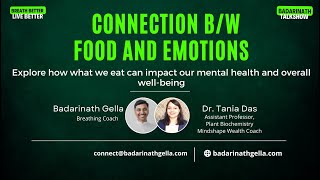
In this talk‑show style interview, host Badrinath Gella converses with Dr. Tanya Das, a plant biochemist turned Mindshape Wealth Coach, about the scientific relationship between the foods we eat and our emotions, mental health, and sleep. Dr. Das explains how plants are living, signaling organisms and how the biochemical constituents of food—antioxidants, proteins, lipids, carbohydrates—enter the bloodstream, reach the brain, and influence neuronal signaling, thereby shaping emotional states. She discusses how unhealthy foods high in sugar, refined carbs, trans‑fats, and pesticide residues can amplify negative emotions, promote stress‑eating, and even contribute to sleep disorders such as sleep apnea. The conversation covers the impact of plant stress and organic versus conventional farming on nutrient quality, the importance of mindful, sensory‑focused eating, and the role of dietary patterns (MIND, Mediterranean, DASH) in mood regulation. Dr. Das shares practical tips: develop a conscious bond with food, eat without distractions, respect portion timing, and choose brain‑healthy foods (walnuts, avocado, dark chocolate) to support emotional balance and sleep quality. The interview emphasizes that health is wealth and that understanding food‑emotion connections can empower listeners to make healthier lifestyle choices.
Chapters
That plant is also a living being. It can breathe. It's just that the difference with plants and us is that it is not mobile and we're mobile. The food is having chemicals in the form of, you can say, antioxidants, in the form of proteins, in the form of lipids, carbohydrates. So it's going all inside you and mixing with your bloodstream, it's flowing into your brain, and then through neurons the signals are happening, and boom, your emotion is born.
So these are not taught in our schooling. They only taught us intellectually how should we grow, but they did not teach us how should we live.
Just understand the taste of it, feel it, and making a connection with that food, that what is going into my body.
Hello, welcome you all to Breathe Better and Live Better. Talk show. So today we have one of the important guests, Dr. Tanya Das, who is plant biochemist. She is going to share us about the food and emotions, how the food impact on our emotions. So you might be confused like how the food we are eating is going to impact. She is going to decode that in scientific format, how that is going to influence on our emotions, our thoughts our stress and worries in our daily life. So even in yoga, we say tamas, rajas, and sattvic. So we have 3 categories. The food we are eating divided into these 3 categories as per Indian philosophy. But today we are going to see the scientific aspect around to it. So thank you, thank you, Dr. Tanya Das, for coming here and like taking the session for our audience and like giving the knowledge about how the scientific aspect, how it influences on our mind. So let me read out the profile of Dr. Tanya. So Dr. Tanya is a biochemist turned Mindshape Wealth Coach, and she worked as a research scientist and assistant professor, mentored 10+ batch students from UG level and PhD. So Dr. Tanya, I think like with your research you have done so far, I think you can add huge value to all our audience to like to bring out the real facts behind how food influences on emotions. Thank you, Dr. Samia.
Well, thank you so much for having me in, in your show. It's a very— it's a great opportunity for me to represent, uh, this topic as well as, you know, share, shed a light on the scientific aspect of of our emotions and how we behave and act and how we eat foods and how foods impacts our lives as well as our behaviors and how we connect with other people. So it's, it's great to be here. Thank you.
Great. So, uh, Dr. Tanya, like, uh, it's important work you are doing as a professor, like teaching the students and everything. So I want to understand what really motivated you to choose this profession. As a, like, yeah, biochemist.
Okay, biochemist. Well, I would say, like, the research in the space of this, whatever you are doing, this area. Okay. Yeah, this happened, uh, as an accident rather. Although I was interested in biology, I was going to go for a biotechnology subject, but this biochemistry happened, and I had to connect with biochemistry. And people, some people say still don't know that these are the sister branch. They are not the same. Uh, biotechnology is some technological part, and chemistry is like we deal with chemical reactions that's happening in living organisms. So as we all know right now, that plant is also a living being. It can breathe. It's just that the difference with plants and us is that it is not mobile and we are mobile. So, uh, plant is also— can feel and can send out signals. And it also has its own, uh, self-defense mechanism going on inside. And it's all bio— biochemical procedures. And, and the area that studies all these sectors is biosignaling and biostatistics parts. So It's very interesting actually, and how I jumped into this and it started to reveal itself in front of me. And you can say that I fell in love with it through the process. It didn't happen in the first place though.
Wow, wow, that's amazing. So like, it's very, very interesting, you know, like even see, I never read the that much. I haven't done that deep research about this, but when you are talking about this, I can remember that like we call that as prana, the life. Even the plants has that life. Yes, even, uh, the animals has that life. Even the— we, we only think like only humans or animals are having, but even plants also having the life and the living beings. That's a very, very interesting like, uh, for Like, to hear from you as a, as a plant biochemist, to understand like how plant also has some emotions, how plant also has some healing capabilities as a prana. So wow, wow, that's interesting. Uh, that would be a very great topic also for us. So like, now I want to understand, like, the first question is, how does food affect our emotions?
Okay, so, uh, first we need to understand that what emotion is. We think that this is emotion is something that is happening to us, or it's a feeling, but it is not the feeling. It is how we are interpreting it, that whatever is happening, and however if we interpret it and then we label it, then it becomes an emotion. Like, uh, like in a similar situation Some people feel sad, and at the same time, others can feel angry.
Yeah.
So it's a process. It's a process that is happening. For example, the fear is the process of, you know, fearing. You're getting scared. So it's a process. The emotion that you are exerting, it is fear. It is frightness that you are showing. On the other hand, food, what we know about food is like it is having diverse colors, shape, size, appearance, smells, and it, you know, it gives some sort of signals into our brains through which it connects. Sometimes it connects with the moment that we had it for the first time or with with whom we had it for the first time. It's like it's, it's a connection, it's a signal that it sends. All these things that they're happening inside a brain that, that we're having through that food. Now what food is having on the other hand? The food is having chemicals in the form of, you can say, antioxidants, in the form of proteins, in the form of lipids, carbohydrates. So it's going all inside you and mixing with your bloodstream, it's flowing into your brain, and then through neurons the signals are happening, and boom, your emotion is born. It's like that. So, oh wow.
Yeah, so basically, like, whatever, uh, the nutrients which we need for our body is coming through food, one of the form, like as water, air, and and food. So that is mixing in our bloodstream, and that really like, uh, like impact on our emotions.
It's giving us energy. And what emotion is, it's, it's energy that we're showing.
Yeah, right. Different energy, like energy.
And energy has intensity, radiates. Yeah, it has intensity level. Okay, so wow, like if some people feel bored and sad, they indulge in having foods. Now this also has a negative side of it, like sometimes people go and indulge in having unhealthy foods, and what they don't understand is this unhealthy foods can increase the intensity of their current or running emotion that is going on. If they are feeling bored, they are going to feel more bored. If they are feeling angry, it's gonna just increase its intensity. So it's, it's really necessary for us to understand that how food and emotions that we show, or, you know, the resultant part, it has a connection, and how it's impacting, and which is actually happening in the back end that we're not able to see, we're not able to understand. We think that, okay, I just want to eat, and which is actually stress eating, which I also used to do when I used to feel stressed. And I thought that I was just a foodie, but no, it is a stress that I needed to understand. I needed to, you know, look within. And then I, I, I— what I had to do is just having foods which are having more nutritional value rather than just, you know, having those foods without even feeling hungry. So yeah, that was, that was important for me to even figure out. It happened to me because I, I had my thesis work on stress effect on plants. So how plant behaves and its biochemical reactions and physiological reactions when it is under stress. So while studying those plants, I understood, okay, if they are showing this kind of physiological behaviors, or even the grains or the fruits that we see that is, that we are getting from those plants. So yeah, we can see that it is not of that great quality, the fruits or the grains. Then what is actually happening inside? Okay, and now that we are having those fruits or grains from that plant which was under stress, how it is reacting to our body? Because I guess everybody is now more prone to having organic foods. What are organic foods anyway? Organic food is something which are grown in a field which are not having any synthetic pesticides or insecticides. Okay, so that means it's coming out of nature. Here the soil is more fertile and it's having more organic matter in it rather than some synthetic, you know, synthetically made nutrients for those plants. So, so if we are consuming that and we know that we— it has some health hazards, uh, you know, how would I say, health hazard qualities, it shows in our body that we are having some digestive problems and, um, you know, it may— it make us feel fatigued and all. So why— and, uh, and that's why all these things goes to, uh you know, goes to some chemical factories to check its toxicity level. So if it can, you know, if using those chemical pesticides and insecticides can, you know, impact our body in such a way, you know, our health and all, and that means when we are having those plants which are also going under stress and the fruits coming out of it, if you are having it, then what is doing to our body? Or if not like something that is visible, those symptoms, maybe in a way like a slow poison it's acting. It's acting like a slow poison. Maybe it's— you can see it in our, you know, communication or behavior, or maybe we're getting irritated. We get easily irritated by you know, having those lifestyles which are, you know, lifestyle that, that we consume this kind of foods and then we don't care about healthy foods and we're just consuming it to just survive. That's it. So we don't think all these things in that direction. That is something that I think people should care to know because, because if we are indulging into organic foods, we should also know that where it is is it coming from and how it's been made and why we do need organic foods anyway. Why the other things that was happening after the Green Revolution, we've been having all this wheat and rice, all these things, but it was not doing, you know, it was not banned or anything like that. But now people are more, you know, conscious about their health. Over food also. So what, what, why is it even happening? If it's happening, you must know the reason also. So that is, that is the reason why I started to connect emotions as well as foods, means how I jumped into it. That is the basic thing, because I studied stress effects, and then I also wanted to study the effects on us, means the humans.
Wow, I think from today I become more conscious on this. Like, I'm not just eating food, I am eating so many chemicals along with that, so many nutrients along with that, so many things like a life of, um, like something which is pranic force which I'm eating. Wow, so that's amazing. Like, uh, it also builds the relationship with the human and the food. There is no relationship, it's just whatever you said, like whenever we are emotional. So like birthday party, for example, becomes more emotional. So that, that brings different emotions. So we like, we go and consume different kinds of food. So wow, that's like completely like blown away information. Thank you, thank you for that. So doctor, I have one more question. Like, can certain types of food enhance or worsen our emotions?
Yes, as a matter of fact, yes, it does. As I said earlier, that when we indulge into more unhealthy foods, unhealthy foods like the carbonated drinks, the— it is having concentrated sugar, and, and like gluten-rich foods, it's having more glycemic index. Glycemic index, something that, you know, it increases our blood sugar level. So that, and that is the reason why it is suggested to the diabetic patients that you must have foods which are having a components, constituents as low glycemic index. Okay, so if we are having more of this, this is not only, you know, means impacting our emotions, it's also impacting our brain health in a lot of way. So brain is something Like we have parts of brain is like emotional brain and other part is rational brain, right? But the signal that it carries, it first, it takes time to reach the rational brain actually. It always reaches first at the emotional part of the brain. So if we are, you know, consuming more of this, like if you are having more of sugar-related, sugar-based foods, what is happening? This sugar, you know, high dose of sugar, it is making a connection, or making, you can say, the reaction with the lipids and proteins more, and that's called the glycation. So what it does, if you are taking more of protein or more of this, then it promotes aging process. You will age faster than you should, you know. So all it also That, that is called your, uh, again, cell, uh, how your cell is dividing. So you must concentrate or you must focus on the things that what you are consuming. I think, uh, as we know that fruit is food or vegetables, these are having different colors, okay, and size and shape. And I told before, like, nature has already, you know, categorized all these foods. On the basis of its size. Like, we know the walnut, its size is like a brain, it looks like a brain, right? So it's actually good for brain. You must, you know, if you are, you know, for your good brain health, you must consume walnut. And in case of carrot, we all know carrot is good for eyes because of vitamin A. I know vitamin A is what we need for eyes and If you cut, cut through a carrot, you'll see that there's a, you know, the shape of it, it looks like eye. And I learned it from, yeah, I learned it from one of my mentors, this Jim Kui, and it was fascinating to learn that actually. So that nature has already given us all these fruits that which are actually good for our organs, and we just, you know, don't care to feel about it. So, and I have also learned from my other mentors that you have to make a connection with your food, otherwise you'll never enjoy, or it's not going to give the proper, or proper nutrition, or it's, uh, you know, its potential nutrients into your body. Uh, it will mostly like, uh, make excreta out of it rather. So what is that like When we are eating, we should be focused on solely eating, not watching a TV or, you know, having a mobile or conversation or anything. Just having a moment with your food. You know, I practiced it. It's not like in this hectic life, I am also not doing that. Sometimes I'm working and then eating, but I've also tried practicing this habit, like solely just having my dinner plate and just understand the taste of it, feel it, and making a connection with that food, what is going into my body. And, and if I make a, you know, emotional connection with the food, that means, uh, like if I want to feel that this food is good for my digestive process, then it is acting that way. It's— you are going to get the 100% ability of that food for the health of your digestive system. But I think like that. And, and likewise, the other things, uh, as you said, uh, whether it worsens our moods or not. So healthy foods, if you're having, it's not only good for your aging process, it's also good for your moods, mood swings, and all that. Okay, it can, it can remain you calm person. Like if you are having more trans fats based foods, okay, it increases the radical, free radical in our body, and which is actually not good for health. It creates stress inside our body, and it's also reason for many diseases in our body. So, so you must focus on fruits and vegetables which are having more antioxidants, because plant-based foods are, uh, they are rich in antioxidants and, uh, like phenolic compounds and flavonoids, which are actually also used in nutraceutical treatment of human diseases. So I would say, like, uh, there was a case study that happened that, uh, you know, they have, uh, 50— more than 50 students, uh, college. And, uh, so they have— they have tried to understand that how their behavior is, uh, you know, taking place because of what sort of food they're consuming. So they have found that positive food, positive, uh, you know, positive reactions or positive thinking process, positive patterns Uh, they found that this is more with those students who are consuming, uh, like nutrient-based foods, like plant-based foods, okay, compared to those which are actually showing the more negative emotions. Negative emotions like irritability, boredom, laziness, or anger, something like that. So they are consuming more junk foods. Junk foods or fried items or fast food types, which are, uh, like, you know, pizza, burger, and all. So, and so this was a study. So they understood it, okay, this kind of foods also has some effects on our emotions. And, and then we get to see the symptoms like aggression, like anger, like, you know, more of fights There is no calmness in their, you know, even when they talk. So it happens. So unhealthy foods and healthy foods, these are all categorized. So based on that study, there was another study that where it is suggested that there is a diet named as MIND. M stands for Mediterranean and I for Intervention in Neurodegenerative Delay. So here DASH is what they try. DASH is a diet approaches that stops hypertension. So in that they have categorized 10 healthy foods, a healthy food that you should have in your menu, and other like 5 unhealthy foods that you should not or avoid consuming. So here you'll get to see trans fat, base foods or pesticides-affected foods. And in case of healthy foods, you will find more leafy vegetables and which are having omega-3 fatty acids like fish. This is the white, white meat. But they do tell to, you know, do tell to avoid the charred meats or red meats because that's— that in the long run it has it does not have a good effect in your cells. It can even turn your cells into carcinogenic effects, like it can even cause cancer. So yeah, so I would say that in, in terms of emotions, I should say that unhealthy foods, it changes our emotions and it takes us to this other part of, like, there is a scale for emotional emotional behaviors. In case of the upper one, it's happy, you know, happy, joyful, enjoyable, and joyful, and excitement. In the downer, as you go down the scale, it's sad, boredom, and all. So it takes us to the down part of the scale when we take unhealthy foods or junk foods. I mean, there is nothing about fast food. You cannot make food that fast. You are playing with the nature here, okay? You're playing with the nature here. If you're heating something too much, that means some of its proteins get degenerated, and you're not taking everything out of it anyway. So it's not going to be of your use, or your body cannot— you're not going to get what you are actually, you know, looking for in that food. So it's gonna be stored and You know, you're just storing fat instead of, you know, utilizing its nutrients inside your body. Yeah.
Oh wow, wow, there is so much behind the food we are eating. Wow, that's great. Uh, but how to identify, like, because as a person, how to identify that, like, this is, uh, healthy food or unhealthy food, or like whatever you say, like, how can we identify that?
God has gifted us with the taste buds, okay, and sense. And that is the reason why in biochemistry what happens, we taste foods whether it's a good quality or not. It's about using our olfactory changes— sorry, senses— olfactory senses, like when we smell something or when we see something, okay. So by the look of that fruit or appearance and the same size and shape, we can say that, yeah, it's, it's a quality one. Okay. And even when we smell it, you know, you will get to smell whether it's a sweeter one or not. Okay. So, so we know that, okay, it has got all the nutrients. That's why it's giving us that taste. Okay. Sometimes what happens when we cook some food, some vegetables, okay, we don't have to add water to make the gravy. The vegetables itself leaves that water inside, the moisture content that it has in the— and it acts as its own gravy. And you can just try these things. You can make one vegetable without adding water, another vegetable just adding water. And just then taste it. You'll feel it, that which one is more tastier. And something that is coming out of your core, it has to be tastier, right? You're not adding something from outside, it is coming, coming from you. So the food is having their own moisture content, and if you— and if it's like, um, you know, with this, you know, making a steam out of it and then cooking from its own steam So obviously this is going to give you, you know, the nutrients are there, it's not, you know, evaporating, you're getting all of it, and then you are taking it. So you know that I am getting all the nutrients, uh, what I'm looking for in that food. On the other hand, when you are adding more water just to, you know, make it soft, that means it is not having enough moisture content, enough moisture content, and that's why you're adding water. And you will get to see the difference between the quality of the taste of that and suddenly your emotions, you'll suddenly say, okay, this is not good, I'm not feeling good about this food. Why you're not feeling good about this food? Because you're not able to connect with the food. The food is not, you know, food has not used its own quality here. And that is the reason why it is giving, you know, it is giving you a feeling through your senses, that is your smell and, you know, your eyes are looking at it. And the information that is going on inside your brain, the signals and the emotion that you are showing here— okay, I'm not feeling good about this food, this is not going to be good for me or my stomach. Okay, and likewise, the other— on the other hand, the other food will, you know, it will give you pleasure, it will give you some sort of a happiness. You'll feel it. I mean, it's just experimental. So I would say rather you do it to learn it or to feel it. I cannot make you understand this. This is something what I did, and I found that, yeah, means food also has their own thing going on.
Oh, great, great. Thank you, thank you for that wonderful knowledge, Dr. Tanya. So my last question of this talk show would be, so can certain foods have an impact on our sleep and emotions?
Yes, uh, and I have actually experienced it personally. And like, uh, which one?
Like on sleep, especially on sleep, if you can tell us, specify it.
Okay, I would say that the brain health foods, means which are good for your brain, it's actually— yeah, it can also solve the problem of your sleep disorders. Because, yeah, so because of the, uh, you know, consuming all these unhealthy foods, what happens to our brain is that we suffer from sleep apnea. Well, now, what is the sleep apnea? Is something that you're sleeping and in between your breathing stops and starts. It's something like that. And sometimes it stops for a while that, you know, it's, it's a risk for your life. So what your brain does is that it Wakes you up in the middle of the process of sleep. So that happens. And now why it happens? Because of maybe a narrow airway. Okay, you're not, you know, you're breathing the oxygen level that your body needs or your brain needs to function. So here what happens, because of obesity and, uh, you know, large tonsils— those who are, those people who are having large tonsils or something, then, and narrow it. So it Narrows down your airway path and, and you develop sleep apnea. So there, there was a study of brain scans, those people who are having sleep apnea or shows, you know, like severity of sleep apnea. So brain scans showed that some of the parts of their brain are not having a good flow of blood, good flow of blood. So they, they get to see some holes in that. These are not natural, naturally made holes. These are the holes that's made because of this, you know, unhealthy lifestyle. So, so because of this unhealthy lifestyle, that means we are not eating at the proper time and we are eating for longer duration. And, uh, yeah, and we are eating late. Okay, sleeping late. All these things, it, okay, maybe when you are young you don't get to feel it. But there is a, there is a time when your biological clock, you know, biological clock goes the other way, and then you get to feel it. Okay, then now you, you need to slow down and you need to check out, yeah, check out that, okay, you need to, you know, manage yourself with the time, with the time, and then you need to, you know, you know, just decrease that duration when you have food. You can have the food, you can chew the food, uh, within 15 minutes, 20 minutes, okay? And, um, because of that, your breathing style changes, okay? Because of, uh, you know, some— when we indulge into having unhealthy foods, we store fats in, in the cells and the part of our body, and then, and then you know, if, if it's in our genetics that we can become obese, then we are going to also develop sleep apnea or insomnia, and it's not good for our overall health anyway. So to, you know, for sleep apnea, we suggest that go for brain-healthy foods. For example, as I told, walnut, avocado, and even dark chocolates is also there. Dark chocolates, it's, it's, uh, increases our, you know, boosts our mood. So there is a list of brain healthy foods. You can just search and find out which are brain healthy foods. And it, it helps in many ways in case of our breathing pattern. And because our breathing pattern is very important for our sleep. Yeah, yeah. And again, it's a cycle actually, and sleep is also important for our overall performance and overall, like, emotional balance with the rational mind. This is also important. So we are like intertwined with everything.
Wow, so much, uh, like it's so connected. Everything is like the life which we are living is so connected. It's happening because of many things, not just the money we are earning. Right, we always think like the life is happening because the money we are earning, but it's not happening only just because we are earning. There is so many factors involved in to happen this life. Uh, so wow, like these all like making us really become conscious and we all are sharing this planet each other. Uh, so wow, that's amazing.
So that's why they said that health is wealth.
Yeah, exactly, like health is wealth. And, uh, like, uh, like, uh, the more— like, at the end, if you are not taking care of your health, you have to spend all your wealth to take care of your health.
How long you're gonna run anyway? Your battery is gonna drain.
Yes, as you are saying, like, when you are angry, you are okay, like, but when it goes on, like, you feel that. So I also see, like, the people who are conscious are above, like, adults. Like who become more conscious than like young people. But we already spoiled our health and going back and fixing takes some time. So what people again want, immediate solutions. So when it comes to immediate solution, the only option is to take pills.
Yeah, supplementary.
Yeah, yeah, supplements to reduce the like, uh, the symptoms especially.
Yeah.
So yeah, but it was Very, very like informative for our audience. I think now they become more food conscious. But at the end, Dr. Tanya, before you leave, I want to share one tip. What would you like to share one tip to our audience?
Well, I would say it's start making a bond with your own food, okay? And means be conscious about what's, uh, what you're taking or what you are you know, giving inside your engine. Okay, because when you use premium fuel, it's— then you know how your bike runs. So it's really important what you are buying and what you're also giving inside and how you're using it. And you know, the proper time— it's not like you are going to ride the bike for the whole day. At some point you are going to stop. So, and so the duration Also, and how long you are taking the food means what is the time limit that you are, you know, giving yourself to have the food. And you must also check that whether you are overeating or not, because all these things, uh, you know, it's gonna, you know, it's gonna affect your mood and, uh, you know, your health and your personality, your characters, everything.
Wow, that's great, interesting. Yes, as you said, like, uh, people always say like don't watch phone or TV while you are eating, but today because you explained us why we should not watch, so that is what really impact people.
I also learned it from someone. Yeah, someone, and then I tried it. So I think you can also try. It's all about knowledge transfer, so here I'm transferring.
Yes, exactly. Exactly, exactly. So, so the more we educate like the people, so it's about like how we should live. So these are not taught in our schooling. They only taught us intellectually how should we grow, but they did not teach us how should we live. So everything, uh, at the end, like, uh, the— we are missing the important aspect of it, of our lives.
So yeah. And how we're connecting with the nature.
What— it's very, very interesting. Like, thank you, thank you so much, Dr. Tanya, for coming here and enlightening with all this wisdom to our audience. And I, I 100% guarantee that people who really watch this video completely are going to become more conscious on what they are eating, their relationship with food, their relationship with the plants, their relationship with, uh, with, um, their emotions or their body will also be completely different. So thank you so much again and taking your time, uh, with you.
Thank you so much. Thank you so much. I, I think I could do some justice to that topic.
A lot, a lot. Yeah, that's very interesting. Thank you.
Thank you so much. Thank you.
More from Badarinath





How Conscious Breathing Transformed My Health, Family & Career | Inspiring Success Story

International Yoga Day Celebrations 17th to 21st June | Morning 6 AM | Evening 7 PM

30-Minute Breathing Exercises | Reduce Stress & Improve Lung Health | Yoga Day | @badarinathgella


