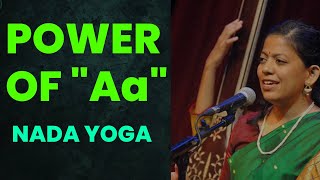
In this instructional video, Dhani Gundecha explains the concept, significance, and practical method of vocalizing the vowel sound "A" (Aakar) within the framework of Nada Yoga. He begins by noting that every language starts with the letter A and that the first sound a baby makes is "ah," suggesting its primal, universal nature. Gundecha links Aakar to the first component of the sacred mantra Om (A‑U‑M), describing how the sound originates from the navel, ascends through the chest, and reaches the brain, embodying the body's vibrational spectrum. He then details the correct physical technique for producing a clear Aakar: an erect spine, relaxed jaw, neck, and shoulders, and a mouth opening of roughly 1–1.5 finger widths between the jaws. He warns against over‑opening, which distorts the vowel. Gundecha emphasizes that sustained Aakar practice focuses the mind, acting as a meditative long‑note exercise that brings the practitioner into the present moment, a core aim of Nadi Yoga. He demonstrates Aakar on all seven musical notes using a tanpura, showing how the practice induces calm and concentration. The video concludes with an invitation for viewers to comment and ask questions.
Chapters
I think we should first wonder as to why every language has its alphabet A or A in the beginning, of why akaar is so important. Hello everyone, my name is Dhani Gundeja. And I'm very happy to come on to Badri Naz's page to meet you all and speak a little bit on the practice and importance of Akar. Let's first understand what the word Akar means. The Akar literally means a form or a shape. So when we say aakar, it means the sound of a, which forms the word aakar in Hindi, right? So first, it is very important to understand why is aakar or the practice of it so important. I think we should First, wonder as to why every language has its alphabet A or Ah in the beginning. Or have you ever wondered why the first sound that a human baby makes is of Ah when it cries? Or for instance, if you happen to think about the sounds that animals make, A lot of it begins with the primitive sound of A. Now, as we go along this discussion, this conversation, why is A considered to be primitive, most core sound that a body, that a living body makes? For this, we have to understand that 'ah', the sound of 'ah', it is supposed to be originating from the navel, and that makes it the primitive sound, the most primeval sound that human knows of, right? So in the spiritual practice and in the music practices, we have seen that the bij mantra of Om as the core chant, or wherever we begin, we begin with the sound of Om. Now, how does that relate to Akar? And what is so common about these two sounds and word Om, right? So here I want you to understand that Om is made of 3 sounds majorly: A, U, and M. So Aum, that means the A is beginning from the navel, the sound travels up to the chest, makes it U, and to the cerebrum makes it M. So Aum together makes it Aum, right? So this sound is comprising of all the vibrations that our body is made of. Now, Aum is also called as the Anahat sound. It is a sound which is ever-present. It is the unstruck sound, right? Why? Why is that the unstruck, the anahat sound? Why is that considered so? If we go into the details of the sound itself, for example, if I do, and if you observe the— if you observe it in a very detailed manner, the first sound that sprouts out of the body is 'uh.' Like that. So 'aum'— that is giving that roundness and completion of the sound. The word Om. So it begins with the sprout of that word Om, and then it's getting rounded off, which also gives the greater philosophy of circularity of life and of sound itself, right? Now, what— since we have discussed of why Akaar is so important, and why is that the first sound, the first vowel A that we speak of, why is it most important? Why the practice of it is so important? Let's talk a little bit of what is the correct Akaar, how to maintain a correct Akaar, and how can you, you know, sitting in your own homes, can test if your akaar is correct or not. Now we will begin with a simple understanding of sound. When we are talking of akaar, which is a simple aah, now this involves certain elements that you need to understand very well. Is that how much mouth am I opening to get that optimum akar sound in my voice, right? So usually in our vocal practices, we understand that a gap of 1-1.5 fingers between both the jaws will be optimum space for the akar to be perfect. Right now it may vary slight bit with everybody's vocal dynamics and the body and the resonation, but broadly speaking, it is that kind of a gap between both the jaws. So, aah. Now you will also notice that my A is not getting distorted into Aa. So this is what will happen if I open my mouth too wide. The Akaar will start getting distorted into Aa. So for us to understand that correct position of the mouth, First, we have to understand that the jaw, the neck, the shoulders have to be relaxed. The spine has to be erect, but the body need not be tensed. Body and spine being erect, you need to understand to keep the jaw very relaxed. The muscles here have to be relaxed, the neck has to be relaxed, and the shoulder. And you don't have to make the neck bend down or go up. It has to be normal and straight. So, and then you start singing. Ah, like that. So Wherever you are, you have to practice in front of a mirror. Sit and watch that gap between the, between the two jaws, and the mouth doesn't have to be stretched too much or be open wide too much. It has to be just the optimum amount, right? Now, as we go ahead, we have discussed the beginning or the root of 'aah', the sound of 'aah', and how it is involved in the most holistic and bij mantra of Om, how it is making up the sound of Om, and how to practice this Akar. We have to understand that when we are practicing Akar, musically speaking, It is bringing together a lot many factors which we tend to miss while the practice of, you know, Akar or the understanding of it. So what this Akar is actually doing for us is it is bringing that focus, bringing that focus of the sur, when you're focusing on the sur, when you're focusing on that akar, you are dropping all your attention from everywhere, from all of your surrounding, and you are at that moment, for that moment, for those moments together, you are only focused on the sound. And that itself is a meditative practice. Now, in In music, we call this as the long note practice. So what we have to do is just take the first note of Sa and try to incorporate that in your Akar. For example, I'll just turn on my Taanpura and show it to you. Sa or Aaah. So when I'm singing this note, all my attention from whatever stress or work that I have to do or work that needs to be finished is gone, and I'm totally and completely focused on the here and now. Which is what meditation is. You have to drop everything and just be in that moment. And which is why Nadi Yoga becomes so important in the spiritual practice is because it is that fastest way to be in the present. This sound, this practice of sound of Akaar gives that focus and meditation to the person who is practicing it. Right? So let me just demonstrate Akaar on all the 7 notes going up and coming down, and maybe you can practice this in your homes with your tanpuras. A, a, a, a. A, a, a, a. A, a, a, a, a. Now very naturally, this practice of aakar with the tanpura gives that meditative and calm effect to the mind. This is one of the biggest reasons why Nadi Yoga is considered to be very helpful in the practices, in the spiritual practices. I hope this I hope that this video was helpful for you to understand the practice and importance of Akar, and also helps you and guides you through your meditations. If there are any comments that you want to post, kindly post them in the comment section and we'll be very happy to answer. Thank you.