Importance of Lung Health and Preventing Respiratory Illnesses with Dr Rashmi Dharwadkar
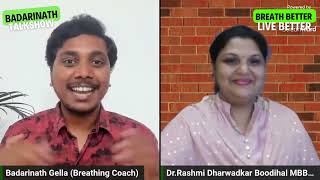
In this YouTube interview hosted by Badrinath Gella, Dr. Rashmi Dharwadkar – a consultant anesthesiologist and holistic health coach – discusses the critical role of lung health and how to prevent respiratory illnesses. She shares her personal journey from operating‑theatre practice to holistic coaching, emphasizing that emotional well‑being is as important as physical treatment. Dr. Rashmi explains the physiological benefits of healthy lungs, outlines how to recognize early signs of common respiratory diseases (cough, wheeze, shortness of breath, chest pain, fatigue, fever, night sweats), and describes how air pollution, allergens, and seasonal changes aggravate conditions such as asthma, COPD, bronchitis, pneumonia, and tuberculosis. She highlights the therapeutic value of breathing exercises and pranayama, detailing the muscle groups involved and how they improve oxygen circulation. Stress‑induced asthma and the hormonal pathway to bronchospasm are also covered. The conversation concludes with holistic lifestyle recommendations for the post‑COVID era – balanced nutrition, regular physical activity, adequate sleep, and consistent breathing practice – framed as a way to preserve lung function and overall well‑being.
Chapters
Whenever there is a healthy lung, the immune system, the immunity of the person is strong.
So, but how can one identify he's having a respiratory problem?
Brain exercise is meditation.
Yeah.
So in that way, the lung exercise is breathing exercise.
When we born, the first thing we do is inhalation. When we die, the last thing we do is exhalation. So in between, like, we are keep on breathing. Hello everyone, welcome to Breathe Better and Live Better talk show. Today we have one of the eminent doctors, Dr. Rashmi. She is an anesthesiologist and also holistic health and wellness coach. She is here to explain us about the respiratory system and the importance of our lung health. So let me introduce you all to Dr. Rashmi. So Dr. Rashmi is a highly experienced consultant and anesthesiologist in Karnataka, and she is also a holistic health and wellness coach. With over 20 years of dedicated service in medical field, she has helped over 4,000+ patients heal from their physical pain and achieve an improved quality of life. It's like mind-blowing number, like 4,000+ lives. It's not only about the patients, it's about the families. 4,000 families she helped. And Dr. Rashmi is now on a mission to address the emotional pain and promote holistic wellness. I welcome you, Dr. Rashmi, and thank you for accepting our request and coming here to share your experience and to share your knowledge with our audience about the respiratory health and lung health.
Dr. Rashmi, thank you so much, uh, for having me here. It's a great privilege and honor to be here so that I add some points on the mission what you are on. So definitely it's a great privilege. Thank you so much for inviting me and looking forward, uh, for the greater session. Yes.
And yeah, so I was very much inspired of the work you are doing as well as, uh, also the coaching programs you have gone through. You have trained best of the best trainers in the world, and also you don't need to do them as a doctor, right? So I really wanted to understand, you took another step as a doctor. As a doctor, you took a better step, like, uh, to move another step ahead as a doctor to serve the people. So what really motivated or inspired you to learn about holistic health or to learn about life coaching?
Okay, that's very interesting question. And definitely I must say, uh, I must say that this is a turning point in my life. Uh, over the period of 18 to 20 years, as you said, I am in the medical field and I'm serving as a consultant anesthesiologist, uh, in the taluka place called Gokha in Karnataka. So I always used to think, you know, whenever my work is basically within operation theater, so whenever I used to meet patients before taking them inside the operation theater, I used to see them anxious and apprehensive. Then as soon as I would go, then I would just tell them, now that your problem is identified and it is going to be solved. You just have to have faith in God and you just have to take deep breaths so that, you know, those few words of concern, words towards them, it would make them feel so calm. And I used to observe them over the monitor, either their heart activity or blood pressure or any other vital parameters. There would be drastic improvement. So as a result of that, so I felt, and also after the operation, next day when I would go and meet them, and those again, they would, those eyes would look for those, you know, sense of soothing words from me. So with that, I realized that yeah, definitely, even after healing their disease, Okay, so healing has to happen. For the healing happening, there should be, you know, relief of emotional pain as well. So that's how I felt that, yeah, I should take up this journey also. And added to that, when pandemic, like, you know, COVID pandemic hit year 2021. So I entered the journey of self-transformation and I started certain rituals and healthy habits in the form of meditation, breathing exercises, and with that I felt phenomenal changes within me. So with that I felt, you know, I could see the new Rashmi within me. So I thought, why can't I take this to the world. So many years I have been working to save the lives of the people. So I really, I, I'm blessed to do this work and I feel happy for that. And also I'm glad that I decided to take the journey one step ahead in into the changing the lives as well. So now I am on the mission of Healing the emotional pain. So yeah, that's how.
And here, really inspiring, Dr. Rashmi, because I know like whenever I go to the doctor, like they only think in the physical perspective. Like, like some— sometimes the— our emotional and mental problems aggravate as physical problems, right? So the root cause lies in the emotional part or mental part sometimes. So if So it's very, very important to heal those mental and emotional wounds as well. Like, you are very inspiring, like your journey is very inspiring. We need more doctors like you in India, especially because by just treating physically, they are not going to heal. Again and again they may, they may come. So, but like by treating holistically, for sure, like they, they're going to lead a happy and fulfilling life. And I respect your decision and thank you so much for uh, like educating your patients on holistic wellness.
Yeah, thank you so much. And also, previously you mentioned that, you know, it's not, not only the, uh, you know, uh, the patients, those number of patients, and their families as well. Definitely, because in a family, one person is suffering, it's like a whole family suffering, because, uh, you know, uh, the balance, balance somehow it becomes, uh, imbalanced. So financially, socially, and mentally. So yeah, definitely health is very, very important.
Yes.
Now for that matter, we know like, you know, uh, physical health as well as mental health, both are very much important for the balance to happen.
Yes, true. So today's topic is mainly focused on respiratory system and lung health. Everyone got awareness, more awareness during the period of COVID right, about lungs and respiratory system. Previously we just take it as granted, so it's already happening, why should I take care of it, right? So today we are here to educate you all about the importance of respiratory health and lung health so that you can make them strong and not to get affected with any diseases. So my first question to you, Dr. Rashmi, What are the benefits of maintaining healthy lungs?
Okay, that's nice. So maintaining healthy lungs is very, very, uh, important. Anything whichever is healthier, that is always good. Even for that matter, when it comes to health, when it comes to lungs also, the same thing applies. So whenever there is a healthy lung, there is improved breathing. As you all know, uh, yeah, first of all, I would like to appreciate and acknowledge the audience over there. They, in spite of it being a Sunday afternoon, they choose to be here. And, uh, thank you. So thank you, thanks to all of them. And coming to the question proper, yeah, having healthy lung is very, very important as we all know. Lung. Why? What importance of lungs? Lungs is nothing but a spongy-like structure, air-filled cavities. It is nothing— it helps for the oxygen to reach the muscles. So whenever there is an improved oxygen supply to the muscles, so the performance is better, either it's a physical performance or a mental performance. So there will be— whenever there are healthy lungs, there is an improved breathing. Whenever there is an improved breathing, so there is a better oxygen supply. Because once oxygen from the atmosphere breathed in through the nose, it enters the aeropharynx and to the larynx and the windpipe, that is trachea. So from trachea it enters the— which is divided into two parts. Called bronchi, and one to the right lung, another to the left lung. So they further are divided into smaller branches and ultimately leading on to the small air spaces called— the terminal branches are called alveoli. Okay, they are like a sac-like structure. Those alveoli are surrounded by the blood vessels. Okay, so The oxygen exchange from atmosphere into the blood happens there. So when there is a healthy lung, the atmosphere oxygen from the atmospheric atmosphere, it enters the body. It is also essential, once it enters the body, it should be exchanged in the blood so that that oxygenated blood is carried to the several tissues and muscles of the body so that it helps in the normal functioning of multiple organs of our body. And in the exchange of oxygen, there should be something else, right? So with exchange to oxygen, they, uh, leave out the carbon dioxide. So carbon dioxide is nothing but one of the, uh, like, you know, uh agent which usually, uh, left out, and the oxygen is breathed in. So carbon dioxide is removed and oxygen is taken in and supplied to different tissues and organs of the body so that normal functioning happens. And also what happens is, uh, muscles— for any physical activity, muscles muscle activity is very much important. So whenever there is adequate oxygen supply, the functioning of the muscles is normal. So patient can do activity— I mean, person, person can do normal activity. For example, uh, whenever there is a healthy lung, the, the depending upon the nutrition of the body, the person can, you know, go, go for a longer activity. In the sense, there won't be easy fatigability, okay? Because a person doesn't get tired easily, so he can run as long as, like, you know, the maximum limit. So something like that. So this is one of the importance of healthy lungs. And also, whenever there is a healthy lung, the immune system, the immunity of the person is strong. So to be healthy, immunity, good immunity is very much essential. So if there is a good immunity, then there is no chance of any other diseases. So the stronger the immunity, the healthier the person is. And apart from this, healthy lungs also help, you know, normal functioning of the brain as well, and also mental health. Whenever there is a good lung health, good functioning of all other organs, the mental health is also be there. Like, you know, lung health is directly proportional to mental health, as a way, in a way you can say that. So definitely there will be a sense of well-being. Yeah, and the sense of well-being is directly proportional to, uh, the, you know, uh, the it creates impact in our social life, financial life, everything. Like, if person is healthy, if he is mentally sound, he feels like going for work, he feels like, uh, you know, um, working to his full efficient, uh, full potential. So that efficiency—
yes, so great, great. Like, uh, it's good to know the functions of the lungs, like, because We know that we have lungs, but we don't know what lungs does. So we only know that it takes oxygen and exchange the carbon dioxide, but in the process, like, what exactly happening? Uh, thank you for explaining us, uh, in easiest way and better way to understand. So like, nowadays, like, many people are having some other respiratory problems, uh, like, uh, we can name many, many respiratory problems. So, but how can one identify he's having a respiratory problem? Because identification has become very difficult. People just take it easy. Later on, it becomes like, uh, bigger and bigger and bigger. By the time, like, they have to go for surgery or, uh, like, permanent medication. So how can one identify this problem so that they can avoid, uh, the any, any bigger problems?
Okay, so, uh, the identification of, uh, the respiratory problems is nothing but the awareness towards the disease. Awareness of the disease. Either awareness can be of the normal health or the abnormal health, where the even person should— has to— has even— he should know whether he is aware. He should be aware that whether he has normal lungs or abnormal lungs, he has any respiratory illness, or he is free from any respiratory illness for that matter. So awareness is very, very important. And, you know, respiratory illnesses can be in the form of either coughing or change in the respiratory sounds like wheezing. Wheezing is nothing but the whistling kind of a sound, okay? And he may have a chest pain, and also he is, you know, he may be feeling tired, easy fatigability. All that can happen. For example, whenever there are so many diseases of lungs, to name some, bronchiolasthma, bronchitis, pneumonia, tuberculosis, and flu, all such things. COPD, chronic obstructive pulmonary diseases. So the illnesses can be in the form of cough. Patient can be— a person can be coughing, but he may not— he might think that it is a part and parcel of a life. Like sometimes he may think, yeah, it is normal, but it is not that. So if person is having a persistent cough for more than 2 months in a particular year for consecutively 2 to 3 years, so it is termed as a bronchitis. So it cannot be taken as normal. So, uh, the necessary precautions and measurements have to be taken. So other presentations, clinical presentations of respiratory illness can be wheezing, as I said, And also person can have a shortness of breath as though he's feeling air hunger. He's feeling difficulty to take the air in. Okay, even though everything is fine, but atmospheric— in the atmosphere oxygen is available, but he is not able to take the air inside. Why it happens? So it, you know, it is exactly how happens is in case of airways, either bronchial asthma or bronchitis. It is nothing but the disease of the airways. I spoke about trachea, bronchi, and bronchioles, the terminal branches of the bronchial tree. So there, they are like pipes, okay? So if there is inflammation, infection of those pipes, so what happens is that they are usually pipe-like structures. Whenever there is an infection or inflammation Or say, for example, in asthma, there will be, you know, a spasm of those bronchi or bronchioles. So as a result of that, air will not enter the lung. So patient, there will be availability of the air, but it is not entering the lung because there is a blockage. You know, for example, I, I'll just give an example. Uh, I think, uh, you might have— you seen the touch-me-not plant? I'm sure many of them have— touch-me-not plant.
No.
Okay, so, okay, many of them, they will be aware of it. They are like, you know, uh, they are, they are small, uh, you know, tamarind-like leaves. They are herbs. Okay, they are grown in the ground. So as soon as we touch, usually they are open, those leaves are open. Okay, so as soon as we touch, they just— so the same thing happens in case of bronchioles also, in cases of asthma and any bronchiole diseases, so that that pipe is blocked, they are closed, so there is no entry of air into the— so then they can reach the lung proper, like alveoli. So there will be wheezing-like sounds and the air hunger. Okay, yeah, they are feeling as though they are, uh, thriving for air. And also chest pain will be there. Um, it depends upon what type, what part of the respiratory system is involved, whether it is lungs or the pleura. Pleura is nothing but covering of the lung. Even in that case also there can be chest pain. And also if there is any accumulation of the fluid in the layers of the pleura, that is called pleural effusion. Even in that case also there can be chest pain. And also in cases of pneumonia, person can be having cough with expectoration. Expectoration in the sense formation of mucus or phlegm. He will be able to, you know, that mucus-like secretion whenever there is an infection. Cough with expectoration patient can have, and there can be dry cough in certain diseases like asthma. And chest pain. And there will be easy fatigability. Patient can have easy fatigability. It is because whenever there is an infection, there is a pathology, then the decreased air supply. So that to the structures like muscle and all. So person can feel, uh, very, you know, um, tired, easily fatigue, and also have a fever also. In cases of infections like pneumonia, bronchitis, and all, patient can present with a fever also. And there can be weight loss or night sweats. Some, for example, if some cases of patients can have tuberculosis also. You might have heard of tuberculosis.
Yeah, TB is one of the biggest problem in the world. Yeah, yes.
So tuberculosis, it's an infection caused by a bacteria. So in this, in that, it is particularly characterized by night sweats and weight loss. So there are, you know, so many different kinds of diseases, but the common features are cough, fever, chest pain, easy fatigability, and air hunger. And yeah, performance is decreased. And definitely when patient is ill, person is ill, his mental health also becomes ill.
Okay, great. So if anyone is watching, if you have these symptoms, you have to immediately take action. I hope this is, uh, like, this has given very much clarity on how to identify whether you have any problems with your lungs or respiratory system. So thank you, thank you so much for that clarity, Dr. Rashmi. So, you know, like, we all are living in a polluted world now. The all the metro cities, like, the pollution rate is very high. Not even metro, now even semi-urban areas also getting polluted. So how does the air pollution affect lung health and contribute to the respiratory illnesses?
Yeah, definitely the polluted air has a greater impact in the disease of the lungs. It is because whenever there is polluted air, it acts as an irritant to the airways. Okay, if even it can affect normal person also, or worse, it can worsen the deceased person also. If a person is allergic to some particular substance in the air, if air is polluted, whenever he inhales those, that kind of air, or he, he lives in that particular area, so definitely there will be some kind of allergens which can irritate the airways. So for example, if a person is staying in the area where in that area if there is a mill, like, you know, mill, like, you know, from which the pollutants are released, the person, there may be like, you know, person who is sensitive might have a persistent cough or persistent features in view of difficulty in breathing or on and off fever. All that can be there. And all— if a person is sensitive, definitely this will affect that person. And even if he is normal also, it can affect if the person is sensitive. And what if the person is deceased? So what if the person is deceased? Because already he is suffering from either asthma, pneumonia, tuberculosis, bronchitis, or flu, anything like that. So first of all, his airways have become sensitive. Whenever the airways have become sensitive, and add on to that, if there are any pollutants Okay, if there are any pollutants, so they definitely worsen the disease condition of the person. Okay, so that's how these— better to avoid the air pollution whenever such a scenario is there. And if a person is forced to stay in that particular region, then he must, he must take precautions to avoid those allergens, to avoid those pollutants. Stay indoor as much as possible and use filters and usage of air conditioning rather than a fan and avoid the dust, avoid the pollens because some people are prone for allergy to pollen grains and all. Like, you know, paddy fields will be there sometimes, you know, during certain seasons there will be like harvesting and some winnowing and all will be happening. So the dust of those grains, if they are circulating in the air, so that can, you know, aggravate our symptoms, aggravate the symptoms. So that can be life-threatening as well because, yeah, definitely, because in asthma there is one condition called status asthmaticus. Asthma itself is a, you know, it's a, you know, I have a greater respect for asthma because it's such a situation. It's like, you know, uh, uh, the airways are very, very hypersensitive. Okay, so whenever there is a, uh, and patient is, uh, hunger for air, all those symptoms are there. If it is, um, you know, subclinical, fine, but whenever it aggravates, patient will have a difficulty in breathing, he will have cough, and also, uh, if If such a disease is chronic, you know, long-standing. Okay, to begin with, if it is only bronchial asthma, it is fine. Okay, so if it is only respiratory system disease, okay, fine. And if we take care of that, and in case if we try to avoid allergens, if we take care at the initial periods only so that the next subsequent stages should not happen, then okay, the normality is preserved. But in case, okay, if the sensitivity increases and whenever there is a bronchospasm— bronchospasm is nothing but closing of those airways, okay? So there, you know, difficulty in breathing. So in that matter, either person has to take the medication which will dilate those airways, prevent the inflammation of those airways, okay? So, uh, if it is— if before Before that, person has to take care that such an attack should not happen. If at all he is having frequent attacks, so it's a great time, high time that he has to look for a healthcare provider and specific treatment has to be taken. And I was talking about, you know, if it is in the initial stage, it is okay. So whenever there is a, you know, if the disease is neglected For example, person is having COPD, that is chronic obstructive pulmonary disease. Year by year, every year, he almost gets it. Okay, so if at all, if it becomes longer standing, the respiratory system, how much— to some extent it can tolerate the disease. That it starts creating the side effect on the surrounding organ. So what is the organ nearer to Lungs is the heart. So there will be back pressure over the heart and the heart can go on to failure. So all such things will be there. So it's always essential to identify the disease in the beginning and better to avoid. As we all know, prevention is better than cure. So avoid the pollutants or the allergens. Whichever are causing or are threatening in the form of disease or the infection or the problem.
So yeah, yeah, like we don't take that seriously. Uh, like it's very, very like, uh, important to identify. And also if there is a requirement of diagnosis, you have to go for diagnosis. And very important to really understand this. Yeah.
And also, uh, I remember like, you know, it is a seasonal It's a very, very important thing, seasonal variation. Seasonally, usually the person, people with COPD or asthma, they will, they are quite good, quite better during summer seasons, but during winter seasons or rainy seasons, their symptoms aggravate. It is because they are, they have allergy to cold, and because of all those things, and also The intake of medications, if at all, like, you know, in the form of if they are using the inhalers. So inhalers during summer is totally nil because I remember my grandmother, she was known for chronic— I mean, bronchial asthma patient. So I used to see her using inhalers. So her usage of inhalers would be minimal during summer, but it would increase the frequency during winter and rainy season. So I have seen her suffering. So that's how, as I said, I have a great respect for bronchial asthma. And to that matter, my is also a known bronchial asthma patient. But anyway, due to the right, due to the approach in right time, it is being maintained. So that's, that is the importance. As I said, the during summer they are usually better. During winter and rainy seasons, symptoms usually aggravate. And depending upon the medications or, you know, whatever is prescribed, if it is properly taken in time, the chances of going into severe— severity is less. That's what I just want to mention.
Yeah, great, great. Thank you, thank you. Even the children are facing nowadays many respiratory problems. It's very, very important for them to educate and take the necessary action before it, uh, become worse.
Yeah, yes, very important point. Important age group, pediatric age group. Usually I've seen many, uh, you know, mothers, they say, yeah, my son, he is, you know, allergic to ice cream, he's allergic to even the chocolates. Uh, I used to wonder what, but you know, but it is all related to their, uh, allergic condition of the body. Yes, thank you so much for reminding the pediatric age group.
Yeah, so, and, uh, Dr. Rashmi, I have, uh, like, you know, I'm a breathing coach. I closely work with the people who are having respiratory problems. So I want to know, in your perspective as a medical doctor, what do you think about breathing exercises or pranayama in terms of like medical sciences or in terms of health and keeping this— maintaining, managing these respiratory issues.
Yes. Yeah, this is one important, vital point, I must say. So, uh, pranayama, yeah, it is nothing but the force, life force, regulation of the life force. It is very, very important. I myself practice pranayama. That's how I know the importance of pranayama. Yeah, uh, I must say pranayama or breathing exercises, they are nothing but— it's like, you know, uh, they are, uh, um, uh, how yoga or gym is essential for, uh, physical fitness of the body, or how meditation is required for the brain. Brain exercise is meditation.
Yeah.
So in that way The lung exercise is breathing exercise. Okay, so yeah, I would like to convince you more by telling that, okay, it is like, you know, personal training sessions. Taking the personal training sessions— breathing exercises are taking like a personal training sessions. If you want to look fitter, more efficient, people go for personal training sessions. So Practicing breathing exercises are something like that. Okay, and, uh, in other words, I must say it's like, you know, uh, pressing the reset button.
Yeah, true. Anyway, so that's what, like, it's about managing, right? So they cannot completely, like, depend on medicines, so they also have to change their habits. So here comes, like, uh, how does habits play a role in managing this?
Yeah, habits. Uh, yeah, when it comes to habits, definitely healthy habits. So one of the healthy habits is breathing exercise and pranayama. As, uh, yeah, definitely they will increase the efficiency of the lung and also, uh, they improve the oxygen, uh, circulation, uh, oxygen supply. Okay, in that way they are helpful. And also, uh, um, whenever, uh, the breathing exercise happen, uh, it's like, you know, there is a contraction of different kind of muscles, um, chest cavity, rib cage muscles, diaphragm, abdomen muscles, and also pelvic floor muscles. So, uh, so with this there is a better exchange of air. Okay, so, uh, that's how it, uh, impacts.
And also, I would like to— curious to know, one of my students also asked, so does stress play any role in respiratory problems? Yes, emotional stress or mental stress?
Yeah. Definitely. As I was talking about asthma, there are different causes of asthma. So one of the causes what I, what we have come across is allergic asthma, occupational asthma, like, you know, during our occupation if any, any allergens or any pollutants come, and exercise-induced asthma. Due to exercise, the problem might aggravate, and also stress-induced asthma. There is something called stress-induced asthma. Whenever there is stress, the hormones are released. Those stress-inducing hormones cause bronchospasm. As I said, bronchospasm is nothing but the closure of the airways. So there is no easy entry of air, and there will be tightness of the chest also. So that's how it affects. It affects.
Hmm, okay. So like, you mean to say that like those hormones will release and that, that spasm will release whenever we get that stressful situation? So that's why some people, many people feel tightness in their neck and they feel breathlessness when they are emotionally charged. They feel breathlessness. So it's so connected. Our body is so connected. Like, uh, how— so we may not be connected with our spouse or our family, but our body always stay connected and work together as a team. So yes, definitely.
Yeah, one important point you have, uh, uh, raised, uh, Badri. Uh, I would like to address that. A few days back when I was doing, uh, the breathing exercise, the meditation, so I was— when I was in the deep meditation, uh, one thing what I realized is that what I have with me is only the breath. Breath is with me. I'm not alone. Whether anybody can give company or no, but definitely my breath will accompany me. So that was the greater realization.
Yes, so that's, that's how the breath is, the importance of breath, dear friends. It's like when we born, the first thing we do is inhalation. When we die, the last thing we do is exhalation. So in between, like, we are keep on breathing. So breath is with us for our whole life. Once it is gone, there is no use of this body. So that's how they have to understand and really work on improvising this. If you have any questions, please type in the chat box. And thank you so much, Dr. Rashmi. And would you like to share any closing comments to our audience? Uh, like in terms of maintaining holistic health or anything in your personal— with your personal experience seeing the patients. And yeah, okay.
Yeah, this, uh, post-COVID pandemic era, maintaining, uh, healthy lungs is very much, uh, important. And also I just want to, uh, you know, uh, express that, uh, we, we have this— life is a present, it is a gift. We have to live in the present, and why not utilize this present in the best way? Have a healthy life by having healthy habits, by having a healthy food habit, healthy physical habits, healthy sleep habits, and also in the form of breathing exercise. And, and not only that Having good health itself is a present for us.
It's a healthy routine, like nutrition, in terms of nutrition, any form of exercise.
Yeah, any form of exercise, healthy food in the form of vegetables, fruits, lean protein, and definitely they will add on to the health. See, one thing what I want to say, if you want to live a better life, healthy life, if you want a healthy lung, if you feel that you, you have a healthy lung So you will be— you should be able to climb the stairs as though you— yeah, as though you, you, you, you have not— uh, you should not feel after climbing the stairs, you should not feel that, yeah, I have submitted. It should not be that very difficult for you guys. And also, as everybody celebrates their birthday, so whenever you are celebrating your birthday, whenever you are blowing the candles, so with one go you should be able to blow out those candles. There should not be need of any second blow to blow the candles. That much should be your healthy lung status.
Yeah, exactly. So it's very easy to monitor now. Like you gave two examples. One is like everyone, those who are watching this, just go and climb at least three floors and see like whether you are able to climb easily or like you are facing any difficulties while climbing. And also second thing is try to blow the candle in one shot. So, and see like whether you have healthy lungs or not. So that's very simple, like simplified. Thank you, thank you so much, Dr. Rashmi, and deep gratitude to you for taking your time. And we need more doctors like you, uh, to, to encourage the patients and, uh, for holistic health, not just about physical health. And maintaining that optimal health, it's not only about during the treatment, it's also after the treatment, how you have to maintain and manage your health is very, very important. Thank you so much for working towards sustainable health. And our mission and vision is same, like to help the maximum people in however way we can. If you have any questions, feel free to reach out to us and we are happy to help and answer your questions. Thank you so much.
More from Badarinath





How Conscious Breathing Transformed My Health, Family & Career | Inspiring Success Story

International Yoga Day Celebrations 17th to 21st June | Morning 6 AM | Evening 7 PM

30-Minute Breathing Exercises | Reduce Stress & Improve Lung Health | Yoga Day | @badarinathgella


