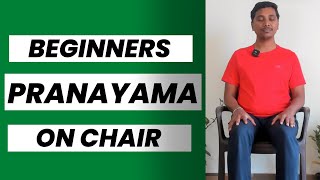
Badrinath Gella teaches four pranayama breathing techniques you can do sitting in a chair. Kapalabhati Kriya, diaphragmatic breathing, yogic full breathing, and Brahmari breathing each take just minutes and require no mat or special space. Benefits include better sleep, relief from sleep apnea, and improved oral health.
Chapters
Namaste. Whether you are at office or resting on your sofa or going for a jog or sitting in the park, these are the simple breathing techniques which you can practice while sitting on the chair or sitting on your sofa or office chair. In this video, I am going to show you simple breathing techniques, how to practice them and how to integrate into your lifestyle, and what are the precautions you should take while practicing them. Let us get in. Hi, my name is Badrinath Gella. I am an internationally certified wellness coach by Ministry of Ayush, Government of India. I have been teaching yoga from past 6 years. I am the founder of Conscious Breathing Hub, where all the like-minded people join together to work on their overall health. So before you practice any pranayama, as I always mention in my videos, if you are sitting on the chair, make sure your spine is erect. Don't lean back. You keep your spine erect. You can place your both hands on your handrest, or you can place your both hands on your knees. This is the perfect way. And make sure your weight is equally distributed on both the feet. You are completely relaxed. Your shoulders are relaxed, neck is relaxed, and you are comfortable sitting on— sitting here. Before we go forward, like, look forward. Once you settle in your position, the first breathing we practice is Kapalabhati Kriya, also known as Kapalabhati Pranayama. So to practice Kapalabhati, you have to exhale completely from your abdomen. Only exhalations, active exhalations and passive inhalations. Observe me. Place your both hands on your knees. Observe my stomach. We will repeat this for 15 times. Slowly, look by keeping your spine erect, close your eyes and exhale for 15 times. Relax. Keep your eyes closed. Observe the changes. Observe the changes in your breathing. Slowly open your eyes. The next breathing we'll do is diaphragmatic breathing or abdominal breathing. So place your both hands on your abdomen. Slowly inhale, bulge your abdomen out. Exhale, relax your abdomen. Inhale slowly. Exhale, relax. Make sure your spine is erect. Keep your eyes closed, shoulders relaxed.
Slowly keep your eyes closed, release your hands and open your eyes. This is called diaphragmatic breathing, very, very important breathing. When you are exhaling, your abdomen should come out. When you are inhaling, the abdomen should go in. Do it slowly and repeat for 15 to 20 times. The next breathing we will do is yogic breathing, the yogic full deep breathing. So for this, place your right palm below your navel, left palm on your chest. Slowly inhale deeply towards your abdomen, towards your chest, and towards your shoulder region. While exhaling, relax your shoulders, relax your chest, and relax your abdomen. Like you are filling from down to up and emptying from up to down. Down. Slowly inhale, bulge your abdomen, expand your chest, lift your shoulders. Exhale, relax your shoulders, relax your chest, relax your abdomen. Make sure your spine is erect. Keep your eyes closed. Relax your shoulders and relax your neck. Now repeat. Let's repeat this for 2 more times.
Inhale. Exhale. Inhale, 1, 2, 3. Exhale, 1, 2, 3.
Let's repeat last time. Inhale deeply towards your abdomen, chest, and shoulders. Exhale, relax your shoulders, relax your chest, and relax your abdomen. Slowly keep your eyes closed, release your palms, and open your eyes. Again, repeat this for 15 times at least to see the benefits of this breathing. The fourth breathing we'll do is Brahmari breathing. To practice Brahmari, we'll close our small ears. While you are exhaling, you have to make humming sound, humming bee sound. Like this.
Mm.
You should do it from your nose. Okay, let's do this. Make sure your spine is erect. Again, close your small ears with your index finger, and let's repeat for 3 times.
Inhale. Mm. Inhale. Inhale. Slowly release your hands.
Keep your eyes closed. Observe the changes and open your eyes. The humming sound reaches to every cell of your body. This is very, very important breathing, especially if you are suffering with sleep apnea, sleeping disorders. This breathing helps you a lot. So these are the 4 breathings you can practice regularly while sitting on the chair. Many people give me an excuse that they do not have any yoga mat, they do not have a space, and all these things. So you don't need a space, you don't need a yoga mat. You just sit on your chair comfortably, practice this regularly. You will see a lot of changes in your oral health. I, I hope you will practice these videos. If you find this video useful, Please like this video, share this video, and do not forget to subscribe our channel. Thank you. Namaste. See you again.