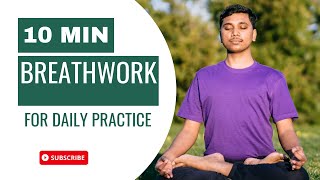
In this 10‑minute guided session, internationally certified yoga instructor and breathing coach Badrinath Gella leads viewers through three core yogic breathing practices. He begins with a brief introduction, stating his credentials and the intended benefits—enhanced vitality, reduced stress, stronger respiratory and immune systems. After advising on comfortable seating, posture, and an empty stomach, he demonstrates sectional (complete) yogic breathing, emphasizing hand placement (right palm below navel, left palm on chest), three‑count inhalations and exhalations, and a five‑round repetition. He then transitions to Anulom Vilom (Nadi Shodhana), explaining the yogic concept of 72,000 nadis, the importance of Ida and Pingala, and the use of thumb‑index finger mudra or Pranayama mudra. Detailed step‑by‑step instructions are given for alternating nostril breathing, with emphasis on slow, deep breaths to stimulate the parasympathetic nervous system and alleviate nasal, digestive, or asthma issues. Finally, he introduces Bhramari (honeybee) pranayama, directing participants to place both hands on the thighs, keep the spine erect, and produce a humming “ma” sound, repeating five times while observing vibrations throughout the body. Throughout, he repeatedly highlights physiological benefits—stress reduction, improved sleep, enhanced cellular vibration, and immune support. The session concludes with a gentle reminder to keep eyes closed, observe sensations, and a call‑to‑action to subscribe, comment, and join a free VIP Facebook group for further lessons.
Chapters
Namaste. In this video, I am going to teach you simple breathing practices which you can practice regularly.
I am Badrinath Kella.
I am an internationally certified yoga instructor and breathing coach from Ministry of Ayush, Government of India. Today I am going to teach you simple breathing practices which can help you to improve your vitality, reduce your stress and anxiety, and strengthen your respiratory system and immune system and removes majority of your diseases. So let's get in. Before we practice, you can either sit on the mat or you can sit on the chair, wherever you are comfortable. In case if you cannot sit on the mat, you can sit on the chair or on the bed and practice it. Try to practice with an empty stomach, that gives more benefits. And make sure your spine is erect. And the position to sit, you can either cross leg Or you can come in Siddhasana or Padmasana, where you can place your right foot on the left thigh. So make sure you are comfortable for the next few minutes. To start this, roll your shoulders back, look forward, place your both hands on your knees. We will start with sectional breathing, the yogic breathing, complete yogic breathing. Place your right palm Below your navel, left palm on your chest. Inhale deeply towards your abdomen, towards your chest, and towards your shoulders. While exhaling, relax your shoulders, relax your chest, and relax your abdomen. And now we will do this for 3, 3 counts. Inhale, 1, 2, 3. Exhale, 1, 2, 3. 1, 2, 3. Now we will repeat this for 5 times with 3 counts. Inhale slowly and exhale slowly, as slow as possible. Make sure your spine is straight and keep your eyes closed. Now place your right palm below your navel, left palm on your chest. Close your eyes. Inhale towards your abdomen, your chest, and your shoulders. Exhale, relax your shoulders, relax your chest, relax your abdomen. Inhale, abdomen out, expand your chest, lift your shoulders. Exhale, relax your shoulders, relax your chest, relax your abdomen. Inhale, 1, 2, 3. Exhale, 1, 2, 3. Inhale, 1, 2, 3. Exhale, 1, 2, 3. Last time, inhale, exhale slowly, slowly. Keep your eyes closed, release your palms, and slowly open your eyes. This is called sectional breathing. This is a preparatory practice before we go to the pranayamas. Real pranayamas and breathing techniques. The next breathing we will do is Anulom Vilom. It is also called Nadi Shodhana. In our body, as per yogic sciences, we have 72,000 nadis which branch out from your navel region. Two nadis are very important, Ida and Pingala. By balancing these two nadis, we can activate the energy of Sushumna, which is called Kundalini energy also. To practice that, you can either adopt Pranayama mudra, or you can also use these two fingers, the thumb and the index finger. So whatever you are comfortable. And place your opposite palm, left palm, on your left knee, palm facing upwards. First, close your right nostril and inhale from left. After inhaling, close your left and exhale from your right.
Inhale from your right, close your right and exhale from your left. Inhale from your left.
Close your left.
Exhale from your right. Inhale from your right. Close your right. Exhale from your left. Inhale from your left, close your left. Exhale from your right. Inhale from your right, close your right. Exhale from your left.
Repeat this for 3 more times. Inhale slowly and exhale slowly, as slow as possible. The more slow you exhale, the better it is. It strengthens your parasympathetic nervous system. It stimulates your autonomic nervous system. If you have any breathing difficulties or digestion problems or any nasal problems like nasal congestion, or else asthma or sinus, this breathing is very, very helpful. This helps you to reduce your stress, anxiety, worries, and tensions. Do it slowly, as slow as possible. The more slow you do it, the better it is. Exhale your worries, tensions, frustrations. Inhale happiness, love, and peace. Slowly remove your hand and open your eyes. This is an instant relaxation breathing, very, very powerful breathing. This is the breathing which helped me to cure my respiratory problems. So the next one we practice is Pranayama breathing, which is very, very important breathing. Again, if you are suffering with any sleep problems, sleep apnea, or any other problems, so this is the best practice. Do it 15 times before you go to the bed. You will see a lot of changes in your sleeping patterns. So to practice this, place your both hands on your both thighs, palms facing upwards. Make sure your back is straight. Your back should be straight, your spine should be erect. Looking forward, shoulders relaxed, neck relaxed. From here we have to be honeybee sound. We have to make honeybee sound, humming sound. It's like black honeybee buzzing sound. So we have to make that. You can say your mouth should be closed, your mouth should be closed, and you should produce the sound of ma. We'll do this for 5 times, okay? So place your both hands and do it with your own capacity. Once you are done, keep your eyes closed and stay and observe the vibrations. It reaches to every cell of your body. The breath reaches to every cell of your body. The vibration reaches to every cell of your body. Observe what vibrations coming into your mind. So slowly Close your eyes.
Inhale deeply. Mm. Inhale. Mm. Inhale. Inhale. Mm. Inhale. Mmm.
Slowly keep your eyes closed, observe the vibrations. Slowly open your eyes. I hope this session helped you to relax yourself. If you want more videos, please subscribe and comment below what you want me to cover. And also please join free VIP Facebook group where I am nurturing the people and also I am offering some free online lessons. Thank you. Namaste.