Rooted in Yoga, Transformed by Breathwork - Here is the journey of Anita Parihar
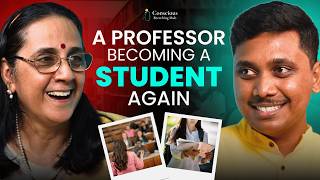
In this interview, host Badrinath Gella speaks with Professor Anita Parihar, a media scholar, filmmaker, and lifelong yoga practitioner, about her personal health struggles, her deepening yoga practice, and her transformative experience with the Conscious Breathing Hub (CBH) and its Diamond Membership. Anita recounts growing up observing yoga in her family, the turbulent phase of her marriage that led her to seek deeper practice, and her initial reliance on inhalers for seasonal breathing issues. She describes how a recommendation from a flute teacher introduced her to CBH, where she progressed from a 2‑day introductory session to Silver and finally Diamond membership. Through CBH’s structured breathwork techniques, diaphragmatic breathing, habit tracking, journaling, and a calibrated low‑fat diet, she reports reduced inhaler use (from twice daily to once), a 4 kg weight loss, increased stamina, and a more resilient, positive mindset. Anita reflects on the program’s emphasis on accountability, community storytelling, and “hand‑holding” support, which helped her adopt detachment (mudita) and emotional balance in family interactions. She shares how these practices have influenced her teaching of media students, her parenting, and her overall life philosophy, emphasizing the importance of regular “me‑time” for working women. Finally, she proposes documenting CBH’s model as a research paper to inform policy and broader wellness initiatives, and urges listeners to experience the program for holistic health and spiritual growth.
Chapters
When I was in a very turbulent phase of my life, in my personal relationship, to my marriage. I do have issues when the season changes symptomatically, and I have to have inhaler. Breathing inhalers twice a day. This was a dialogue which Pitama is lying on a bed of arrows and Arjun says, "What is the secret of your success?" And he says that whatever I've achieved in life is when I put myself under pressure. I have become much more sturdy and positive, and CBH's breathing techniques or the whole holistic process that you've, you know, made us go through, small, small exercises, culminates somewhere like a pebble in a pond in our daily dealings in life. The way you've presented it in a program for your community, in the way that you continue to present in detail and 100%, no, 110%, you know your matter. We are not just talking through just to feel good. We have experienced it. We've experienced this journey with you in terms of, you know, growing better as an individual, as a— in terms of an individual's better health. If your health is with you, for which you need to work at, then believe me, life is a song. I can see myself Dying happily, thanks to CBH.
Today we are joined by someone who beautifully blends wisdom, intellect, and the spirit of yoga. Professor Anita Parihar is an academician, scriptwriter, and director with a remarkable background in media studies, research, and even yoga films. She has studied at prestigious institutions, been a British Council scholar, and contributed to education and wellness for decades. Despite her deep connection with yoga through her family and training, Anita ji felt there was still room to go deeper, to look within, to refine her breathing, and to reclaim her health. From being dependent on 2 inhalers She has now reduced to one, lost weight, and cultivated a mindset of awareness and growth through her journey with the Conscious Breathing Hub and Diamond Membership. Her story is a reminder that no matter how much we know, there is always a higher step in the ladder of life. Let's welcome Professor Anita Parihar ji. Namaste, Namaste Anita ji. Thank you for coming for this podcast. So Anita ji, you have been practicing yoga since your childhood, like through your father, through your sister.
Yeah.
So what really inspired you to practice yoga?
Actually, as I grew, you know, and became an adult, I would, through my earlier years and more so as an adult, I would observe my father doing yoga asanas and My elder sister was somebody he considered as the most level-headed person in the family. So over the years, when I got married and settled into my life, being the youngest in the family, I was considered, you know, brought up with a lot of shelteredness. So I was naturally very emotional, and I didn't know why they used to tell me to do yoga, but I used to say, okay, I'll do it. And then they mentioned Yoga Institute. And slowly I got into yoga like that, you know. I think the time when I went again on my own to the yoga institute and a yoga teacher of repute was when I was in a very turbulent phase of my life, in my personal relationship to my marriage, and I wanted to make it work, as every idealistic person or a homemaker or an Indian woman, I think, you know. And I had a very good teacher, in terms of the yoga guru, and she always taught me to look at life positively and to be receptive and give positive vibes. And that's when I first learned that yoga is not just asanas, though they are asanas, they are also a way of life. And much against my early understanding, which was not complete, of yoga, I understood, and it took me through many challenges in my life. From time to time, they kept surfacing in this journey of life, and I always felt yoga was like a bulwark. You know, you would come to it from time to time. So I guess it's been on, and I made a film also over the years, because I felt if I could benefit so much in awareness, if not totally in implementation, then why shouldn't it go to more homemakers? That's when I told my yoga guruji at Yoga Institute, can I make some films and show it on cable? And I was pregnant with my first daughter, and she said okay. So I made a few shots on yoga, And that was again, then I went back to my home duties and my professional life. So yoga came like punctuation marks in my life. Wow!
So then what really inspired you to be part of CBH? Why did you join us?
Very good question, and it needs a truthful, honest answer, which I'll try to, you know, cover everything. See, having made a film on yoga, doing yoga. I wasn't doing yoga 24/7. I was working. I am a homemaker, as I said. CBH happened to me by— not chance, that wouldn't be honest. I was learning flute through a teacher who asked me, why do you want to learn flute? When we had— I was a Diamond member. So I said, I want to learn flute because I, for all my yoga experience, Even though not consistent, but in belief very strong. My health, in terms of my breathing, I do have issues when the season changes symptomatically, and I have to have inhaler. And I want to get rid of this, you know, habit and just follow. That's why I'm learning flute. So he said, why don't you check out my friend Madhuri? 'And for me, sir, honestly, with due respect to you, I didn't know you then.' I said, 'Okay, sir.' And that was— he said, 'Just enroll, you don't have to pay anything.' I think it was your 2-day thing. It was in April, this April 25th. I was traveling to Shirdi, and I had attended the first day, and the next day I was in train. And my elder sister, who is 70 plus, She said, you know so much as a knowledge, why are you doing an extra course? So I said, look, the person who is explaining this course deconstructs the philosophy of breathing and in a way that I know but don't fully know, and what's wrong if I check it? So every time I was doing your course and even then became a Silver member, I was wondering, well, no, I know so much, why am I doing it? Because With due respect to you, I had this question till I went deeper and deeper into your teaching methodology, the precision, the exercises, parasympathetic, sympathetic, so many terminologies which I knew and didn't know fully. I felt I needed to be, sorry, more involved towards my health, and you are, you know, the person who's come into my life by divine intervention, I don't know. And Silver membership happened.
And so what were the challenges you were going through before that, like before joining?
Like I said, breathing inhalers twice a day, not practicing pranayam regularly, doing it twice. I used to swim once a week, do pranayam, everything very sporadic. What came to me was to take charge of yourself, you said, through knowledge and awareness and implementation.
True.
And the people who were the part of the community began to identify with their case studies, the way you would express, allow them to speak their stories. And I realized that this is not something like a 1 2 3. There is a conscious curve, you know, in whatever we do. And I began to give more of my time and commitment towards being a member. Like journaling, we had done in yoga earlier where I had learned, but I had never done journaling so regularly like you advocate. And habit tracker was something which I had to be pushed myself, you know, if like you hold a gun on your head to do something for your good. Like in Mahabharata, once I remember this because This was a dialogue which Pitama is lying on a bed of arrows and Arjun says, what is the secret of your success? And he says that whatever I've achieved in life is when I put myself under pressure. And I really began to put myself in the nicest pressure way for my health because I was looking at a reality. You gave me a reality check. You know, you're kidding yourself if you think you do a swim or do some time yoga and you're okay. Don't you want to be okay for life? So that was the reckoner, you know, the tug which made me seriously think of being a Diamond member. And I'm not a full-time worker, nor do I earn a lot of money. I put a lot of my savings, which I just earned by being a visiting faculty at Bhuvaneshwar, into the Diamond fee, and I have Not saying that, you know, I've changed. How can I change 360 degrees? But I have changed in some ways in that, that I consciously breathe, not only during your sessions, but at least 2 times. Though my aim is to do every 2 hours, I say, but I can't consciously, you know, breathe like that because you're working. But I've seen that when I work for 3 hours, I'm teaching students. And then when I go out of breath after a full, very satisfying class, then I tell myself, look, you have to understand that I have to stop and channelize my breath in the way that you've taught. So many ways of breathing, sir. I didn't know so many. I knew inhalation, exhalation, the box breathing, then the different ratios of breathing. You know, you took us right inside the ocean, and we went in, and we still went further in, you know. And I really— the challenge for me is to implement that consistently. Even today, I have not really done it, but I feel motivated very strongly. Unlike— with due respect to the other times in my life, I had good teachers, but this is It's maybe a lot of factors besides what I'm saying. How structured your program is, how you explain diaphragmatic breathing. You had a session day before. I knew that is, we used to call it Pranayam 4. Breathe in, breathe out. Then you gave us the example. I have never seen that in that intricacy. So you, and with depth, you give us Accountability, to be accountable to ourselves. Yeah, thank you for coming into my life.
So thank you, thank you so much for implementing all of those.
I'm trying.
So, uh, yeah, so, so what changes have you seen in terms of your work, in terms of your family life, or in terms of your emotional control after going through these processes?
Actually, it's more for the others to say, but I think it's again a question which makes me think. Family, to be You know, like you say, karma yogi, you do your yoga without expecting any results. But now there's a continuous— I feel I've, through all my hardships or challenges like all human beings face, I have become much more sturdy and positive. I know my health is not 100%.
Some of the principles, can you share one of the example of the principle which you have implemented in terms of exercise or diet or both? In yoga principles, if you have taken any detachment or without expecting any results or Yoga Sutras?
Detachment. Mudita in seeing happiness of the others from within. So if suppose my daughter is not talking to me because I've given her a kind of a— not a lecture, she's 28 years old and I tell her you should settle down. But if she says something which is contrary to my belief or my line of thought, I accept it. Sometimes my husband, with due respect, has his own views. My other daughter— they are all adults. And as parents, what earlier would make me feel emotionally ruffled, I tend to look at it detachedly, like from a vantage point, like a witness, you know. To look at, but I'm still in the process. I have not achieved it completely.
It's a continuous process, it's a lifelong process which we have to work on, right? So that's why, uh, like yoga is not a practice, it's a way of living, right? It's not just about the 1-hour practice which we are doing, it's about how we are living our life after the practice, how we are reacting to each situation, how our emotions are during any situations. That is what really makes you AOV. And it's a continuous process because we are living in a normal life, right?
Yeah, absolutely.
So now I even saw that you have been sharing this knowledge with your students, whomever you are. So what really inspired you to share that?
I don't know. I think it's like it's become like a part of your makeup or your breathing or your line of thought. And many times, like nowadays, MA students, some of them don't come for classes. Now either you can fire the student, but what will that achieve? This has been in process over many years, but it's in this time frame that you and I have connected through this wonderful community, CBH. I feel I have, you know, we hear old stories of reaching Moksha and salvation. We haven't, I haven't. With due respect, you are way ahead of us, sir. But when we deal with daily routines of life, like my students, when they come late or they don't attend my entire semester, I still try to connect with that student. Like I had a student, I won't mention his name, he didn't attend the entire semester and he was one of my students where we used to communicate the year before. So I think what yoga does by default and CBH's breathing techniques or the whole holistic process that you've, you know, made us go through small, small exercises culminates Somewhere like a pebble in a pond in our daily dealings in life. You know, like it may be the food I've cooked and somebody in the family may not like it, and then I'll say, okay. So my yoga teacher used to say, if somebody dislikes something what you made or doesn't agree to you, say, okay, there's that point of view also. I didn't think of it like that. And earlier I would react, why can't she see my point of view? But I feel this is the change, and maybe with my students also, I have learned to just accept. I have not succeeded in many things even now with my equation, maybe with, you know, in family or friends. I still have hiccups, but the consciousness has come in through— I don't know, even if I do this, it's not enough, sir. You know, it's a lot we learn from you and your experiences which you share, and you continuously want us to learn new, new things.
So being a teacher, how is it? How are you feeling like learning now?
Actually, I'm not a good student in terms of being 90 out of 100 kind.
Okay.
But I really am an honest student that I want to learn from your vantage point and imbibe it. I enjoy being a student because it's a change from being a teacher and you know it all. I don't know it all. When you talk many things, like in the class you asked about diaphragmatic breathing, I was listening. Otherwise I would have said something in the chat box, but many of our senior CBH members were answering and I was learning. So I don't have all the answers. But I know I'm on the right path, you know.
Got it.
And I think my family senses that. They love me. I love my husband and my daughters a lot, and they have supported me in so many ways which I also may not know, but I sense it. And I think this change in me, God willing, and it may affect them also for the better. I hope so. But I don't expect. I am happy with— today I've reached a state of not happiness or sadness. Like you say, you know, go above your likes and dislikes.
Yes.
But again, like, I can't say I know it all. I don't know it all, but I know the path. The path.
Exactly, exactly. Awesome. You have been a consistent practitioner. What is the one thing which really inspired you in CBH, which brought you greater results? So what are the elements?
Can you explain us what was that one thing in CBH which has inspired me in terms of a practice?
Yeah, practice.
So diet correlating with my breathing. You know, when I— before I joined CBH, I used to get these pains for the last 6 months, a year. And I'd say, you know, I get a cramp or something, and I thought, I'm 60, that maybe, you know, this is sign of something or something. Then when we started doing LFC, following the diet, yeah, following the diet, that also, you know, like, we've— I've had a reasonably good upbringing, and we've always had salads and foods and jowar rotis. But what here I noticed is in CBH with the nutritionist and your envisionary approach of, you know, maintaining a diet within calories. So I can fool the whole world that I'm having your diet, but I can't fool myself when I'm having, instead of 1,500 calories which is prescribed per day for me, 2,000 calories. So I may have half a paratha. Now when I have an aloo ka paratha, I know that the next meal I need to have fruits, which again, I don't have an aloo ka paratha very often. But so, you know, these are like pressure in the nicest way that, you know, it's like a hook, which like a tring alarm bell, which tells you, okay, you know, reality check. Now just take it easy. You do have your You're a human being, so you do have your kinks and you do things. But what happens is more and more you want to start the day with fruits, jeera water, detox. You gravitate towards a simpler life, and this desire of eating tasty food beyond limit gets toned down. I have not gone through this except in the last 4 or 5 months.
Wow.
I mean, so there may be 10-15 things I haven't told you because I don't know them, but they are showing change in my body. I'm still using the inhaler. There are days when I use it once instead of twice. I've lost 4 kg weight. There may be countless things I don't know if I'll ever stop the inhaler, but I live in the present thanks to you and my earlier teachers. I try to, and I feel God has been very kind to me in spite of all my challenges. You have come at a juncture in my life where much needed, and it's showing some results.
Got it. So many people tell that, like, I already know. For example, you are also a teacher and you already knew the knowledge, everything. So what is the difference? Like, have you seen, like, many people tell that, okay, whatever he's teaching, I also know. Then what, what would you like to tell them? Like, people who say they already know but they are not getting the results.
Very, very interesting question. There are lots of intelligent people in this world and they know equally much, or maybe with due respect to you, more than you by age or experience. But what I can tell them about this program, and that is not praising you, sir, It is calling a fact a fact. Is your deep study of the subject, the way you've presented it in a program for your community, in the way that you continue to present in detail, and 100%— no, 110%— you know your matter. So you, if somebody like me knows 70%, or 60%. I have to, if I'm not accepting you welcomingly, even then I have to grudgingly say that this part I don't know. But for that, to be like that for others is their own journey. I or you cannot make others do different from what their essential nature is. But our stories can Help the young minds, the pure minds, like your children community. It's such a wonderful thing. I've taught yoga to children because I had done 900 hours of yoga teaching at Santa Cruz. I've taught at school, so it resonates with me because that is one area where— so those people, and those who don't join, it's their call, you know, with due respect.
Exactly, exactly. So we have gone through a lot in your life and you came here and you have been practicing consistently. So what is the message you would like to share to the people whoever is watching?
I feel that if your health is with you, for which you need to work at, then believe me, life is a song. And you, for making your health, being in control of your health through this avenue or another avenue, but here you can't get something like this hand-holding and then making the person want to achieve his health and grow further is what you go beyond. You just don't give a prescription with a relief through yoga. You go so much inside. And what I think, sir, you're as old as my son, if I had a son, and yet I don't feel like that because of the wealth of knowledge I've got. So my message My message to all the people who don't know about you— from my vantage point of having some experience as a yoga teacher, as a yoga filmmaker, and as a yoga believer, learning yoga through, you know, a very carefully explained program which substantiated with a lot of practical aspects and You go beyond the yoga when you call people. So for the others, my message is that please go on the journey with you for maybe a workshop, maybe 2 days, and decide for yourself that in this modern complicated world of today, you achieve close to salvation through this journey. And if somebody wants that, it's more priceless than any wealth or crores of rupees. If you have your health and your spirituality which keeps you going, then all these things just fall in place.
Absolutely.
I mean, that's what I take from you as my wealth of knowledge which I'll hold carefully.
Thank you, thank you so much. And you also mentioned about the support, hand-holding support. How much, how do you think that plays an important role?
So important, sir.
Exactly.
Hand-holding doesn't mean, you know, just, you know, showing you the way and then leaving you. Hand-holding means 24/7 you are living, breathing, eating Sharing your inner knowledge, your continuous knowledge to the people, and all our community can hold this as a testament, you know, that without me saying also, anybody you ask in our community, we are not just talking through just to feel good. We have experienced it. We've experienced this journey with you in terms of, you know, growing better as an individual, as a— in terms of an individual's better health, in terms of being a social person, in terms of sharing our most negative or harsh realities. And you have shared yours. So, you know, there is no It's like there is no barrier in terms of, you know, just being a sanitized, pedicured person attending a workshop. We actually are really communicating as real souls to each other, and you are helping us grow. So please check it out, I say to all the people who— and experience it for yourselves. If you have a desire to better yourself, then they should check, check this CBH program. Because I can see myself dying happily thanks to CBH, irrespective of being cured.
That is, uh, most important thing, right? So exactly right. So like, when you are leaving this planet, do you have smile on your face?
I will have a smile, sir.
Whatever happens to me medically, and I'm not even thinking of that, Now you've grown beyond your body. No, sir, you're seeing yourself.
Give me something which, you know, yeah, you've said it, you know. I guess I, I have no words to say beyond the fact that I, I'm really full with all the learnings that I've gained from you and continue to. I think what I need to do is now come out of myself and try to help like you do so many people I think that that is what you said, you know, come to Swadharma with a goal. What do you want to do for yourself in life? So I don't have any tall claims, and I don't even know if I'm capable beyond teaching television production to MA students, but I would like to help people.
So you're teaching a production, like how to produce films and all, and you also said we had a one-to-one call. You even asked me, like, can I document your story? What really inspired you?
Yeah, I would say not only document your story, I would say to document this as a research paper. A research paper means, like, with you, you would know, that is to meticulously deconstruct the making of CBH and show it. See, there are many wellness platforms happening. To have a platform correlate it with what's happening across the world. So we are not just talking about you, but to correlate it logically with maybe a parallel like you as an organization, and to give the possibilities of change in the community, which can become an action-based research project. So if you were to show it at a conference or present it to some policy stakeholders in the government or private organizations, if like in Thailand, one of my colleagues She'd worked on a program to how to make older generation who are retired digitally savvy. So why can't we have something like this at a national policy level where we can benefit a larger people? And you have many CBHs under— that is the potential of CBH. The documentary, sir, you're a living, breathing document. That is the easy part, to make a documentary on you. But it is not so easy also because one has to be very meticulous in making a documentary.
True. Now, what really inspired you, like, in CBH, that, like, you felt like it need to be published?
The whole program, sir. When we read your— when we go to the portal, whatever little activities we do, journaling, writing our thoughts, habit tracker, then your You know, the donations you've done, the charity. I have, my life, all the time I've done charity on a festival, given a saree or some money to the beggars outside. My father had given charity to a girl's education in Punjab, and my sister believes in charity, and yet I have never done until again, you know, you have sort of dug out in all of us things which we didn't know we should do. And I really think that's another area. So coming back to why CBH, the program, the people, changes, the communities, networking, it's just growing. And there has to be a document to show this. Hence the need for a research paper is crucial and being presented to the right people.
Yes, absolutely. Thank you. Thank you so much for giving me that opportunity. So what finally, like, uh, what is your message to the women Whoever is watching, like, like, who are working, women who is working, taking care of their family. So what is the message you would like to share?
I think you need to, as a woman who has so many multitasking from cooking to parenting, yeah, but to make time for yourself. Many years ago when I was newly married and I was getting very irritated that my life begins by getting up, cooking for my husband breakfast, this, and by the time the day is half done, what have I done? So my sister told me, why don't you do one thing? Go for a walk in the morning, first thing, then come back and make breakfast. So I am using this as an analogy that for all working women, make time for yourself. Do whether it's yoga or breathing or swimming or just walking down your society compound. Give yourself that me time because then you become more productive with your family. You do make your nashta with love. You must address yourself. I began to do that gradually in my life. You know, we all do it gradually, or we get hiccups in life, and then you do it. And today my life has a pattern. So I have CBH in the morning, or walking, once a week a swim. I love cooking and making food that makes my husband and daughters happy. But I like to go back and teach. So punctuate your life with your me time, which is constructive. It can be fun also. You might want to watch a series on Netflix as a one-off. That's cool. But you must have the me quotient high. So I would tell all women, there's always a way because we can do so many tasks. We can creatively balance things also.
Yeah.
And then not feel, you know, frustrated. Working women who work full-time, challenges are more. So do it twice a week, if not daily. Make small goals, not very big goals, which are achievable.
1% better.
Yeah. So I really feel I have become like the way I have because I gave myself time and my work and my home. I was never a consistent homemaker except in the earlier years. I'm never a full-time worker. I have not achieved what my colleagues may have gone far ahead in life, but I have no regrets. I have really experienced life and I continue to. If we have Navratri, we wear different color sarees, we love to be ourselves, but when you go to office, you have to give your 100%. So manage your life, learn on your own, you'll learn through your experiences or others' experiences.
Absolutely. Thank you, thank you so much, Anita ji, for implementing and being a consistent practitioner and coming here and sharing these insights. Super, super inspiring. I wish you all the best, and I wish you achieve all your goals.
You make me feel taller than I am, but actually you're the one who's motivated and inspired me so much. So God bless you.
Thank you.
Thank you so much.
More from Badarinath





How Conscious Breathing Transformed My Health, Family & Career | Inspiring Success Story

International Yoga Day Celebrations 17th to 21st June | Morning 6 AM | Evening 7 PM

30-Minute Breathing Exercises | Reduce Stress & Improve Lung Health | Yoga Day | @badarinathgella


