Sleep Disorders: Causes, Symptoms and Treatment by Dr Moulika Mandal | Insomnia
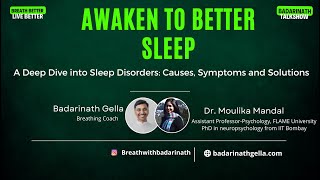
In this podcast episode, host Badrinath Gella interviews Dr. Moulika Mandal, an assistant professor of psychology at FLAME University and a certified CBT‑I therapist. Dr. Mandal explains the most common sleep disorders—insomnia, sleep apnea, restless‑leg syndrome, and narcolepsy—highlighting their prevalence and how modern lifestyle changes (night‑shifts, screen exposure, irregular schedules) disrupt the natural circadian rhythm. She identifies stress and anxiety as a primary driver of insomnia, describing a vicious cycle where rumination leads to sleep loss, which in turn heightens stress. Diagnosis is framed around the “4 Ds” (dysfunction, danger, deviance, distress) and practical assessment tools such as sleep diaries, actigraphy, the Epworth Sleepiness Scale, and polysomnography. The importance of sleep is emphasized for cardiovascular health, brain aging, metabolic function, and overall productivity. Dr. Mandal outlines lifestyle and environmental factors that influence sleep: diet rich in magnesium, calcium, melatonin (e.g., cherries, chamomile), avoidance of stimulants, regular exercise, and minimizing blue‑light exposure before bedtime. She discusses how deep breathing, pranayama, and progressive muscle relaxation physiologically calm the nervous system, reducing stress. Therapeutic strategies focus on CBT‑I, especially re‑conditioning the bed as a cue for sleep only, and cognitive restructuring of irrational thoughts. The conversation also covers when to seek professional help—counseling psychologist for relational stress, clinical psychologist for severe mental health issues, neurologist for disorders like narcolepsy or sleep apnea—and the role of yoga, meditation, and support groups. Dr. Mandal addresses cultural stigma around mental health, noting that physical ailments are more readily disclosed than psychological ones, which hampers help‑seeking. Finally, she offers concrete sleep‑hygiene tips: a 30‑minute wind‑down without electronics, a calming bedtime routine, and consistent sleep‑schedule adjustments.
Chapters
Major problem is, you know, stress and anxiety. So the levels of stress— so when they go to sleep, all these thoughts come to their mind, and, you know, all these worries come to their mind, and they just start ruminating about it, and it just, you know, messes up their sleep. Yoga, meditation— these are some techniques which have been, you know, proven throughout the centuries that they work. And there is so much research and, you know, actual evidence that, you know, these, they work because they help you recenter, they help you, you know, control your body, they help you control your thoughts. Apparently it can, you know, if you take like 20 to 30 minutes of, you know, like a power nap during the afternoon, it can boost up to 60 to 80% of your brain health.
Sleeping problem is not sleeping problem. Sleeping problem is a stress problem. Yeah, so anxiety problem, depression problem is leading to the sleeping problem.
Breathing. So you deep breathe, you calm yourself, and you're calming your, you know, stress at some point also.
Hello everyone, welcome you all to the special segment on sleep disorders. Today we have Dr. Maulika Mondal. She is an assistant professor of psychology at Flame University, and she is a certified CBT for insomnia therapist. And she has done her PhD in neuropsychology from IIT Bombay, and she also has 7 years of experience as a practicing therapist. I welcome you, Dr. Monica, to our podcast. Thank you so much for accepting our request and coming here to share your knowledge to our audience.
Thank you, thank you so much, Vadrinath. It's a pleasure being here, and thank you for inviting me. I'm happy to share what I can.
Great, thank you. And I, I'm just going through the research on sleep disorders. As for Sleep Foundation, when I researched about sleep, for like one of the sleep foundation, they mentioned 30 to 45% people are suffering with insomnia across the world, and many people are suffering with sleeping— different sleeping disorders. Today, that's why I want— I invited you to really wanted to discuss on what are the common sleeping disorders and how can we address them naturally. So my first question, uh, to you, Dr. Monica, is what are the common sleeping disorders that everyone faces, right?
Uh, so yeah, I mean, it's, uh, it's actually— I mean, the prediction would be the numbers would only go up because of the kind of lifestyle we have and everything, more people are actually getting sleep disorders because we are not in sync with the, you know, the actual nature cycle anymore. So some very common sleep disorders are, you know, the primary one is insomnia, which basically means difficulty in falling or staying asleep. So as a result, it leads to very poor quality sleep and the duration of sleep reduces And insomnia can be manifested in various ways. So either you may have difficulty in falling asleep in the first place. If you do fall asleep, you will probably wake up many times during the night or during the time of sleep, or you wake up very early in the morning. So insomnia has its ways of manifesting, and there are some other disorders like sleep apnea where you know, the breathing kind of stops during the sleep. So a person who experiences or who has sleep apnea just might wake up in the night with like a gasp, and because they are not getting adequate sleep, so that the entire day goes into, you know, with a lot of sleepiness. Then there is a restless leg syndrome where there is an irresistible urge to move the legs during rest. So you're just, just shifting and shuffling the whole time because your legs are restless. So that, you know, it does not bring you to that point of rest where you can actually fall asleep. So as till the time your body is constantly moving, your brain is not going to, you know, understand that it is time to sleep and it will sleep. It would assume that the body is still active. So that, you know, causes poor quality sleep again, or lack of sleep. Then there is narcolepsy. So in narcolepsy, it causes a lot of daytime sleepiness. So people fall asleep during the day itself, and, you know, they just fall asleep at very odd times, or without sort of having any control over their sleep. So it's just like a— it's It's more sleep than you actually need, and it can be very difficult because sometimes people can be asleep during, you know, while they're driving a car or, you know, at situations which could be very inappropriate that you sleep, but it's just that they have no control on their sleep. So these are some common sleep disorders which people experience. Insomnia being the, you know, being the most common.
Yeah, very popular and the most popular and majority of the people facing this issue.
Correct.
So what do you think the root cause of these problems?
So I think one, as I mentioned, is definitely the change in lifestyle. So, you know, as we are all products of evolution, we all, you know, belong to the animal kingdom. So as— and as diurnal creatures, we— our brain and our entire, you know, genetic system is adapted to the sun. So, you know, when the sun comes up, we are supposed to wake up. The brain signals that, you know, it's time to wake up. And when the sun goes down, the brain signals our body to, you know, just shut down, go into a shutting down process. Now, when that does not happen, the brain is just confused that what's happening? Why aren't we going to sleep? The sun is down. So all these lifestyle changes that we have made has completely, you know, malfunctioned our own system. So it does not know when to go to sleep or when not to go to sleep anymore, because ultimately our brain is telling our body to, you know, go to sleep or, you know, get into that process. So one is our lifestyle changes, which is why, you know, we used to study this nursery rhyme like early to bed and early to rise. That was actually a life lesson more than, you know, just a nursery rhyme. And it makes sense now even more when, you know, so many of us are suffering from insomnia and that's not happening anymore. Early to rise and early to bed is not happening. So lifestyle changes are one primary thing. A lot of us are working night shifts, are working odd hours. I know so many of my, you know, colleagues and friends who are working the American schedule, so they are staying up all night and, you know, sleeping during the day. So imagine how much it's going to confuse all our genetic system and our brain. So lifestyle changes is one thing, and another major problem is, you know, stress and anxiety. So the levels of stress, so If you take like a generalized self-reporting stress scale, you would see most of us are, you know, on high to moderate levels of stress. And it is a vicious cycle when it comes to, you know, sleep. So what happens is, as a result of high stress and anxiety, it makes, you know, it causes difficulty in falling asleep. We are thinking, we are ruminating, or something is happening and we are unable to sleep. And that leads to sleep deprivation, which is further causing, you know, even more stress. So it's like we're just, you know, somewhere stuck in the cycle where we are stressed, so we are sleep deprived, we are sleep deprived, so we are, you know, even more stressed. So that's another primary reason that might cause insomnia, at least in today's day.
Okay, great. So yeah, as per ancient methods also, we used to say like when sunrises we should wake up, and sunsets, and we also have to have the food before the sunset. We used to say like ancient method. So I think it's going back to the roots. Yeah, actually, yes. I just want to understand, like, because you have been practicing this, what are the common symptoms of the sleeping disorders and how a person can identify he has a sleeping disorder, right?
So, um, so how do you identify? So, you know, for any disorder, um, to identify something as any disorder, we actually look for 4 Ds. So these 4 Ds are, uh, dysfunction. So if it's probably— if you really have a sleep disorder, it's going to cause dysfunction, you know, either your social life, your work is going to affect it, your, you know, interpersonal relationship is going to affect be affected. It might pose some kind of danger, which is the second D, either to yourself or to others. And there must be a deviance. So your normal amount of sleep that you require is not happening anymore. The normal, you know, after waking up, we are ideally supposed to feel very, you know, content and satisfied and, you know, refreshed. But that's not happening. So we are somewhere deviating from the normal, you know, sleep duration and the quality of sleep. And the fourth is distress. The 4 days. So if there is any distress as a result of poor sleep quality, I mean, just imagine a day, or like if you haven't slept for like a couple of days or, you know, 3 days, you will be irritable, you will be— I mean, it would be difficult to concentrate on things, you would be feeling very tired and very fatigued. So all these are signs of distress that has been caused by, you know, a sleep problem because I've been able to sleep properly. So if all these 4 D's exist, that means there might be a sleep disorder and you might want to get, get it checked. And to get it checked, you can either, you know, check with your physician, um, you can keep a sleep diary or a journal that can help, you know, track your sleep. Um, there is an Epworth Sleepiness Scale that you can use to track your sleep. And we all have smartwatches now which has this actimeter, so you can actually track how much you've slept. And I'm not sure how accurate all these smartwatches are, but it actually tells you this was the duration when you were in deep sleep and this was the duration when you were in, you know, you were light sleeping or you were awake. So these are some things that you can actually track to check whether your sleep is adequate or not.
Okay, great, great. So, uh, we discussed about the causes and, um, like how to measure our sleep, but what is the importance of sleep? Because many people don't acknowledge that and don't really give time for their sleep.
Sleep, yeah.
And what is the importance of sleep and what is the duration of sleep required, right?
Okay, so So importance is something that I can't stress enough, how much sleep is required. So, you know, it's actually— so think of, you know, we have these trains which go on a journey and it goes, you know, onto the shed to, you know, get repaired and, you know, to take rest. That's just what sleep does to us. So the entire day we are awake, we are taking putting a lot of load on our body, on our body, on our brain, on the entire system. So body needs some time, you know, to shut down, to repair. So actually when you're sleeping, it's not like your body is completely shutting down. It's actually like you're aware, you consciously are shutting down, but your body is actually repairing itself, which is something that it needs to repair. Your all the brain or all, you know, your brain needs to repair itself, your muscles need to repair itself. So everything, it goes into a repair mode during that time. So it's just like, you know, in a way our bodies are machines. So if you don't let a machine rest and, you know, repair itself, so it's going to break down at some point. So that's essentially what sleep does to us. So, and if you're not getting adequate sleep, then there have been so much research that would tell you it leads to poor cardiovascular health. It makes a person more susceptible to get a heart attack or like an MI. It's horrible for your brain actually. So cognitive aging, you know, as we age our brains also, you know, there are certain changes that happen on a cognitive, on a neuronal level. So for a good brain health, you know, when you are 80 or 60, your brain needs to function and if you have had adequate sleep then it's more likely that you will have good brain health. Than if you're not. And in fact, there are so many of these studies, and a lot of countries are actually adapting this also, of about getting a power nap during the afternoon. Apparently it can, you know, if you take like 20 to 30 minutes of, you know, like a power nap during the afternoon, it can boost up to 60 to 80% of your brain health. So it's more— it's very less— it's, uh, it would decrease your likelihood of getting a stroke or, uh, or Alzheimer's, or, you know, dementia. So that's how, you know, sleep is important, and that's what sleep does to— it's just something that, you know, it looks like you don't even have to do anything during sleeping, but that's actually— it's changing everything. It's bringing a newer version of you every day, that sleep is. And there has been some standardization of the amount of sleep you need. So, you know, the standard hours is 8 hours, but for younger people whose bodies are better at, you know, regenerating themselves, so they can, you know, go up to 6 hours of sleep. For them it is adequate, but 8 hours is ideal. So even, you know, all these top people like Bill Gates and, you know, all them, we might think that, oh, they probably don't have the time to sleep. But Bill Gates, Elon Musk, all these people have always vouched that they make sure that they get enough sleep, and that is what is the reason— it's one of the reasons why they are so productive. So if they can get adequate sleep, so I'm sure we can. We should try to at least.
So yeah, what I understood is sleep deprivation also leads to many other health diseases, disorders, and also it reduces our productivity. Like whatever we can do more better in our day, like, which reduces our productivity. That's, uh, like, amazing thing to know, like, for people to really, like, because, um, they don't prioritize their sleep to work more, but if they sleep more, they can work more productive.
So yes, absolutely. Yes, yes, absolutely. Like, your metabolic function goes, uh, goes on for a toss. Your immunity decreases. Mental health, of course, decreases. Um, people who have been diagnosed with mental disorders, there is a direct history of, you know, poor sleep quality or sleep disorder. I mean, that has been a comorbidity. Um, then you're— yeah, I mean, there's just so many problems you might get into if you're not getting proper sleep. Not today, but yeah, at least in the next 2 decades, in the long run. Yes, absolutely.
So, but can lifestyle factors such as diet, exercise, and technology usage impact sleep problems?
Yes, yes, absolutely. So there are some certain, you know, diet things which are very good. So for example, food that are rich in magnesium, such as, I think, yeah, magnesium, calcium, so your dairy products. Then cherries, they have something called melatonin, which induces sleep. Chamomile, these kind of— I mean, we are often told that, you know, take chamomile tea before you go to sleep. So chamomile has natural sedatives. So these are some things that you can take. And it is said that a Mediterranean diet is very good for sleep, so which has very high roughage content and nutritious content. So these are good things for sleep. And by all means, avoid any stimulant during the night like caffeine, having a cup of coffee, tea, chamomile tea is different. It's a flower which is infused. So that is fine but like the regular tea, caffeine, smoking, all these things are stimulants which confuse the nervous system. They tell us that we need to be— all these substances bring alertness and wakefulness to us. So they are not helpful for sleep. So that's one problem. And then exercising is one thing. So you need the body to, you know, work up itself to a certain amount so that it decides that, okay, I need to lie down and I need to repair myself now. So, you know, it's all the brain is telling the body to do everything. So the brain would realize that, yeah, I'm really spent, I need to— we need to lie down now. So it will tell— signal the body to lie down. And speaking of electronics, I can't— again, I cannot emphasize enough how electronics is absolutely detrimental to our sleep routine. So what happens is when we use these electronics devices like mobile phones, lights, TV, laptops, iPad tablets and everything. So these devices emit a blue light, something called blue light. So this blue light mimics the sunlight. So when a person is using these tablets, the brain thinks the sun is still up because it's getting blue light. So then it tells— so it sort of signals the body to not sleep immediately. So again, it just gets confused that I thought it's sundown, but the sun is still up. We are getting the blue light. So which is why it is recommended that at least— I mean, we call it a wind down. So at least 30 minutes before your bedtime, you start winding down. So you don't use any electronics, especially the blue light emitting. Perhaps you can read a Kindle, which does not have a blue light, or you can read a book if you want to, but not use electronic devices for at least 30 minutes before your you're planning to sleep. So you start to wind down, and then the brain gets it that, okay, there is no blue light, so the sun is gone, let's sleep now.
Wow. Okay, so it's very deep actually. Like, we don't really recognize, uh, the small things, but, uh, they matter a lot. Yes, great. And, uh, if a patient comes to you, like, how does, uh, as a psychologist are doctors diagnose people who has sleep disorders?
Okay, so there are some basic things again like an Actigraph which tracks, which we wear on the wrist that tracks sleep patterns, physical activities. At least in India there is a sleep questionnaire. Doctors conduct some clinical interviews, check for the symptoms of various sleep disorders and see what's happening. In some places, there is something called polysomnography, which actually happens in very specialized sleep clinics. So people actually stay in those clinics for the entire night, and their various physiological parameters are being measured. But it's not very common. I mean, how many of us do we know who goes for a polysomnograph? But typically, it's the clinical interview that doctors or physicians take. They check for all the symptoms that are there. To check for what kind of insomnia that they have, what kind of severity they have, what kind of onset they have, what kind of triggers they have. So is their insomnia being triggered by stress and anxiety? Then we need to take care of the stress and anxiety because that's what's causing the sleep. Is it happening because of some physiological condition like hypothyroidism or things like that? So then we need to address that. So we check for all these comorbidities or, you know, various combining or interfering physiological conditions to understand why the sleep problem is happening and what is happening.
Okay, so what are the common factors? Like, because you might have seen many patients or done many studies, what are the common factors that influences some sleep?
Like Speaking of the factors, so people come up with mostly, you know, they— at least because I have been a psychologist, so most of my clientele has been into mental health. So most of them have reported having stress, especially, you know, a lot of them may told me that they have— they are stressed particularly during the night. So when they go to sleep, all these thoughts come to their mind and, you know, all these worries come to their mind and they just start ruminating about it and it just, you know, messes up their sleep. So then I would say the trigger is or the problem lies with the stress and anxiety. So because, and you know, our thoughts are very automatic. We don't have a control on our thoughts. If you're worried, then we are worried. If you're thinking, then we are thinking. But thought does not act alone. The thought is coming from something else because we have a problem, we are concerned about something, from that these thoughts are coming. So we need to address that, we need to get back to the root level and we address that. So that's what I would do with my clients, that if they are having sleeping problem because of stress, because of these worries, because of these thoughts, then we work with that, like whatever is causing these problems. So we discuss about the problems that they are having, about what is causing them stress and how to address that. So once we address that, then their worries go away and then, you know, the sleep improves. And in some cases, people, when it's very intense and it's absolutely interfering with their life, then sometimes some individuals may have to go for medication, which is not something recommended, although we have better and lesser side effect medications now. But again, I'm not the perfect person to comment on it because I'm not a medical doctor. But yeah, I mean, therapy is something that really helps sleep. And yeah, stress and anxiety is a very common factor. And as I mentioned, the lifestyle problems and certain external events, you know, some people have lack of— have problem with sleeping because of environmental conditions which we don't realize. So I mean, when we are trying to sleep, it's actually ideal to— we call it a sleep-conductive environment. So the environment should be cool, it should be dark, it should be quiet with comfortable mattresses and pillows. So these are actually something that really helps getting better sleep. So if you have, you know, like neon lights outside your window, please get, you know, better drapes. Or if you have I mean, there is a lot of noise around you. So, you know, there are students who live in hostels. They have a lot of noise around them. They have difficulty in falling asleep eventually, and then they have various mental health problems. And you can use earplugs and things like that. But make sure, you know, you're— you make it basically— make it easy for your body to fall asleep. The more difficult you make your body to fall asleep, the body makes it things more difficult for you. Body gets back at you. You didn't take care of me, I'm going to take care of you now. So yeah, these are some things that makes—
yeah, like, uh, we always say stress is an internal disharmony. If there is some disharmony inside, then that leads to the stress. Like, you have to go inside to really find out that the answer to it. Yes, so people, uh, really doesn't know how to go inside. So here comes my question. So like, being a breathing coach, I have been giving some of the tools and techniques which I know. I used to share with them to help to come out of this stress and anxiety disorder, because sleeping problem is not sleeping problem. Sleeping problem is a stress problem. Yeah, so anxiety problem, depression problem is leading to the sleeping problem. So people consider sleeping problem, but they forget to emphasize—
and it's actually a stress problem.
It's actually a stress problem.
Yes.
So what is the role of breathing techniques? Or like, in traditionally we call it pranayama, but now as in breathwork, it's very popular across the world. So what is the role of breathwork in really improving the sleeping quality?
Right. So, so, you know, when when we get agitated, we get angry, we get irritated, you probably might notice a change in your breathing. So when we are stimulated, we are alert, it automatically, you know, changes. It reflects on our breathing. So, and while when we are breathing, when I mean when we are agitated or, you know, we tell each other like, you know, deep breathe, breathe deep, take a deep breath, take a deep breath. What we are doing with taking a deep breath? We are basically taking a deep breath taking a deep breath and we're calming, you know, our nerves, calming our muscles too, you know, speak in a very layman way. So basically when your body is relaxed, you can't be stressed out. So that's actually the essentially the idea of deep breathing and progressive muscle relaxation also. So if you can calm your body down, your stress will also go down because your body cannot be relaxed and agitated at the same time. And our brain or— and our mental stress and our physiological stress go hand in hand. So if you are mentally agitated, our body would react. If our body is calmed down, our mental anxiety would also calm down. So something that causes us stress, and if we learn to relax ourselves at that time, it won't be causing us stress anymore. So that's— so basically, by deep breathing and, you know, by using these techniques we are trying to change the physiological response, which would automatically change our stress or mental response. So that's the direct connection of deep breathing. So you deep breathe, you calm yourself, and you're calming your, you know, stress at some point also.
Yeah, so basically they help you to stabilize your thoughts. I think I can say like stabilize your thoughts. And, uh, yeah, like, I, I, I have seen like many people like who worked on their breath could able to control their thoughts and they can go to their breathing techniques. So, and, uh, like many people doesn't know like, uh, where to get the support from. So my next question is like, how can people with sleep disorders get the support they need? So where, whom they should approach and what kind of support they required, right?
So, um, I'm sure there are support groups for sleep disorders. Uh, there might be some, there would be on Facebooks or over Instagram. When we live in the age of social media, so you can always try to find the people that, you know, would be supporting you. And more importantly, you need to lose the people who do not support you. So if somebody thinks that your sleep disorder or sleep problem is a joke, then it's the time— it's really time you should not be talking to them anymore. Or you can try to educate them somehow, but support— and sometimes it's possible that we may not have the support of every single person or everyone that we want to. So in that case, just focus on the people who are positive about it, who actually, you know, care about you or are willing to understand your problem and be the support. So just focus on them, even if it is one or two people, that's, that's fine. Um, and yeah, I mean, just lose the people, or, you know, not avoid talking about this to people who do not support you, because it's just going to make you feel bad.
And also, people want to know, like, whom to consult. Like, for example, they look for some traditional therapies like yoga and meditation and few other techniques. So whom should they consult apart from yoga? Like, because I am coming from the background of meditation and yoga and breathing. So I know that like people, uh, also seek this help to really solve their problems. Apart from this, like, what kind of, uh, whom should they contact?
Um, so if they believe in yoga, then why not go for yoga? Because I mean, yoga is one of the most ancient techniques which originated from our country. The West is getting crazy about it, so we should not shy away from embracing these traditional techniques which we know that they work. And yoga, meditation, these are some techniques which have been, you know, proven throughout the centuries that they work. And there are so much— there is so much research and, you know, actual evidence that, you know, these, they work because they help you recenter, they help you, you know, control your body, they help you control your thoughts. So once you're able to control so many things about yourself, you will be able to control your sleep as well. So definitely go for, you know, if a proper yoga. And of course check for this, I mean, psychologist.
Yeah, along with yoga, like, they can also visit psychologist or neurologist, or whom should they visit?
Like, okay, apart from yoga, so if the problem— if there is a psychological problem, if they are experiencing some psychological distress then definitely they should approach a therapist, a psychologist. If they think that it's very— they feel like there's— it might be depression or something, it's too heavy, they can go for a clinical psychologist. If they think that it's just some relationship issues they're having or some family problems they're having, which is why they're distressed and that's causing their sleep problems, then they can go for a counseling psychologist. And, you know, for severe disorders like narcolepsy sleep apnea, yeah, they can— they should consult a neurologist. So depending on the degree of— again, the 4 Ds— depending on the degree of dysfunction and distress they are having, they can choose to, you know, either go for a counseling psychologist, a clinical psychologist, or a neurologist.
Okay, great, great. So yeah, that is the information which is not available. People do not know whom to consult when they have these problems. So yes, like, of course they seek help of meditation and all, but And apart from this, like, they can also approach to these doctors and to seek the help, actually.
Yeah, and honestly, yeah, sorry, go ahead, go ahead, please. And I was just saying that, you know, uh, going to a doctor is probably going to get you medication. So, um, so if you are reluctant to get, uh, get medication, again, they might— these medications might not have that bad side effects as we have always known that, oh my god, like sedatives are the worst. But these are new age medicines which are better than what we have known. But if you're reluctant to go for medication, go for psychologist first and let them refer you if there is an absolute need. So your first line of therapy or first line of treatment, self-treatment, could be therapy.
So psychologist, when it comes to psychologist, like I come from the small town and rural parts, but not many people familiar with the terms called psychology and not really they seek the help of psychologist. Why do you think like why people are not really, uh, like, like interested to approach the psycho even though they are facing many problems like psychologically they have many problems And also, as you know, like many problems rooted because of psychological problems, the modern diseases like diabetes, hypertension, digestive disease disorders, skin diseases, many disorders because of the psychological problems. Why do you think like people are like not interested to open up their psychological problem? It's about opening up. Like if they have diabetes, they are proud to say that I am diabetic. Yes, they're proud to say that I am, uh, like I have BP. Like whenever they go to visit any house, they mention that I am diabetic, I have BP, I have, I'm a heart patient.
Yeah, absolutely. Yeah, yeah, that is the most unfortunate thing. I mean, at least as a psychologist, that I would say, um, because, um, you know, physical problems are— I— so there is a direct cultural stigma associated with psychological disorders. And the smaller, you know, like the more interior we go into the, you know, into the country, the more stigma is. And it's completely cultural because, you know, there was a time when psychological problems, you know, would be treated with exorcism and whatnot. Like it simply means that some supernatural forces has taken over. So from there, it would need some time to transition that no, I mean, it's psychological— having a psychological problem does not mean that, you know, that extreme. There is a lot more milder version of those things also, which could be very distressing and disabling as well. So there— I mean, the society at large needs to self-educate and, you know, would probably need that time to make that transition because there is a major difference, at least I can see in the last 7 years of my therapy, that more people are coming to seek therapy now, and we are going more, you know, interior. Like how it was even 10 years before, it's way different now. People are coming forward for therapy. They're— they've started to acknowledge the mental health problem. And it is true, you know. And I think the problem is that when we have a physical problem, it's visible. Like, you know, if somebody has diabetes and they don't take insulin, it would show. They would, you know, it would show in various ways. The problem would. If somebody has an ulcer or like a kidney stone, their pain and everything would be visibly obvious. But that's— it's not the same with depression and other mental disorders. It's very easy to label something mental that, you know, they are just weak or they're just acting it out. It's, it's not a big deal. So, you know, how many times people who have depression are just told to get over it. Even a lot of therapists say that, actually, like, you know, oh, deal with it, it's not a big problem. So, or people might say that, oh, I have had a similar problem, but I dealt with it, so what's the big deal? We were okay. So all these things, so it's not taken seriously, I think, in that, with the seriousness it needs to be, because it's not obvious like a physical disorder. You can see the X-ray if you have a kidney stone. You can see the ultrasound if you have a kidney stone, but can you see depression on a, you know, on a film or on a plate? No. That's what makes it difficult for people to understand this, that, you know, this is not obvious. So how— what do we make out of it? So people— and things people don't understand or that are not overt, then they start to have their own interpretation.
And just—
we just have many versions of, you know, depression and things happening among people, and that's what it is.
So I want to know, what is CBT, like cognitive behavioral therapy, and how does it really help? Like, could you just give us a—
yes, yes, definitely. Um, so the term is, if I break it up, it's cognitive. Uh, cognitive means our thoughts, our belief system, what we think you know, what runs in our mind, simply that, and behavioral. So whatever we think, whatever we believe is going to translate into our behavior. So cognitive behavior therapy addresses these two things. So the idea is if we can fix the thoughts, we can fix the behavior. So if somebody, let's say somebody is extremely afraid of dogs So every time they see a dog, they run away. Like, you know, some— they would be like, no, I can't be in a room where a dog is, or, you know, they're just extremely terrified of the dog. So the reason they are behaving like that is because they think that dogs are dangerous. So their thought is translating into their behavior. Because they think dogs are dangerous, they cannot stand to be with a dog in a room. Now if we fix the thinking, if we say that 'No, dogs are not dangerous.' If we make them believe that dogs are not dangerous, they would be completely fine with, you know, having a dog in the room. They would probably pet it or, you know, whatever. So this is what we try to, you know, target during cognitive behavior therapy. Fix the cognition and the behavior would be fixed.
Great. So everything starts from the thought. So that is the root cause of all the problems. So you are helping to fix them, to change the perspective of their thoughts so that everything will fall in place.
Yeah, sometimes these thoughts are irrational. So, um, I might think that, um, okay, if I go out, I might, you know, I might be run over by a bus or like by traffic. So I'm not going out, I'm not leaving my house at all. So, but if my thoughts are changed that no, it's outside is fine, it's not dangerous, I can go out So I'm having an irrational thought that, you know, if I go out, something bad would happen to it. So identifying that irrational thought, that this is rational, this is irrational, and fixing that is what essentially we do with cognitive behavior therapy.
Wow, it's amazing. Like, because that's what we need, like, that is the root cause of all the problems. That is surely going to help. And that skill, everyone has to develop that skill actually, like I can see.
So actually, the therapist helped them develop that skill. So they eventually identified that, okay, what I was thinking was wrong, was irrational. So this is the right way to think, and their behavior automatically changes.
So lastly, like, um, with your professional experience, what advice would you give to someone struggling with sleep disorders?
Um, okay, so primarily, make your— make the right lifestyle changes. If it is absolutely avoidable, you work with an American company, you have an American schedule, and it's unavoidable, then at least, you know, make the right choices in your diet, exercise, try to avoid electronics in the last, you know, do a wind-down routine where you would not use any electronics in the last half an hour of you know, when you want to sleep. You can engage in various activities. Actually, it seems like mobile is just— has become a part of us now, our smartphones, but that's not true. You can read a book, you can, you know, like take a hot shower, you can have some chamomile tea, you can just, you know, let your life go at a very slow pace in the last 30 minutes and just go to sleep. And if I am to apply some CBT for insomnia here. We actually use our bed for various things which are not sleep, not sleep inductive. So we use it to work, we use it to, you know, use our mobile phones, we use it to, you know, just to sit and watch TV. So basically it confuses our brain. So when we are in our bed, the brain does not know what are we here for. Are we here, you know, to talk to someone or are we here to use your— or, you know, do a call on our mobile phones? What? So the idea of CBT is to rewire our brain into thinking that bed is only for sleep. So use the bed only for sleep, you know. The moment you— if you're not feeling sleepy, just get out of the bed, sit on a chair, read a book, whatever. But do not sleep or do not sit on the bed or do not do any activities other than sleep. So eventually the brain would come to know that the bed is, you know, used— supposed to be used for sleep. So brain— the brain gets rewired accordingly. So every time it sees bed, it thinks sleep. It's sleep time. So then the brain will signal your body to, you know, okay, we are on the bed, that means we are ready to go to sleep. And sleep would come. And it's going to be very unnatural in the beginning. You would not fall asleep because your brain is not used to just sleeping on the bed. So, but yeah, if you continue to do that, at least in a month you would see results and you would be able to go to sleep at the right time as soon as you go into bed. So that's CBTI, uh, we can try.
Wow, wow, thank you so much for all your inputs. And I think it's one of the valuable sessions we had today. Even if they take some of the tips which you have shared and implement them, they can highly improve the quality of their sleep.
I hope so.
Yeah, I think so. Thank you so much, Dr. Maulika, for coming here and sharing your knowledge with our audience. And I think this is one of the valuable sessions for them to really implement practically on their life. And I hope if they have any questions, they'll reach out to you. And Dr. Molika is from Flame University. You can find her contact on over the LinkedIn or on the website of Flame University. You can reach out to her if you have any specific questions on these issues. And again, once again, thank you so much.
And thank you so much, thank you so much for having me here. It was a delight.
More from Badarinath





How Conscious Breathing Transformed My Health, Family & Career | Inspiring Success Story

International Yoga Day Celebrations 17th to 21st June | Morning 6 AM | Evening 7 PM

30-Minute Breathing Exercises | Reduce Stress & Improve Lung Health | Yoga Day | @badarinathgella


