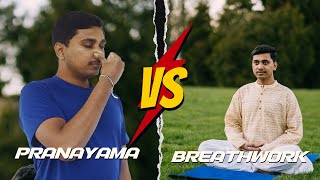
Badrinath Gella, founder of the Conscious Breathing Hub, distinguishes breathwork from pranayama: breathwork targets physical health through faster, unrestricted breathing, while pranayama works with prana for spiritual growth using slow breaths, breath-holds, and specific techniques. Traditional texts list only nine to twelve classical pranayamas. Choose breathwork for physical goals or pranayama for comprehensive development across body, mind, emotion, and spirit.
Chapters
Namaste. Many of them heard about pranayama and breathwork. Many of them are having confusions. What is exactly pranayama and what exactly breathwork? People, some people may think both of them are same. Even though we are using same breath for both of them, the purpose of both is completely different. Let us see what exactly pranayama breathwork means in this video. Hi, my name is Badrinath Ghella. I am the founder of Conscious Breathing Hub, where we all like-minded people join together to enhance the quality of our life and holistic well-being. If you want to be part of our community, do not hesitate to contact me. So let us see what is breathwork. So breathwork is set of exercises mainly focuses on physical health. So there are these exercises which will help you to enhance in your physical level. So like, for example, if you want to expand your lungs, if you want to like heal some physical problems, so this is a breathwork, is one of the very, very important tool. So whereas pranayama, the pranayama means the prana is a vital energy. It's not just breath. The vital energy is inside the breath. So it's not visible, but breath is a tool for that life energy. The life energy is responsible for various functions in our body, whether digestive system, respiratory system, excretory system, or circulatory system, or many other things. Even when you're speaking, there is some prana involved in it. Even though the pranayama is also helpful, very much helpful in your physical level, Especially, I cured my asthmatic problem through pranayama techniques. So it is also helpful for physical practice, but the goal is not physical, the goal is spiritual. So to connect with the source, the main purpose of is to enhance your spiritual practice, to enhance, to take you to the next level. For example, in Patanjali Ashtanga Yoga, This is the fourth step. After fourth step, the antaranga yoga starts. This is bahiranga yoga. This is external yoga. The internal yoga begins from here. So breath is one of the very important tool to calm your mind, to control your thoughts, to control your emotions, to go inward. So to, to, to, to tell easy way, so pranayama is an inward journey. It's not external thing, it's an internal thing. Okay, and also the pranayama involves various mudras, various bandhas. Like for example, this kind of mudras, if you have, if you have experienced, if you have seen any classes. So these are some locks, mudras, and there are so many other elements involved in pranayama. Whereas in breathwork, so we do not have any of these things, any of these restrictions, or any higher level of practices, or higher level of consciousness and these things. And another difference between breathwork and pranayama is, so breathwork we used to do little faster. We don't really care about, uh, the speed of your breath and everything, whereas in pranayama you have to breathe very softly and very calmly. It involves majority of the pranayamic techniques except bhastrika or kapalabhati. Like kapalabhati is also kriya, not a a pranayamic technique. So, but most of the pranayamic techniques mainly involves the slow breathing because it's very, very important to calm your mind. We believe our breath and mental state is connected. So that's why whenever you calm your breath, your mental state will also will be stabilized. And also in pranayama, we have holding the breaths. So we inhale and hold, it is called kumbhaka. We exhale and stop the breath, which is suspending the breath, which means suspension of breath, or bahya kumbhaka, or also called as shunya kumbhaka. So these are the things which are involved in pranayama. So basically, like, if I— like, many people have confusions, which one should I choose? So it depends on your requirements. Right, so you can also start with breathwork or pranayamic techniques. Anything is fine. And pranayamas are not many nowadays. If you see, like, there are so many, so many breathing techniques, but traditionally there are like 9 to 12 pranayamas. That's all, maximum of 9 to 12 pranayamas, which is given in Hatha Yoga Pratipika or Krihanda Samhita, the main Hatha yogic texts which you see. So if your requirement is only about physical level, so you can go with breathwork. If your requirement is mainly towards the spiritual growth, towards like all the dimensions of your growth, like it's a holistic well-being— so as you know, the definition of health from World Health Organization is physical, mental, emotional, and spiritual well-being. If you want to work on all these dimensions, then pranic practices are best suited for you. In conclusion, you can do both of them also, so you can really enhance your lung capacity, and slowly you can deepen your practices through pranayamic techniques. I hope this video has given some clarity for you what exactly pranayama and breathwork means. So breathwork means mainly focused on physical level, a physical enhancement. Pranayama is a prana, the vital energy, the life energy, or else biological energy For example, if you consider me and a dead body here, both of them has body, but what is not there in that person is prana, the vital energy, life. So it's a life force. So pranayama believes beyond physical level. So if you believe yourself, believe that you are beyond physical level, then pranayama is a best practice and must practice you should do. So if you find this video valuable, please comment below and also subscribe to our channel and share it with your friends. Thank you, see you again.