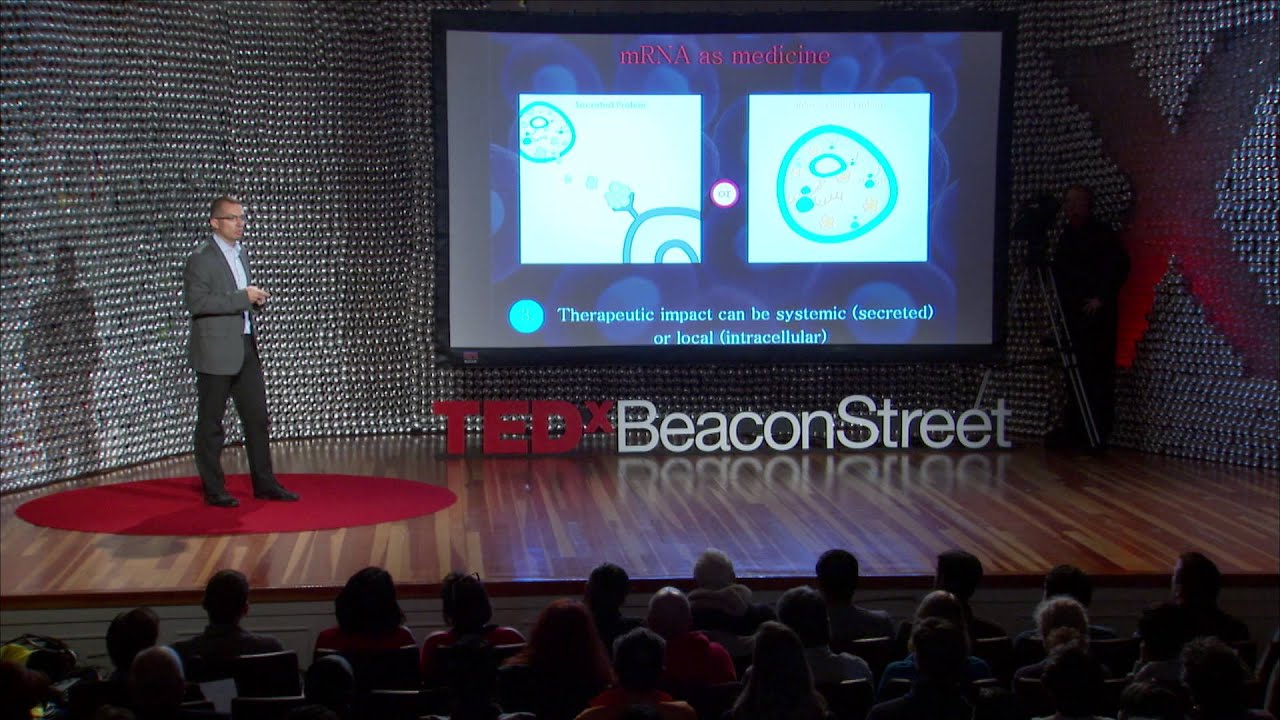
2026 CEO Chat: Stéphane Bancel, CEO of Moderna

Moderna CEO Stéphane Bancel reports $1.9 billion in 2025 sales and three FDA approvals, while detailing a $2 billion cost-reduction push through portfolio cuts and AI adoption. He's betting on oncology, geographic expansion to Canada and Australia, and a flu-COVID combo vaccine to drive 2026 growth.
Chapters
Welcome to the flagship studio here at the 2026 JPMorgan Health Conference. I am here with our first interview of the conference, Stephane Bancel, the CEO of Moderna. It's a great way for us to get started here in the, in the studio, and I look forward as always to my conversation with Stephane and hearing about what's going on at Moderna. Stephane, I was reading your annual letter, which I really commend to our audience. There's a lot you can learn. And there were 3 things that you anchored in: commercial progress, pipeline momentum, and financial discipline. I want to ask you about each of those in turn. Tell me first about commercial progress. You've got some new approvals in 2025.
Exactly. Well, first of all, thank you so much for having me. It's always a pleasure to be back. So, yes, indeed, we had 3 BLA approvals in 2025. And so that allowed us to have good momentum in the US. We are announcing at JPMorgan that we are $100 million better than the midpoint of the range. So we'd say $1.6 to $2 billion of sales, and we are announcing around $1.9 billion of sales.
Congratulations.
Thank you. We're super happy. In terms of pipeline, so we had not only 3 products approved by the FDA in '25, but we're also positive phase 3 for our flu program. So this one we just announced last week, we filed in the US, Europe, and all the big geography. It has been filed over the—
I saw that was a very blanket filing.
Yes.
Last week's filing.
Yeah. We try to always do that. We go by geography size as like US, Europe, you know, Canada, UK, just goes on the list.
Yeah, the whole—
Exactly.
Run the gamut, as they would say in Vegas.
Exactly. So the team did that over a 3-week timeframe just to file everything. And then if you look at what's going to happen soon in '26 is we're going to have even more product approval, more data. So great momentum. And then cost. If you look at cost, the team has done a remarkable job. We've took around $2 billion out of our cost structure in 12 months.
$2 billion in 12 months?
Yes, out.
How did you— what were the guiding principles that led you and the team through that process? Because many biotechs are trying to figure out, right? Many pharmas are trying to figure out how do we winnow through this market period on our most promising, most impactful programs. What can you teach them? What can you guide based on that kind of reduction in that kind of timeframe?
Yeah. So what I could share is that we first looked at the portfolio and tried to be very disciplined about the portfolio in terms of what are the programs of the most value, what are the programs that are the most de-risked, and try to still, in our case, to keep a portfolio to manage risk. Because you never know what's going to work. So if you bet on one thing, you become the average biotech company. So what we try to do is to keep a portfolio, and we try to really pressure test with the management team, with our advisors, with the board, what's the right portfolio to trim down. And then we did a lot of work on restructuring manufacturing, because, as you know, during COVID we had to go with this crazy scale-up. Yeah, for sure. So we did basically the scale-down, which was very painful. with both partners and with employees. And so we're in a good place now. We, we are in a good place. We're going to continue to do cost improvement because we're still negotiating with suppliers, better pricing. We're still using a lot of AI to basically reinvent work business processes. If you think about AI, our first journey was really around writing GPTs. I think we have 4,000 or 5,000 GPTs in the company.
Wow. But now it's really about reinventing work across the firm, including scientific work, because we talked last year about sort of digital First.
Yes.
Are you using AI to direct scientific work?
Correct. So there's basically 2 big chapters for us in AI. The science, inventing new molecules where we think we have the biggest impact from a value standpoint. But the timelines to impact are going to be longer. OK. And then there's kind of business. How do you improve manufacturing? How do you improve supply chain? How do you improve quality, clinical trial and so on? We use AI to reinvent business processes where you will get some value, not as much as with science. But you're going to get quick wins.
So your senior leadership team, if they were here, your, your, your general counsel, your CFO, you're all of them using GPTs of some port in their areas throughout the company.
Exactly.
We were—
it's purchase to pay or in HR or in legal. So the whole company, we still have a lot of work to do. Yeah, but it's across the entire—
and that helps with your, with your financial discipline.
It helped a lot.
You talk, you talk also in the letter about pipeline momentum. Yes. Tell me about cancer, because that was such a huge area of promise in terms of the incredible results that we saw with your program with Merck.
Sure. So if you look at '26, now that we spoke about '25 a bit, sales growth. So the great thing about '26 is we're going to go back into sales growth.
Okay.
Which has been a few painful years coming down from COVID Right.
Where do you see the growth coming from?
So 2 things: new products.
Yep.
And geographic diversification. So a few years ago, We did a pretty creative partnership with the UK, Canada, and Australia where we basically built plants in those countries for long-term partnership of volume commitment and clinical trial participation and pandemic readiness.
I remember, I recall those announcements.
Yes. So those sites have been finalized. So we opened Canada early September. I went to the UK end of September, Australia at the end of the year. So those 3 plants are open. So in '26, we're going to have just a mechanical full-year impact. So even if the US is flat, we're going to be— the company is going to be growing. So that's really exciting. And then the pipeline. So as you said, this is going to be a crazy year for us in a good way because we filed flu. So we should get flu approved in some geographies. We should have flu plus COVID combo approved.
Is there a flu combo product on the market now anywhere?
Nowhere.
But in '26 there will be.
There will be.
I'm signing up for that.
Yeah, but you might have to wait because it's going to start in Europe.
I'll go to— if I have to go to Paris to get my shot, I'll do it.
You can go to Paris, get a coffee or glass of wine. But in the US, we're still waiting for the FDA to tell us when we can refile. But in Europe—
But it'll be available through EMA and through—
Correct. We should get the EMA approval this year, in '26. So, and we have still a phase 3 for norovirus. Ongoing. They should have data for phase 3 this year.
Norovirus still seems to be a pretty significant threat in parts of the country and for certain populations.
Oh yes, it's a bit like COVID and the flu, which is seasonal. The virus mutates and you have people at high risk, i.e., the elderly, people immunocompromised, kids, young kids. Same thing. Some of my scientists call it the flu of the bug, of the stomach area. And so that's for infectious disease. And then in cancer, we're going to have a lot of things. So we should get first imatinib, you know, individualized treatment that we combine with Keytruda. We should get first the 5-year data of a phase 2 study in melanoma.
And when will that data be available?
Soon.
Okay.
I'm thinking weeks, not months. Okay.
Weeks, not months.
We already shared the 2-year and the 3-year data. What was exciting is the 3-year data was better than the 2-year.
Wow.
And if you look at distance-free metastasis, which is critical in cancer, because as you know, people rarely die of their primary tumor, they die of metastasis. The distance-free metastasis at 3 years, you had 2 out of 3 people compared to Keytruda alone that were still distance-free metastasis or death-free after 3 years. And so now we're going to have the 5-year milestone for cancer. Yeah, it's like considered a cure.
Exactly.
If you talk to doctors, they consider 5 years a cure. So that data is coming really soon. So we are really excited. And then throughout the year, we're going to get a lot of clinical readouts. We should have pancreas cancer phase 1. We should have gastric—
Is that with a partnership or—
It's all with Merck. So this product is with Merck. So what we're doing now that we've got signal in melanoma, we're just expanding.
So pancreatic?
Pancreatic, gastric. We should have kidney cancer.
Wow.
We should also have bladder cancer this year. And then the big one is melanoma, but the phase 3.
Okay.
So 1,000 people, we should have data this year. And the factory is ready in Marlborough, Massachusetts. And so—
Specifically for the cancer vaccines?
Yes. Because here you make it individualized, meaning if you and I get diagnosed the same day by the same doctor, let's say we have skin cancer, Moderna will make a drug just for you. Make a drug just for me in 30 days from biopsy of your tumor, customized to your genes of your tumor cell. Amazing. And it will be combined to Keytruda. So you'll get Keytruda IV, you get Moderna.
My monogrammed edition.
Yeah, exactly. Exactly.
And so that's Marlboro, Mass., where that factory is.
Yeah. And so that's ready. So as soon as we have the phase 3 data, we'll just file the BLA as fast as we can with Merck, get the product on the market for patients. So that's one big product for us, of course, in cancer. There's another product in cancer that is fully ours. It's called mRNA-4359. And so that drug we use in metastatic settings. So the previous drug, Intysmiran, we use post-surgery.
Okay.
But the drug I'm talking about now, we use metastatic settings in lung.
That's 4359?
4359. We use it in lung and in melanoma, so skin cancer. And what we have shown is people that were refractory to checkpoints, meaning you are a stage 4 patient, they give you a checkpoint and it doesn't work. They give you another checkpoint and it doesn't work. Then they give you mRNA-4459 plus Keytruda and we had a very high percent of people responding. So far it's 69%, which is an absolutely amazing number, but it's a small number of patients. So what we're doing now, we're doing a big phase 2 that I'm sure should have data this year.
But a real lifeline stage.
Oh yeah. And we've heard several stories. Actually, there was in The Guardian this week a story from a patient in the UK who had metastasis and said in the article that she was cancer-free now. She had no more tumor. So really remarkable products. So the thing we don't know yet, which is why we need to do a bigger phase 2, which is ongoing now, in lung and in melanoma is how good is the signal. Because it's most probably not 69%. If it is, it's amazing for patients. But even if it's 20% or 30%, those are people that you give them a checkpoint and they don't respond. So they have no more hope. And that's where 4059 will be positioned too. So that's really exciting. So we should know that this year.
Very exciting for patients.
And then the other piece this year is rare disease. As you know, we have been doing rare disease For a long time.
Yeah.
And we should have phase 3 data of our first rare disease drug this year. Proprionic acidemia, it's a disease of the liver. The kids don't have the right protein, and so they have acid accumulating in their blood.
Okay.
They get a lot of brain damage, and there's no treatment available today. We have now kids 3 years on drugs from the phase 2 doing extremely well.
Oh, that's great to hear.
Yeah. And so we are—
You'll have phase 3 data this year?
Yeah, phase 3 data this year. And then filing for an approval. And then if the data is positive, we will put MMA, which is another liver disease, same technology. So if one works, the other one will work.
Even in a winnowed-down context, you have quite a breadth of portfolio.
Yes. We went from like 45 drugs in the clinic to maybe like 25. So still a happy program.
Okay.
So, you know, and this year is where so many things are reading out.
It sounds like it. Can I just say, 2026, you just talked about infectious disease, about rare disease, about oncology. If you had to choose sort of a watchword for 2026 for Moderna in terms of clinical program, what would, what would it be?
I would say maybe 2, if you allow me. One would be oncology.
Okay.
And the other would be upside.
Upside?
Yeah.
Is that a market context or is that a regulatory context?
Because everything—
your letter began with a challenging environment.
Yeah, but we're going to grow sales, which is more fun than sales going down.
Yeah.
We're going to develop new partnerships with new governments around the world. We are launching a drug in oncology. I mean, data in rare disease is going to be really exciting. I mean, just think about just the flu-COVID combo. You know, we have been excluded out of Europe since the end of '26 because the EU did a contract with Pfizer with no tender, which is actually illegal in Europe during the pandemic. And so we're actually excluded from Europe. Wow. And so we're going to come back in '27 with markets reopening for us with a flu-COVID combo, be the only company in Europe with a flu-COVID combo. And for all those governments that are trying to increase the vaccination rate of COVID the easiest thing is you give a flu shot and a COVID shot in one. And so it's going to help a lot of people and prevent hospitalization.
So as we look to 2026 for Moderna, we're looking for oncology and we're looking at upside. I may next interview Stephane here at 2027, but I'm going to go for my combined shot in Paris. Well, you choose coffee or wine. Thank you for being in the studio, Stephane. Thanks so much.
Thank you.
More from Stéphane
Stéphane Bancel: Leadership, Innovation, Giving Back & Inspiring the Next Generation