What if mRNA could be a drug? | Stephane Bancel | TEDxBeaconStreet
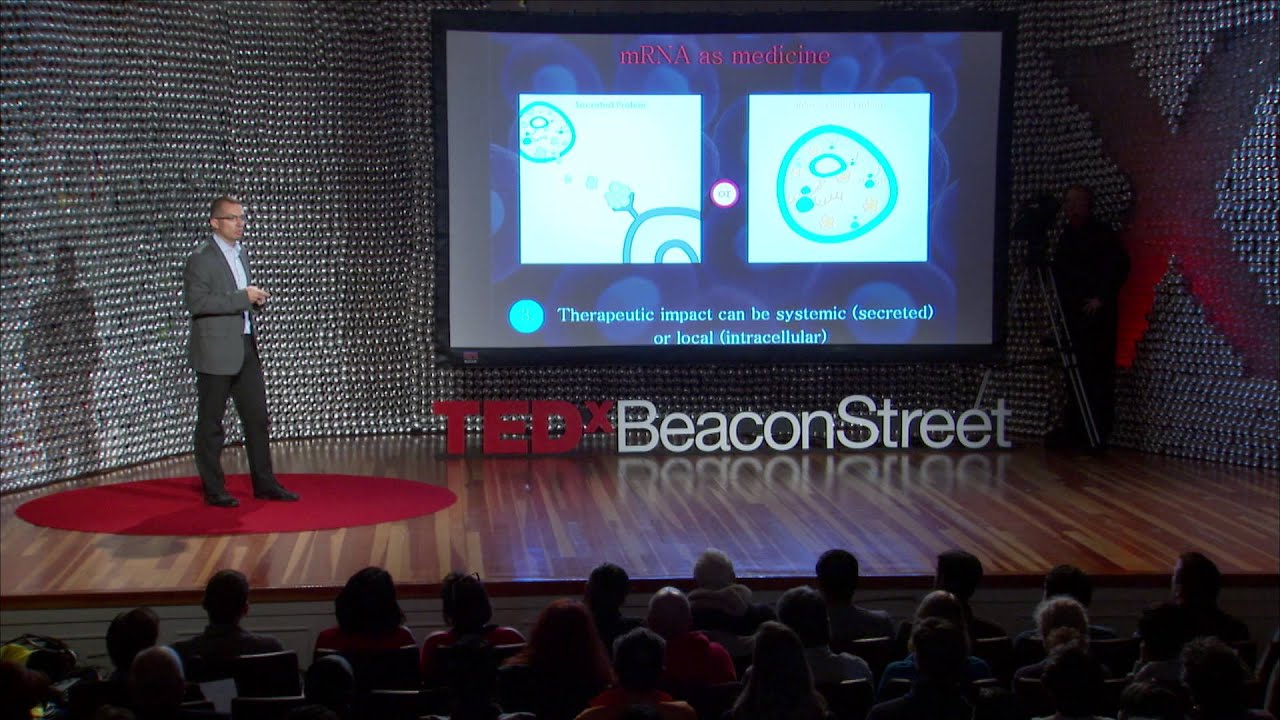
Stephane Bancel explains how mRNA could become a drug for rare genetic diseases that have no treatments. His team solved two problems that blocked mRNA therapy: immune activation and rapid degradation. In animal studies, a single dose of VEGF-A mRNA after a heart attack triggered stem-cell regeneration and dramatically improved survival.
Chapters
We have a lot in common, more than you think. 22,000 genes, 3 billion— that's with a B— base of genetic information. But one mistake, one mistake out of 3 billion base can change your life, can be fatal. Like for example, if you are unlucky and you have a mistake on the gene UGT1A1 on chromosome 2, that leads to cri-glanagia. It's a fatal disease. You basically are unable to process your red cells. There is no treatment. The only thing that clinicians have found to save the people that have this disease is to have him 12 hours a day under phototherapy, 12 hours a day. And by the time this little guy is 18 years old, he's going to die because his body is going to be too big. The phototherapy will not work anymore. It's only one of more than 6,000 rare diseases, 6,000 rare diseases, and the number is going up. And by the way, cancer is also a disease of the genome. Thank you. So that matters. We have a lot in common. So let me maybe spend a few minutes zooming in and walking you through the basics of molecular biology, the human cell, the basic unit of biology. Your body needs protein, tons of protein to survive, to function, like insulin, growth hormone, and thousands more. So when your body needs a protein, what it does, it basically uses the information of the genes in your DNA. And not to damage the DNA, it makes a little copy of only what it needs, only the gene it needs. And the copy is made in what is called messenger RNA. The messenger RNA goes inside your cells and in a little machine called the ribosome, it makes a protein. So if you want to think about insulin, the way it works, it gets the insulin message from your DNA, makes a copy, messenger RNA, And the ribosome makes a protein, et voilà, you just made insulin. So based on those discoveries 40 years ago, the biotech industry started. Think Genentech, Amgen. And what they did, they made in yeast or in bacteria those proteins in the factory that they put in a syringe to inject to patients. And you had the first human insulin, human growth hormone, and so on. So it was a fantastic revolution. Then scientists kept pushing the envelope and asked themselves, well, what if we could get the DNA inside the patient's body for the information it's missing so it can make its own protein? And this is when gene therapy started. The only problem is now we are 40 years after those first discoveries, those first biotech products. But is it success? 6,000 rare diseases, and the number is going up by the week as we understand more and more biology. There's one gene therapy product approved for patients. One. There's around 20 recombinant products approved for patients with rare diseases. 6,000 rare diseases. Is it enough? So a few of us, a couple years ago, sitting in Cambridge, Massachusetts, thought about the following crazy idea. What if mRNA could be a drug? And the reason people have not developed mRNA drugs in the past, because from what I explained to you, it's pretty obvious, mRNA drugs, why not? It's because of those 2 things. mRNA creates an immune response. Why? Because a virus is made of mRNA, like flu. So if we inject mRNA in a patient, what happens? Your body thinks you just got the flu. And it's not very good for a drug because, you know, all the symptoms of the flu, not super nice. The other reason is that mRNA was thought to be very unstable, minutes in vivo. I don't think a drug that you have to inject yourself every couple minutes would be a good drug either. So those 2 reasons are really the foundations of why we never made mRNA drugs before. But we ask ourselves, what if? And we worked tremendously hard for 2 years, and I'm happy to report that we found a way. We have a way to work through those 2 barriers. And what we do now, we make mRNA drugs. So how do we do that? Well, we make mRNA in the reactor, in the factory. We put it in a syringe, and then we inject it into animals, patients down the road. So you can think in your belly fat or in your thigh. You inject the mRNA and what happens then? Inside the cell, the little guys in gray, the ribosomes, they read the mRNA we just injected like they read all day long your mRNA. Trillions of times a day, they read your mRNA. And so what they do here is they read the mRNA we just injected and they make the protein we tell your body to make on demand. Think insulin. And the beauty, and it's a piece that we did not expect initially, is we can do 2 things with this technology. 2 unbelievable things. The first one is we can make secreted protein. Again, think insulin, think growth hormone. This has been done by the biotech industry, but again, there's not a lot of products that have been made. You have in your body around 4,000 secreted proteins. There's less than 100 products that have been made by the entire biotech industry over the last 40 years. So there's still a lot of drugs that are needed by patients. And so what happens here, you inject the mRNA, let's say for insulin, it's made in this cell, and then you— we tell the cell how to secrete the protein inside the blood to go at the right place in your body. So we just mimic what your body does when you're not sick. But the big bingo is on the right. Oops, sorry. The big bingo is on the right where we inject the mRNA, the little guys, the ribosome, they make the protein, but we are able to tell the cell, do not excrete, do not secrete outside of yourself the protein, leave it inside. So it's trapped inside the cell, meaning we can make intracellular protein, which are most of the proteins you have in your body. And today there is no way, with no technology available from either the big pharma companies or the biotech companies, to make intracellular protein, those proteins that are needed for your protein to function. The disease I just spoke to you about at the beginning, Kriegler-Najjar, that gene with that one mistake, UGT1A1, well, we are able in animals today to make that mRNA, For UGT1A1, inject it, and it makes the protein, and the protein stays trapped inside the cell where it has to be so the disease does not hit. And this is really the big breakthrough. And again, if you think that your body has 22,000 proteins, only 4,000 are secreted. Most of the proteins you need to be healthy, to live, are intracellular. Totally undruggable with any technology available today. This is the big breakthrough. So let me walk you through one example of an application that has been tried over the last 40 years across many companies that has always failed. Is how do you regrow the heart after a heart attack? Okay. So Dr. Ken Chen, who is one of Moderna's academic co-founder. He's a professor at Karolinska in Sweden, has spent his life studying heart. He's a cardiologist. And what Ken taught me is that on every one of your hearts, we have stem cells until the day we die. All your life, you have stem cells sleeping on your heart tissue. And what Ken taught me is that there is one protein in the body called VGF-A that if you send that protein to the stem cell, it's going to tell the stem cell, go back to work. Make more heart. Okay? And so what Ken has done 4 years ago, he tried to make a drug with recombinant protein, the technology that the biotech industry has used, where he made the protein for VGF in E. coli in a reactor in a factory, and they injected into the heart after a heart attack. The problem is when you inject it, it go into circulation in your blood way too quickly. And so to have enough VEGF so the stem cells are gonna wake up to make new heart tissue, you need to go very high in dose. And the problem of going very high in dose, as you go around your body, you have ton of side effects. So the drug failed in trials. And then 10 years after, when gene therapy was discovered, Ken jumped on it again. He said, I'm going to try gene therapy for my application, VEGF. And the problem with gene therapy is once you inject it, you cannot stop it. It keeps making VEGF all the time. And that's not good either. And so when Ken saw that technology, Emanet, he said, that's exactly what I've been looking for for the last 30 years. And he tried. And the first time he tried, he got those results, which I'm going to try to walk you through. So this is basically one year and his survival rate in animals, okay? Animals having a heart attack at the beginning and different groups of animals. So the blue line is the animals that get no treatment. They just get a water injection, a placebo. And you can see the survival rate, only 15% of the animals. still survive 1 year after the heart attack. In green, you have gene therapy. Not so good as a drug. You kill the animal faster than if you do nothing. Because it keeps making VEGF and you just have the whole body going crazy because it's not supposed to be. And on the red line, what you see is 1 dose, 1 injection of mRNA VEGF within the 48 hours after a heart attack. One dose, not daily, not weekly, one dose. And what this one dose do for 48 hours is going to make a lot of VEGF, sending a very strong signal to the stem cell on your heart saying make heart tissue. And then it goes away. The mRNA gets degraded after 48 hours, it's gone. But the VEGF is here and is that instructed the stem cell to regrow your heart. And as they say, a picture is better than anything. So what you see here Is a cross-section of a heart after 1 year, okay? On the top picture, what you see is untreated animal who just got water injection. And what you see here is scar tissue. That's where the heart attack happened. And because of the scar tissue, the heart cannot pump anymore. And that's why the patients or the animals after a year, most of them are dead because they die of heart failure. The heart cannot pump anymore because it's a big, big scar. Look at this picture. One dose of VEGF mRNA after a heart attack. The heart slowly, with a stem cell on your heart, regrows itself. That's the power of this technology. So once you understand you have a technology like this, we have always been paranoid. How do we not mess it up? When you understand you have a technology that can change society, impact so many millions of lives, How do you, how do you build that company? Because if you look at the history of biotech companies, it's a very bad cemetery of dead companies. Why? Because it's tough. Less than 1% of the drugs started by biotech companies never make it to market. It costs a bloody fortune and it's complicated. So what we told ourselves when we started is how do we do that? How do we not screw this unbelievable technology so we bring it to patients that are suffering? And what we told ourselves, let's think about it like we are climbing Mount Everest for the first time. Like those first guys, when they look at that mountain, how do you climb it? There's no map. Do you go right, left? Every time you need to ask yourself and be very thoughtful. So that's what we did as we started Moderna. We first chose to have only one investor. Most biotech companies have many investors to de-risk. We said, no, we want one investor because we want to focus on building the company. Not people fighting for how much money they're going to make. We also said, you know, most biotech companies work on mice and rats. This is nice and cute, but mice and rats, if it worked, it would be known. Cancer would have been cured 10 years ago because we can cure cancer in mice. We cannot cure cancer in people for many cancers today. So we went straight into monkeys. Why? Because monkeys is the closest animal to human. So we went straight into monkeys, very atypical, cost a bloody fortune. Then we decided to stay stealth. Most biotech companies, when they have a big scientific discovery, they go in the paper and so on and so forth. We say no, we need to stay focused on the science. This is too big an idea to be defocused. So for 18 months, no website, no press release, no nothing. Just focus on the science. Make this science work. Then we hired the best people. And we always focused about the clinic. The only thing we are excited about, the reason why after a short night of sleep we get up and we go back at it, is because we're thinking about the clinic. We are thinking about the patients and the drugs we can develop. So we, our team at Moderna, we feel very blessed. We feel this is the most probably the only time in our lives that we will have a chance to really change the world. And we are working really hard at it. We are passionate about it. And we really hope that within a year or two, we're going to be in a clinic with wonderful drugs to help patients. So think about it. What if mRNA could be a drug? Thank you.
More from Stéphane
Stéphane Bancel: Leadership, Innovation, Giving Back & Inspiring the Next Generation


