The Next Era of Healthcare is Personal

In this McKinsey Podcast episode, host Eric Kutcher interviews Moderna CEO Stephane Bancel about the transformation of healthcare through mRNA technology, AI, and personalized medicine. Bancel recounts Moderna’s rapid COVID‑19 vaccine development, emphasizing teamwork, regulatory collaboration, and the ability to scale manufacturing quickly. He frames mRNA as an "information molecule" that enables a platform approach, extending from vaccines to rare genetic diseases, cancer immunotherapies, and autoimmune conditions. The conversation delves into individualized cancer vaccines, where each patient receives a unique mRNA‑based drug, requiring a novel regulatory pathway focused on approving a manufacturing process rather than a single molecule. Bancel discusses cost implications, arguing that personalized therapies can reduce waste and overall healthcare spending when combined with prevention, screening, and lifestyle measures. He outlines Moderna’s global manufacturing strategy—building adaptable factories in the US, Canada, the UK, and Australia under long‑term supply agreements. AI’s role is described in two buckets: accelerating drug discovery via robotic‑driven experiments and closing “air gaps” across the organization, from R&D to sales, finance, HR, and robotics deployment. The interview also touches on Moderna’s culture, highlighting a dedicated mRNA platform team and a combined HR‑digital leadership model that re‑imagines work with AI and robotics. Looking ahead, Bancel predicts dramatically shorter drug development timelines and higher success probabilities, envisioning a future where medicines are developed in years rather than decades. He shares leadership lessons about hiring, culture, and maintaining high standards, and reflects on his desired legacy—delivering life‑changing medicines and preserving a patient‑centric culture.
Chapters
Hey, Roberta.
Hey, Lucia. How's it going? It's going well, and welcome to our audience. On today's episode of the McKinsey Podcast, we've got Eric Kutcher, our North America managing partner, and Stephane Bancel, the CEO of Moderna. Stephane actually led Moderna through the development and release of the COVID-19 mRNA vaccine. Very cool. You know, we were just talking about vaccines the other night. My sons were asking all these questions about the hantavirus. We've been reading so much about the status and what's going on there. From what I've read, there are some vaccines that are being developed, but none have been approved for the hantavirus. Right. It's hard not to flash back when reading about hantavirus to the bad old days of the COVID pandemic and that wait for the development of vaccines, which at the time seemed so long, but was actually incredibly quick in retrospect. One was, of course, Moderna. So let's hear from Eric and Stephane about how AI and Moderna's technology are transforming healthcare.
So welcome to the Welcome to the McKinsey Podcast. I am joined today by Stephane Bancel, CEO of Moderna. Stephane, what a wonderful gift to all of us to spend some time with you.
Thank you so much for having me, Eric. It's good to see you.
What was it like? What was it like in that moment where the world is shut down, where many of us are uncertain about how it kind of reopens, and you're now working on a solution that allows us to go back to as normal— what most people would say was normal, although it may have become a new normal?
It's interesting because it was really kind of just focusing on doing our jobs. We had done 9 vaccines in the clinic before COVID happened. We were mRNA technology. So we thought we had a shot at it. And so we just worked as quickly as we could to try to get a vaccine in the clinic. And then when May happened, we had the first clinical data, which showed a high level of antibodies similar to what people had when they had the natural infection. So we thought we were in the right zip code. And so then it was about how do you scale up manufacturing? How do you get into phase 3 to run a large 30,000-people safety study? So we're just doing our job. We're just trying to be creative of how do you do it on different timescale than normal.
So what were the things that stuck from COVID till now?
I think the fact that you have to work in teams, including with the regulators, and the government and the doctors, because there's a lot of air gaps in the system. If you look at drug development, you know, over 10 years to develop a drug, if you realize there's a lot of wasted time across the system, and if you can really project manage the whole thing so that people understand all the moving pieces and can help each other, you can shave a lot of time without taking any risk on safety or efficacy.
All right, so maybe let's zoom out for a minute. I don't know quite how to describe Moderna because what I kind of know it as is the savior of the— one of the saviors of that moment. But you really are at this intersection of technology and biotechnology, maybe AI and biotech. Talk a bit about what the company is and kind of the role that technology plays in what you're doing.
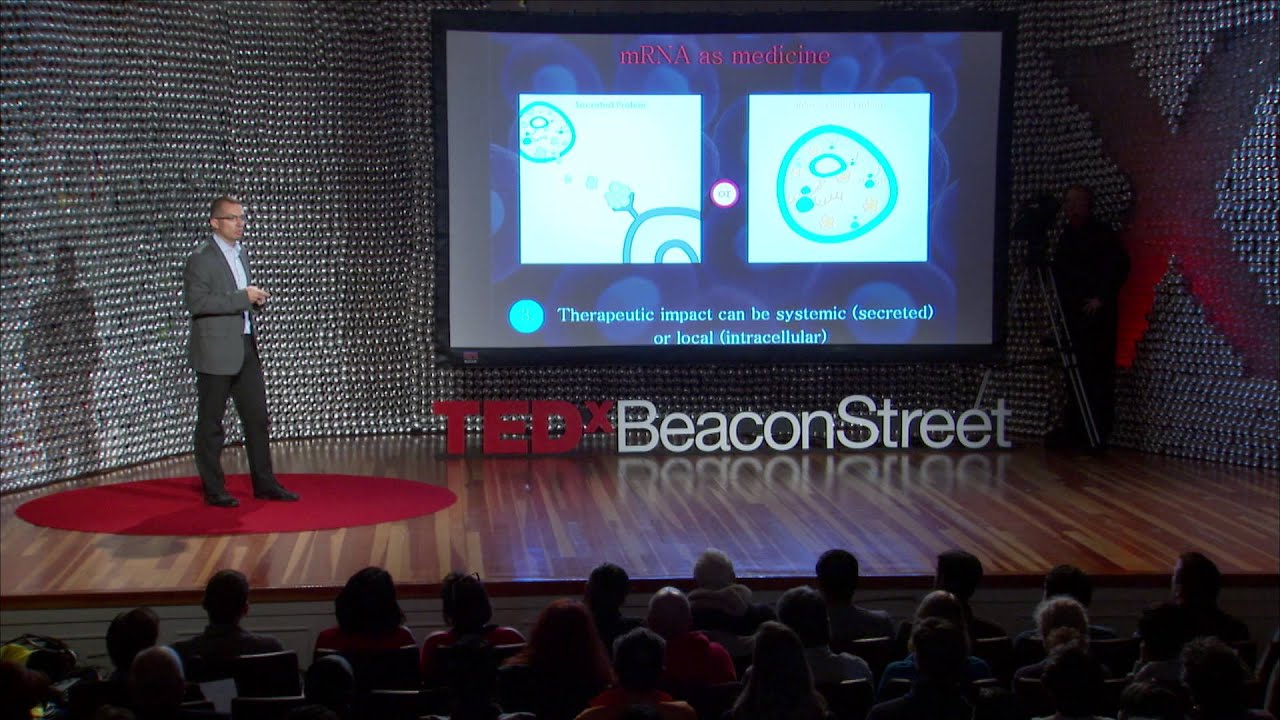
The reason I decided to join the founding team and to start Moderna from the ground is that mRNA, as now everybody learned during COVID is an information molecule. And if you think about life, life is basically the flow of information. When you die, you still have information in your DNA. Think about retracing DNA in bones of people that have been dead a long time. But the stop of a flow of information is basically death in biology. And so when we see this molecule that is an information-based molecule is if you can figure out how to make it a drug, then you can address biology at the fundamental level of information and play on that information with respect to infectious disease, like in the case of COVID making a vaccine that gives your body the instruction, the information on how to make antibodies to COVID to protect you. when you'd be infected, or what we're doing in cancer, where we're trying to give information to the immune system on what to look for to go eat your cancer cells. It's all about information.
Okay. So, if it's all information, how does the world now evolve? Take us through biotechnology. How did it work before you started thinking of it as just information to where do we go with it?
If you think about pharmaceutical medicines, that have impacted the lives of billions of people in the last 100, 150 years, it was really an analog world where it was throw spaghetti on the wall, see what sticks, see what works, and then take those to patients. Now with sequencing of a human genome and more and more research happening in academic labs around the world, we are getting closer, not there yet, We're getting closer to understand how your body or my body works like a computer or like a car works. There's still a lot of things we don't know about the immune system, which is why cancer is not solved yet, or how the brain works. It's a very complex system, but there's more and more biology, and rare genetic disease is the best example where if I know which rare genetic disease you have, most of them can be drugged with today's technology.
So, what does that mean for something like a cancer treatment going forward?
If you think about cancer, what we know today is that cancer is basically an instability of your DNA, either caused by a genetic mutation or caused by a virus. Think about hepatitis leading to liver cancer, or caused by an external factor. Think about sun driving exposure into your DNA of your skin and driving Melanoma skin cancer. So basically cancer is instability of DNA, of human DNA. And if you are healthy, you have instability all the time. Think about the number of cells you have in your body, the number of exposure you have. We all have instability around all our lives. But if you are healthy and your immune system is healthy, then you're going to recognize at first pre-cancer cell. And it will eat it like Pac-Man so it doesn't become a tumor. But if your immune system misses it, it becomes 2 cells, 4 cells, and you start to see a tumor growing. So one of the things we are doing at Moderna using mRNA technology is we are basically designing customized, individualized medicine where if you and I are diagnosed by the same doctor in the same hospital on the same day with skin cancer, Moderna will make a chemical for you. And we'll make a different drug for me. It will be chemically different.
How far are we until we'll be able to get that to happen? I get this is all immunotherapies behind. Is that the term that people use?
Correct. It's immunotherapy. It's how you use your immune system as a therapy, as a medicine to go eat your cancer. So what we shared in January of this year is 5-year survival data using our technology, the individualized technology I described. We've showed a 50% improvement as to standard of care, and we should have later this year the phase 3 data, which would allow us to file to the FDA for approval. So we're currently expecting a '27 launch of a product, meaning patients will have access to that medicine most probably next year.
What you're kind of highlighting is we're now approaching the end of average where you can treat every individual and their DNA and the challenge that they have based on all of that together.
Correct. Because as I just mentioned, cancer is an instability of your or my DNA. The way we've developed medicine forever is everybody gets the same medicine. For some disease, it works because the mechanism of a disease is the same in your body or in my body. But in some disease like cancer, because it's an instability of DNA in your body and in my body, we need different solutions.
So what does that mean in terms of drug discovery, the way we do clinical trials, the speed with which we bring— how to think about that?
So it changes everything because in the past, you basically get an approval for a drug. In this case, we had to go to the FDA and other regulators around the world. And the process we're following is the approval of a manufacturing process. What I have to prove a regulator Is every time I get the same input, the same information about somebody's DNA, they'll get the same output, the same medicine. But every medicine is different. So I cannot get a drug approved because the drug for you and the drug for me will be a different chemical.
And so, so again, I apologize. This is just me kind of, it's fascinating in this pathway going forward. Like, how do you avoid missteps to get the benefits that you're describing?
Is we test in a very large clinical study. I mean, the phase 3 study is more than 1,000 people with melanoma disease. We randomize it against standard of care, which is ketudra by itself. And so we prove both the safety and the efficacy of a treatment, like the old way. The only difference is that instead of having one molecule approved, I'm getting a process approved.
Okay. And then the other thing that you hear about all the time, not surprisingly, is the cost of healthcare. And obviously medicines are a non-trivial portion of that cost. How do we think about what is the cost of the way we did things in the past versus the cost of what you're describing is kind of where we're heading to?
Sure. So first, as you know, the cost of medicine is 10 to 20% of the cost of care. And the other piece for me is how do we start, because we understand how the machine, how the body works, how we also invest as a society on prevention and on screening. Let's go back to our discussion in cancer because everybody's interested in cancer. The best thing I can do to prevent cancer is eating the right food. Is making sure I sleep enough because my immune system gets reset, gets restored during my sleep. So if I don't sleep well, I won't have a strong immune system. Exercise. So all those things are really important to prevent the disease. Then there's screening, which is, as we all know, getting a cancer in stage 1 of the disease when it's very early, increases the odds and thus reduces the cost of treatment. And so how do we deploy screening of cancer At large scale. And then the treatment, if the treatment is customized for you, the price tag might be higher for the treatment, but because you have a much better outcome, because you have less side effects, because you don't waste the cost of a drug. I mean, think about it. When you get immunotherapy today, 5 years out, only 50% of patients have responded. So if you think of it from a cost standpoint, half of the cost of a drug went into the garbage, right?
Yeah. Not to mention all the treatment that happens afterwards.
It's a bit like your car. Let's go back to the car analogy. If you do good maintenance of your car, it can drive for a very long time. If you don't change the oil, if you drive and push the car all the time and you go super fast when the engine is cold, you're going to damage the car, right?
You and I talked a little bit about this. This is back on this whole premise of longevity and personal care. And about 18 months ago, I really started to get into this more. I'm not always perfect about it, but I wear multiple devices. I've got my— and it is remarkable to see how your body reacts to everything depending on kind of the state that it's in. So if I happen to have not slept enough, right, I watch the way my body reacts to certain foods in the way that it wouldn't ordinarily. And so it's just a, it really does to your point of there's a lot of things you can do preventatively. And then what I think you're saying is, and that doesn't always work or for whatever reason it didn't work. And then how do you kind of treat them in a way that sort of suits you the best?
Correct. And what you just said, Eric, confirms that biology is an information Yeah. Based on science. It's all information.
Okay. Let's pivot now. Talk a little bit about Moderna's role in this kind of evolution of the biotech life sciences space.
If you think about Moderna pre-pandemic, because I think after the pandemic, we came back to strategy, we believe we can build a platform, an mRNA platform, that has a lot of different verticals which are applications. So think about vaccine, cancer, rare genetic disease, lung disease, and so on. And so what we're trying to do as a company is to increase the span of that platform by investing in core science to get mRNA into different parts of your body. Because once we get it to work once, we can make a lot of drugs because then it becomes copy and paste. You just change the genetic information as we do with COVID And you have another medicine. So that's a bit where we are as a company. If you look at the company today, we have 3 approved products. We have 2 more under review by the regulators as we speak, a flu vaccine and a flu plus COVID combo in a single shot. And then in phase 3, we have a rare genetic disease in the liver where kids are missing information in the DNA of their liver cells. So we have a lot of acid accumulation, brain damage because of their disease. We are working on cancer, as we just spoke about, and we're also starting to play with autoimmune disease. So just trying to increase what the platform can do to really be able to bring very quickly medicines to patients, because the big advantage we have is, for example, a manufacturing advantage. We make all the mRNAs in the same reactor with the same recipe, because you just change the order of the letters, again, information. And so you have the ability to go very quickly. We have not talked enough about it. Why could we go so fast during the pandemic is I didn't have to invent the manufacturing process.
One of the things that is very prescient in the moment is this question of manufacturing and where you manufacture and how you think about that. What does that mean in terms of how you think about the where? Because obviously the speed at which you move, but the location matters a lot in this moment.
We have been US-based since day one. What we've done recently, Eric, is we bid factories in Canada, UK, and Australia because those governments wanted on-the-ground independence. And so they basically entered into long-term agreements, kind of 10-year supply agreements where we build a factory, we paid for it, and we are running it. But it's like a service-type business model where every year they committed to X number of doses or X million number of doses. And every year they can change the mix because for us manufacturing-wise, it's the same. So They're basically getting a tool that's very able to be adaptable year by year based on which virus is more prevalent in the country. And God forbid, if there's a new pandemic, they could ask us to switch right away any amount of capacity toward that new pathogen.
You can change the lines of the manufacturing because, as you point out, you're just changing letters. But how small, how micro can you get it and still be effective and efficient?
We can go as micro as we want. And if you think about it, our individualized cancer treatment is very micro because literally we shrunk everything down. So I make product for you. And then once we throw out all the plastic, small little reactors in a robot, we make a product for me. Wow.
It's a pretty remarkable thing to think about where this is going and the implication. Maybe describe a little bit of the way that AI has impacted where you've gotten to and where you see it going.
Even though we've done a lot of AI since 2017, the impact is still tiny compared to what's coming. And I think there's 2 big buckets of value. One is on the discovery, inventing new medicine side of the house. What we're trying to create there is a feedback loop where basically we have experiments run by robots, where all the new lipid is being tested behind in cells and animals. And when the data goes back into an AI system to iterate the next set of experiments, to keep learning as a flying wheel, to be able to expand, again, the size of the operating system of Moderna. The backend, which is from where you have a drug and you say, I want to test this drug in the clinic. If you think about it, this is what is usually kind of a 10-year time to develop a drug, but this is a lot of dead time. And so what we're trying to do there is to apply AI, whether it's GPTs or using vibe coding to be able to create new apps to tie the business together, to remove all the air gaps. Because in that 10-year timeframe, there's a lot of air gaps.
Yeah.
And so it's really hard for me to tell you now, Eric, in 3 or 5 years, are we going to reduce by 30%, 50%, or 70% the time of developing a drug? Because we have not mapped it Process by process, but it's going to be extremely significant because most of the time, it's actually not clinical trial.
Interesting.
Okay.
And then, how about— so, you described the way AI is going to impact kind of the core R&D, if you will. How about the rest of the business? How do you think about it in the context of what you do from a sales point of view, from a finance point of view?
Sure. I would say this is very typical to what you see in other industries, which is the sales team is working on it to increase kind of customer product adoption, being closer in terms of feedback to new products. In terms of finance, we have a lot of tools there. Same HR, a lot of GPTs into the HR team to help streamline whether it's performance management or benefit enrollment or all those things that you see across industries. We're not smarter than other people. We're just trying to think about how do you basically reduce the air gaps, enable the users to have access to data, to talk to data. So that, a bit like the airline making me check in online, I'm happy, they're happy. It's a bit the same kind of mindset. Then in manufacturing, it's helping us a lot in robotics. I think a lot of people that are in service industries do not appreciate how much the world of robotics is changing and is going to change. And one of the things we're starting to do is to use AI to allow us to deploy robots faster.
What is it about the physical AI that enables you to do more differently, et cetera?
Sure. I mean, if you look at most industries, most of the deviations that are being reported are basically human errors. And so, if you can remove those from the business, not only you improve quality, but you save costs, you save time, your customers are more happy, you are less out of stock, and so on. So, there's a huge value in driving out of a system recurring deviation, recurring errors. And so, if you're able to deploy robots to do 2 things, one is to have robots being taught by the user closest to the use of the robots. In the olden days, you need to have engineers deploy robots. Now, thanks to AI, because AI is basically this interface that you talk to the AI system that basically transcribed and code the robots on what is the task to do, you save a lot of time and you reduce the cost of deploying a robot. And then when you start to have robots learning from each other doing the same process, Amazing.
So given the way your organization, like one of the things I'm always fascinated about is culture and org, and I think that's particularly important in the moment. Given how you started, how does your organization look different or how have you thought about it relative to what most biotech or most life sciences organizations look like?
So I think maybe 2 examples. One is the platform because we believe mRNA is really unlocking What should be dozens and dozens of medicines coming from that information platform. We have a team of around 150 scientists whose only job is to invent how do you increase the surface area of what the platform can do. So they're not focusing on drugs, they're focusing on mRNA technologies to increase the world of possible. The second piece is we combine HR and digital. So my head of HR is also my head of digital. Because we believe in today's world with AI and robotics, the key challenge of our organization is to reinvent work and to be able to go back to business processes across the organization and to say, okay, what work has to be accomplished to drive value for customers? And then work backwards from, okay, if you are AI-centric and robotics-centric first, how would you design the work? What's the role of software? What's the role of GPTs? What's the role of robotics? What's the role of human in that whole system?
Okay. So the design of what you're describing makes sense. If I were to look in the organization, I compared you to pick your favorite competitor, what is it that looks different as a result?
I think the speed at which we can learn. Because if a feedback loop is very quick, like if you go back to the platform, the basic mRNA science, The feedback loop is so fast that sometimes in just 2 or 3 months, people invent a whole new category of medicine. Usually, what will take you 5 or 10 years in pharma happens in a matter of months. So, it's just a different scale of learning, pace of learning.
With all of that as background, as you kind of think about and paint pictures of 10 years from now, what will drug discovery and, frankly, drug manufacturing look like a decade from now or 15 years?
I think 2 big variables will change profoundly. One is time. The time it takes to develop a drug will shrink. As I said, I don't know if it's going to be from 10 years to 5 years, from 10 years to 6 years or 4 years, but it's going to shrink in a very profound way, meaning the drugs will come faster to the clinic, also meaning they're going to be less expensive to develop. The second piece is probability of success. As you know, Today in the industry, a drug that enters the clinic for a phase 1 study has only 10% chance of getting approved. If you look at Moderna's track record, because again, we're information-based, we are more in the 60%, 70%, and I think that number is going to get better as we keep on learning. So, the industry will also get higher. So, if you combine much shorter time and much higher chance of working, the impact on patient in terms of the number of medicines coming is going to be Very different. Amazing.
All right. One of the things I often ask leaders is what is the thing they wish they knew when they either took on the role or when they were a younger version of themselves versus what they know today? What are the things that you got wrong along the way that you try to keep others from doing and the things that you wish you knew that would have changed your direction as a leader?
I think the importance of people and teams. Really is something that I think really determined the trajectory of enterprise. Because at the end of the day, if you think about it, there was nothing if you talk about Moderna. And then there's this company now with 25, 30 drugs in the clinic. It's making sure that in terms of the people we hire, we ensure we have the right culture fit all the time, that we are disciplined sometimes to Not fill a job when there is urgency, but you put in a candidate that is good but not amazing. Over time, you pay dividends for that. So I think it's really around the people angle of things that I would want to tell my younger self, make sure that you keep a high bar and that sometimes you don't confuse quality and speed.
I think it's a great point. I find we often take inside the firm this test called Myers-Briggs, and it's kind of a way to to understand a little bit of your own personality. And it's amazing to watch. At least I feel like I've changed a lot. I was an extraordinarily strong T for a long portion. Like, I thought about the answer. I thought about how do I get to the answer as quickly as possible. And I would say I have become a much stronger F because I care much about how you get there and the impact it has on people, how you bring them along. It's a really I think your point is the earlier you can learn the importance of that, the better off you are.
Yeah, I agree with you.
This is an unfair question because as Oprah Winfrey taught many of us inside the firm, you don't actually get to define your legacy, but that rather your legacy is the interactions you have with everyone every day. But ignoring that brilliance for a moment, if you could paint a picture of what your legacy would be from this role in this company, How would you paint that?
I would say maybe 2 answers. One is outside the company, it's really about the medicines we're bringing to the world. That's kind of the only thing I really care about. And so if we can make a big dent on cancer and a big dent on autoimmune disease, help kids that have rare genetic disease that have no hope today with their families, and continue to prevent through vaccines people getting to hospital, especially as we have aging population, that'll be an amazing legacy. And internally, for me, it's really about how do I make sure that the day I'm not around every day, that people stay as passionate about the patient, that it stays a very personal fight, and that the culture stays that every day matters because somebody is going to be waiting for the drug for any day we would not have done our best work.
Stephane, this has been amazing. So thank you.
Well, Eric, thank you so much for having me. It's always a pleasure. And The next 5, 10 years are going to be really exciting for human medicine. I really believe that we are very close as a society to understand how the human body works and then being able to design prevention, screening, intervention, as treatment to make sure people can live a full and healthy life for many, many years. Amazing.
Thank you, Stephane.
Thank you, Éric.
More from Stéphane
Stéphane Bancel: Leadership, Innovation, Giving Back & Inspiring the Next Generation