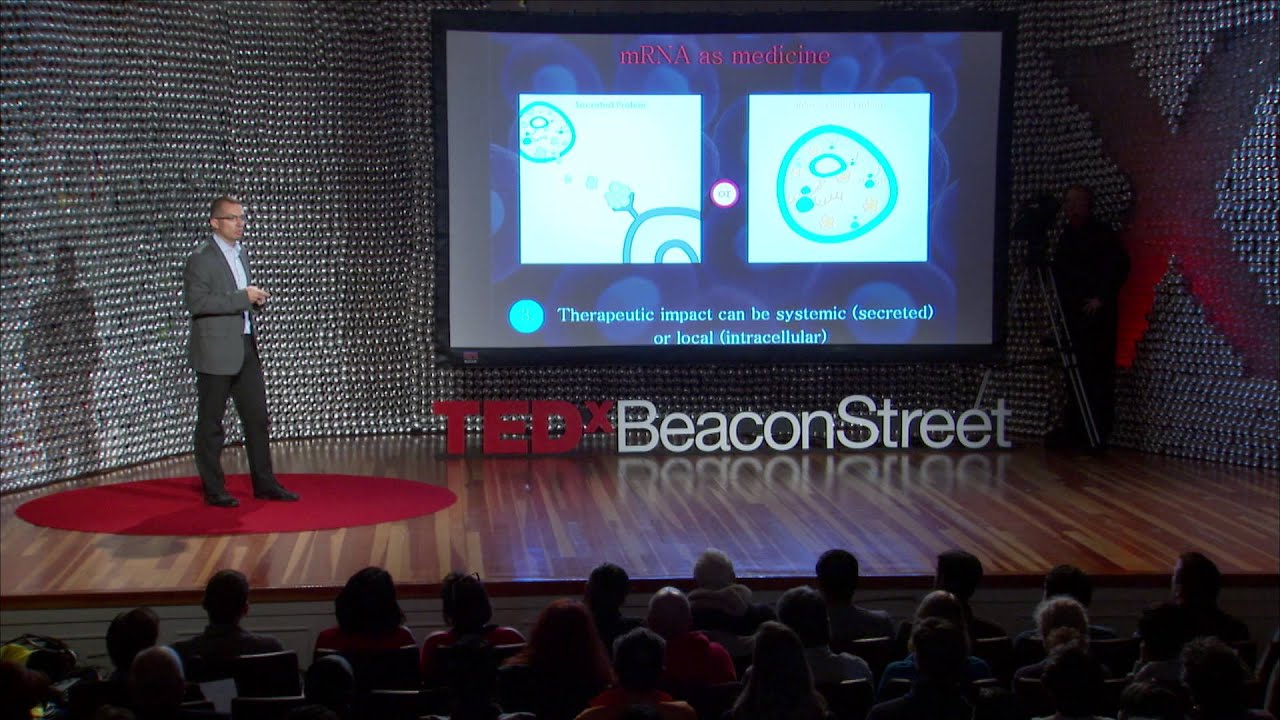
Stéphane Bancel: Leadership, Innovation, Giving Back & Inspiring the Next Generation
Moderna CEO Stéphane Bancel traces his path from engineering to leading mRNA cancer vaccine trials, a six-year journey from concept to phase-3 data. He tells students to master math and science early, hire mission-driven people, and skip social media for running and cold showers instead. A need-based scholarship and Jesuit education drove his commitment to founding schools and supporting education equity.
Chapters
First of all, my name is Stephane Bancel. I'm the CEO of Moderna. So I'm trained as an engineer. I love chemistry, so I studied a lot biochemistry that led me to do more classes in genetics. And I got into biology through the back door, through genetics.
That is exciting, exciting stuff. So we'll just jump straight into some questions. This question was actually emailed to me from Marseille, from France, a student there. Like I said, a lot of kids watch the recording afterwards. The student wanted to know, with this week's successful phase 3 cancer vaccine results, does this feel like for you one of those moments when a vision you've championed for, for years is finally becoming a reality?
Yes. And to give you a sense, the first time we discussed with my team the idea of using mRNA to make an individualized treatment, meaning if you and I, Ralph, get diagnosed that we have skin cancer today in the same hospital by the same doctor, Moderna will make a drug for you and will make a drug for me that's a different chemical. So that first idea happened in June 2015. So think about the journey from June 2015 to literally this week where we have phase 3 data. We know for sure it's working and we're going to go very quickly file to the regulators, FDA and around the world to get these to patients hopefully next year when they have time to do their review to make sure everything is good. It shows you that When you do science and biology, but I think it's true in a lot of places in life and in business, when you try to do big things, they take time. And you need to have a great team around you. You need to be resilient because many people thought we were crazy, thought it will never work. And go back to the data and the facts so that you can manage that.
That's brilliant, brilliant advice. I have a question from Asvika in India. She had a very good question. Asvika, you can unmute to ask Mr. Bancel. Go ahead, pal.
Yeah, hi, I'm Aswika from Madurai, especially in South India. And my question is, I'm deeply interested in computer science and data science. I'm fascinated by how data and AI are becoming tools for scientific discovery. Looking at your journey across engineering, biotechnology, and business, do you think the innovators of the future will be the specialists in one field or people who can complete disciplines like mathematics, computer science, biology, and business. And if you were starting out as a student today, what would you learn first to prepare for that future? But you do have a keen interest in mathematics.
That's a wonderful question and very thoughtful one. I will definitely start by science. Science, mathematics, engineering. Those are hard things to learn, and they get harder to learn as you get older. So I would say do all the hard work early. And in today's world, mathematics, data science are going to be critical. As we get more and more technology in the world, we're going to be able to analyze a huge quantity of data. In our field, making medicine, the quantity of data is gigantic. Think about you have 20,000 genes, You have 20 trillion cells, 40,000 metabolites like insulin, you know, and cholesterol and so on. So we're going to make huge progress in the world, whether it's fusion energy or clean energy or medicines, by really understanding what's going on in the physical world and be able to find solutions. And so I think math and data science, you cannot go wrong.
That's great. And I would be remiss. I had a student email me this, and this came from Poland, but I would be remiss because not many people are aware about your work in education equity and your philanthropic work. And we try and encourage the kids on these about giving back to their community and doing for those who can do nothing in return, just to kind of spread kindness. This student emailed me and they wanted to know, you were able to come to the United States and study at the University of Minnesota with the help of a Need-based scholarship. How much did having someone invest in your potential before you had achieved everything you've achieved influence your commitment today to creating educational opportunities for other young people?
Yes, it's a wonderful question. And indeed, that has a huge impact on me. I mean, 2 things had a huge impact on me, which I only realized much later in life. One is I was raised in Jesuit education. So for those of you who don't know, Jesuit is a sub-branch of Catholic religion. But the Jesuits, they educate you with a very big mindset of serving. So, you know, religious people have different philosophy. The Jesuit is about serving and doing God's work through action. So that has a huge impact on me. And then the other one is, of course, that scholarship you mentioned. Because my parents were from a middle-income family in Marseille, France, couldn't afford to send me, of course, to America to graduate school. I didn't want to take on debt because I was worried starting my life with debt would be complicated. And so I got that scholarship from Procter& Gamble. And that was, of course, a godsend because I could go to Minnesota for my master's.
That is, and it changed the world too. Like that, it's just that kind of spark that started a fire that started just—
Which is why, to your point, Ralph, My wife and I do a lot of giving to education. We actually started a Jesuit new school in Marseille, in a low-income neighborhood of Marseille. We're doing a lot of things in the US also for education and so on. Because the way we think about it is one kid educated, think about their lifetime trajectory, what they're gonna do for the world. the family they're going to raise, the children. So the impact is multigenerational. And as we all know, education is key. Look, my wife came from a very low-income family. You know, her dad worked in the railroad in Minnesota, in the US. I come, you know, and education is why I've been successful. And so I will always advise all the young students is you can change your life and the life of your future family By just learning, working hard, and you can do amazing things and have fun doing it. Like, my job is fun. Like, I literally tap dance to the office every day because I work with very smart people that I choose to be very nice and kind and respectful because I hired everybody, started the place from scratch. And we're doing good work because we're making medicine to help people that are sick. So it's very energizing. You know, we're not making guns or we're not, making cars or other things. We're doing things that every day you go home at night and you achieve something. You move a ball down the field to help people around the planet. Think about the COVID vaccine that we did during the pandemic. It's just for us to help people. And that's having meaning in life is much more important than making money.
That's brilliant. And I saw an interview where you were talking about education equity, and it was, I think it was dealing with the Posse Foundation.
Yes, correct.
And I'm a firm believer in that, Tests don't measure everything. It doesn't measure the human heart. And, you know, it shouldn't be the wealthy kids just learning about certain things. So I'll move it along. We have a question from Amrita in India. You had an awesome question, my friend. Go ahead and ask Mr. Bancel.
Sir, I have 2 questions. The first one is, what are the strategies do you use to manage stress and avoid leadership burnout? And the second question is, how do you think AI will change the required skill set for the next generation of business leaders?
Those are wonderful, smart questions. Geez, you guys are way much smarter than I was at your age. So stress is a very, very important question. And we are all different, meaning we have different genes, different body, different culture, and so on. So I'm going to be careful to share what I've learned. I've learned first that social media is terrible. And so that you know and you can check, I am on no social media. Zero. Okay? I'm not on Facebook, not on Instagram, not on TikTok, on nothing. Why? Because the instant very positive, very negative thing mess up your brain and create a lot of anxiety and stress. So I get my news because you need to know what's going on in the world by reading newspaper, even online, but reading high-quality media. So whether the content is checked, where there's accountability, and not being on social media makes me very calm. So one thing. The second thing, I do sport. I've realized I didn't know when I was your age, but I realized as I started to have more calories and also more stress. That by doing sports, and for me it's running, even when like Wednesday morning with the big news with the cancer product, I was going to go on live TV in New York. I went running in the morning, even half an hour, just to calm me down. I took a nice cold shower, you know, put my suit on. And so you learn with age and what works for you, but experiment, experiment. The other thing I learned is if I don't sleep enough, I'm not— I don't deal with stress well. I'm short with people, which I don't want to be, of course. My fear sometimes takes over my thinking when I'm tired. So I try to be very disciplined to go to bed at around the same time and try to get a good night of bed. I don't have my phone in my bedroom. It's another discipline thing. When I go to bed, I plug my phone in my bathroom, I turn it off physically, it's off, and I go to bed. So those things I've learned are really important to keep me with low stress or be able to manage my stress. On your second question, on the AI skill set, of course, you need to be black belt in using AI because it's a new tool. So you need to keep learning how to use it. And Ask not only the AI itself tips about how to use it better, because it sees how you are using it, so it can help you. But also ask friends. I do a lot of time where I share with my friends, hey, how are you doing this? How are you doing that? Because it's a new tool that's new to all of us. So none of us know all the things it can do. So, of course, learning the tool, learning also about human psychology. At the end of the day, to achieve big things, you need people to work with you, teams. But all of us are different people. So I would say a thing that has been very helpful to me, it's a psychology system that you guys can start reading about. It's called the Enneagram. E-N-N-E-A-G-R-A-M. You can find books on Amazon or other places. It's a system of 9 personalities that was developed hundreds of years ago. that describes for each personality, what do you look like when you are healthy, when you are good, and when you are unhealthy? And then how do you manage other personalities to be effective? That has been useful for me at home because my wife and I have a different personality type, and at work. So I think if you can learn how to be effective with people that are different from you, that's how you make strong teams. When raise different skills, because we are all biased. You know, and if you can use tools like AI to be productive, if you can do those 2 things together, you'll be very successful.
Brilliant advice, guys. This is like one in a million. I'm so happy that, that we're able to connect with Mr. Bancel. We're gonna go with a few more questions and let him go because it's getting kind of late for our kids in Eastern Asia. So one of the students in Florida emailed me this. They want to know when we talk about educational equity, and I'm sorry, we're jumping all over the place because you are truly a Renaissance man. Do you think we're giving students enough access to information, or are we also failing to give them access to people and experiences that can expand their sense of what's possible, like dreaming?
Yes, I think totally. I think we all learn first very differently. Our brains are wired differently. And what I've realized through my life is that doing only one thing is not how you develop your brain the best. For example, reading books about topics is really important, of course, but reading books alone won't give you all the skills. Another thing you should do is go do internships, get real-life experience. And I know some of you are very young, but go even work in a cafe as a waiter, go work in a factory, just go into the real world because you're going to start to understand how the real world works. The good and the bad of it. You will have to interact with other people and work on your skills of working with people. So I think you need to think about what are the different things you need in life to be successful. And as I said, working with other people is not easy, and you need to be very good at it to have, you know, jobs that are interesting and that have big impact. And even being a waitress or Helping, you know, somebody in a little store, at the cash machine, all those jobs you can do in the evening or on the weekend or on vacation. Those things are really important to help your skill set to become a better person and a better leader.
Brilliant, brilliant. We have a question from Swastika in India. Swastika, you had an awesome question, my friend. Can you ask Mr. Bancel? Might be having technical difficulties. So Swastika messaged me. She wanted to know, what advice would you give to students who want to become an entrepreneur, and what skills should they gain, let's say, outside of school?
That's a tough one. So entrepreneur is hard. Um, you know, I was lucky, uh, because I worked for big companies before becoming an entrepreneur. Which allowed me to learn about business, and that was helpful when I became an entrepreneur because some things I didn't waste too much time thinking about or stressing about. I knew what to do. But as you know, there are some people who start a company outside of college. Some people don't even go to college, college dropouts. So there's entrepreneurs of every flavor. I'm always impressed when people that have done extraordinary things like Steve Jobs or Bill Gates. that drop out of college. Because I went to college, I went to graduate school, and I went to business school. So I got helped by education and frameworks. The thing that's important with entrepreneurs is first the people skill, because if you're an entrepreneur, you're going to be the first employee. So the choice you make about who is employee number 2 and employee number 3 and employee number 4, especially that early team, is very, very important. Those are people that need to be very good at what they do, that you need to have the same vision. Like in Moderna, we knew it was going to be really hard science. Why? Nobody had done mRNA medicine before us. So we didn't know what we didn't know. I couldn't go to the MIT bookstore down the street here in Cambridge, Boston, and get a book about how do you build an mRNA company. The book, we're going to write that book. By doing, and so you to have people that are really mission-driven like you, that are good people and good values that you and people you enjoy being with. What I do when I hire people, my last thing always when they work for me directly, I go to dinner with them because if you cannot have a two or three hour dinner to talk about work and outside of work and the world and having a good time with somebody, do not hire them. And same for you guys that are gonna look for jobs. Try to ask your bosses when you do interview, at the last interview, if you could have a lunch or dinner with them. Because that's when people relax, and dinner is better than lunch, because at the end of the day, everybody is tired, they are more relaxed, you see the true self. And so, get to know people, because if you are in great company, you can do great things. If you have people that are selfish, that only care about money and stuff like that, you won't do great things because they will care about those things versus caring about the mission and what you're trying to do to make the world a better place.
And this is a follow-up, this is from me. So you've seen firsthand what happens when people are willing to make a significant bet on an idea before its potential is ultimately realized. When an initiative has already demonstrated like real traction and impact, What makes you believe it's worth investing in it so it can reach that next level? What are some things that you look at?
Yeah, so for me, always when I look at any project is what is the upside, meaning if it works, what will happen? And not in the next few weeks, in the next few years or decades. I think anybody who has done big things in the world has been thinking in decades. Not weeks, because you cannot change the world in a few weeks. You know, if you build a new product, a new medicine, do some— it takes time. And then you need to think about what can go wrong and to figure out how do we get the right team to help us reduce the risk of things going wrong, managing the risk of a project. Because if you do something big, it has a lot of risk. If not, people will have already done it, right?
Brilliant. This is our final student question. This is Asvika. We're going to kick it back to India. Asvika, you had an awesome final question. Go ahead and ask.
Yeah, this is me again, by the way. And since I'm already building my foundation across UK, US, and Australian curricula, and as well as I'm studying the concepts of engineering computer science, data science, and mathematics plus AI. I'm wondering how much of an advantage that could give me when I enter university. Rather than using that head start simply to make the degree easier, what would you recommend I do during my undergraduate years to push myself beyond the standard curriculum and become genuinely an expert? I mean, extremely good at that field. Excellent.
It's a great question. I would say, when you go to college, what you should try to do is find out in the graduate school of your college who are the best professors in the field and go intern for them. Because in every college, you know, you have college and then you have some graduate school. Usually it's only for graduate students, right? But if you go and you are very motivated and you work hard and you want to help a professor and the team in the graduate school, in a lab or on a project, If you're smart and you work hard, they will take the help because it will increase their chance to be successful, right? And so I've seen sometimes people, I didn't do that and I wish I had done that. I've seen sometimes people later on in life that spend their weekends or their evenings in college helping a professor in graduate school. Imagine how much they learned.
Brilliant. So this is our final question. I ask this of all of our guests, all of the 1,100, 1,200 guests we've had over the past 10 years. So Stephane Bancel, What kind of advice would you have for these kids, whether they wanna go into medical, business, startup, something completely different? What advice would you have for these kids as they go and figure out what kind of lives they wanna lead?
That's a great question. So I would say first, figure out things where you can change the world in a good way, because there are some industries that do things that we need, but it's not really fulfilling. I've heard a lot of time from, Friends, people, young people, they go into the industry because there's a good salary or because it's easier. No, no, think about what will give you joy. In life, to do great things, you need to put a lot of hours. There's no secret. And if you're going to put a lot of hours, it needs to be something that gives you joy. As I tell you, I go to work in the morning, I'm jumping out of bed because I'm going to make medicine to help kids with rare disease. or cancer patients, or protect your grandpa or your grandma from having a virus and getting hospitalized. That gives me joy. That's who I am as a person. So find the places, the industries that excite you, that give you joy, where you're going to read books, you're going to read articles, scientific papers, because it's exciting for you. Even if you make less money, even if it's going to be harder, that's not important. What is important is that you are energized, Because if you're energized, you're going to do wonderful things.
Brilliant, brilliant. Uh, guys, we have many more guests coming up. Next week we have September 11th survivors, we have a former CIA director and former United States Secretary of Defense, uh, a lot of other guests for you guys, so feel free to sign up. So before we go, Stephane, uh, I traditionally allow everyone to unmute to thank our guests, and I end the meeting for all. So can we all say thank you to our guest, Stephane Bancel, for taking time out of his day to entertain and inspire so many of you guys? Thank you. Thank you so much, sir.
Thank you so much, sir.
Thank you, everybody.
Thank you.