Stéphane Bancel: The 5% Bet That Built Moderna

In this Positive Leadership Podcast episode, Microsoft executive Jean‑Philippe Courtois interviews Stéphane Bancel, CEO of Moderna, about his personal journey, the bold decision to bet on mRNA technology, and how that 5% risk led to the rapid development of the COVID‑19 vaccine. Bancel explains the scientific breakthroughs, the intense fundraising and manufacturing challenges, and the importance of trial diversity and global access. The conversation then shifts to Moderna’s future pipeline, especially personalized cancer vaccines and a goal of delivering 5‑10 new vaccines in the next decade. Bancel also details his philanthropic work through the Brenda Foundation, supporting education scholarships, mental‑health programs for youth, re‑entry initiatives like Homeboy Industries, and seeding social entrepreneurs. He reflects on the legacy he hopes Moderna will leave—transforming cancer into a manageable disease and improving global health. The interview concludes with Bancel’s advice to young scientists and entrepreneurs: surround yourself with mission‑aligned, exceptional people. The tone is conversational and inspirational, highlighting both technical achievements and personal values.
Chapters
Hello and welcome to Positive Leadership Podcast, the podcast that helps you grow as individual, as a leader, and eventually as a global citizen. I'm Jean-Philippe Courtois, and today I'm delighted to welcome a leader who made one of the boldest bets in modern biotechnology and helped change the course of medical history. In 2011, he left the security of leading a major diagnostics company to join a 50-person startup built around a radical idea that messenger RNA, long dismissed by many, could transform medicine. Then came 2020, and as a new coronavirus emerged, this team designed a vaccine within days of receiving the genetic sequence. Just 63 days later, the first human received a dose, which is an unprecedented scientific breakthrough, obviously. And by the end of that year, The vaccine was authorized, and billions of doses would go on to help the world confront the deadliest pandemic in a century. But his vision extends far beyond COVID. Today, Moderna is advancing personalized cancer vaccines and using AI to accelerate a new generation of therapies across infectious disease. He's been named a Chevalier of the Légion d'honneur, as we say in French, in France, elected also to the US National Academy of Engineering, recognized as an inventor on more than 45 mRNA patents, if I'm correct. Yet what stands out most to me is his mindset: a deep belief in people, bold innovation, and a discipline to keep looking ahead. So, Stéphane, Stéphane Bancel, CEO Moderna, a very warm welcome to the Positive Leadership Podcast. Bienvenue au podcast Leadership Positive, Stéphane.
Merci beaucoup. Thank you very much, Jean-Philippe, for having me. It's a pleasure.
So, Stephane, I always start by asking some questions about the background, the early bringing of my guests, and your past was anything but conventional, I think. I mean, you grew up in Marseille with a doctor mother and an engineer father. Your parents split when you were 8, I think, and your education was shaped by the Jesuits. Men and women for others. and by your mother who demanded excellence. So can you tell us how did those early years, and particularly your Jesuit education, your mother's as well, I think demanding nature, and your family's culture of honesty shape the leader you eventually became?
It's a great question, Jean-Philippe. And it's true that I think for all of us, at least for me for sure, those early years growing up and discovering the world and who I was and who I am, were shaped by, and I think you touched on all the key of them, maybe a new one I'll share with you. So, of course, my mom is very demanding, which I think has stayed with me for a long time. And I think she became even more demanding once my parents divorced because she kind of felt a lot of responsibility to raising my brother and I.
Yeah.
The Jesuits have had an amazing impact on me, very profound, that I only realized Maybe 20, 30 years after. And it's for very simple reason, as you would appreciate, which is I only lived my own life. And so given that I will go to school since 6e, so middle school, to a Jesuit, all the things we'll do in terms of education, engagement to the community, helping others and so on, just seemed normal to me because I knew nothing else. Right. Yeah. And I think this passion I have for medicine, using our time on this planet to help other people through medicine, even when I was at Biomérieux, it was still the world of medicine, diagnostic disease. So Vignesit had a very profound impact on me. The other big impact that had on me that I didn't realize until maybe a few years ago is my dad used to love sailing. And he was kind of nuts. Actually, they moved to Marseille from Saint-Étienne because he wanted to sail all the time.
So not because of soccer, obviously.
No. And it's interesting because we'll sail all the time. It'll be raining outside on Christmas Day, we'll go sailing. And the piece, I realized much later that growing up on the sailboat, it wasn't a big boat, it was a 30-foot, 10-meter boat. taught me to enjoy adventure. We'd always go to places we'd never been before, you know, try to be on the middle— because there's no GPS, of course, when I was a kid— on the middle crossing to Corsica, entering during the night to look at the weather radio and try to do on a map the different axes to figure out where we were roughly. And I think also the city teaches you a few things. I mentioned that to my team last year. When, as you know, we've had quite some challenges with the US administration on science, NIH, vaccine, mRNA, and so on. And I told Margrethe, I said, look, the thing you learn sailing is a few things about a storm. The first thing you learn is that when there's a storm, you need to be very thoughtful and you need to be very calm. Because overreacting is usually when people do something silly that ends up being sometimes bad or very bad. And the second piece is a storm will always go away. You don't know if it's going to be a day, 3 days, but a storm always ends up passing. And I think this side of adventure, to be comfortable in the unknown, has been critical for me as a CEO of Moderna, because as you know, There was no mRNA company before. Nobody knew if mRNA was going to work. When I decided to join Moderna, when it was a one-scientist company, most of my friends told me not to do it because I had a great job at BioMérieux, and BioMérieux is a great company. And so I think this sailing also taught me the sense of adventure and dealing with the unknown.
Wonderful memories that you just shared, Stephane. I'm curious actually about Any legacy as well of maybe in terms of spirituality with the Jesuits? Something that sometimes people call that religious. It doesn't mean that you need to be a practitioner, but in terms of, yeah, there's something bigger out there. Oh, for sure.
And I think again, the passion for doing medicine is really helping people. I mean, some of the basic Christian beliefs, but I think it's true in most religions, which is being a good person, helping people around you, welcoming people, all those basic, I would say, Christian teachings, again, that you see in all the big religions, have had a huge impact on me. I could not see myself not doing what I'm doing. It's interesting this week, Jean-Philippe, at one of my weekly lunch meetings with 20 employees selected randomly just to catch up and get feedback from the team.
Mm-hmm.
I got asked a question that I've not been asked, I think, ever. And the question was like, if you are not in life science, what would you be doing? And I paused because it never first crossed my mind I would not be in life science. And then I paused and I said, I will be working for clean energy.
Ah.
One of the things that I've done recently is I've joined the board of a fusion company trying to make energy out of fusion. It's called Commonwealth Fusion. It's an amazing team out of MIT. And the idea that you could do like a little sun, you know, plasma into a factory and create clean energy without the toxic waste that we have with nuclear energy will be, of course, amazing. A glass of water will be all the energy I consume for a year, which is kind of crazy to think about it.
Yes.
Including my travel by airplane and so on. And so I think this teaching from the Jesuits and this Christian teaching of doing good and helping others, of course, had a very, very profound impact of how I think about the world.
Well, you're opening even new horizons. I'm not going to open another chapter right now of your life, but it looks like there's something there as well. It tells me so much to be done.
So much to be done. And the other one is, I think, on the philanthropic side, which I never talk about.
Oh, I will ask you some questions. No worries, because that's something of interest for me as well.
Okay, so I will wait then.
No, no, for sure. I'd like to continue the discussion, Stephane, on your education. I think your education combined elite French engineering at École Centrale Paris with chemical engineering at the University of Minnesota and an MBA from Harvard. But you've said something interesting, that studying geography and history, not just sciences, was crucial to your success, which seems intriguing, right, when you do École Centrale de Paris engineering. So why were geography and history so important to you? And what did they teach you that pure engineering could not?
So it's interesting. So first, I was very bad at geography and history when I was young.
Okay.
Because studying about the past, I thought that was not interesting. And I'm dyslexic, and so remembering geography and so on was not something easy because I was not very interested. I became interested more as an adult and read a lot of books. And so on. And geography is because geography, as you know well, has a huge impact on history. And I got really the travel bug when I started working in Asia and discovering cultures and people. It was really interesting for me as a 23-year-old living in Japan full time. I think I started to understand the French culture, the good and the bad of French culture, when I was out of French culture by being in Japan. I also learned a lot of great things about the Japanese culture, some not so great things about the Japanese culture. And I really got the bug of discovering the world. And as you know, I lived in many countries in Europe and in the US. I think this is my 4th time living in America, and this time is 18 years. So I've not done the math yet of when I would have lived more in America than actually in France. And so History is interesting because it teaches you how to think about things and how to think about humans. Because at the end of the day, business is a group of people working together to do something for other people. And the human interaction, the human psychology, I think, is something really important and very interesting. And I think you can learn a lot. from it through history. I love business. And so I got into learning about business history, how companies were built 50, 100 years ago. As I talk about AI to my team to remind them that there were companies operating before there was electricity. I know it's hard for most people to even think about it, but the railroad companies were built across countries when the steam engine was discovered and invented. There was no electricity. So everything was written on paper, on notebooks.
That's right.
You couldn't pick up the phone and call somebody or send an email. But those massive national enterprises still were run. Most probably we'll see today very inefficiently, but they were run. So I think there's a lot of interesting things about history that can be used in everyday. And also as you think about where the world is going, because I think as a leader of a company, I need to spend a lot of time thinking about where the world is going, the world in general and the world of life science and medicine in particular, of course.
Yeah, maybe quickly, because you make me think, of course, of a bigger question. Stephane, as a leader of a very global company by design, in a way, when a virus gets born— and of course, we got some news recently in terms of a new virus with the antivirus— do you see the world more actually decentralized, more deglobalized, some people would say? What would you call the world we are going through right now over the last few years?
Yes, I think the world has, as you know, many more tensions than we used to have 5, 10 years ago. The world is much more polarized. I think personally that technology has played a big role in that polarization that some politicians have exploited. On some parts, there is more collaboration. And I see some pockets of more collaboration than 2 or 5 years ago. And then some parts of the world where there's much less collaboration than we used to have 20 years ago, which seems a bit crazy because one will think almost linearly about where the world is going. And again, you go back to history, you see that through history where you have those phases of huge step forward and then step backward and then huge step forward. Humans have not evolved on this planet in a linear fashion. And I think We just had another moment where this is happening.
Yeah, agree with you. So let's come back to your kind of your learning path, because back to your studies, you then made a really unconventional move after getting your chemical engineering degree. You took a sales job, I think, at Biomérieux, right, in Asia Pacific, instead of an engineering role. So why sales? I'm intrigued. I've been myself a salesman for most of my life, so I love it, obviously. But most engineers would never consider that path. What did you see that others did not see, actually?
So it's interesting. So you're correct, I started in sales and marketing. I thought it was really interesting to learn how do you serve a customer? Because at the end of the day, in any business, and I love businesses and I don't see myself doing anything but working in companies, you are here to serve customers, whether it's a product or service. And being at the interface, I think, teaches you a lot. And so I wanted early in my career, to have that experience. I was very lucky that Alain Mérieux and the team at Biomérieux allowed me to do that because it's not the linear path. And I've learned a lot, which, by the way, made me realize that I didn't know much about business, that I went to business school. Yes.
So in 2011, you are the successful CEO of Biomérieux, right? At the time, 6,000 employees, but billions in revenue, recognized as one of the top biotech CEOs in the world at 39. Then Nubar Afeyan called about a tiny startup working on mRNA, a technology that had never produced an approved drug. Take us to that moment, Stephane, when you told your wife you are considering joining that onesie company, Moderna, and she asked about the chances of success. I think you said around 5%. So why did you say yes? What convinced you to take that enormous risk?
So it's interesting. As I told you, a lot of my friends and family members told me not to do it, except actually my wife told me to do it.
Yeah.
And my wife is interesting. She's not a scientist at all. She's a photographer, creative person by background, and now she's running her philanthropy full-time. But she got very excited about how I was describing medicine that we could do, especially for kids with genetic disease using mRNA.
Yep.
And as I was describing all the challenges, and this is where the 5% came as very low odds of this working, she actually told me, you have to do it. And I look at her puzzled. I said, what do you mean I have to do it? She's like, you are so relentless and bold and stubborn, she added, that if it's going to be that hard or that improbable of working, you will find a path. You will get around you the right people, the right team. You will set a culture of relentlessness. You are so obsessed about, again, going back to which is with peace, doing good for the world, good for people.
Yes.
You will find a path. And so you have to do it, which became an interesting moment in our marriage. I was like, shit, I think this is crazy. Everybody around me telling me I should not do it. All my coaches—
Except my wife.
Except my wife, who, by the way, is not a business person and does not understand science. I'm like, okay. But I think she had the key essence of the mission of the company at heart from day one. And then the reason why I decided to do it is It became very clear. If you look at the history of the biotech industry, the biotech industry, Jean-Philippe, as you know, was started by Genentech and Amgen in the '70s. And if you look today, most of the drugs that are the most impacting cancer, or think about the GLPs or anything you want, they all are biologics products. They come from a biotech technology, biotech industry that those 2 companies started 50 years ago. And so I use the biotech industry as a mental model to say, look, if we can make mRNA work, And you take a 30, 40, 50-year arc and you think about what medicine you could do, you cannot even think about the medicine that you could do. We had a town hall last week with our team after our Q1 earnings call. And I closed by telling them, I still believe that we have not invented yet our best drug. Despite we having amazing drugs, including what we did during the pandemic for COVID, I don't think we've invented our best drugs.
Yeah.
And so as I thought about this arc of innovation and medicine and the impact it could have on people around the planet, I'm like, you have to do it because even the upside is so big for the world that even downside is we're going to lose some investors' money and I'm going to have to find a new job because we go bankrupt and help my team find a new job. That's a very manageable downside.
Yes.
And the asymmetry was so gigantic between the upside and the Very manageable downside. It ended up being a very easy decision.
I see. Well, it looks like it was almost like a calling, Stéphane, like a vocation coming true. Almost, right?
Yes. And it became even more after, which is interesting because it was more intuitive initially. And as I learned more about the technology and I saw what the team was inventing and how we were going through the S-curve and the technology was improving very quickly and so on, it became almost a calling.
So you said that the key insight was that mRNA could access 2/3 of human biology that traditional drugs could not reach— proteins inside cells or on cell membranes. Can you explain that in simple terms for listeners who are from very diverse backgrounds? What made you so certain that this was the right bet despite those odds, actually?
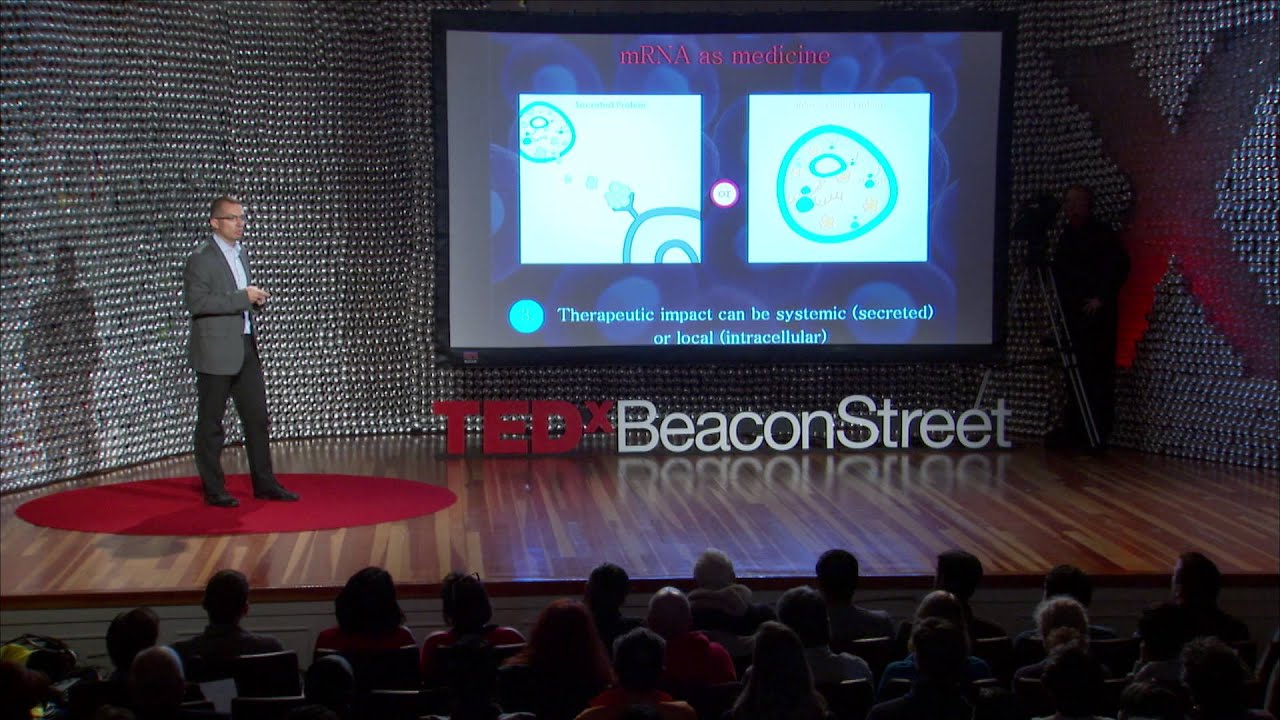
Sure. So to do very simple biology, we have around 22,000 genes in our DNA, so instructions for 22,000 proteins. And a third of those proteins are called secreted protein. Think about insulin, where they're made inside the cell, like your pancreas, from your DNA instruction. And once they're made inside the pancreas, they are secreted, they are delivered outside of the cells of the pancreas, and they go into your bloodstream, do their business. Well, two-thirds of the protein in every cell To make your cell function. Think about your cell like a town with a lot of different jobs. You have a police, you have fire people, and educators. That's what a cell does. It does a lot of jobs. And to keep the cell living, 2/3 of the protein in that cell never leaves the cell. And so, if you make a protein in bacteria like the biotech industry does or your cell for, let's say, cancer or insulin for diabetes, when you inject it—
Yeah.
It stays inside the blood, it goes turn around, it doesn't go inside human cells. And so the entire world of proteins staying inside cells is just unaddressable, undoable using recombinant biotech technology. And so because in the case of mRNA, the protein is made inside the cells, once we bring the mRNA we make in the factory inside your cell, like we did for COVID, we are right there. And so we can make any protein inside the cells that we want, which is the fun part of the science.
Well, thanks for opening our eyes and our brains about the potential of those two-thirds. Now let's dig into it. I mean, January 2020—I'm sure that's a time, a date you—you still remember vividly. You're on vacation in South of France, maybe close to Marseille. I don't know. You're going to tell us. Reading the Wall Street Journal before sunrise, and you see reports of pneumonia in Wuhan and at Davos. I was there actually in Davos at the time. People show you data on their phones, human-to-human transmission, flights to every corner of the world. You return to your hotel and think, this is not SARS, it's going to be the 1918 flu pandemic. So take us inside that moment. What did you see that others didn't see at the time, and what did you do next? Sure.
It's interesting to go back in time. So I was made aware of the virus, as you said, during the Christmas break by reading the newspaper. I reached out to Tony Fauci's team at the National Institutes of Health in the US, the NIH, and they were monitoring the situation. They clearly were aware already before the reporter of the Wall Street Journal was aware, and they were monitoring. And when the sequence, the genetic instruction of the virus was put online in early January, we started to prepare a product to go to clinical trial, because I thought, like everybody at the time, it was going to be like SARS or MERS, or a local outbreak, and then it will go away. But I wanted to prove to ourselves, to myself, and to Tony Fauci, that we could go in the clinic in 60 days, which was what I had told him before in 2019. that he didn't believe me could be done because when SARS happened, it took the NIH, Tony had told me, 20 months to go to the clinic. And, when I told him we could do it in 2 months, of course, he didn't believe the guy with French funny accent. Plus, I'm not even a biologist, not even a PhD. So, think about it, what credibility do I have to make such claims?
Yep, yep.
And so, my goal at the time in mid-January was Let's get a vaccine made with a sequence that was just published by the Chinese online, and Tony Fauci will run the clinical trial. We will have proven we can, in case something really bad happened one day, do that in 60 days. And then I'm in Davos and I'm monitoring the cases on my laptop. I built an Excel spreadsheet by country, and the R naught that everybody has learned now, which is the pace of of contamination, of people-to-people transmission, seems really, really high. And as I spent time in Davos with a few people, including Jérémy Farrar, who is now the Chief Scientific Officer of the WHO, he was running the Wellcome Trust before, it becomes very clear that the R-naught is very, very different from SARS or MERS. And then the piece, as we discussed with Jérémy, because we will meet a couple of times a day between meetings at Davos just to catch up. Yeah. So a few things then happened on the Wednesday of Davos. I don't know if you remember, the Chinese government decided to close Wuhan. Right. And I'm like, geez, what do the Chinese know that we don't know? Because you don't close a city like this. And it's not a small city, Wuhan. I know most people in France or others had not heard of Wuhan before. Yeah. But Wuhan is a very big industrial city. Yeah. And then one other thing I had done at Davos when I started to get more and more worried is I had looked at all the flights leaving Who won? Direct flights. And I had to realise that every capital in Asia had direct flights from Wuhan, every capital in Europe, and every big city on the West Coast of the US. And as I looked at the R-naught and the incubation time, which was estimated at the time 7 to 10 days, and the travel and number of flights, I went back in time, even to when I read the article between Christmas and New Year, and just calculated how many people could have been contaminated with no symptoms. And I've left Wuhan. And the number was so gigantic that it became very clear that this was going to be like 1918, which, again, connecting the dots, why studying history is helpful, because I knew how bad 1918 had been when we had the Spanish flu, which, by the way, didn't come from Spain. Poor Spanish. Came out of Russia. And so that's the week where I pivoted. Wednesday or Thursday night, I forgot now, of that first week to realize this is going to be like 1918 and I need to change my plan because my old plan is wrong.
It's obsolete. Yeah. And so as you said, I think it was 63 days later, right, after that genetic sequence was posted online that the first human received a dose, which is 10 times faster than any vaccine in history. Can you actually lead us through your organization? How did you do that to accomplish something that never happened before in such a record time?
Yes. So I would say there's some piece that are linked to the technology. It has nothing to do with my organization. It's just mRNA. And there are pieces of what we had built. So a few things. So mRNA, because it's an information molecule, I can make another mRNA vaccine on the computer in 2 minutes as long as I have a sequence. I literally copy and paste it to a cassette that we built before. And we had done, which most people didn't know, 9 vaccines in clinical trial before January 2020. So, we have done a lot of different constructs, never coronavirus, but we've done flu, Zika, a few other viruses.
Yep.
And then, the other piece we had done for cancer, which is why this platform is so interesting because you can connect the dots in ways that are science fiction-like for traditional pharma. For our cancer treatment, which I hope we can talk about in a moment—
Yes.
We had to develop a manufacturing machine to do individualized product for one human at a time.
Wow.
So, we shrunk everything and we also shrunk the cycle time, the time it takes to make product. And so, we basically use a cancer machine to make The entire lot because in vaccine, the dose are much lower per human than in cancer.
Yeah.
So, you could make for the 60 or 70 people of a phase 1 study, you could make the entire batch. And, that process I knew could take 30 days. So, it took us around 30 days from mid-January, we got the sequence to make the product.
Yeah.
And then, it must be 30 days for the FDA to review the file to authorize Tony Fauci's team to start dosing human. With a green light from the FDA.
But I think then really comes the real problem, or the real problem, another problem. You didn't have the money to manufacture the vaccine at scale. And I think your head of manufacturing could not buy the ingredients. So probably one of the scariest moments of your career, I guess, which is, you know, what was going in your mind, actually? You had the vaccine design, but you could not afford to make it. So how did you navigate that storm, coming back to your storm? On the sailboat.
Yeah. And that was a long storm. It was a couple-month storm where I tried every way I could to raise money. I talked to every big foundation in the world, didn't get a penny. The biggest one, I called them 3, 4, 5 times. I even told them I will put a factory just for low-income countries, but please help me. Got not a penny. Nothing. I asked big pharma companies, all the big vaccine players, they decided not to work with us. And what actually ended up saving us, which is an interesting clin d'œil from the capitalism system, it's actually the public market who saved me. Wow. So what happened in May 2020, we knew the clinical data were coming of a phase 1. And because we couldn't find money anywhere, Big Pharma not helping, foundations not helping us.
Foundations either.
The government was starting in the US to help us because in the meantime, Congress had passed some budget for clinical trial. So the US was helping us, as has been well documented. We got more than $1 billion from the US government to pay for the clinical studies. able to accelerate them without taking any safety risk for the population and the people in the study. But what was not part, because the other players were all big companies, was manufacturing and buying machines, buying raw material, and so on. And so, when we got the phase 1 data in early May 2020, we went to the capital market to make a raise.
Wow.
And, one of the amazing things that happened is Morgan Stanley was one of our banks. And James Gorman, the then CEO, is retired now, Morgan Stanley, called me on a Sunday and said, "You cannot waste time on a road show. Your vaccine is working." The team had told me you're going to do a fundraising and a road show next week. You cannot. It's a waste of your time. The bank will buy everything. Wow! Wow! And it's like, you know, James, it's more than one point three, one point four billion dollars. Like I know. He's like, "We'll buy everything. We'll put it on the bank balance sheet," and then. We will resell it to investors. We might make a gain, we might make a loss. It's not the point. The point is you cannot waste a week on a roadshow.
Wow.
It would be criminal now that you have the first vaccine that seems to be working in the clinic, given we're living in a pandemic. And Morgan Stanley, and I've said that story many times, and James is a gentleman, Morgan Stanley basically took the entire— when the market closed on Monday at 4:01, we signed the transaction, they got everything. All the stock, we got all the cash, and then we were able to use that capital to buy machines, to buy raw material, to hire people who could scale manufacturing. Because I think the media has done an amazing job during 2020 to cover all the different vaccines by all the companies. But what the media has never really done is a story about the incredible industrial challenge, which was to go from no manufacturing capacity To a billion doses in 12 months. That was incredible. And the team did it. It's really even more remarkable than getting a vaccine out of the door in a year, I think.
No, I think it's an amazing story. And what you just called that as well, because we don't necessarily talk much about finance, investing into— well, I'm not even calling that a— it's not private equity, but really a bet, a huge health Human bet, correct? And that call was pretty amazing. The way describe it is like okay, this guy made a very principled decision on behalf of his organization, which was not necessarily backed up, I'm sure, by many of his shareholders. But he just bet bet on you and Moderna, and you did it.
So so yeah, which is also fascinating to build on your point because again, as I said, big foundations around the world said no. Yeah, which you will think a foundation there's a pandemic people dying they're going to be helpful said no. And big pharmaceutical companies that were the biggest players in vaccine in the space said no as well. And it's a public market and the bank who helped us.
So continuing on this story and accelerating a bit on this one, Stephane, in July 2020, you started your phase 3 trial, but you are not enrolling, I think, enough people from diverse backgrounds— African Americans, Latinos, the communities that were, I think, and you can correct me, most impacted by COVID. And you made the painful decision to slow down enrollment to ensure that trial was representative, which must have been, I think, I'm sure, an agonizing choice with people dying every day. So what values guided you to make that call, which I'm sure was not necessarily popular among other people?
Yeah, it's a great point. It was most probably the most difficult decision I made in 2020. It was very painful. We debated it for around a week, and then we're like, we cannot keep debating, we need to decide them. It's exactly what you described, which is as we're getting the data on the trial, not the clinical data, but the representation of a study, which is something every company gets, we had mostly white people, to be simple.
Yeah.
And because we wanted this vaccine to be a vaccine for the world, not a vaccine for white people, there's a lot of things about the human body and human health we don't understand collectively around different genetic background, different representation. And it was really important for us that this would be a vaccine for the world, not a vaccine for white people. And so we decided to slow down. And the way we slowed down is we told some sites who had recruited mostly white people, you cannot get any more people into the study. And we added new sites in communities where there were people of color. It was agonizing. It was even more agonizing at the end. Because as you say, people were dying.
Yeah.
And then we ended up having our product approved one week before Pfizer, and they really twisted it in our back saying they were the first product approved and so on. And we were ahead in that race, but it was the right thing to do. Again, in the end of the day, you have to live with yourself and your decisions. I'm very happy with the decision I made. I hope I would make the same decision again if it was presented to me, because at the end of the day, it was me and the team debating it and with the board, because it became at some stage a board discussion. with my recommendation to slow down because we wanted this to be a vaccine for the world, not for white people.
No, wonderful decision, very principled decision, and fantastic, Stephane. We'll come back in a few minutes to another question when it comes to another, I think, big issue for medicine and pharma, which is global access, obviously, to health in the world. I'll come back to that. But now I'd like to shift the discussion a little bit to cancer, which obviously is something you've been actively working on. mRNA cancer vaccines represent one of the most exciting frontiers in medicine. And the concept is extraordinary. So your melanoma vaccine in Tizmiran developed with Merck, I think is now in phase 3 trials and showing a 49%, if I'm correct, reduction in recurrence risk. And your Marlboro factory advanced automation robotics delivers a personalized vaccine in under 30 days from tumor sequencing Can you help our listeners again understand in a simple way how personalized cancer vaccines work and what makes this approach so revolutionary, of course, compared to the traditional cancer treatment we still have today?
Sure. So I'm going to try to be very simple, and any doctor or scientist who listens to me might have a few goosebumps, and I apologize in advance. So basically, We all have cancer cells in our body all the time of our life. And if we are healthy, which is why sleeping and sport and eating well and so on are so important, your immune system, which basically lives in your blood and goes around your body, will see that first cancer cell and will eat it. Again, massive simplification, but that's what happens.
Yes.
If a cancer can grow because, for example, you spend a part of your time you go through a divorce, you have a big trauma in your life where you don't sleep for a month or 2, you see sometimes 5, 10 years after, people having cancer. But it started at that moment. So if your cancer grows, your immune system becomes blind to it because it becomes used to it. It's part of the environment.
Yep.
And it doesn't fight your cancer anymore. So what we developed is a technology at Moderna where we basically take a sequence of your tumor, meaning we take a biopsy of your tumor, and we read all the letters of the DNA of your tumor, the 3 gigabytes of letters. We do the same on a draw of blood to get the DNA of a healthy cell of your body. So we can know what is Jean-Philippe's DNA.
Yeah.
And we compare via informatics all the mutations where all the letters have changed. In your cancer cell compared to your healthy cell. And then, through our software, we pick the 34 mutations that we think, based on biological rules and medicine rules, are the most relevant. And, we make one mRNA with all those 34 mutations in one molecule in a factory in 30 days.
Wow.
And, when we inject it in your arm in your hospital, what we've shown is after around 4 doses, because remember your immune system missed the mutation in your cancer. After around 4 doses, we start to see your immune system recognizing your cancer. It's waking up to your cancer and it starts eating it. And so the data, as you said, are quite incredible that we've showed in the 5-year survival study of a phase 2. The phase 3 is coming soon. We are now in lung cancer, in pancreas, in bladder cancer, kidney, and many, many cancer types in clinical studies. And the uniqueness is because mRNA Again, it's an information medicine. It allowed us during COVID to flip very quickly to make a design of a vaccine on a computer. That same technology allows us, if you and I get diagnosed having skin cancer the same day by the same doctor in any hospital of the world, we'll make a molecule for Jean-Philippe, we'll make a different molecule for Stephane.
For you.
That in each case is adapted 100%, like a hand to a glove of the right size, to your tumor and to my tumor.
So is the envision, Stephane, that at the end of the day you'll be producing billions of doses, but one dose at a time for one person, one individual on the planet to cure cancer?
That's correct. That's the way. And our biggest vision is to go actually much earlier in cancer. We just announced last week we are starting a lung study, but we've already done lung study that's ongoing for people with stage 3 and stage 4 disease, so advanced disease. We're going to start our first stage 1 testing because in lung cancer, you can find cancer early if you do an X-ray of a former smoker. You can find cancer early. And, we think that would be even more powerful because there's less disease.
Yes.
And, you have a stronger immune system. And so, the thing we're trying to do in Moderna is to go as early as we can in disease and also to prevent disease. We have also another product that's going to start a clinical study in the UK at Oxford any week now. That is for people that have Lynch syndrome. You have 1 in 400 people that don't know, but they have mutation in their DNA that increase tremendously their chance of having colon cancer. And so, in that case, we're developing yet another product where we're going to give you instruction so that the cancer will not develop. So, it's a prevention of cancer.
Prevention.
So, there's a lot of things that we're able to do with this technology because As I said, it's an information technology in your body. And life is information. And so we can, as the world learns more about disease and mechanism of disease, we can then very quickly make new tools to fight disease.
No, it's amazing and also incredibly exciting to think about the opportunity for the world. And coming back to the challenge you had with COVID right, in terms of manufacturing, that must be mind-boggling. Mind-boggling, sorry, in a sense, again, of all those individual doses produced. So are you solving that manufacturing puzzle?
Yeah. So we are trying to scale out the process by shrinking everything. So if you were to go and visit our Marlborough factory in Massachusetts in the US, what you will see is A lot of engineers trying to shrink everything smaller and smaller and smaller because if I can make more per square foot on the floor or meter carré or square meter.
Yeah, yeah.
And I can do more 24/7, this is how I improve my output. The team has already reduced compared to what we used for phase 2 study to what we are now ready to go commercial because we're hoping to get the data this year and to launch a product next year in '27. We've already reduced by 10x the size on the floor, and the team has a roadmap for another 10x.
Wow.
So of course that would be 100x. And we're trying to also shrink the manufacturing time, because if I can do something in 1 day versus 5 days, of course I can do 5 more, 5 times more, right? This is basic math. And so we're just obsessed about the output and think, what are all the variables we have? That's where being an engineer comes handy. What are all the variables we have in terms of improving the output? And we're working on all of them in parallel at the same time.
That's amazing. It makes me think as well about all the process that the CPUs, now GPUs kind of industry has gone through for the last many years to miniaturize, to basically process a lot more in a much smaller footprint.
100%. And just one example of— I was discussing with engineers maybe 6 months ago. And I was obsessed about square inch on the floor and so on. And one engineer came with a great idea that nobody had thought about before. And he's like, by the way, we can move all the compute of a machine out of a room because we operate, of course, in clean rooms for the safety of the patient because you don't want bacteria in the product, of course.
Yes.
But he said all the compute is still in some of the robots. I'm like, what? I didn't realize. So we moved all the compute out. And so all the compute is out. Again, human ingenuity, when you are very clear about what problem we're solving for, is just amazing.
Has no limits. So shifting gears now, I'd love to talk about the combo of, again, biotech, pharma, and AI. I think you've been announcing already a couple of years ago a partnership with OpenAI to accelerate drug discovery. And there's obviously a lot of hype around AI in biotech right now. So what is AI actually doing at Moderna today? Not in the future, but right now? And how do you separate AI hype from AI impact in your operations today, Stephane?
Yeah, it's a great question. So I think in our world, there's 2 big applications of AI. There's AI for science, making new medicine, and AI for accelerating business processes, like work reinvention around AI, so we can serve a customer faster. Those are 2 very different uses. On the innovation side of the house, we at Moderna have had a few innovations that have come from AI that have been put in place in terms of the molecules we are developing. This is just the beginning of a huge tsunami coming for the industry and for Moderna. But most consumers will only see the benefit years from now because you need to invent a new molecule and then you need to test them in the clinic.
Of course.
Where there's already impact on the consumer positively with AI in our case is shrinking business process time, because then you can develop a drug faster and it can be available to patients faster and cheaper. And that's what we're trying to do with work reinvention. And that has already example in Moderna in manufacturing, where the team have used AI or using AI every day in quality to improve quality. Like we build an agent that when When there is a mistake happening on the manufacturing floor, by law, and also by good business practice, but by law in my industry, we need to document what happened as a deviation and you need to document a corrective action. I was getting frustrated that our corrective actions were not really improving in terms of repeating corrective actions.
Yes.
So I told the team, let's build an agent that will refuse a corrective action submission if it's not good enough, because the agent finds holes in the corrective action that it could still happen again. So we built an agent to do that, and our quality has improved. So that's another example. We use it in marketing.
Great example.
We use it in finance, we use it in HR. So I think you're going to see mid to short term, but already today, impact on the speed at which medicine can be developed. through business process reinvention. The science will take longer, but the science will be very profound.
Hmm.
We're going to be able to invent medicine that my best scientists cannot think about, because the human body has 20,000 genes, as we spoke about, has 40,000 metabolites, think glucose and other things in your body, and you have trillions of cells in your body. And those things are talking to each other, sometimes in nonlinear ways. So, there's no human who can have the functioning of a human body in their brain, like a good engineer can have the functioning of an engine of a car in their brain.
Oh, those are amazing examples. Just from a pure kind of people talent standpoint, I mean, how do you make that happen? In other words, do you have like a chief AI officer working hand in hand with the different business units? I mean, from discovery to sales and manufacturing on AI capacity, how does it work? to make it so effective.
Yeah, so I'm de facto the chief AI officer because I really think, given the impact the technology has already had, if it will never improve again, and given we know the compute is doubling every 6 months, I think any company that's serious in AI, the CEO has to be the chief AI officer in terms of understanding the technology and driving the change in the business. Then, of course, I have teams helping me do that. I'm not alone. So, of course, we have a tech team. We're spending a lot of time understanding what the technology can do. As you said, we have partnership with OpenAI, but we're also working, for example, with Anthropic on coding a lot.
Yep.
With vibecoding. Actually, this morning I was on a call with the leadership of DeepMind at Google on the science side of things. We're also developing our own machine learning system for doing some biology where LLM is not the right tool for doing machine learning. And then for the work reinvention, we actually started with my head of HR, a work reinvention team where we're basically prioritizing what are the few— we have 3 right now— big enterprise-wide projects that we want to redo from scratch, business process reinvent AI first.
Yep.
We have same thing happening in each of the big functions of the company. Like, for example, my CFO has 4 or 5 projects within finance to totally reinvent how you do things in finance, and same thing across each function. And then we are trying to really help managers at the department level to think about what they can do in the department. And then at the individual level, we are doing a lot of work in terms of training. Every employee of Moderna has access to GPT Enterprise from OpenAI. We are doing training on how to use tasks, how to use projects, how to write GPTs. So all those things we have done. We deployed GPT at Moderna in the spring of 2023, just after OpenAI GPT came in November '22.
Yeah.
With a Moderna version in the Amazon cloud, with only Moderna data coming in and the data not going back, educating the rest of the world with our confidential information. So we have been at it early and we're trying to stay on the frontier of what can be done with AI by having deep partnership with those frontier companies like OpenAI and so on. Yes. I was with the leadership of OpenAI on the phone last Friday and again with somebody here at Moderna on Tuesday this week. So this is a permanent reinvention. And the permanent learning from all of us, starting with me. I even have tasks set up to keep me updated several times a week on whatever new use case at Moderna, but also outside the company.
No, it's an amazing, actually, growing success story. When people sometimes have some doubts about AI usage in large companies, well, I think what you just described is quite exciting. Now, I'd like, Stephane, now to explore a little bit the future of pharmaceutical innovation, because I think the landscape, and you know it better than any of us, the landscape is rapidly evolving. We have established Big Pharma with massive resources and global distribution. We have biotech companies like your company that are nimble, science-driven, willing to take bets. And now we also have a new wave of AI-powered companies entering the space, like Manaos AI, founded by Reid Hoffman, as an example. Which is using AI to accelerate cancer drug discovery. Where do you see the biggest disruption coming from in the next 5 years to 10 years? Pick your timeframe. And how does Moderna position itself at the intersection of biotech agility, AI acceleration, and the commercial reach needed to bring personalized medicine to every patient in the world?
Yeah, so within the pharma biotech companies, I think it goes back to the 2 chapters I spoke about, which is going to be huge innovation in new medicines that were just unthinkable before.
Yep.
And the acceleration of the time it takes to develop a drug because of all the business process work reinvention, I would not be shocked in 3 or 5 years' time, it takes half the time. So, 5 years versus 10 years to develop a medicine. So, when you multiply this across the industry, that's an amazing impact for patients, of course, that are waiting for the medicine. But the biggest impact will be on medicine as we learn more and more about how the human body works. So I think outside the companies themselves, there's a few things that I think are going to be really important. First is I believe we are a few years away, maybe 5 years away, to be able to map human body in silico. But I mean cell by cell, mechanism by mechanism, like you will map an engine of an airplane or an airplane with the engine as one of its parts with all the wires and all the mechanical parts.
Yeah.
We're going to be able to do the same thing. And again, it's a very complex problem, 20,000 genes, 40,000 metabolites, trillions of cells, but it's not an infinite problem.
Yes.
And it's not black magic, it has rules. A lot of times things happen in biology, in medicine, in disease we don't understand, but it's because we don't understand, it's not because it's black magic. So I think we're going to get to a world where there'll be no more black magic, where we will really understand mechanistically what has happened to somebody. And this will enable us and others in the field to invent new medicine. Because if you know how the engine works, you can go fix it because you understand how it works, right?
Yeah.
The other piece I think would be fascinating is the improvement in understanding of how disease progresses. Because as we spoke about cancer earlier, cancer, you don't have a tumor 5 centimeters large happening overnight. It starts with one cell. Yes. And then 2 cells and then 4 cells. And then the diagnostic tools, whether it's through blood work or through imaging enabled by AI, enabling to see much earlier disease, because we all know the earlier you can treat a disease, the higher the chance of treating it. And especially if you have exactly the right tool versus guessing or taking chemotherapy, big tool, like big hammer going after and destroying a lot of things around the problem. happening with chemotherapy. I believe personally chemotherapy will be a thing of the past. And in 20 years, people will say, why did we ever use chemotherapy? This was barbaric.
It seems crazy. Yeah.
Yeah. The other piece I think is going to be a huge impact is on health equalities. One of the pieces that drive me crazy is just here in Boston where I live, between the richest zip code and the poorest zip code, there's 10 years of life expectancy difference.
Wow. 10 years.
10 years in the same city, just 2 different arrondissements or zip codes.
Couple of blocks away. Yeah, yeah.
It's crazy. And one of these things is the inequality in understanding disease early. Inequality is, of course, access to healthy food versus crap food in a box. There's a lot of pieces, but diagnostic is really important. Understanding disease early is really important. So I think another place where the world is going to change tremendously is we're gonna move from sick care to really healthcare. Today, if you think about what we call healthcare, it's not healthcare, it's really sick care, which is I have a cancer, I have a heart attack, I have— and do something for me. I think the world is gonna change and the companies of the future are gonna be companies that are gonna help people stay healthy. That's— I will not be surprised if some pharma companies will end up disappearing. Because if you think about it, if you're in a world where you need much less medicine because you have very early prevention, very early diagnostic of disease and intervention to revert the disease, it has already been shown in some disease that some disease you can revert them back to healthy state. You know, some companies are developing new organs out of cells from your own body. People have already done. 3D-printed bladder.
Yeah.
People are working on 3D-printed hearts, starting from just a few cells from your skin or from a blood draw, from just your blood. And they're making heart cells, they're making bladder cells. So you can think about a world where we're going to be able to change parts in our bodies as they are too damaged, as they are too hurt, either via an accident or via a disease or via aging. And so all those things happening outside the industry is what gets me a lot of excitement. That we're really going to move into a world of preventative medicine, where we find disease very early, a bit like in Star Trek. You find disease very early, and then you can treat them so we don't become sick.
That's an amazing perspective, Stephane. And when you think about the kind of core capabilities that will be needed to succeed, you know, because I was calling out kind of the key types of organizations like biotech, big pharmas, AI-born companies like Manaos and others. How would you express the shape of that kind of company that can succeed in this new kind of healthcare as opposed to sick care model in the future? So I think a few things come to mind.
One is, of course, a deep understanding of biology, because you're going to want to— because human is about biology— to be able to understand it so that you can apply it to do good, to serve your customer or the patients if you're directly interacting with patients. I think that the ability to connect the dots and to leverage technology, we just spoke about AI.
Yes.
To leverage technology, whether it's for discovery or the delivery of care. And as we talk about AI in imaging, about AI down the road, I believe if I'm still alive, that my doctor will have my body in silico as a model.
As a model.
And as I do blood work, as I go for my annual checkup and use other devices, that model will be adapted. and will allow my doctor to help me do things. Because also everybody's going to be sequenced. You're going to be able to find a lot of disease early, which is, of course, again, the best prevention.
Yeah.
I think the use of vaccines is going to be much more amplified because, as we know, vaccines can prevent cancer. Think about HPV, that amazing vaccine developed by my colleagues at Merck, or MSD outside the US, that I believe every young boy or every young girl should have when they're a teenager before they start kissing too much. Because that's how the virus spreads, through body fluids. Dying of HPV cancer, head and neck, ovarian cancer down the road is just criminal because that can be prevented.
So, I mean, wonderful, again, kind of picturing of the future, Stephane. Now, I'd like us to move from the industry, from the science to the public health and kind of a public debate, right? In August 2024, Robert Kennedy Jr., our now US Health Secretary, revoked $500 million, I think, in federal funding for mRNA vaccine programs. And he's expressed public skepticism about long-term safety despite, again, $3+ billion administered. And even the FDA's lead biologics regulator called deprioritizing mRNA research wise. But this goes far beyond mRNA. We are seeing a broader trend, I think, in America, rising skepticism towards scientific institutions, declining trust in public health authorities, and increasing politicization of medical research, which represents a profound challenge, not just for Moderna, but I assume for the anti-scientific community. So as a scientific leader, how do you maintain public confidence while continuing life-saving research?
I think it has to go to communication as a big parameter, which is to explain to people, to share the data. If I could go back in time, one thing I will do differently and try to do a better job is to explain in 2020 that we and our colleagues in other companies never cut any corner for safety of the development of vaccines.
Yes.
And you can imagine how people can believe that we cut corners Because how could you do 1 year if it takes 10 years usually? We did that because we were able to do a lot of things in parallel because there was unlimited amount of money for clinical studies, which is why the US government, as we talked about, gave us and others billions of dollars.
Okay.
Because we told them, if you want to help stop this pandemic, we need vaccines. If you want vaccines quicker, we need a lot of money so that we can take a lot of business risk.
Yep.
Doing things in parallel. So you don't do them one after the other, which is what people do usually to manage business risk, financing risk, where they do things one after the other once they know things are working. Because if not, they will be irresponsible financially in normal times. But in war times, when you fight a virus and people are dying and economies are stopped, the government basically just threw money at the company to see everything you can do in parallel, do in parallel, which is what we did. The other thing that they did at the government level is that they stopped reviewing all the other non-COVID vaccines. Why? So that all the people at FDA could focus on Moderna and Pfizer and the other vaccines, so we could go very fast. In normal peacetime, you know, it will take a month to get just a meeting with FDA. We had the name and mobile number of all the people on the Moderna team.
We could call them up.
And so we didn't do a good enough job, we collectively, but us, Moderna, too. To explain what was being done that could enable this without cutting corners. Then, of course, the vaccination mandate, which is not the vaccine but the obligation to be vaccinated, created in the US a lot of political backlash. And so there's a lot of things like this. Look, like always in life, and again, going back to history, there's pendulums going back and forth. By the way, when Monsieur Pasteur started doing vaccines, there was massive public backlash.
Yes.
And so I think things are going to go back and forth. At the end of the day, you can say gravity does not exist, but jump by the window and you'll see gravity catch up with you very quickly. And so it's the same thing with biology, just a bit slower, which is you can say measles is not an issue, stop vaccinating kids by spreading misinformation, and your measles cases are going up, as we're seeing. And so I think those real outbreaks that unfortunately are actually going to hurt a lot of humans that should not be hurt because the products exist, are going to remind people and get the pendulum to go back. So again, being a long-term thinker, being an optimist, having studied history, I know the world is going to go back to a good place. It is not right now in a good place. And it's, of course, sad because innocent people are getting hurt by that misinformation.
Yeah, no, that's— I think it's a great way to to actually summarize where we are and be optimistic about the future. But yet today, again, what is your recommendation, not just for yourself, obviously you are doing it, but for your peers as scientists or CEOs of large biotech companies and others to again regain trust of the massive public opinion in the world on health? What should we do more of? What should we do differently to tell the story? of the reality of the evidence, of the science.
Yeah, I think communicating, I think explaining mistakes as well, because mistakes happen, whether it's done by industry labs, government labs, public health leaders, business leaders, mistakes happen. So acknowledging publicly the mistake, I think, is a great way to build trust. And I think sharing some of the benefits that people are going to get. I mean, we just spoke about the improvement in diagnostic, the improvement in disease.
Yes.
I think over time, care will become cheaper. In a lot of places, some people, because of their income or their lack of insurance, cannot get access to the best care they can. I think as we move to a prevention world, as a true healthcare, not sick care, this is going to be less and less of a problem. So I think those are the type of things we need to do more of communication and explaining, including mistakes.
Yeah, makes a lot of sense. So it's a good segue, Stephane, in terms of global access. You're even talking about access in Boston, right? To MedCid a few blocks away. And we've seen some of that, obviously, with COVID unfortunately, where it was super hard to make the vaccine available to billions of people in emerging countries. So what is your vision for global access to breakthrough therapies Again, like the personalized cancer vaccine you talked about. How is it possible, as a CEO as well of a very valuable company, to deliver both shareholder value while ensuring equitable access? Or do we need fundamentally a new model to reinvent that model?
Yeah, so I think to really solve it for good, you need technology like AI. To move to true healthcare, not sick care. Because it's a bit like like your car. It's an interesting analogy, which is as you know, if you never change the oil of your car and never do car maintenance, your car is not going to last as long. Yeah. And same thing with our bodies. As we live every day, as I'm going to eat today my lunch, my body gets older because the very process of eating. is actually having a lot of consequence chemically inside my body, which makes my body older today than I was yesterday and the day before. And so, as we understand all those mechanisms and put those in place and really enable through technology and mass dissemination of information of the technology to deal with things early, then the cost will be much lower. It's like, you know, if you do the provenance maintenance of your car, It doesn't cost you a lot every year. But if you wait for your car to be destroyed and you have to change a big part of your engine, then the cost is very expensive.
Yeah, that's a good analogy.
I think we're going to truly solve the cost problem of healthcare by moving to true prevention healthcare, not sick care. Sick care is very expensive.
Yeah. So now I'd like to move to a leadership culture kind of conversation for the next couple of questions to come, Stephane. I'd love you to walk us through the evolving culture of Moderna, because I think to do what you did and to keep doing what you promised to do, which I know you are working on, which is an incredible vision, you've got to be bold, relentless, curious, collaborative, honest. So how do you shape such a culture? And as the CEO of the company, how do you make it real, authentic, and lasting, or changing as well, given the new challenges you have? Tell us more about the way you do that.
Yeah. So look, I don't know of a way to lead but by example. And so I hold a super high bar on myself on living to those values.
Yeah.
In our case, I had the mission of the company written on every wall of every conference room in the company, and I point to it all the time. And I tell people in my teams, which is, They need to be driven by the mission because either today or tomorrow or in 5 years, somebody they love is going to need a modern medicine, whether it's cancer or I would prefer to prevent disease like vaccines.
Yeah.
And that every day matters. And because by extension, people in your family, Jean-Philippe, I don't know them, but I know you love people in your world like I love people in my world. Of course. That's what makes us human. And it's one of the many things we have in common. I use that mental model for people on the planet, which is, I don't know most people on the planet, obviously, but I care about them as I care about my family because they are part of a family, of an ecosystem, of friends, community, and so on. And I think that if all of us at Moderna are always obsessed about that, and so I try as a leader to talk about that all the time, I think as humans, We get very distracted. I think it's even worse now with social media. By the way, I am on no social media.
That's a good practice.
Which I think is great for my mental health and great for my ability to focus and stay present and stay on mission. And I think we all get distracted. And I think what is important in leaders is to every day remind people why they do what they are doing.
Yes.
Because at the end of the day, people reduce their job as a set of tasks and a to-do list and going to meetings and so on. And if you're not passionate every day about what you do, then you lose your energy, you lose your commitment, you lose your relentlessness. And so what I try to do as a leader is that, to always put back the passion in everything we do, every meeting, every meeting, literally. And I'm obsessed about quality and speed. of how we operate the company, because I don't believe yet we operate at the best version of Moderna. And patients are suffering, or patients in the future will suffer, because today I'm not operating as the best version of Moderna that I should and I can. And that's a driving force that I want to talk about to people all the time, which is if today we cannot develop in the lab a drug as efficiently as we could, well, in 10 or 15 years, people are going to get that drug later. 'Cause it would have taken us 2 more weeks to do something that we should not have if we had done our best work today.
Well, that's obviously an amazing mission, but also a very frustrating mission in many ways, right? Because it's a never-ending game.
It is. So it is, it is. But at the same time, it's very energizing. So it's both, which is interesting.
Yes.
Which is, it's very heavy sometimes.
Yeah.
But if you do your best work every day with the best team, then it's very energizing because I don't know how to do better than my best work with the best team. So it's always raising the bar on making sure I have the best team, making the bar I do the best work I can. I communicate, I help people, I give energy, and I'm always trying to figure out where are we losing energy in the company because of business processes or lack of technology, which is why I'm so excited about AI. For me, AI in the business process reinvention side of a company is it should enable all my employees to be much more engaged, much more energized, because their work is more impactful every day, because the part of their work that drives no value and drains them is gone and run by a piece of software.
No, I love it, Stephane. To me, in a way, you summarize very well what my conviction is. I mean, the chief executive officer is the chief energy officer. Positive energy officer, by the way. I would always add positive because there are all kinds of energies, but I can feel it and I can feel the vibes, I'm sure, through the doors of your building out there in Boston all the way to Paris. Now, continuing on that discussion a little bit, I had a fascinating conversation with Pascal Soriot that you know well, CEO of AstraZeneca. I had the wonderful pleasure to be a director on his board when Pascal became the CEO of AstraZeneca a long time ago already. And what struck me most was Pascal's conviction about what truly unlocks human performance. He breaks it down into 3 things a leader must align. Number 1, the shared purpose, saving lives. Number 2, the individual contribution. Does every person understand how their specific daily work connects to that mission? And the culture, number 3, a workplace where people genuinely enjoy doing that work together.
Yeah.
And he added 2 principles as well, by the way. Culture is invisible infrastructure. You build it before you need it. And assume good intent. So do you actually believe it holds in that actually, you know, does such principles hold in high-tech environments? Or is it a luxury leaders telling them, telling that to themselves? Assume good intent in particular.
No, I completely agree with Pascal. That will not change the world. Look, media makes us believe that there's a lot of bad people out there in the world, and I don't think it's true. If you look at the facts and the data, it is actually not true. Most people want to do a good job. Most people want to contribute. And when I say most, I mean 99.9%. So almost everybody, I mean.
Yeah.
And so because of that math, you have to assume that people have good intent. And when you see outcomes that you don't like, you need to figure out why.
Yeah.
And you figure out if you obsess about the why until you get to the true root cause of a problem. And sometimes you have your personal problem. Sometimes an employee at the company might be going through a very tough time in their personal life, which means that You might have made a mistake, they might not be engaged and so on, because you don't realize they're taking care of a mother with terminal cancer or a kid with suicidal thoughts and so on. And that, of course, has a huge impact. I always tell people, look, I'm one human being, I'm not two. And so the Stephane that walks in your office every morning is the same Stephane. It's one Stephane.
Yes.
Which is why I always advise our teams to focus on human harmony, not work-life balance. I like to tell people my life and my work is not balanced at all. It's totally out of balance.
Yes.
But my job is to keep those 2 in harmony so that I could be the best CEO I can. I can be the best husband I can. Am I the best husband in the world? I don't think so. Am I the best CEO in the world? I don't think so. But I'm trying to, for those pieces that are really important to me, to be the best version that I can be in that ecosystem.
Yes.
And I agree with Pascal 100%. You need to assume good intent.
Oh, it's a wonderful convergence we have between 2 great leaders. I'm fascinated by something I think you do every quarter, Stephane. I'm told you spend time at home imagining where Moderna will be in 3 or 5 years, then ask yourself what CEO the company will need, and you reinvent yourself to become the leader. Is it something you still do, and can you walk us through the way it works? Sure.
Yeah, I still do it. You have good sources, Jean-Philippe. I still do it, and it took me a couple of years after starting Moderna to start realizing I needed to do it. Because what was really hard for me is, since now July 2011, I've worked in my office with Moderna on the door of a building and as a CEO of a company. But as you can easily understand, when Moderna was me and one scientist in actually Flagship's office, our VC, back in 2011, before we even had the lab, to being preclinical with 20 people doing research, to being in the clinic, to being public, to IPO, to the pandemic, it's not the same company. It does mRNA.
Of course.
It says Moderna. I'm the CEO, but it's not the same company at all. But I had to go slowly through that process because I live with myself every day, right? And so what I realized a year or 2 into being the CEO of Moderna is that I was doing things I should stop doing. There was new things I need to start doing, and I was not doing it in a structured way.
Hmm.
And I told myself it's most probably a mistake because you cannot rely on your intuition on people's feedback to do the right thing. And so I realized that because Monat was changing so fast, the biggest problem is I had to redo the job description of a CEO much more often. And that's kind of what I do.
Yes.
I do it at home because that's the only place I can be 3, 4, 5 hours quiet, whatever time I need. And I start by thinking about the company a few years down the road to a very clear mental picture of a couple of key scenarios and what's going to be the size, number of countries, the number of products. try to really get in my head and my gut kind of the company. And then I write the job description of if I was hit by a bus today, or if I was telling the board, I'm going to do something else today.
Okay.
What would be the job description that should be handed to the headhunter or to the board or to a new CEO of, this is your job? And I do it, and then I turn back on my computer and my calendar. And again, I'm pretty tough on myself. I look at my calendar over the last month.
Yes.
And I look how I use my time and I critique myself of did I use my time in the places I should have? Are there things I need to start doing that I didn't do before? Are there things I need to stop doing? Do we need to stop, stop doing them? Or it needs to be somebody else on my team or in the company doing those tasks because very important. So that process I still do around every quarter and doing it has been really important for me because the company has changed so much.
Yes.
And I need to be the best CEO I can of Moderna today, not Moderna 6 months ago.
That's an amazing process. I love your kind of religion on time management, also on your dedication to actually what your job is and should be. It must be a delight for the board, by the way, to have a refreshed job description for the CEO every 3 months.
Yeah, you need to ask them that.
So coming to almost the last few questions, Stephane, and coming back in a way to your personal roots, family, and so on, you've also talked about your experience as an immigrant and how it shaped your tolerance for people who communicate in a second language and what it means as well in their life. So can you share with us how has your immigrant journey influenced your leadership and what does Moderna do maybe differently because of that perspective?
Sure. So let me start by the end of your question. What we've done differently since the beginning is we've always hired the best regardless of where they come from. And in the early days of Moderna, somebody coined the term the United Nations of Moderna because we literally had maybe 30, 40 people in the company. Most of them were from around the world. The people literally from Africa, from the Middle East, from China, from Japan, from Europe, obviously many countries including Iceland. And I know because one day at one of our happy hours on a Friday, I got on Amazon a big map of the world, put it on the wall, and people having beers and stuff. And everybody had a pin, and the pin was not what your nationality is because this can change in your lifetime and sometimes many times. The pin was where were you physically born. And we started with the sun in Asia, and people slowly went and told their stories, and you have pins everywhere. And so that has shaped me a lot. I remember when I was at Eli Lilly after my MBA, I ended up being able to hire a lot of super smart foreigners. Why? Because we had an accent, and especially people from China. And people in the Midwest sometimes had no patience to see the talent through the difficulty of communicating, and they would not promote the best talent. And I would go and steal people within the company. The best ones. I have best ones. I had a couple of Chinese people working with me that was just unbelievable. scientists, unbelievable scientists, who would be doing so much work and be so relentless. And because they got the sort of a job where other managers were not seeing the talent, they'd be super thankful.
Yes.
So being an immigrant has shaped me in many, many ways and also has allowed me to be more curious. As I told you earlier, I only started to understand the French culture by being out of it in Japan.
Yes.
I think being an immigrant also was very instrumental in my journey at Moderna because it's about going to new places you don't know.
Yes.
You know, we went into an mRNA space of making medicine that nobody in the world knew. You know, we had stuff that Nobel Prize winner told me will not work. My team made it work. There was stuff Nobel Prize winner told us will work. still 15 years after don't work. I don't know if it's us cannot make it work or it will never work or we don't have the right technology in today's time of humanity. So being an immigrant has been really a wonderful gift that I had the pleasure to have.
No, I think it's an amazing reflection. And I was smiling, Stephane, because myself in my former global role at Microsoft, I was the one kind of filtering those accents that many people in Redmond would not necessarily understand or accept for a long time, and finding so many amazing talents all across the world, from Asia to Africa to Middle East to the Americas. And so, yeah, that rings a bell to me. No, really, at the very end, something that people don't necessarily know a lot about you, Stephane, is your big heart beyond the mission of your company that you obviously drive incredibly. You and your wife, Brenda, you've created the Bancel Philanthropies. And I think your philosophy as a scientist, you said, we view love as our most untapped resource. Major gifts I think you've done to the Post Foundation, Villanova University for educational equity, to the International Institute of New England for refugees, immigrants, to youth mental health programs, and I'm sure to many more programs. And you also signed the Giving Pledge, for all the listeners who don't know, which means you've been committing your entire Moderna stake to philanthropy, keeping only your home and your daughter's education and some resources for your family, but giving the rest for the future to those causes. Can you tell us more about what drives you and Brenda to the causes you've chosen and the philosophy behind Bancel Philanthropies? I wish you had many more Bancel philanthropies across the world. And I know Bill, of course, Bill Gates, when he started that as well some time ago. So tell us more about your own journey as a philanthropist.
Sure. And just to clarify, Jean-Philippe, we have not signed the Giving Pledge, but we've said publicly, and you're correct, that we're going to give everything away. I just want for the record to make sure.
Okay, thanks for clarification.
So yeah, we said with Bruna we're going to give everything away, but a tiny bit for education of kids and stuff like that. Because nobody needs that much money. And you have so many problems in the world and people suffering that we just could not comprehend with Brenda that we'll keep all that money versus putting it to use. Because I have no interest to be the richest guy in the cemetery, to do good things for the world. And so we're trying to do 2 big chapters. One is really around youth.
Yes.
Because we both got lucky with Brenda to get educated. And as you know, a lot of kids don't have a chance to get an education. And so we're doing a lot around helping people from low-income communities to get access to education, including universities. So we have a number of scholarships across the world. We are also doing a lot of things around mental health because we think it's a serious problem. in the youth, also to older people, but especially in the youth, as you know. So we're doing a lot of work in mental health. So youth is a big topic. And the other big topic is people later in life that are dealing with a lot of harm. And so one of the philanthropic efforts we are super proud about is we are helping Homeboy Industries, It's a nonprofit organization in LA started by a Jesuit, Father Boyle, who reinserts in society around 10,000 people a year that are former gang members. So lots of them coming out of jail, you reinsert them, give them a job. He's created a bakery, he's created a lot of businesses to give them jobs, to reinsert them in society. Because as you can imagine, when you leave jail— prison, sorry. A lot of time your family doesn't want to see you. You have no money, you have no job, you have nothing. And you have, of course, prison history on your record. So it's not easy. We're helping a group here in Boston, an amazing doctor who is the doctor of the homeless. Literally, he goes in the streets with his team and they know all the homeless and the disease they have, and they give them medicine. They have medicine in their backpack, they follow them and so on. So we're trying to help people in those 2 big chapters, youth And people that are hurting a lot, and we're trying to do it by enabling other entrepreneurs. So the foundation is my wife plus one person because we hate staff and overhead and so on. Bureaucracy. Yeah. And so what we're trying to do is to find people that are doing extraordinary social work, like Father Boyle in in LA, and providing to them long runway of visibility of funding. So it's pledged for many years. usually 3 to 5 years, 3 when we don't know them well, and then 5 years so they can hire and build programs like we do in companies.
Yes.
And the other piece we also do is we provide support to organizations to help them seed new social entrepreneurs. So I'm a big believer in social entrepreneurs because, like entrepreneurs in the business world, they are passionate about their mission. They study every detail of the system and they make the system better all the time. And so that's what we're trying to do with Brenda, because we think it's much better for the world that our capital goes toward those organizations than it stays on my bank account.
Yeah, that's amazing. And of course, one day I hope we have the time to have a drink together in Boston, Paris, Marseille, maybe, Stephane, to share my own passion as well for philanthropy, social entrepreneurs. I've got a community of 1,000 young social entrepreneurs in France. to go and scale. So all the things you talk about are like music to my ears, something I'm privileged to spending time on now because I retired from my professional life. So I'm also doing— anyway, my very last question, Stephane. When you look back on your career someday, what do you want Moderna's impact to have been?
Oh, wow.
And it's a big one.
Yeah. And you need to kind of framing time-wise because in 20 or 50 years is Pick your time horizon.
Pick your time horizon.
Yeah. So I would say if we are like 10 years from now, I would love to have developed 5, 10 more vaccines so that for the biggest impact, so that people can get a vaccine and don't get a disease that will impact their quality of life. I would love that cancer, that we have had a role, because as you know, AstraZeneca has a huge role as well. But I would like to be a company that has had a big role in turning cancer into a disease that is not a death sentence anymore. As you know, because it has happened in your life, it has happened in my life, when you have people diagnosed with cancer, the world kind of falls apart and changes drastically.
Yes.
Thankfully, thanks to the work you guys have done at AstraZeneca and many companies, The survival rate is way different than it was 10 years ago. But I hope that we're going to be a big contributor to making sure that we can find cancer earlier and we can have the right treatment to help people go back to their normal life and to have cancer becoming like when you tell somebody they have diabetes, it's not great news, but it's not the end of life news.
Yes.
And I hope that all of us working on this and Moderna in particular will have a big impact in that space.
Well, that'd be more than an amazing kind of legacy. And very last, I promise, because we are just on time, in a very fast way, as far as you can, what advice would you give to young scientists today, or young entrepreneurs, young leaders who want to make a positive impact in the world? What would be your advice?
I think the most important piece is surround yourself with amazing people that share the same mission. Yeah, because you're gonna have to go through a lot of tough times. Same missions and the most amazing people you can, because it's going to be a lot of hard work. And to do great things, you need to be surrounded by great people.
I love it. I believe in the power of people, amazing people that elevate ourselves. Stephane, thank you so much for this enlightening, inspiring conversation. It's been wonderful. To our listeners, of course, if you have not subscribed to the podcast, please do it. Leave a comment. And take care of yourself. Thank you. Merci beaucoup, Stéphane. Ça a été une conversation superbe.
Thank you, Jean-Philippe. Merci.
More from Stéphane
Stéphane Bancel: Leadership, Innovation, Giving Back & Inspiring the Next Generation