Beryl Krinsky, MBA, MS, RD, LDN - Komplete Business Dietetic Internship: The RD2BE Podcast
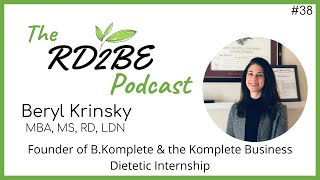
Beryl Krinsky, an RD who spent a decade at Campbell Soup, created the Complete Business Dietetic Internship to teach dietitians how to run their own practices. She shares how she built the program, what she looks for in applicants, and why most dietetic education skips the business side entirely.
Chapters
For applicants, we're gonna look for that leadership experience, whether that's having a volunteer role, a paid role, combination, leadership within undergrad or a master's program. So that's the first thing.
Do you ever have so many questions and no one to ask, so they're just wasting away on Google searches you'll forget about in an hour or so? We had that same problem, and that's why we created the RD2B podcast. Podcast, a resource for dietetic and nutrition students looking for answers that their peers don't have. We are students Macy and Emily and registered dietitian Carl Barnes. We engage in conversations and learn from RDs. Join us weekly as we gain insight into the unique journeys of registered dietitians all over the country.
Welcome back to another week of the RD2Be podcast. I'm your registered dietitian host, Carl Barnes. This is our podcast where each week we sit down with a different registered dietitian to not only highlight the diversity of opportunity in the profession, but to really dismantle this notion that there is a traditional career path in dietetics. On that note, very excited. We've been really making sure we're highlighting all sorts of different areas. We've highlighted some private practice, but to really dig deeper into the entrepreneurial side, we're sitting with Beryl Krynsky today. An entrepreneur in dietetics. Super excited to have you here. Thanks for, thanks for being here. I'll let you introduce yourself in more words than, than I can.
Carl and Emily, thanks so much. I'm thrilled to be here and looking forward to our conversation today. And ever since I was a little girl, I knew I wanted to be an entrepreneur. And so it didn't start later in life. But when I was little, I thought to myself, I either want to run a business, start a business, all of the above, and Fast forward many years and I'm living my dreams, which is so rewarding, so amazing. And I'm really looking forward to sharing my path in nutrition, food, dietetics. Definitely not traditional. I never worked in a clinical setting. And I know a lot of times people think you have to work in clinical, you have to pay your dues, at least 2 years in clinical, but I didn't. I did, so we'll talk about that. And one of my most, I guess you would say rewarding truly, was starting the dietetic internship. And so in 2020, we got accreditation for the complete business dietetic internship. And we have our first class, our top 10 is happening right now. We have our lucky 13 starting in August. And then we, we just got approved for a fall match and we can take up to 7. So we're rockin' and rollin' with that, so excited, and I'll stop talking 'cause I know you have questions for me.
Awesome, thank you so much for being here. As always, I'm Emily, your RD2B from University of Maryland. So what makes Beryl Krynski Beryl Krynski?
Oh gosh, Emily, that's a good question. I think that couple traits that I have that make me, myself, Determined. Determined and never giving up and having that belief in something more than myself. And so when I think back to starting both Be Complete and then starting the Complete Business Dietetic Internship and even further back in my history, getting certain jobs, there were a lot of roadblocks and a lot of challenges. There were a lot of nos. And I tried my best not to take things personally. And I kept, you know, that bigger picture in my mind, in my heart, in my soul. And just didn't give up. And that's a piece of advice I have for students, for RDs-to-be, for when you're in your internship. There are gonna be challenges. There are gonna be people saying no. There are gonna be people telling you you can't do something. But when you believe in it, a bigger, something bigger, you want to make a difference in the world and you don't know how you're going to do it, but you know you're going to do it. That's going to give you the motivation to keep going. So definitely that determination. I think the second thing is a positive attitude. I definitely had to work on that. And through a lot of learning about ways to manage stress, and practicing being mindful and having that gratitude, that has helped me to be so positive. You know, I have bad days and I have challenges like everyone else. And with that, I still can see the positive in the situation. And that kind of gives you that natural motivation to get up every day, get excited to go to work no matter what's gonna happen. I think it just gives you that natural fire. So I'll go with those two.
Most definitely. So would you mind talking a little bit about your background, like your undergrad experience, where you did your master's?
Sure. I went to undergrad at Virginia Tech, and when I was an undergrad, they had a major called Human Nutrition, Food, and Exercise, and that was specifically a dietetics track. And that was great. I loved my introductory nutrition class. That kind of sold it. I knew that was okay. I'm going to be a registered dietitian. I love this. It's so interesting. I always had a really strong interest in food also. And I graduated. And then I graduated in 2001. And back then, I don't think there were distance dietetic internships, or if there were, it was just starting out. So I just looked for in-person internships. And I ended up moving down to North Carolina, and I did my DI through Meredith College, which is in Raleigh, North Carolina. And that was an on-site internship. So I traveled around to different sites in North Carolina. That was great experience. I learned that I really liked prevention. I did not like treatment. And I still made the best of the clinical rotations, but I really liked the outpatient. I did my enrichment at Nike Corporation on the West Coast, and I loved how they had the wellness for the employees and they were all about exercise and healthy living and prevention. And I thought, okay, this is probably for me. In my internship, it was towards the end of our program, a woman came in that is is an entrepreneur. She had started a soy, an edamame food company. She had a big grant from the USDA to bring edamame cultivation to North Carolina farmers. So they were working on getting rid of tobacco and they were gonna grow edamame and she needed help. And she wanted someone with a nutrition background. She didn't mind that we weren't yet registered. I went and I spoke with her and her husband. I shared my background. They hired me on the spot. So that was my first job after my internship. And it kind of led me to get that master's in food science because I loved all of the food and the prevention. And we would do community presentations. We'd go into hospitals and Whole Foods, and we teach people how to enjoy edamame and cook with soy and heart-healthy recipes. And we would do cooking classes. And I really loved it. and I really wanted that additional background in food science. NC State is in Raleigh. They have a really good food science program, so just naturally transitioned to get my master's, and that was great because then I could go into the food industry and do all different types of jobs. So I'll stop. I think that answered at least the first part of the question.
Yeah, definitely. So what would, what are some experiences during your undergraduate experience that you think helped you for your internship?
In undergrad, I always studied hard, so I always tried to get good grades, and I always tried to do extracurricular, whether it was volunteer or paid work experience. And I think some of the extracurricular really helped me for the internship. For example, at Virginia Tech, they had wellness peer educators, and I did that, I think it was 1 or 2 years, and that was great experience because you're educating your peers on different wellness topics, and that's really good experience as you go into your internship. I also worked with a professor, and, and she would have me do literature reviews on different topics for her research. That was a really good experience because I got to read research articles, learn more about evidence-based and how you would reference things in your research. So that was really good. And then I had a cool job in a food science lab where I would bake. We were trying out different wheat varieties and I would bake different loaves of bread and see how much they would rise. And so that was also great as you go into your internship doing trials, learning about food science. Measuring, all the things you need to know for food science and food service also.
Cool, so looking back, what would you have done differently during your undergraduate experience?
That's a hard, that's a hard one for me to answer because I really, really enjoyed— I guess it's going back to the positive, the positive mindset. It's hard for me to say I would really do anything differently. I guess when I was Applying and interviewing with the dietetic internships, I, I applied to 5. I kind of heard that, you know, like that's, you know, between like 3 to, you know, 7 or something. That's what you should target. Maybe I would have done a little more research, but I loved my internship and I loved living in North Carolina, so I wouldn't change that. I think that all experiences you're gonna, you know, you can learn and grow. So everything was good.
What stood out to you about your, your specific internship?
Well, I did look for internships that were lower in clinical hours because I kind of knew even going in I didn't want to work in a hospital, and then it was confirmed when I actually did the rotations at the hospitals. But I looked for something that was lower in clinical, and I liked their internship because they had that enrichment, the 3 weeks where you got to pick whatever you wanted to do. You could be with any dietitian pretty much anywhere, and that was great.
Great. So I know you have your master's in food science, but I know you also have your MBA. So what made you want to pursue an MBA?
I ultimately knew that I wanted to be in the business realm, and I knew that I either wanted to have a leadership role within an existing business or create my own businesses. In traditional dietetics, you generally don't learn business acumen. You don't learn structure of business. You don't learn legal considerations. You really don't learn sales and marketing. And I knew if I'm gonna start a business or take on a leadership role at an existing business, I need that business acumen. And I was living in Philadelphia, I went to St. Joe's, they have different MBA programs. The one I selected was, it's called an executive MBA, so you can keep your full-time job and you can go to your classes on Friday and Saturdays. And you can stretch it out. So it took me 4 years to complete my MBA, but I wanted to keep my full-time job. And the focus was in food marketing. And so I got to network a lot with other people within the food industry that were getting their MBA within my class. And I learned about finance and econ and accounting, and that was great. And then that MBA, opened up the door so that I could get a marketing job. And so I was able to be, it's called an associate brand manager. So within that role, you are managing a brand and I was on the Campbell Soup Red and White team. So managing the, the red and white soup, the chicken noodle, the tomato. And as you can imagine, that's a huge responsibility. And so you're managing the profit and loss statement for like a multi-billion dollar brand, which is such great experience. And I got to help out with some of their advertising, their marketing, their cost reduction operations, just all different things that you need to understand when you run a business. And so then it was a pretty much pretty natural transition when I said, okay, I've had enough of corporate America, had a good run, 10 years give or take, and I'm ready to go out on my own and start a business. Definitely.
So I know you worked at Campbell's like you just said. What did you do as an RD? So I know, I understand that you did it for the MBA perspective, but what kind of experience did you have having the RD credential at Campbell's?
It was a little different at Campbell's because when I got into Campbell's, I was really going more in, they wanted to hire me because of my master's in food science. They liked that I was a registered dietitian because they knew that would bring an additional depth to the role. But the reason I got in was for that master's in food science. My first job at Campbell's was in product development. And so I got to work, I worked with the Prego and the Pace team. Got to develop some Prego sauces. I actually worked with a chef. We developed some sauces under the Wolfgang Puck brand, worked on some paste projects. And then I, when I was getting my MBA, I transitioned into supply chain and then I was a project manager and then completed my MBA, transitioned into marketing. As a dietitian, so for people that are interested to get into the food industry, You don't necessarily have to have a master's in food science. You'll need a master's in something, but you can get into the food industry in different areas. For example, Campbell's has a kitchen. It's a corporate kitchen, and dietitians will work in the corporate kitchen. They'll get to do consumer-facing. They'll get to work on recipe creation. They'll help out with the website. They'll do really cool, innovative things that are different that you would normally do. And they don't have a master's in food science. They might have a master's in nutrition or communication or public health, something like that. And you can also get into food companies for different types of communication roles. So sometimes food companies will hire dietitians to help out with all the website copy, the public relations, managing the social media, helping with recipes. Customer service, things like that. So those are some ways to get into the food industry.
Great, and then when you trans— when you did your transition from Campbell's to creating your business, how did you go about that?
I luckily had an amazing business mentor because even with that MBA and even with 10 years of experience, starting a business is really hard. And I luckily had another entrepreneur, very successful. He had had his businesses for many years and he showed me the ropes. He said, okay, the first step, the first thing you need to do is you need to get insurance. You need to protect yourself always. First step, insurance. In the internship, the interns have to get their insurance. They're like, what is this? First step, get insurance. So that's the first step. Then you look into, okay, branding. And he kind of just went through all the steps. And so I am extremely grateful for that. And that's really what helped get it started. And then through networking, through a lot of networking and listening to podcasts and getting additional mentors, that's, those are all the things that helped me start Be Complete and then ultimately start the internship as well. And that's really the reason for the internship. I wanted to, I want to give back to the dietetics profession and share all of those tools and tricks and insider information into how to start a business because it's not taught. So that's the whole reason for the internship.
Great. And then what do you do as a chief executive officer for Be Complete?
Well, I do lots of different things and let's see, I do the sales and marketing. And so that involves whether that's scheduled sales calls, I will do cold calls also. Um, Olivia now is helping with the marketing. So we'll do newsletters, um, social media, things like that. And I do the hiring for our team. So Be Complete is a really holistic firm. We have registered dietitians. We also have yoga instructors, chair massage therapists. We have dietitian technicians. We have personal trainers. So it's very holistic. So I'll, I'll interview, hire, screen the team members, do training. And let's see, I love doing, I love creating some of our materials. I have that creative streak, so I love creating PowerPoints, things like that. And let's see, we have an office space, so it's kind of like managing the office. I have a great office assistant, she's awesome, so she helps out with a lot of like the invoicing, scheduling events, things like that. Gosh, I don't know. When you're an entrepreneur and you're running a smaller business, you do have your hand in a lot of different things. So now, you know, I have a small team that helps out, which is great, but I still kind of have my hand in a lot of things. Awesome.
So I know you wanted to create the dietetic internship to give back because you had so many great mentors to help you. So how did you start creating a dietetic internship? What does that process look like?
It's a lot of work, and the first step to create a dietetic internship is that if you're a business entity, you have to have been in business and profitable for a minimum of 5 years before you even apply, because ASCEND doesn't want a business starting an internship and then going out of business. That would be a huge disservice to the interns and the potential interns. So the first, that's the first hurdle. Then after you pass that hurdle, you do, I can't remember if it's called a self-study initially, but you do a really lengthy report and it's kind of like a business plan. So you'll detail all of your ideas and how you're going to execute this internship. You'll have to provide financial information, operational information, your team. Oh gosh, educational components. It's, so think of like writing a 200-page book basically. So that's what you use to apply. Then Ascenda will review it. And then if that passes, then you go to the next step. And then I think you do another really long write-up business plan, and then you have a site review. So then reviewers will come, they'll meet you, your team, potential preceptors. They'll kind of look at everything, make sure everything's in a good spot. They'll have questions, you have to go back, review, review and redo some things, and then, you know, the goal is then to get your accreditation. So the process can take anywhere from— the shortest would be, the shortest would be a year, up to like 2 years, just to get that initial accreditation. And then you have that initial accreditation, and then within the next, call it like 3 to 4 years, they'll come again and then they'll do your full accreditation. As long as you pass that, then every 7 years you are up again for a review.
Awesome. So as a program founder and director, what are a few things that you want to make sure that you have in your program that sets you apart from other dietetic internships?
Sure. Well, the heart of the program is that business focus, and we always will have that real— what you need to really know and do to start a business, because the model is for anyone that's really serious, when they finish our internship, they have the tools to start a business. That's— so that's number one. Number two, we, we have one existing partnership and working on with working on additional partnerships with master's and MBA programs, and we're going to have really exciting master's RD tracks. Some are going to be short, like I'm talking 12 months to get your supervised practice hours and your master's. And then we'll also have MBA options to have that RD MBA credential, which is going to help open up a lot of doors for RDs to be. Let's see, we have really innovative rotations. And so we do, of course, we have clinical, food service, community, have to have that. But we have 8 weeks in business and our interns will rotate private practice, media dietitians, industry dietitians, all these things that aren't often available during internships. We have front and center in our internship. We also have the 3 weeks of enrichment. When I did my DI, I just loved enrichment so much. And so we brought that into our internship and our interns are doing amazing, amazing experiences for their enrichment. They're working with media dietitians. They're doing rotations with dietitians that are in academia. They're doing podcasts, dietitians, all different things for enrichment, which is really, really exciting. And I guess the last thing would be some of our food industry partnerships for the internship, where our interns can do rotations if they select to get that great hands-on experience working at a food company as a dietitian.
That's awesome. So, um, I know, I'm sure that you are the one that reviews applications if you get a student interested in your dietetic internship? Am I— is that right?
So it would be myself, our assistant director, and then several members on our board. We have an awesome board also for our internship. We'll help review.
Great. So what do you look for in a potential applicant to be a good fit for your dietetic internship?
For applicants, we're gonna look for that leadership experience, whether that's having a volunteer role, a paid role, combination, leadership within undergrad or a master's program. So that's the first thing. We also want our applicants to have some type of work, whether it's volunteer or paid experience. And we like to see applicants having overcome something. So really strong applicants could say, I maybe came to this country, didn't speak English, I worked really hard, I did really well in my undergrad or my master's, and I worked really well on my English, and I wanna become a registered dietitian. That's such a strong candidate. Or someone that says, I had a personal health challenge, and I had to maybe stop for a semester, but I overcame, and I still graduated, and I still got good grades. Or I was an athlete, I was a college athlete, things like that. So something that's gonna stand out a little bit showing that they're not afraid of hard work. So that's really good. We look for professionalism. And professionalism can be shown in the very first email. And so when applicants will always say, they don't have to say Miss Barrel or whatever, but if they say Dear Barrel or Good Morning Barrel or something like that, just that little, little heading is going to make such a big difference. Sometimes applicants will say, hey, that's not professional. And so just that little difference makes— it really does make a difference. And then writing in complete sentences, having specific questions really, really helps. If it's very vague, doesn't show a lot of conviction, and it might not show they're very interested in the program. And then another thing is having a little bit of that entrepreneurial excitement or potentially even have having started a business. Some of our current, our current interns and our interns on the way have already started businesses, which is such great experience, and it shows that they're not afraid of hard work.
Great. And then as a distance internship, how do you ensure that your students maximize their potential during your internship?
A few different ways. We're really proud of our curriculum, and we created a very comprehensive and detailed curriculum for all rotations so that wherever the intern is doing his or her rotation, they're going to get a comparable experience. And it kind of makes it okay because some preceptors are amazing, and then some preceptors are not as experienced or not as caring. However, with our curriculum, the interns know these are the questions I need to ask, these are the things I need to learn, and these are the assignments I need to do to make sure that I'm entry-level. And we also link up all of the competencies so the interns know, okay, even if it's not the best rotation, I still know I'm achieving these competencies when I ask these questions, when I get this hands-on experience, and when I do these assignments. So that's one of our main, main help, I guess, to get— have everyone have a consistent experience. We also have class days. So we do our class days between once and twice a month on Fridays, and we will review a lot about business and a lot about the rotations. We'll also do the RD exam prep in our class days. So this is also helping to drive a consistent experience for the interns. Plus they get to know each other. And our top 10 class is really tight. They have a text, a group chat. I think they text each other every day. They are constantly talking to each other. They're some of— sometimes they do rotations with each other, which is great. We have them do team projects for the class days and they've really gotten close. And our lucky 13, we're going to follow a really consistent model to that. And we are assuming they'll be very close with each other too.
So how do you go about planning a curriculum for a dietetic internship?
Gosh, well, we have used some things that we've learned from other internship programs, what works, maybe what doesn't work, and the— my current assistant director had worked at a university-based dietetic internship for several years. The assistant director that I had previously had worked for a dietetic internship and worked in academia for many years. So making sure that I have people on the team that are smarter than me in certain areas and more experienced in certain areas is great because I'm not going to learn everything about everything, and that's fine. But then having those people on the team, plus our board is extremely diverse and has a amazing backgrounds, and so they've helped out also. They will help and look at curriculum. They'll also look at our internship goals and objectives. They help with interviewing the candidates, and so there's really a whole team behind the development of the program.
So for someone who doesn't have that strong of an interest in a clinical setting and having a clinical setting in your rotation, how do you make sure that you stay up on the latest information? And, you know, yeah, just I guess keep up on the most up-to-date info.
I don't pretend that I have any up-to-date information on clinical nutrition, and that's why I hired an assistant director that had worked in a hospital for 6 years, so, and is very up to date on clinical Plus, some of our board members have worked 20, 30 years in clinical, and we can always reach out to them with questions. And then when we're— we are reviewing preceptors too, we want to make sure that the preceptor has had a minimum of 1 year working in the clinical site before precepting our interns. We prefer at least 3 years. And our clinical curriculum has been reviewed by many different dietitians. To make sure that it is as up to date as possible. We're also members of the NDEP committee, and so that we're on that listserv, and that listserv sends out up-to-date information for clinical, community, public health, so keeping up to date a variety of ways.
Great, and then I know you, I'm sure you haven't always had a clear vision of where you saw yourself, but how has your vision changed over time?
Well, Emily, I feel like I did have a clear vision of when I was a little kid. I just, I kind of knew it. I, I always loved food. And so I didn't, well, I didn't learn about nutrition until I was a little bit older, but I always loved food. When I was really little, my parents would take me, they would just take me to dinner with them. They'd always just take me. They would feed me whatever they were eating. And I just started developing more of a mature palate, I guess you would say. And I would talk about, well, this cheesecake is good, but it's not the best I've ever had. And I would say like, I want quiche for my whatever. And I had very rich taste when I was little. I used to— I don't eat meat anymore, but I used to love fried chicken. I'm always like, I want fried chicken, all these different things. And so then when I was in 7th grade actually, my science project, my mom said to me, she said, why don't you do a science project and you can do food makeovers? Because kids, you know, kids eat lots of junk food. So when I was in 7th grade, the most popular lunch item was something called a pepperoni roll. And it was, you know, white roll, pepperoni stuffed in with some American cheese stuffed in, and people would love it and eat it. Really not very nutritious. So I developed these healthier versions of the recipes. I had my classmates try. Everyone really liked the healthier version. I think I won like the state science fair or whatever it was. And then I started thinking, oh, so you can eat food, it can be really delicious, and it can be healthy? Wow, that sounds really interesting. And so kind of, I think my path was predestined.
Awesome. And then I guess my final question is, if someone was on the fence of going between your dietetic internship and another one, what would be your selling point as an entrepreneur?
Our internship is laser-focused in helping our interns create the business of their dreams. That is what we stand for. That's what we're all about. If you want to start a business, if you want to start a private practice, you want to be a consultant, you want the ins to get into a food, a food industry job, our internship is for you.
Awesome. Well, thank you so much for taking time out and speaking with us today.
Oh, it's been my pleasure. Thank you so much for having me.
Thanks again, Beryl. And this is fantastic for all the students. This is one of the top questions we get is private practice related things, entrepreneurial questions. So I think you really really shine a great light on it and showcase that the sky's the limit. And you can even be planning this stuff as, as a student. So for, for all those listening, join us each week. We showcase a different dietitian each, each week and we drop a new episode every Sunday. We'll see you on the next one.
More from Beryl
Dietetic Internships - What You Should Know ft. Beryl Krinsky | My Dietitian Journey