How to articulate your value proposition workshop #2 with Betsy Tong
Najafaisal and Betsy Tong work through a framework to turn Betsy's ICP (mid-size SaaS execs at $10M–$250M ARR companies) into a high-converting offer. They map her skills against their core pains: scaling, margin issues, meeting overload, AI governance. The sample outcome: save 10 hours per week in 14 days.
Questions this video answers
September 15, 2024
Tech/SaaS executives at companies with ~$10M–$250M ARR and ~50–500 employees
Reclaim 10 hours per week (a tangible benefit) delivered within 14 days (sample timeframe).
Parrots Lab (website referenced: ParrotsLab.com)
30-day satisfaction guarantee ("if unsatisfied within 30 days, you don't pay").
Chapters
Again. Hi, Betsy. How are you doing today?
Great. How are you?
Good. Good. Happy Saturday.
Happy Saturday.
All right, and this is week two. This is our second session.
So in the first session we talked about.
Just to recap what we are doing here as a project between you and me, my name is Najafaisal. I'm the founder and CEO of Parrots Lab, which is a B2B market marketing agency. And Betsy, why don't you also give us a snapshot about you as well.
So I am a business advisor to executives in primarily SaaS or tech companies. And I'm what happens if you have a McKinsey partner plus an executive coach who grew up building huge organizations, taking PowerPoint into business, and have this applied knowledge that I bring to bear.
Awesome. And your company name is?
Ignite AI. Ignite AI Co. Absolutely.
And you've written already two books.
Yes. So back in July, because I wasn't very busy or busy enough, I wrote two books. The first one is called, called the Edge your brain on AI, which is talking about a use and a relationship with AI like ChatGPT, Claude and others that really helps amplify who you are and what you do in a way that I think most. Most of what I read and see about AI is more about how do I get more productive, how do I do things faster. And this is really about how you train yourself to work differently and then.
Drive more insight, drive more execution because you are using AI. And the second book is about being the unpaid caregiver for my dad who is in early stage dementia. And all the things that you don't think about that when you're fighting with somebody who has cognitive decline and you think everybody is logical and data based and. And the conversations that happen and the protections that you have to put in place. And so both books became bestseller. And yes, that is me.
Awesome. Sounds very good. And just to put things in context, so we met. Betsy and I met on the first collaboration was a podcast episode. Feel free to check it out. I probably put the link somewhere in the description of whatever videos we comes out of this collaboration. And then this is a kind of a second project where we are collaborating on building.
Betsy's marketing system and starting with the core foundation of her brand and looking into.
In depth on what is her ideal customer profile, what is the value proposition to state it and articulate the value proposition and then from there building a connection offer that she can put on a highly optimized landing page that can convert a stranger into handing over their email address. And starting building and nurturing that relationship so that eventually Betsy could.
Betsy and that prospect could hop on a call and have a discovery call and then from there see if they are a good fit to have a long term customer agency relationship or customer coach or customer advisor relationship. So this is basically the project we are after and I'm going to try to share my screen a little bit to just show the map of what we are doing here.
So let's see.
Yeah, so that's basically the map. The first week we did the ICP identification framework, we talked about everything like how to discover your icp. And this week we're going to be focusing on the value proposition. And just to quick recap what we discussed last time, which is a framework that I've developed on how to really find this ideal customer profile. And Betsy and I talked in depth about it last time, which basically looking at your background as a company or as an individual or a founder and then shortlisting growing industries within your scope, within your perception, within your field of vision and then putting them in a short list and then from there try to scrutinize that shortlist of industries and using the four circle criteria in the right side to navigate and eliminate the niches that you probably don't want to focus on right now and keep on the bullseye on the star, keep that niche that fits within all the four circles and that would be your main focus as an icp, at least for the coming six months until you basically exploited that opportunity to the maximum. So we talked about last time and we entered into a deep discussion with Betsy and Betsy went home and she come up with a more in depth analysis. By the way, Betsy, could you tell us what do you think about this session of last time? What's your reflections, what was your takeaways from what we discussed last time?
So I very, I believe this is incredibly effective. And one of the things that I was just writing an article about for LinkedIn is most of my clients, regardless of the issue that they hire me for, have no idea who they're talking to on the other side. And, and so for example, if there's a marketing issue, they say, well, we market to MedTech B2B companies. That's a category, it's not a person.
And it doesn't get precise enough in a way that you can really show how you're relevant to a person who is in a business trying to do a thing. And that's why I think the ICP is pretty powerful. And the other thing that I really like about it that I also don't hear enough when I'm working with.
Other clients is they don't understand, they haven't thought about the easy to find, the enjoy working with and the purchase power. If they're smart, the most that they get to is biggest pain, but the other elements are missing. And so it's great if you understand and you're solving a big pain, but if somebody, as you said last week, can't pay for it and they are not easy to find in the sense that they're not in your natural network and you don't enjoy working with them, then it's probably not the right client for you anyway.
Yeah. And last time we also went into discussion on whether an entrepreneur would fit within your ICP or whether you want a more established company executive. And we talked about the difference between that. So right now, as of with this last week, you have thought about it, you shared some document and thinking process about this particular topic. Have you found or articulated who is your ICP right now?
Yeah. So I think the issue that I was having last week is when you were trying to put me into a place of talking to founders and entrepreneurs versus senior executives is on both extremes. Neither of those things work for me because one doesn't have the purchasing power and the other one has too much bureaucratic process that a solopreneur can manage. And so the sweet spot that I came back with after many discussions with, with ChatGPT, Dave is.
A tech or a SaaS executive in a business between 10 and 250 million that that has maybe 50 to 500 people in the overall organization. And that is, you know, from a purchasing power perspective, that's somebody for whom my particular fees and retainer are going to be a nit. And then I will not have to go through a massive RFP procurement vendor qualification process that takes me six to nine months.
Just for the record, when Betsy talked about Dave, it's her AI. So she has multiple, multiple ones and each have their own kind of personality and character and a name.
And so, you know, one of the brilliant things about this day and age is even though I am, I work, I'm a solopreneur, I have a whole organization built out in AI that I use for various purposes. And so Dave is.
My COO.
Yeah. And you say on LinkedIn that you build AI factories for those executives. So in terms of ICP and based on what you sent me, in terms of documentation, we're talking about mid size SaaS companies. We're talking about executives within those mid size. And what, what you did very good about is that you identify not only mid size, you didn't keep it Vague. You mentioned 50 to 500 employees. So we're talking about a very specific type of companies that you can identify, easy to find, and you could look into the executives of those companies. And you mentioned that vp, CEO, CEO. So you're very, you nailed down the ICP into an identifiable.
Specific kind of avatar of people, which exactly what we like to see.
Yes. And then the other thing that I thought about and I, as you know from last week, very much resisted picking a industry. And SAS is, I guess it's sort of an industry, but the reason why SAS made sense to me is that these are executives who have a great understanding of agile from a development perspective and have an agile approach to mindset and to business as well. And that I think is the type of leadership style that I very much enjoy working with and then also would particularly benefit from the way that I work.
Yeah. And if we examine that ICP, when we talk about executives in, in around 500 employee SaaS companies, if we put the, if we evaluate the four circles here, why would you think their biggest pain is?
So I think for many of them it is an issue of scaling, right? And so they've gotten to a point and they're probably finding a couple things. One, it's harder to grow.
To the fissures in their foundations and the way that they do things are showing up, especially if they've grown very quickly. And so there might be both.
Strategic revenue that they're trying to get at and figure out adjacent markets or how to do better at the markets that they're in. And there also might be gross margin operational issues that, where things are breaking and they need to figure out how to do better.
You know, what are the levers that actually help improve their churn, improve their margin, what, what have you. They can no longer throw money at the problem or throw people at the problem. They need to get to that next level of consistency and maturity in the way they approach things. And then the other thing that I think that happens again in any company, much less.
Much less the target that I'm going for. And the kind of executive problem that we have is we have this idea that more activity means better. And activity for an executive tends to be more meetings. And you know, meetings are not actually an output, an outcome. And so what usually happens is everything is important, therefore nothing gets done. And what I really try to do from a Coaching perspective is sort of think about what are the one or two things that truly, truly matter that you need to be focused on versus the 19 tasks that get put on your plate.
Yeah. And another, when I was reading your documentation, when I also, you know, again, it's an additional kind of idea around that biggest pain for executives these days that they are seeing all that buzz going around AI and they are kind of feeling left behind because they're very busy. Their time is so absorbed and they don't have that time to dedicate, to learn about how AI is going to help them learn about how to integrate AI within their workflows. So there's a lot of professional development that needs to happen for those executives to stay relevant in a very, very competitive landscape.
And what's even worse, on top of that, what's even worse is many governance boards and compliance officers and others are dictating how AI is being used in the companies. And they are not actually native users in the way that you and I are. Right. And so you have these people who don't understand fundamentally how to use AI in the way that I do or you do and then are coming from the, well, we can't let anybody use it because we have all these compliance issues. And the answer should actually be this is what it can do. This is the way we would like to use it. We have these constraints which are the compliance issues. And then now let's figure out how to.
Achieve our goals using AI. And so my typical client who are senior executives in companies, they don't have time to learn AI. You are right. And they also are not necessarily hiring me because of AI, but they understand that by working with me, I will also teach them skills that they need to be successful and what I call robot proof in the future because I fundamentally am trying to change the way they work, not just give them, you know, strategic insight.
Yeah, absolutely. The other criteria are also you've really went ahead and identified them like they have the purchase power check. They are in a growing industry. Obviously. SaaS is a growing industry. They also, they are easy to find. You mentioned that there are many platforms that.
You can easily tap into that segment. So we're very good there. Congratulations. I think that you have a very strong icp. So. Amazing.
So we can Dave now.
Yeah, so tell Dave that, you know.
He doesn't did a good job with me.
Absolutely. All right, so now that we identified the ideal customer profile, let me talk to you today about.
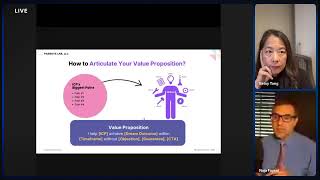
The articulation of the value proposition and why it's important. So we all, you know, interact with people, whether online or offline. And the first thing we, we are asked, what do you do? And this is a very difficult question to ask and, but it's very essential for us to know on the top of my, our mind on a very high level, exactly how to answer that question. Not only. It's good to, for the, for the person on the other side. When you answer that question confidently and with clarity, you also, it's also important for your business for. Because everything else stems from that statement, right? So if you have a clear value proposition, then your content will be easy to create because you know exactly what you're going, going after. And also you know, who is the person on the other side that you're talking to with your content. And then what are you, what, what you're trying to achieve with them. So this is a statement that, you know, whenever it's done, it gives so much energy and direction and, you know, purpose and it clarifies the engagement with, with other people and it also clarifies your own mission with, with your company. So how do we create that value proposition? And this is basically what I'm trying to achieve today in this slide. I, I mapped out, so the ICP's biggest pain that you mentioned, the ICP's biggest pains. We list them down, we see, okay, which of these pains are like, so crucial and need to be solved for the icp. And then we looked at our skill set. What are some of the skills that we have that could contribute and effectively solve the pains or the problems that the ICP have?
And it takes a lot of, like, research and soul searching. And once we have that map, we map the skill set we have and we map the pains of the icp. Once we do that, then we can start doing the matching part where we match the pain with the skill set that we have or the skills that we have. And then we arrive into an, a dream outcome. It's kind of like a simple equation. Pain plus our skills equal dream outcome. And we do that for pretty much all the pains that we have for the icp. And then we looked at the dream outcome and then we evaluate them. Which one is the most important, which one is the highest priority, and which one is the one that.
The ICP would be willing to pay for.
Once that is done, then we look into the mechanism of how we're going to deliver it in a unique, special way. That's when we talk about the unique methodology within that value proposition. But also we shouldn't forget that.
Time is the most valuable asset that everybody have. If I tell someone, just random example, if I tell someone that I can help you lose 30 pounds and I, and I put a period there and then the question becomes like, by When? Because 30 pounds in five years. No thank you. Like, I don't want 30 pounds in five years. Right. We want, we want a time frame that bounded that relationship within a time frame time constraint that makes it more tangible. And like, I know like in two weeks is different than one year. So there's, there's that time that is important. But we also want to address any objection that they might have. So. Oh, you wanna, you want me to lose 30 pounds in, in, in two weeks? Well, I might die because of hunger. So that's the objection that naturally comes out when you propose this kind of value proposition. So you need to address any objection that your customer might be thinking about when you subject them to that proposition. Because in the end of the day it's a proposition, it's like a proposal. You're putting it in front of your icp. And then finally, to battle any last minute resistance, we like to offer a guarantee. Like in my, on the Paris website, ParisLab website, ParisLab.com, you will see that if unsatisfied within 30 days, you don't pay. So I make it so easy for them to say yes. Because you know what, if you're not satisfied, we're not going to refund you all the money back. So with that guarantee, they will feel the decision becomes easier. And that's what we need to achieve. And then we finally end it with a CTA, with a call to action. Because again, this is kind of like an elevator pitch or something that in the end of that elevator pitch, we want to ask for a next step. And that's where the CTA comes about. So what do you think about this structure so far?
I love it. Lay it on me.
Okay.
Magic.
So again, I thought about the proposal I'm going to tell you for your value proposition before this conversation.
So I didn't have the insight that you brought just today. So I thought about the proposal initially when you sent me that documentation, but it might change. But here's what I came up with.
Okay, Can I write it down?
Sure, yeah. You can even take a screenshot or something.
Again, it's before all the insights that you just laid today. So you may go back and change it. But I want to highlight few things that are interesting here.
Executives of around 500 employee SaaS notice that I didn't go with the range. I go into around 500. So we're talking more or less, so we're keeping that flexibility, but we have the 500 number there. So we are specific enough to know what are the companies that we're approaching. And then SAS is your industry.
And then executives. So executives are the C suite, Very, very, very clear. So we have a specific ICP and then the dream outcome. This took me a long time to figure out because you can.
Serve them with a variety of different services that they can benefit from. But I'm looking at what is the most tangible thing that.
You are giving them, what is the specific deliverable that they can.
They can justify them paying for. And time is the most precious commodity for those executives. If you can reclaim 10 plus hours per week for them, you are making a big leap in their productivity, efficiency and time with their family. Right. So you can package it in so many ways because. And this is really the ultimate promise of AI, isn't it? Like it's really all about time saving. Right.
I don't agree.
For me, the ultimate power of AI, time saving is an element of it. But the ultimate power of AI is it enables you to do things in a way that were impossible before and to get there better. And so, so.
This really. Yes, absolutely. Saving time for an executive is an important thing to do, but automating what they do today is not really an outcome. I'm not an automation specialist, I don't automate anything. But what I do think about, like in the case of my book, I wrote it in 72 hours. And so I didn't automate writing. What I did was I sort of thought about my thinking process and I said, well, I need to this type of feedback, I need this type of research and insight. And then I created a factory of workers to help deliver that to me. Or, and I need this type of, I will need an editor at the end. But I did not automate the writing itself. So, yeah, so as I said, time and effectiveness together are good. Automating actual process is probably somebody else. I'm not a automation or outsourcing genius, nor do I ever want to be. Unless you're talking about how do you create better process for your brain.
Right. So as I said, this is a proposal. So yeah, we're, we're just outlining here a thought process of how to approach that value proposition.
No, very good thought process. Very good thought process.
Yeah. And in the end of the day, when you talk about writing a book in 72 hours. Where in the past, before AI, it will take you months. So what you reclaimed is months of work. Right. Even if there's other effectiveness, you know, you have still have to do a lot of work yourself. We are not denying that, whether for you or for the executive that you serve. We're not saying that we're going to replace your job with AI.
No, no, no.
We're just gonna. Saying that we're gonna make, we're gonna give you more time so that you can do what you do now in less time. And that's really the power.
No, again, I fundamentally disagree because AI is too much put in the place of the, the tool, which is exactly what you're describing. And it's an intelligence. And yes, there is the capability to have tons of agents to do work for you, but if you don't understand how you change work because you have access. And this is, this is the story of the book and how I created the army of agents to create, to help me create a better book than I would have if I had just been by myself with my computer and, you know, Google for research. Okay, the library it is. So, so.
Just.
So what is your deliverable. What is the specific deliverable that you can replace reclaimed 10 hours per week with?
Well, I'm not stating that I reclaim 10 hours per week. Yeah.
But I'm saying what would you replace it with? Like, if you, if we were to remove that reclaim 10 hours per week and put something instead of it, what would that be?
So say you have 25 projects that you have to work on. Or 17. Right. Whatever the number is. I tell you the three that create the most leverage. And so that saves you money, time and then gets you to effective delivery faster. It's a higher level issue than just my personal time and how much time I'm spending on something and whether I can automate the tasks around it.
So you will help executives.
Identify the, the, the, the three top priority projects to work on.
I could. That is, that is something that I do. And so I have a, I have a framework that I use, which by the way, NAJA is automated. Semi automated. Right. Because it can't be fully automated. You have to have interaction that a normal consult. So let me give you the contrast. If you're going to hire a normal strategy consultant to help you define your strategy and your North Star and where you want to go and what markets to go after.
There'S a procurement process that happens in an rfp. There's a vendor qualification, and then there's contract negotiation that's maybe easily typically two to three months. And so then you have this idea that you want to get off the ground. You try to hire consultants, you've already wasted three months and countless internal hours to try to get the vendor in. And then There's a typical 12 to 16 week consulting project cycle that has a third of that in discovery. Not to mention you're onboarding their team and they want you to create a steering committee and all this other infrastructure because their goal is to sell you the next project and to land and expand. I can come in and you can be walking the dog, you can be going to Starbucks and we could talk for 45 minutes, 30 minutes, whatever. And you can give me the layout of what you want to get to and where you want to go. And so for example, if you have a million ARR target, here's the ideal state, here's the inputs and output KPIs and then where you currently at. And then I can do an analysis that shows you these are the top levers of inputs that you need to focus on. That's in one conversation. In I could do it in less than 30 minutes. If you have some basic figures about what are the KPIs that are important and then what your own inputs. I don't even need to know what best practices because obviously I have access to all of that via AI.
Got it. Anyways, we're talking here about it's a sample value proposition. So I'm going to keep repeating that because I don't want you to think that this is your value proposition. It's really. You have to write your own value proposition. I'm just showing you a framework of how to articulate it. And the main key points are underlined here. For example, 500 employees, how specific can we get the better 10 hours per week. This is basically a tangible benefit that an executive could get from let's say if this is not your service or not relevant to you. But I would say that for me, I would probably create a product around that value proposition because I feel that executives would love to save 10 hours per week and stay on top of the AI revolution because that's they hire us to be their AI consultant so that they could catch up and not miss out on that revolution yet and see how I address the without part. So without adding to their workload. Because this is what they don't want. They don't want AI to be an added work workload. And therefore we address that objection. And also we added that within 14 days. So if I get engaged with a client, you know, I want to establish their, their, I want to save them that 10 hours as quickly as I want, as as quickly as possible. So I want to claim their 10 hours per week and as soon as I can. And in my head I think you are able to do it with, by, and this is the methodology here. How would you do it? You identify their top three time consuming tasks. The first question you ask your prospect or your client is that what are your top three time consuming tasks? And then from there there is a, you know, I've done automation, I've done, taken many courses on it and I'm, I am, I understand the concept and I've done some automation myself. And there's a process, there's something within robotics and automation called process mapping, which means that you take that task and then you break it down into little individual steps that needs to happen for that task to be completed. And then, so this is basically the methodology of how we're going to save them 10 hours per week within 14 days. So I will use that, that blue line here to identify, I mean this could also be shorter at some point. Like we could find ways to make it shorter and then without, as I said, addressing the objection and then finally a call to action. Now what is missing in this one is a guarantee, perhaps we can add that. But in general we don't have to use every element in that. For example, in these ones, especially when it comes to putting your value proposition on LinkedIn, we might not be able to put, to put the entire thing there. However, you know, just choose what is the most relevant, what's the most important, but you should know by heart, like what is the, what is the individual elements within that value proposition that make a lot of difference. So I know that this probably not so relevant to you or you don't agree with it. Again, it's a proposal at this point. It's not something that I'm projecting at you. I'm saying you have to do this. Of course, nothing is like, you know yourself better, you know your skills better, you know what you want to accomplish with your clients. This is something individual to you. This is just a sample to give you an idea of how this value proposition would look like.
Yes. And so, for example, if I were to take this, I already know, because I've been an executive in tech at some of the largest companies in the world what the issues are and what are the things. Nobody even has to tell me what their most Personalized, like how to save them 10 hours. When you're in meetings all day, you're context switching all the time. You don't have time to take notes, you don't have time to reflect on the meetings. So for some of my clients, and this doesn't take 14 days, it literally takes me a couple of hours thinking through how they think and how they like to see data organized. And I can create a custom GPT that they dump transcripts of their meetings into and they get.
They get, they, they get the outputs of the meetings that they can refer to in notes. The other thing is that a lot of executives spend a lot of time in reviewing people who work for them work. Well, if your standard operating procedure is you have a chatgpt that that person goes to.
Review their work against before they come into a meeting with you, you can be much more targeted in the meeting. Like all of those things I can do, it's just again, it's not my core, it's not the core value. If it's the most value to my client, I do it for them, but it is not the core value of me.
Yeah. And as for people listening, you're seeing this role. So basically Betsy and I never like did anything backstage. So all of this is happening live. So we might disagree, we might agree, we might fundamentally be on a different tracks here, but that's really what happened in the real world. When we engage with clients, we as an agency, we don't inherently know every single thing that goes in the mind of our client. What we try to suggest are frameworks and thought processes. And whatever we suggest something, it's more on this is how we think about it. But we are not by no means claiming that what, for example, I think is going to be true for what I think is true is true to you, Betsy, or true to anybody else. It's not the case. It's just that we are sharing what we know to be effective in crafting that statement, which is very important for the long run.
Yeah. And the discipline. And again, I think the value is not so much that you nailed my value proposition. That wasn't the expectation. I think the expectation was here's an approach of a way you can think about it and you're an external person sort of thinking about my market and what I said about my market and applying your lens to it, whether it is nailing it or not, again, was never the idea based on a, you know, 30 minute review of my, the document that I sent you. It is the, the structure of the methodology behind.
What you came up with, not the thing that you came up with alone. And that for me is, is the value of engaging.
Awesome. And just like you did with the icp, you know, last session we had the session and then you went, went and then you shared with me your ICP statement and all of that. Maybe for next week we can, you could work on that.
And then David and I will whiteboard.
Together, you know, the homework, you know, I have to give you homework.
I know, I know, I know. It's fine, it's fine. And by the way, I love it because this is, you know, this is really important.
This is really important. And having an expert like you help me crystallize the framework on which I hang my hat is, makes me better than I would have been by myself, even with my brilliant army of chatgpts.
Amazing. And then after we nail out, we nailed down the value proposition that is specific and unique to you, we're going to look into building a connection offer. And this connection offer, some people call it lead magnet, I don't like to call it lead magnet because lead magnet feels very devilish, as if we are tricking the customer, which is really not the intention here at all. The intention here is really offering something of value and offer it in exchange for contact information, in exchange for the opportunity to connect with that, with that prospect. And this.
Must be a very valuable thing. On my website, ParisLab.com, i've outlined my connection offer, which probably I could perhaps show you an example.
Off it real quickly here.
That would be great.
Yeah.
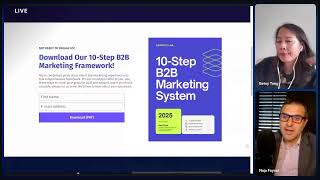
So this is basically the landing page of pirateslab.com and as you can see, I have addressed my addressable market, My ICP is right there. And then this is what my promise to them is. And then here is my guarantee that I talked about. And here we addressed any last minute resistance. So the application process, obviously I cannot take any client that comes my way. I have a very limited capacity, so I have clients would have to apply to see if we're a good fit. So there's an application form, very small, it takes two minutes. And then I assured them that I take only limited number of clients and I don't take competitors. And then shortly down after, if they're not ready to engage us yet.
They would download our 10 step B2B marketing framework. And I put so much effort into that, into that connection offer. It is a substance of years of research into that and experience things that I have experienced myself, things that I have.
Deeply understood and I'm not really claiming anything that does not really work for companies. So I really work so hard on that. But this is basically my connection offer that I am offering to customers. So next, the week after, we're going to try to figure out what is that for your business, Betsy? So we're going to really work hard on getting that done.
All right, So I think some of the terms and things, because I'm not a marketing person, I don't understand in the way that you do. So I really just. You just want me to come in with my value prop and we're going to work through all the elements of the offer.
Yes.
So then even if I disagree, no.
Next week is going to be your value prop week. So we're going to. You're going to articulate it with the value prop?
Yeah.
Yes. This is for next week. You make it personal. You make it yours. The only thing I can tell you with the value propositions, the more specific you are, the better. And then. And then from there, we can talk about how to develop that connection offer based on the value proposition. It's not going to be like they are all inter. Inter. Linked and they're connected. Yeah. So, yeah, that's basically our plan.
Okay.
Thank you so much for joining me today, and if you have any more questions or any final thoughts.
I'm good. Thank you. I got my homework again.
Awesome. All right, so thank you so much. And I'll see you next Saturday.
See you next Saturday.
Bye.
More from Betsy
Fear is Just an Emotion - Betsy Tong on Resilience, Reinvention and Finding Your Voice