How to find your Ideal Customer Profile workshop #1 with Betsy Tong
This is a live YouTube workshop (Paris Lab) where the host leads Betsy Tong through Week 1 of a six-week B2B marketing system focused on finding an Ideal Customer Profile (ICP). The host presents a practical ICP-identification workflow: start with a "resume" of industries/experience, shortlist growing niches, then filter using four intersecting criteria — biggest pain, purchasability, enjoyment as a provider, and ease of finding the audience. Betsy reflects that her target buyers are executives/founders in technology companies (mid-market, startups and more mature), and they refine between founder vs. mature-exec dynamics. The host outlines how the ICP feeds into Week 2 (value proposition), Week 3 (connection offer/landing page), Week 4 (conversion optimization), Week 5 (content strategy), and Week 6 (traffic/ad scaling).
Chapters
Good morning. How are you, Betsy?
I'm great. How are you?
Doing great. Doing great.
So we're excited to start this program. And I'm going to explain a little bit for anybody who's listening what we are trying to accomplish here. So what's happening is that you have started your business some time back and you're pretty successful at what you do, and you're getting some traction. And I also have created a kind of a framework or strategic framework for how I engage with clients that I am so passionate about. And I think that I would like to demonstrate what we can do to businesses. And you would be my client for the coming four weeks, where every Saturday we go on live and we conclude or we finish a module out of the six modules that we have that are part of my framework. So what do you think about that?
First of all, I really think that this is going to be the linchpin of what gets me from where I am, which is pretty exciting because my business is very new.
And where it's grown to date is through my network of people who know me very well, who know what I can do, so I don't have to kind of explain and make them aware of me. They already are. And where I really need the help. And I'm looking for your expertise on is building that awareness or top of funnel. And. And how do I reach the right customers who really are going to value what I can bring to them and go beyond my immediate network to get there. And then the fact that you can do it at that kind of speed, it's also, my God, it's tremendous impact and value. And so I'm very much looking forward to it. And I am so honored that I am your first on this series.
Awesome. I am more. I'm very excited as well. It's, you know, it's been. We've been talking about it, we've been planning it out, and I'm so happy that we finally get to do it. And guess what? You know, we're tagging along the whole Internet with us, so we're completely raw, completely uncut, completely live with everyone on LinkedIn and YouTube. So if you, if you've joined us, just, you know, feel free to write something in the chat, make sure that.
You announce your presence, tell us where you're coming from, and then we can probably get some questions and engage in the very end. All right, so I'm going to start with sharing my screen.
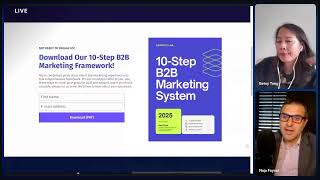
And I hope that everybody sees our screen right now. So this is Basically Paris lab six step B2B marketing system so I've worked so hard.
On cleaning it out so that it's super clear and super easy to grasp for anybody who can.
Who can see it and understand it. And the beauty of it is really the simplicity of it because the more complex the information, the more it takes people off and then they don't, you know, grasp it. But the beauty of this one is that it is simple and effective and it's proven to be effective not only for my, me and my clients, but also for, you know, the proven, the entire ecosystem of new companies that are coming out. And I always say that I stand on the shoulders of giants. I have not invented everything that you're about to see. I'm only someone who has spent two years dedicated to learn all about how to start and grow business in the most efficient way possible. And you know, and created Parrots Lab as a B2B marketing agency to help clients do exactly that. And as you can see on the screen, the process is pretty simple. First we need to identify that icp and this is usually happen in week one with my engagement with clients. So in your case, Betsy, this is week one. We're going to be working on the ICP today and then moving on to the next phase, which is value proposition. So once we identify our tribe, the ideal customer profile that we are after, then we need to demonstrate the value that we provide to them. And, and this value hits their biggest pain. Once we do that, then we move into connection offer. Building that connection offer, other people call it lead magnet. So what we're talking about here is, is something that mimics the real life scenario where we meet people, we demonstrate our value and we offer them something that they will be compelled to hand over their business card to Wes. And this is what the connection offer does is something valuable that we offer it for free in exchange for an email address from our prospects. Once we accomplish that connection offer is going to be week, week three. Then we move into setting up this landing page. And the landing page's goal is only to sell that connection offer. We're not pitching our services, we're not doing anything else except trying to promote this connection offer and convince the prospects to hand over their email address to us. And once that happened, then it's smooth sailing from here. Then we can work into a series of emails offering even more value and of course asking them.
To hop in a call with us or whatever that next step would be. And I would just want to make sure here that we are so against Spam. So when we're talking about, you know, when they hand over their email address, it's a completely consensual relationship and also it is a relationship that they can opt out with from at any time. So as soon as, you know, they receive the connection offer, they could unsubscribe from the email list and they will never basically hear from us ever again. And that's really something that's very dear to me. I'm so against cold calling, so against cold emailing, and so against like spam messages that arrive in your LinkedIn. So I just want to make sure that this is what we're expecting here. And I hope that the clients also are aligned on my idea of doing marketing the right way, the decent way. Once we set up this system up from the ICP all the way to the landing page that is highly optimized for conversion, then we can look into the content plan, how we're going to build that credibility, build that authority in the field.
Using content. This is also a module by itself which takes a week to develop. Then at the end of it, we have a full content strategy that involves the formats we're using, the channel we're selecting, and the frequency of the content that we're putting out. What are the content pillars that we need to be addressing and talking about in our content. Then finally, and this is the last week, would be how to generate traffic to that landing page, how to bring in people to our funnel so that we increase the likelihood of conversion, we increase the likelihood of, you know, getting people in our email list and therefore getting more clients to book our calendar and, you know, so that we have the opportunity to sell them one on one. I would really hesitant to use the word sell them. It's more like we would just discuss their problems, see if we are a good fit to solve them. And then in this last week, we're aiming at perhaps multiplying like making, develop multiple landing pages, do more AB testing to check which, which landing page converts better. And also we're also discussing what is, you know, yes, we are building organic content, but could we possibly add some budget into our mix and then promote, like using digital ads, whether on LinkedIn, Meta, Google Ads, etc. To bring in even more traffic to that landing page. But I always do that in the week six after we have some sort of track record that our landing page does convert from organic content. And also after realizing that the content that we're putting out there is really of high quality. And it's like we Got the reps in place so that we know how to create content on a consistent basis. Only then I recommend usually to boost that system in the very end and optimize as we go through. So this is basically my framework for Paris Lab. How we handle clients, what is the process that we take the clients through. And in your case, Betsy, I'm very excited to. Perhaps in our four weeks we're going to reach the conversion module, which is week four. And then I'm sure you already have a lot of content coming out on the Internet, and maybe we could probably extend that. We'll see about that. But for now, we're going to be every week focusing on one section of this framework. And in this week, we're going to discuss the icp, the ideal customer profile. Are you excited about that?
I'm super excited about that because my ideal customer profile is the reason for my being awesome.
And I'm sure that you have some idea. And I'm glad that I'm, you know, you're someone who have been thinking about it. It's not like completely straight strange to it, but I hope the coming slide will put things in perspective to you, will allow you to kind of know what is the process to identifying that ideal customer profile. So let's get into it.
So, I mean, I would say that I've been thinking about it a lot, and one of the issues I have and why I think your framework is going to be so important is I have so many ideas is about who my ideal customer is.
And I'm having trouble editing myself in a way that I think is precise enough, because again, my business is a very specific one.
And I need to be talking to a certain person. And right now, a lot of what I am creating is not hitting for me.
Yeah, yeah, precisely that. And I think it's one of the hardest.
Projects, really, the icp. It took me literally two years to kind of identify and be convinced internally, because you got to internalize it, especially when you offer services that a lot of wide array of people could benefit from. Right. You know, a lot of what we do as business to business, what we do. Like take for example, an MSP managed services provider, IT services, a tech solution that someone comes up, a tech startup that has a service that sells to businesses, most likely these. This company could sell to a wide array of businesses. And it is so hard for the entrepreneur or the leader of that company to decide to say no to X and Y and Z and focus only on, you know, one segment of the population or of the target or the target market. It is very hard because we think we're losing when we do that. We think we're losing opportunity when we do that. Where in fact, and it took me two years to realize it, in fact, you gain a lot by by saying no to others, by saying no to everybody else and focusing only on this person. You gain so much to name a few. First of all, you're not a commodity anymore. You can price as high as you want. So the number one, honestly, because think about it like if you are a CRM, if you are HubSpot, right? HubSpot sells to all businesses.
Now HubSpot competes with Salesforce. They both sell for everybody.
Maybe some differences in terms of sizes, but we're still looking at a wide array of companies that they sell. So if I am a decision maker in one of the companies I have HubSpot, Salesforce and maybe 10,000 other CRM systems. Well it's. All of these systems are game and I will really try to squeeze as much value for as little money as I can and get the cheapest CRM because they're all selling for everyone. But if I am an msp, again managed service provider and I found a CRM specifically for msps, like this is a CRM that is built from inside out, only for MSPs. And it's talking to me like I'm ready to pay premium. Because.
This CRM has already differentiated itself from all the other competition. Competition it already just by choosing that target, you've already differentiated yourself. You've become the expert in the field that I'm in. Because a lot of, you know, when you do a lot of B2B sales like, like I do, like for the last 15 years, you, you know that how to handle. Objection. People will always say yeah, but you know the other, the competitor is better, whatever. Or one common objection is that oh no, but you don't know my industry. My industry is special. I have a special problem that you don't know how to solve. Right? But when you position yourself as expert for that field, you start circulating yourself with people in that field. You start understanding their language. You know the slang that they use, the internal jargon that they use. You know their problem inside out. And as soon as you land your first client, you can tell them, well we helped X client to do exactly that. And now we have this kind of like they really hard to say no when your offer is very targeted. And that's why I'm so passionate about.
Recommending and advising people to narrow down that icp, even if it's hard to do at first, just bear with me and try it for six months. I mean, if it didn't work, you can always change. Right. But give it a shot. It's better than continue to be wide.
Yeah. And I also am very passionate about narrowing down to a specific customer and a specific person or Persona that you're talking to. And it's something that I often start. I work with a lot of executives and CEOs of, of businesses that are, you know, all over the map and they just are chasing revenue and really they need to be chasing customer and the value that they can bring to the customers without being too goopy about it. And you can't do that if you have a very wide range. And so I find it very easy to do for others and I'm finding that I'm really trying to get do the same thing for myself. But having your expertise on the other side, I think is going to get me quicker there quicker than I could do it by myself, frankly.
Yeah. And basically what I'm doing here with like how to find your ideal customer profile. Like how to find your ideal customer profile. And I applied it myself. Like I started with my own and I reflected on how did I do it, how did I really manage to find that B2B tech services as my ideal customer profile and say no to everyone else. And I literally tried to reverse engineer my thought process and that's how I come up with this slide. And that's why I always start with the resume. AKA if you're already a company, you start with your background, you look at your history. Right. And then start identifying.
Okay, let's see if the slide will decide to move.
Okay. Yes. So let's start. Yes. So start identifying.
The growing industries that you have been exposed to. Right. So in your resume or background you have perhaps either worked in different companies that have different, you know, they are belonging to different sectors or industries or whatever, so you understand those industries very well. Or in your previous experience you have served clients that are from different industries. Like for example from when I was in the advertising industry or digital marketing agencies side, I have served so many different clients from so many different industries. So it was so hard. Like I've had the fintech and I've had banks and I have had telecoms and I've had sports and I've had education clients and I've had even oil. Shell was one of my clients at some point. So it's so difficult for me like to say oh, I'm going to say it to all of these sectors and focus on one. But to start the process, just put down the niches or the sectors that you have worked with before, you understand their business pretty much pretty well, and then exclude. The first step is just to exclude the industries that are no longer growing. Like, for example, if you're trying, if you have a lot of experience in newspapers, like printed newspapers, I mean, they're gone already, so may as well choose something that is already growing or something that, you know, there's a lot of momentum and hype around, rather than going into a sector that is already being, you know, being dead or perhaps reinvented, but pretty much like who, who still reads print, printed newspaper these days. So it's completely gone. So of course, when we shortlist these niches, we want to see. We want to see the niches that are growing. And let's say you identified four of them, right? You have four niches that are growing and then you have some experience working with and dealing with. Now the second step is which is the best way to filter those niches and find the bullseye.
The niche that you need to focus your attention on is using this, I don't know what they call it, matrix or whatever. But in these four circles you will be listing.
Let me see your resume slide. I don't know, it has. There we go.
Oh, so there's some sort of a lag.
Basically what we're doing here is to.
Identifying the niches and then finally taking them into a filtering system to identify that one niche that we need to adopt and take home, basically. And this would be using.
These four circles that intersect. And these four circles will have, number one, which of the niches you know that they have the biggest pain, Right? So, you know, some niches, they're already being served pretty much they don't have a lot of pain, but then which one has the biggest pain? They're really like, there's something in that niche that is crying for a solution. And then we will look at how you're going to match this pain with your skills and expertise. And the second criteria we look into is purchasability.
For example. And Alex Harmouzi always talk about this. For example.
If I tell you, like someone who's unemployed and looking for work, right, they have a dying pain, a desperate pain that needs a solution. But the problem is they don't have purchasability. I mean, they're looking for work. Perhaps they're afraid. Even if they have some savings, they're afraid to spend them so they don't have the purchase ability. So if you choose unemployed people looking for work as your niche, you're going to be struggling to get them to pay. They would love your service, but it's going to be hard for them to pull out their wallet and pay for it. So we want a niche that also has a purchase power to be able to pay for the services. And then the third circle is, do you enjoy which of these niches you enjoy working with? And, and I'm sure that in your past you have seen and experimented with different Personas of people in your circles, that some of them, they're too corporate, too bossy, too not my type, you know, all of that stuff play a role in how you select your niche. So you want people that you enjoy working with. So again, we're trying to filter all of these niches and put them into different buckets and, and then we want to see one that is common. And the last circle that you need to use as a criteria for your selection would be easy to find. Right? So you have at least an idea of how to find these people. So for example, if you are looking for, let's say.
Lawyers. Say lawyers. If you, there is a, you know, there are probably some community that has a lot of lawyers, perhaps they hang out on LinkedIn with a certain groups, with all of them, perhaps in Reddit, perhaps somewhere where you can really tap into that community at scale. But some other niches, they're really difficult to find, especially when you are constructing a niche that is not specific enough because people, they gather in communities. If you look into every industry, even when it comes to AI services, there are like aaa, the AI automation agency community that Liam Otley for example, has built and it's growing, it's big. So that is a community of agencies who does AI services right now, if there each sector, if you go, if you go specific and niche enough, you will find communities on Discord, on Meetup, on Eventbrite, everywhere you will start seeing where, where your niche hang out. Once you do that, it becomes much easier to find this niche. So now we have opportunity to, to, to, to target them at scale. So with this four circles, this is when you filter your niches into this. Ideally we want to find one niche that really hits the spot, that one niche that really is the sweet spot there. And once we do that, life is easy. So in your case, Betsy, how do you see this playing out? And if you can like try to brainstorm with me, like what would be the shortlisted niches and then how you can evaluate it based on the four criteria as we just laid out.
So I think some of these things will not apply as much to my business because of where I'm going, the size and the nature of the business versus I think where you're probably your core customer IS, which is B2B SaaS or.
Larger B2B services sector. And so if I describe what I'm doing, maybe that's a good way to start. And the best way that I can describe who I am and what I do for my clients is if.
A McKinsey consultant or partner and one of the best executive coaches in the world got together and they had a baby and the baby went and cut her teeth. And as an executive in big tech building out new business models so completely turning around what they used to do business in to do something new and then created the operational scale that hit global levels and support hundreds of millions of dollars of business. That's me. So I have that mix of strategic brain and understanding of how and what people get stuck around and how they lose focus and have their eyes too big for their stomach. And then I've been where they are as an executive making decisions to build big businesses that scaled and.
That is the insight and intelligence that I bring to my clients problems.
So let me ask you, these executives that you talk about, if you just take a blank piece of paper and start thinking what sectors do they belong to? Are they in.
Tech, are they in fast Moving Consumer Goods, FMCG, are they in event management? Are they B2B? Are they B2C? So what is the industries of the people that most likely you know within your ecosystem kind of whether it's like if you look at your LinkedIn, if I would scrutinize your LinkedIn and look into all the people that you follow and you engage with, where are they, which sector they are?
Well, if you look at my LinkedIn because I've been in big tech for decades, you would see primarily big tech, big tech startups and others. But my client base.
Is coming from my friend circle and they are executives. Again I would say the weighting is more towards technology.
Not big tech, but technology.
And within tech a mix of of startups versus more mature businesses.
Because they have to be able to afford to pay. It's kind of like your analogy of if you want to serve unemployed folks, your rates have to be a certain level for them to be able to purchase your services.
And then I've got mid market, mid market recruiting Agency and then a B2C.
All right, marketing firm.
So all of them. So like the normal.
Probably customer that you work with, I range across a number of industries. But the through line for all of them is they have an idea or a concept that they want to get across and they need to get the focus. Without the focus, they are losing time to market growth opportunities or.
They'Re wasting margin. Right.
And the root cause of any of those things could be either they don't know who they're trying to do this for, their core customer, they may or may not have a leadership team with the experience to do what they want to do in the way that they want to do it. And so they're ending up like running in circles trying to figure out why they're not getting things done correctly. They may lack accountability across the team. Any one of those things is not specific to an industry. It's very specific to, I think the nature of a lot of executives, particularly those in global roles.
You know, you've touched on many, many ideas that could basically provide an answer to us. So when it comes to niche, we're not only necessarily talking about industries, we could also talk about a specific profile of people. Right. Like in your case, you have mentioned executives over and over again. So I think executives as a theme is, is great. Now within the executives, there's the startup in executive and there's the already mature executive. So basically the, the diff. These are also different because a startup executive is usually an entrepreneur who is really like, as you said, juggling million things at the same time. So, and, and so, so if we are writing the different niches here, we could say executive in a mature company, executive in a startup environment. And then Maybe the other two would be, you know, the B2C companies or you know, the other niches that you can go down at. And this is when we cover the middle section. And now if we look into the criteria, we're looking at, okay, so.
Which one of those have the biggest pain?
You mean of the executive profile that you just mentioned? Startup?
Yeah. Like if, if we are isolating the executive, let's say we identify two niches and then we want to drop everything else in the first phase where we said, okay, executives for a mature company, mainly in tech, executive for a startup, mainly in tech. I mean, I'm assuming that this is your, your, your, your area. So which one of them have a bigger pain that your services could help them solve?
So I think of it as slightly differently and it's not because I'm trying to dilute the executive and mature company versus executive in a startup. And I just wrote a post on LinkedIn because a good friend of mine wrote a post on LinkedIn that I was reacting to and we were both pretty fired up about the argument that's going around about founder mode versus.
Manager mode. Right. As if good leaders are only found in a certain location. And so I'm feeling a bit sensitive on behalf of my clients when I hear somebody trying to bifurcate the problems of a mature company CEO versus a startup CEO as if they both have or they do have the same issues around.
Having way too many priorities than the ability to deliver for different reasons. They still have the same issues around needing to amp up and continually mature and to figure out how to mature their teams for or what they want to do. Right. The difference is, and again this goes back to some of the things that you get to in the circles.
I'm probably not your person if you're in concept mode or you're in pre product market fit because what you really want there is somebody who deeply understands the market and the technology that you're trying to build. But I am the person you want to talk to as you start to get into later rounds and you're needing to have scale and operating hygiene and sort of moving from the.
You know what, we're a team, we're all just going to go after it to a, okay, now we have to codify a little bit without creating calcification. Right. That's, that's sort of, you know, where I live and I think about myself as somebody.
Who takes a PowerPoint that somebody's created of a concept and then makes it real by building a systemic approach to building.
Got it.
So yes, it is true that executives are similar whether it's a founder or a mature company. It's just that it's a different dynamic, different type of problems that they're dealing with. Like immature companies most likely. There's a lot of, there's a lot of it's slower, slower pace in terms of decision making. There's a lot of.
Politics involved in, in making things move where if you're a founder of a startup, you move at the speed of light, basically you can move very quickly, especially if you're a, a solo entrepreneur or an entrepreneur who's driving that company on their own. Perhaps you have some partners, but it's still a very fast paced environment. So the kind of demands put on entrepreneurs in that nature is going to be different from an executive in a Mature company. There's a lot of buy in that is needed in mature companies from your team. Even, you know, you probably have a lot of structure, a lot of hierarchy. The buy in should be getting from your, your, your team below you and the stakeholders above you. So it's a different kind of dynamic. And then the question becomes which one of those you enjoy working. And this is the third circle there because I know a little bit about you, Betsy, and I know that, you know, you like things to go fast, right? So now with the third circle, we're getting closer. I mean, in my head, at least from an observant point of view, I'm thinking, well know, I think Betsy will, will burn when, when the decisions are not being taken fast enough.
And then maybe, maybe the founder section or founder niche would be a more fit because they're dynamic just like her. They're quick, they're, you know, they're like pop, pop, let's go. You know. So do you think, do you resonate with founders more or do you think.
That, you know, so I definitely resonate with people who want to get things done right and I resonate with people who are like me, explorers and who sort of really deeply think about.
These ideas where again, I feel very sensitive about founder versus mature management mode. Like I, this is just in my head.
I.
Having built businesses in large tech, the ability to move at speed as a founder versus the ability to move at speed, yes, there's definitely something there. But I also think that founders get into a calcification mode that it's slightly different, right, because in founder mode you might not be worried about organizational politics or breaking eggs or other things. You are worried about getting it wrong because your very survival depends on it. And so I work with an equal number of founders that are sort of in that analysis, paralysis and need to be able to get back to.
The very, very critical priorities that will actually make a difference to what they do. And you know, having come from a more structured system.
It is and having built those structured systems so that I could focus to make sure that just because I had all these ideas popping in my head mean I could build operations that at the speed that I wanted to go to, that we created, where are the points of the correct points of leverage? What are the, what is your work in progress so that you're focusing on, you know, three things versus 17 and you don't add or, or you don't add anything to the three until you finish one of the three. Right? Those are things that again.
Apply and so to me.
Labeling my customer based on a status of their company only works to the extent that again, like I said, a concept stage, a highly technical concept stage, company is not going to be able to, to work with me because they can't afford it and they shouldn't put their money on an advisor versus, you know, somebody who has the deep technical knowledge that they want to get to. But I would argue that, that, that.
That I can help. I help people break down barriers. I help people present in a way that will get them heard regardless of whether they're in a startup or an enterprise.
So, you know, I can feel that, you know, you can, you can tell like how hard it is to really say no to one and not the other. And it's normal. I'm telling you, I feel it, I experienced it. And in the end of the day, realizing that.
The more specific your niche is, the, the better quality your work is. Because if you identify with one niche, let's say founder, entrepreneur or mature entrepreneur or mature executive.
Once you start working with a lot of them, it bec you start forming a pattern. You start realizing you can start getting everything like it becomes a template, becomes everything is very quick and easy to handle.
I'm not disagreeing with you, by the way. I absolutely do agree with you. I'm disagreeing with the way you've defined the niches by startup versus enterprise. But if you want me to center on something that goes around the size and the maturity of the company, I would say that I am a solopreneur. I always intend to run lean myself and to be more.
I'm not trying to be McKinsey one day, which means that I naturally cannot serve a large company that is going to require me to go through a massive RFP process to.
Pass all the check marks required of their procurement process. And so that naturally puts me at a certain size computer company where the CEO can say, hey look, Betsy's my go to, and let's bring Betsy in. And, and that is 1,000%, you know, my niche. And that puts me probably in the 500 and below million and maybe even less.
So there you go.
I mean you, that's where my niche is.
Yeah, I mean you've, you've nailed it, right? Just right now, even before the last circle, which would be, would seal the deal. I think the last circle, the easy to find, would seal the deal for you and will convince you that this is the niche for you. And hear me out on this. So let's say you've isolated you You've said no to the executive in mature companies and you want to focus on tech startups. Entrepreneurs within the tech startup field. Right, or the text.
I haven't said by the way.
You haven't said, but like executives, founders.
I just want to be really clear that what you're saying is not what I said.
That's fine. Would you agree that we were talking about two niches, Executives in mature companies and founders of startups.
Correct, I agree we were talking about that. But I am very much disputing the way that you're definitely defining my niche.
That's fine. But let's say, let's say the two niches that we are exploring in our framework are executives in a mature company and entrepreneur, office startup. Like a founder of a startup. Okay, okay. If this is the case. No, I mean this is basically what we were discussing for the last 10 minutes is really like really understanding these two niches and hopefully selecting one of them to go with and to build your company around at least for the coming six months and to try to really identify with them, understand their pains, match your value to their pain, and then be an expert within that space. And then the last circle that in my head would definitely seal the deal for you would be which one is easier to find executive and mature companies? You know, the only way to find them is perhaps on LinkedIn, maybe some certain circles that they hang out with. I am personally, I don't know how clear are you about maybe for you executive and mature companies is easier to find because you have been in that space in mature companies and you know the people there, maybe that would be a better a place to go. Maybe that would be an easier to find place. But if you look into founders of startups, well, there's a lot of accelerator programs out there that graduate those start startup companies, right? You've got the Y Combinator, the yc, they have already a matchmaker for, for co partners or, or, or they, they have a network for the startups that they create. So if founder of startups is your goal, then may as well like there's a lot of already established communities that you can tap into and then you can find a lot of your audience. And that's really the power of niching is not only that you find a niche that have a biggest pain that you can help with, they have the purchaseability you enjoy working with because you have your experience in dealing with those people, but also now you can tap into the communities where they actually are and instead of presenting yourself as a Generalist, I'm a consultant just like that for a broad range of companies. You go to these communities and you can say, I'm a consultant.
For startup founders. So now you become more relevant to them because you're speaking to them directly and not not more of a general. So I think this is something to think about and I know it's not really.
Easy to do. As I said, it took a long time for me to internalize that concept of saying no, isolating everybody else and focusing on that little niche, which may not be very little, by the way, but, but this is really the hard work of, of building a business. Really, this is the hard work of thinking strategically of where and steering the company into a direction where. Where the more time you put into it that the easier it gets. Like if you are a broader agency or a broader service provider, every client is a different challenge and it will always be the case. But if you start getting one from the similar clients, similar clients, stacking up one after the other, you start developing those patterns, you start seeing those patterns, start developing solutions that, where you develop the solution once and then it will help you scale that solution to so many because a lot of the clients that are, are very similar to one another. So this way you can bring them together. So I hope that this gives you some sort of framework to think about how to find your ideal customer profile. I hope you find this valuable. And I know that this is an exercise that we do with clients over a prolonged period of time, perhaps 2, 3, 4 sessions a week to nail that first week out. That's why we take a full week in Paris lab to articulate who the ICP is. And then once that happened, and this is going to be the next task that we're going to be working on for next week would be to look into.
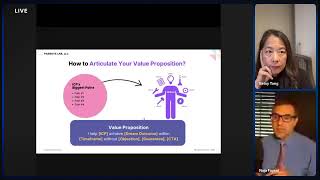
How to articulate the value proposition. This is really, I'm passionate about this. This is going to be your exercise for next week. Here you can see why it's very important to map out the ideal custom profile. Because once we have, let's say.
Startup founders as our niche, now we're going to list their biggest pains. And now we're going to put pain 1, pain 2, pain 3, pain 4. We're going to list all these pains and then we're going to look at Betsy, we're going to look at you and look at, and then we're going to, we're going to identify what skills do you bring to the table. Right? So skill one till seven, whatever we can put a list of those skills and then we try to match your skills to their pain. Right? And this is really magical when we do that because this is how we're really forming your value proposition from inside out. Building on all the career that you had, building on all the skills you acquired and making use of them to solve the biggest pain of your icp, of your ideal customer profile. And then finally once we do that, we can proudly articulate the value proposition template. Again, you can change and tweak a little bit. This template becomes very generic because you see a lot of people on LinkedIn using it, but you can always tweak it. But I think the importance of it is that you know by heart. As soon as someone asks you what do you do? You know, it comes out, you internalize it. It's easy to, to remember. And it says that I help ICP your ideal customer profile achieve their dream outcome, which is their biggest pain. Solving their biggest pain would be their dream outcome. And then within a time frame is always important to keep time because time is immutable. Time is our biggest asset. Without you have to use it. And then we need to handle their objection as well. What, what can they say? No, instead of we need to take ownership of their objection and then address it in our statement. Ideally we want to add a guarantee and then finally a call to action. And once that is done, life becomes so much simpler. From here, you can fly.
As soon as you have this value proposition in place, you feel a sense of relief and clarity. You know exactly who your icp, your, you know what you do to them. You know by what time, as I'm doing right now, for example, I have a four week schedule that I know exactly what to do every week with you. This is exactly what I'm talking about when it comes to building that value proposition that allows you to know what to deliver for who by when handling the objections and giving guarantees so that they can take the action and do what you're doing. We're going to talk more about this next week. I know we're running out of time, but this is going to be our, the task for next week. I'm hoping that you by, you know, you spend some time really consider thinking more about your icp.
You just, you know, maybe it's some sort of reflection that you can make to nail it down and, and understand it and internalize it. And then from there we could work on that part so that next week we can discuss more on, on the value proposition and hopefully you will have something written there so that you can share with us and, and then. Yeah, and then hopefully we can have this done by week two so that we can move into the, the other two phases in our program.
Okay, you're giving me homework. I got it.
But what do you think about this as well?
Oh, yeah, absolutely. I mean, that's, that's the core of being able to, to talk about your business. I, you know, in other terms, it's an elevator pitch or it's a value value proposition, which is what you have.
Awesome. All right, so that's it for today. I'm very happy to have done and, and completed this, this project. Yeah, we, we get the ball rolling at least, and that's wonderful. So, yeah, I'm very pleased about that. And hopefully in the coming weeks, things evolve in your business and that we can, you know, at least by the end of week four, have a complete lead generation system, marketing system, digital presence, whatever you want to call it, that will give you clarity.
In your business. At the same time allows your webpage to convert the right people into your email list. And now life becomes much easier as a business owner.
Yep. Yep. Absolutely.
Awesome. All right, well, thank you. And we'll see you next week.
See you next week.
All right.
More from Betsy
Fear is Just an Emotion - Betsy Tong on Resilience, Reinvention and Finding Your Voice