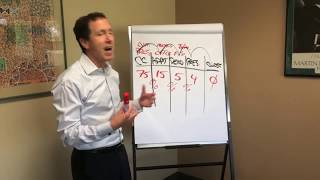
Blair Singer says startups fail because founders chase sales without systems or accountability. He shows how a massage clinic raised conversions from 15% to 40% in six weeks by fixing one part of their sales process, jumping revenue from $260,000 to $970,000 annually.
Questions this video answers
The Monday morning sales meeting.
Conversion improved from about 15% to 40% within six weeks.
About $260,000 per year before versus $970,000 per year after.
Greetings, it's Blair again and thank you for being willing to watch these series of videos. I will tell you that had I had some of this information 25, 30 years ago, would have made a dramatic shift in the way I did things. I could have taken my whole journey to this point, compressed it probably in about, in less than half. So thank you for doing this. Watch this, see if you can relate to what I'm about to talk about. Talk to you about. You have a great idea, Great idea, great idea for a business. Let's use business. I got a great product, great service, got to kill the market. You know how to sell because remember we said sales equals income and you're good at sales and you start growing and growing and growing and growing and growing and growing and then getting to the point, you're making sales, you're making money, people are loving what you're doing, and then it's growing, growing, gone, gone. Not hurt, not demoralized, gone. Now why does that happen? It's a very, very common thing that happened. Or well, that didn't work. I'm going to try something else. I'm going to go down here, I'm going to try something else. Same thing. Grow, grow, grow, grow, grow. Gone. Why? Why? Because a lot of times the person is good at selling, good at marketing, good at promoting, isn't good at the next piece, which is the difference between going from chaos in your business to stability and affluence. It's called accountability and systems. Accountability and systems. In other words, what happens, you end up creating so much chaos out there that there's no way to control it. That one of the keys of being a successful entrepreneur is being able to transfer from that area of chaos, which kind of looks like this when your business is kind of doing that, to an area of stable growth, which I'm sure everybody would like, by the way. This is not just true in your income, in your business, it's true with your health and in your relationships. You need to have a high level of this accountability and systems. Let me give you an example. In sales, I think I mentioned to you before that people ask me, what is the most powerful motivational sales tool? It's the Monday morning sales meeting. So let me show you a system. When I learned how to sell as a rookie salesperson, they needed to make sure that I had a very tight system to operate with and that I was very accountable. So we had something called the five call close. And basically it kind of looked like this, that your first job was to Go out and make a cold call. The purpose of a cold call was to get an appointment. Purpose of the appointment was to get into a demonstration, to be able to give a demonstration. We were selling computers at the time, and then to get to a presentation and then to a close. And that was basically the way that it worked. So that was a system. In other words, we were told, this is what, you do this, then you do this, then you do this, then you do this, then you do this. And don't try to master this until you master this, master this, the process, one step at a time. So that was the system. So then what would happen is every week we have to go up there on the board in front of everybody and say, well, this week I made 75 cold calls. And I got. Out of the 75 cold calls, I got 15 appointments, and out of that, I got five demos and four presentations and no closes. Let's say something like that. So the number is the accountability. The process that I had to follow was the system. They had to work together. Otherwise you say, okay, here's the brochure. Boys go out and sell. That's never going to happen. You're going to have one or two superstars that are disciplined enough to do this on their own. But if you're going to be a business owner, you've got to make sure that everybody is following a system. Because, in fact, if you come to me and you say, you don't have any of this, and I say, how many sales you got? I got none. Well, why? Well, I don't know. Well, if I look at your numbers, I can see where the problem might be is right here. You're not converting very many appointments. Or over here, you got a problem going over here. See, from here to here, that's pretty good. From here to here is awesome. But over here is where you need support. So the system and the accountability is not to punish people. It's to help them so that you can coach them along the way. Like I said, my area of expertise is in personal development, team development, sales development. So for myself, when I coach people in sales and in our business, we are constantly looking at this. Well, some people call it a funnel. I call this a grid. This is the grid that you follow. And what are our percentages from here and to here and to here and to here? And so from that perspective, now we can test, measure, and improve what we're doing. I'll tell you what, I find that most entrepreneurs do not know what their selling cycle is. And if you don't know what your selling cycle is. It's very difficult to systematize it and hold anybody accountable to it because it's a free for all out there. For some people it may be you don't do cold calls. Maybe it's numbers of presentations that you give and then the number of offers that you give and, and then the number of follow ups that you do or whatever the case might be, every number of customers that come through, that come through the door, the number of meals that they purchase and the average dollar amount per meal that they do, or whatever the case might be. But you've got to have a system of measurement to hold people accountable so that you can not only coach them, but improve the system just by doing this. When we were in the franchise business, one of our franchisees worked with a massage clinic. All we did was look at their system, look at what their grid was, and focus on just one area alone. And within six weeks we took their conversion rates from I think about 15% to 40%. Now when you think about that, that's the difference between about $260,000 and $970,000 a year in revenue, which is a very, very big difference. We didn't change any product, any system, didn't change any marketing. All we did was focus down on what was the system they were using, break it down and hold people accountable. One last thing on accountability. Accountability doesn't necessarily mean you're a good person, you're a bad person because you didn't do what you said. Accountability means you're willing to be held accountable for whatever you did. Maybe you had zero over here. You're still accountable because you reported a zero. If you don't report anything or you lie about it, that's not accountability. So accountability doesn't presume right or wrong, good or bad, you know, you're a good performer or bad performer. However, I will tell you that the psychological advantage of being able to measure it and have people review it and take feedback on it. We'll build an incredible sales organization and we'll build an incredible organization in general. One other piece on accountability, one of the core rules of every code of honor that I've worked with ever since I was introduced to it is a rule that says everybody on the team takes personal responsibility. What does that mean? It means no blame, no finger pointing, and. And no justification. That's right. So if something goes wrong, you own it. And if somebody says, well, it was so and so's fault, immediately you stop them. You call them on. You say look, code says you can't do that. Calling you on that let you rephrase it. How can you take responsibility for what happened? That single rule of accountability alone will transform almost any relationship. Think about it. If you could eliminate the whining, the moaning, the complaining and the finger pointing in your team, in your organization, how would it transform what happens there? It's one rule and just getting the agreement and getting everybody to be accountable for it. Try it, you'll like it. So if you like this idea of the grid you can click the link below and we will help you develop your own so that you can actually not only forecast your own income and decide how to generate the income that you want in the shortest amount of time but also to help other people be accountable to help you get it. So click on the link below and we'll help you develop this so you can predict and calculate your own income.