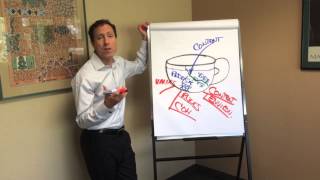
Blair Singer argues that a team's success depends on its container: the shared values and explicit rules that hold everything together. He calls this a code of honor. Leaders must create these rules, get everyone to agree, and enforce them so team members can become bigger contributors.
Greetings. This is Blair again. Several years ago I worked with my son and his fifth grade class and I put them into some business scenarios to teach them a little bit about entrepreneurship. And I'll never Forget a little 10 year old boy raised his hand in the middle of one of our exercises. He goes, Mr. Singer? I said, yes. He says, you know what I've learned? I go, what have you learned? He says, I learned that business is really simple, but the really hard part is dealing with the people. Which I thought was pretty brilliant coming from a 10 year old kid in the middle of his fifth grade class. So let's address that for a second because remember we said here that this is the formula for success, particularly in business, being able to sell, generate a team and to teach. However, like I said, one of the big things that stands in the way is not your product or service, but the little voice. And not just your little voice, but the little voices of all the members of your team, including yours. So let's address that because this, my experience is that's what keeps people very, very small and blocks them from getting their dreams. So I'm going to draw you a picture here that if you're a business owner, an entrepreneur, a parent, a teacher, any kind of a leadership role whatsoever is probably the most important flip chart you'll ever see. And it looks like this, very simply looks like this. It's a cup, okay, so this is a cup. And you can put whatever you want to in the cup. You put tea, coffee, water, some sort of liquid, whatever you want in the cup. And we call that the content of your business or the content of your cup. So in business that would be the content of the business would be your products or your service or the cash flow or maybe the systems and the people you know, your staff, your team, customers, all those people, that's the content. So people are very. People typically ask me, well, I need better product, I need better service, I need better people. I'm going, yeah, that's all good, but that's not the critical element. If you understand what I'm about to show, you could revolutionize your business, your family, your school, your teaching, everything that you do. Let's just suppose for a second that this cup develops a crack in it. What happens to the content? Of course it spills out. Then what happens? That's called business failure in marriage, that's called a divorce. When all of a sudden this container falls apart. We call this container not just a container, we call it the context, or another word is environment. That all that content sits in. There's a big lesson I've learned. It took me, like I said, 30 years in business to figure this one out, and that's this. That the context or the container here is more important than what's going on in here. In other words, the structure that holds your business, your family, your health in place is more important. You can go on 25 different kinds of diets. They may work, they may not work. The key is who you're surrounding yourself with. What kind of environment are you operating in? Is that going to support whatever diet you go on? Doesn't matter about the diet, if that makes sense, doesn't matter what the product or the surface is. You could have the greatest product in the world. But if this bowl is cracked full of holes, if the context is filled with fear, animosity, anger, you're not going to get the financial results that you're looking for. So what's the solution? The solution as a leader is to set up the best environment you can. And the number one tool for making that happen we talked about earlier is what we call the code of honor, which is the set of rules that hold this all together. The rules that hold it all together. What else holds this all together? Something called your values. So people ask me, what's the difference between values and a code of honor and rules? The difference? Values are things like, let's say, safety, traffic safety is a value. Well, that's great, but you need to have rules to support it. So stopping at a stop sign or a stoplight is a rule that supports that value. So if you have in your family and your business values like integrity, honesty, education, respect, goodwill, peace of mind, whatever it is, love, then you need to have rules in place that support that, particularly when the heat goes up outside in the real world. Because are we under financial pressures, economic pressures, social pressures? Of course. So this cup has got to be strong enough to protect and support your family, your business family, your blood family, your love family, whoever that is, to support them, to be able to do their work. The values related to the code of honor. My wife and I have a code of honor. We have a set of rules between us. We have a code of honor, set of rules for our boys, for the family, for our business, for all of our licensees and our affiliate certification people all over the world, we operate by the same set of rules. Because I need to know that if you're on my team, that if you're somewhere in Sri Lanka or somewhere in Des Moines, Iowa, or in Warsaw, Poland, that we're operating off of the same value set, same set of rules that also are driven by a common mission, which is one of our missions, is to improve the quality of life by creating for everybody, by creating the best teachers, facilitators and trainers in the world. And then based upon that, there's a very strict set of rules that everybody follows by. And so what I know is that this right here is probably one of the biggest motivators for getting people to be who they want to be. See, a long time ago I was told this was me back in about 1982, you know, I was struggling entrepreneur, trying to make a buck, all of that. And I was told by one of my mentors that if I was able to follow a particular set of rules, a code of honor that would force me to be a bigger, better person and I would actually become the leader, the parent, the coach, the teacher, the entrepreneur that I wanted to be. I didn't know how to get there at the time, but I knew I had to start with a set of rules that would discipline me to be who I wanted to be. And probably the most important piece of all before I end this is that you want to be able to make sure that anybody that comes into this context is willing to play by these rules. One of my teachers, Mack Newton, 8th degree Taekwondo black belt master instructor, the only one in North America and several time world champion Taekwondo, said this. He says the single most defining factor in your life may be the people you hang around with. Are they playing by the same rules? Do they subscribe to a similar code of honor? Do they operate with the same values? Not that they're good or bad people, it's just if you want to be an entrepreneur, maybe hanging around with a lot of employees may not be helping you get where you want to go. That's my point. So that's why those of you that are here, that are watching this video right now, I applaud you. Because at some level we share similar values. Values of education, values around personal development, values around being the best that you can be and being willing to be disciplined and follow a set of rules to make that happen. So again, if you're a leader, if you're a teacher, if you're a parent, if you're an entrepreneur, are just aspiring to become better. One of the most important tools that we've talked about is right here, a code of honor, a set of rules that will help you get there. One of my best selling books, Team Code of Honor, talks about it in intimate detail, step by step by step, how to do it. And if you've already got a team right now, I suggest you click below on the link to take the free diagnostic that will tell you what kind of a team you have. Do you have a great championship team? Or maybe you have the makings of one. Or maybe you need to blow up the team you've got and start all over again. But answer the simple questions in that questionnaire. If you click below and take the diagnostic and it will tell you your starting point and what you need to do in order to generate a championship team that will help you get your dreams. And so they can get theirs too. Because at the end of the day, if you can help other people get what they want, they're going to help you get what you want.