Losing the Audience and Being Too Nice
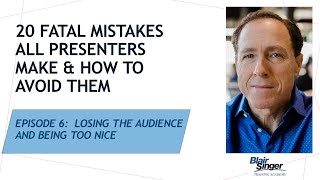
Blair Singer teaches presenters how to handle a hostile or disengaged room. When the audience pushes back, don't argue or get louder. Instead ask probing questions, break into small groups, and use Socratic prompts to keep people thinking and invested.
Episode 6, episode 666. Episode 6 of the Biggest reasons trainers, facilitators and presenters blow up their presentations and how to avoid that from happening, how to not blow up your sales presentation, how to not drive people out of the room and how to be a great teacher, leader, facilitator all the time. So this is episode six. So episode six is the worst nightmare of all. People blow up their rooms, and that is by, quote unquote, losing the room. Now, what I mean by losing the room, there's two ways you can lose a room that you're facilitating to online or offline. And one way is the silent way, which you've kind of talked about before. That's the quiet way. People are bored, they're not engaged. All they're thinking about is how soon till this is over. So they're physically in the room, but you have mentally, emotionally, spiritually lost them. They're just gone and you're up there on your own. It's kind of that sinking feeling that you kind of feel like the room is dead. People are looking at their watches, people are text messaging, doing all kinds of everything except paying attention to you. And you get this pit in the middle of your stomach like this is not going well. Okay, that's one way. And what do most people do? What most presenters do is sometimes they'll talk louder or they'll push harder and they'll think that that's going to help, but that's only driving if you're boring. And if they're bored and they're disengaged, that's just going to drive them further away even quicker. Okay, that's the silent type. The most scary type of losing the room, however, is the non silent way. And that is when someone in the room or a couple people in the room really just don't like what you have to say or don't agree with you, raise their hands or just burst out their disagreement with you and just take you on and start arguing with you or telling you that you don't know what you're talking about or this doesn't apply to them. And what gives you the right to do all of that? For most presenters, that's the scariest one. The scariest one when you have an outright revolt. Now, if you don't know how to hand, if you lose the room in that way, one of the biggest downsides of that is you're going to end up with chaos. Because even if it was only one or two people that were upset, that is like A contagion that will ripple right through the audience. I've seen, I've been in rooms of 500 people where one person disagreed with something in a very outspoken way, and within a matter of seconds at the microphone was able to spread the contagion across the room. And as a presenter, I had to stop it, which is another topic for another time. But it can be very devastating. And it's one of the reasons people actually don't like to speak. And they go into lecture mode. So they just deliver, deliver, deliver, deliver, deliver, deliver, so that there's no even opportunity for somebody to engage. Okay, so losing the room is bad. Okay? I would suggest that one of the things you do is watch other speakers get on other zoom calls and watch how other speakers respond to it. And you'll be amazed. Most speakers will avoid it like the plague. They will say, thank you very much, or can we take it offline, or they just won't engage anybody. You know, they get into a little bit of an argument with somebody and they won't engage anybody. Now, one of the big mistakes that people make in that situation in the second scenario is to argue, don't argue, even if you're right, don't argue. Fight the need to be right. Just ask questions, you know, so what is it you're upset about? What don't you agree with? Why is that? Tell me more about that. So how can we make that work for you? Don't say, well, yeah, well, I'm right. Because don't go there. Because the minute even if you are right and you make the other person look bad, you still look bad because now you look like a bully, okay? And not having anything to do with the material, but having to do with the fact that it triggers other things in people's minds. Like when they were in school and the teacher made them wrong and they got bullied by the smart kids or the teachers and all that other stuff that kind of raises up when you take on that role, which has nothing to do with your material and it's completely unconscious of. But what happens is the room goes south. Okay, so couple of tips. Don't try to ignore it or roll over or shot it down. Those techniques are like putting gasoline on the fire. Again, it takes some practice. And that's why Robert Kiyosaki and myself, we used to lock ourselves in a room every Thursday night for hours and hours and hours, just drilling and drilling and drilling. The worst objections that we could ever possibly get in a room. And even making them up until tempers were flaring and fists were just about flying. But we did it because we wanted to be condition ourselves to be calm if it ever showed up. And it would show up once in a while, not very often. The reason it did not show up very often is because we were prepared for it before we were prepared for it. It seemed to show up all the time. Okay, so these are things that you can practice. Okay. The other thing, the other biggest, one of the other big mistakes that people make that screw up their presentations is what I call letting the participants off the hook. Letting them off the hook. Now this is a little bit related to this. What do I mean by that? Well, in other words, if, let's go back to this scenario. If a person doesn't agree with you, rather than just letting it go and rolling over and say, okay, you're right, let it go. Ask questions, get people involved, get other people involved in the conversation. The fact of the matter is, if somebody argues or somebody disagrees, I guarantee now you have their attention. They're not bored anymore. They may not be happy, but they're not bored. Okay, so they are engaged. That's a good thing. Keep that in mind. That's good. And so as a scientist or an experimenter in front of a room, you go, oh, good, this is good. At least we got people engaged. Now. Probe more into that. Don't let them off the hook. Don't run away just because you're afraid of it. Now how else do you let people off the hook, which kills the energy of a room? Well, when people ask questions, here's kind of my rule of thumb. I rarely answer questions. Now, there's a time for Q and A, but even during Q and A, I don't really answer hardly any questions. Why? I mean, I could answer some of these questions people ask me. Well, how, how do you build a championship team? And how do you produce a code of honor? How do you handle this objection? That objection, I can answer those in 10 seconds, but I don't. Why? Because that's letting them off the hook. What do I mean? The whole idea of education is to get a person to learn right? Think right? So if you give them answers, you have robbed them of the learning. They ask a question, they go, okay, well how, how would you handle an objection on price? That's a great question. So how do you handle it right now give me an example. They give you an example. Okay, good. So how do you do it now? Does that work? Does it not work? Who can help them with that one? How Would you handle it? How would somebody else handle it? So all of a sudden now you've got other people thinking and engaging, and what you're doing is kind of like most people are not used to that treatment. Right. And so what happens, you can almost hear the rusty gears in their brain beginning to. Beginning to crank into motion again because you're actually forcing them to think. You're actually forcing them to think. Now there's a time to give answers, for sure. Okay. But for the most part, I rarely answer questions. And when I train people in the context is not only to not answer questions directly, but. But do your best to solicit whatever answers, even if you already know the answers, to solicit the answers from the room. And if they have trouble with that, put them into breakout rooms or put them into small groups of two or three. Have them discuss it and come up with answers. Yeah, you're not going to cover all the material, but you're going to get 10 times the engagement, 10 times the learning, 10 times the retention that if you just sit there and drone on and they're not going to remember any of that anyway. You're not going to remember it anyway. So don't let them off the hook. As your normal mode of presenting, you should be asking questions. I think I was. I wrote down here. I think at one point I was clocked at asking 10 to 30 questions a minute. Now, that's a lot. Okay, 10 to 30 questions a minute, it would be something like this. So most important thing about what is the most important part about handling an objection? Okay, good. Acknowledgement. Good. Thank you. What else? Good. Asking a question. Now, why are questions important? Good. Because the person asks a question is in what? So how many questions? I just are filling the blanks that I just do. Just there. How am I doing? I'm doing it right now, right? Yes. There's two more. So why am I doing this? To be annoying? No, because it's to engage the brain. Because if you engage the brain, the brain is very creative. It'll start thinking. And your job as a teacher, leader, facilitator, entrepreneur, is to ignite, inspire, if you will, the desire to learn, to make learning fun. Not like school, but to get people to engage that want to learn more, that want to engage, that want to discuss. Look, it's not so much the material that you're teaching, like how to sell or how to do marketing properly or whatever it is. It is their excitement around the material that will allow them to keep going and will allow them to produce the results. Your results are a function of your behavior, which is a function of your attitude and your mindset. If the attitude and the mindset are bright and alive, you're going to get a lot better results. So again, don't let them off the hook. One of the problems that most presenters make is the somebody asks them a question, they get really excited. Oh, good, I can answer this question. And now they're really excited because they get to dazzle the room or the group with their brilliant knowledge. Resist that, resist that. Be a Socrates. Ask probing questions. Get them to discover the answers themselves. Now, don't be condescending. So what do you think the answer to that might be, Johnny? No, not that kind of stuff. All I'm talking about is, is ask. Take them on a road of discovery and get them to collaborate with each other. They will remember a lot more of what they discovered than what you tell them. I'm going to say it again. Whoever you're working with will remember a lot more of what they got the aha about. About what they learned and what they dug for and what they discovered. They're going to remember a lot more of that than whatever it is you tell them because they're not going to remember much of that. They're going to take some notes and they won't even look at their notes, okay? So don't let them off the hook. And I mean that in a loving way. I mean that in a way that assume that they're smart, assume that they're able to do it. Lots of acknowledgements. So every time you ask a question, say thank you. Every time somebody comes up with an answer, even if it's not quite the answer you want, say thank you. Not what I'm looking for, but thank you anyway. So you acknowledge them for their engagement. You're not acknowledging for the answer. You. You're acknowledging them for being part of it and getting them in groups. Remember this. There's probably not a problem in the world today that cannot be solved by people that know how to work together, collaborate, communicate, keep a positive mental attitude about things. We could solve just about anything. The problem is school doesn't teach this way. And now, worse than ever, here's the material, here's the video, or here's the text. You read it, the test is coming up. It's all online. You'll figure it out. It's open book. You're probably going to cheat on it anyway. We know that, but that's fine. That's education today. That's not education. It's not education at all. Education. Iduse means to draw out of, to grow out of, to facilitate, to make things easy, to help people think. Help people think. There's going to come a day here pretty soon where artificial intelligence is putting a lot of people out of work. Now it's only going to put people out of work that don't know how to think and know how to learn. Anybody knows how to think and learn. There's always new opportunities everywhere. But you know, I just heard, you know, truck driver, 2 or 3 million truck drivers, once we go to AI driven tractor trailers delivering goods all across, all around the world, we're not going to need drivers in those trucks anymore. What are those people going to do? Well, they need to learn how to think and make sure that every interaction people have with you, they think, they enjoy it. Don't let them off the hook. Assume that they're bright and they'll turn out to be brilliant, be amazing.
More from Blair

Great Leaders Manage Emotions (Not Just Tasks) | Blair Singer Leadership Episode 12

Give Them Meaning: The 7 Elements That Make Teams Flourish | Blair Singer Episode 11

Silencing the “Little Voice” That Says “You Can’t” | Blair Singer Mindset Training - Episode 10

3 Signs Your Team Is Quietly Disengaging | Blair Singer Leadership - Episode 9

You May Be Killing Your Team (And You Don’t Even Know It) | Blair Singer Leadership - Episode 8

The Fastest Way to Learn Anything | Blair Singer on Lessons from Robert Kiyosaki - Episode 7

You’re Leaving Millions on the Table | The High-Ticket Sales Follow-Up Strategy That Works



