The Foundation of The Blair Singer Companies
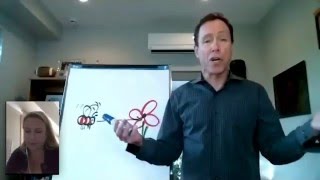
Blair Singer explains how Buckminster Fuller's bumblebee analogy shaped his business philosophy. He argues that focusing on improving quality of life, rather than chasing profit directly, creates a ripple effect that leads to business success.
Okay, so this is the famous Buckminster Fuller bumblebee flip chart that changed my Life back in 1984. Because when Fuller was saying, he said. What Buckminster Fuller said is, he said, you can go out, make money or you can make sense. And I had no idea what he was talking about. But when he drew this diagram, it all began to make sense. And that's why I'm still. Oh, these 30 years, I'm still in this business, still driving it, and still as enthusiastic about it as I was back in 1984. So if you humor me for a second, I'm just going to take this step by step. Now, this is Buckminster Fullerese, which is sometimes difficult to understand, but I'm going to do my best to explain it to you. So I'm going to draw a little picture over here. First it flour.
Got it.
Flourish. Bumblebee.
Bumblebee.
Good so far.
Good so far.
All right. Good. Awesome. So, and this is how developed the mission for my business, mission for my life, purpose for my life, that sometimes when things don't go so well, you got to remind yourself, keep asking yourself, why am I doing this? And this is the answer right here. So let me go through this with you, as Fuller would explain it. So here's a bumblebee, here's a flower. Pretty simple concept. The bee goes flying into the flower looking for nectar.
Yes.
Yeah, it's actually nectar. It's looking for nectar, and it takes the nectar, turns it into honey, which needs the honey for food and shelter. Right. So it's pretty looking for nectar. But what's interesting is that the way the bee is designed, when it flies into this flower, what dusts off on its hairy little legs is this stuff called pollen. Right. And it doesn't know that that's what's going on necessarily. Maybe it does, but it's covered with pollen. Then it bubbles into the next flower. And what happens?
It pollinates.
Right across. Pollinates, Right. So, and then we have new flowers, new trees, new plant growth on Planet Ear, all that kind of stuff. So the truth of it is, is that probably what Fuller would say, in the scheme of the universe or of life, the true purpose of the bee is to cross pollinate and that the honey, the neck. But what it's doing all the time is going out there looking for honey, because why it needs honey for survival. The bee is not concerned about the ecosystem. Bees. The. The bee doesn't get up in the morning and go, can't wait to go cross pollinate today. Right.
It's not.
What it's thinking is. It's thinking I gotta get, I gotta eat, I got shelter. The queen bee kicks me out of the hive. I gotta go get my act together today. Or something like that. Sounds familiar.
Yep, sounds familiar.
But what he said is this is that he calls it precession. Now that's another topic for another time. But the ripple effect, let's just call it a ripple effect. So these are like a dropping of a stone here. These are the ripples that go out that the ripple effect of going after the honey is that it ends up cross pollinating.
Right.
Which is probably the true purpose of the bee. I mean, think about it for a minute. The bees all like in the bee movie, right? If all the bees decide to go on strike and stop, what would happen? I mean not only would there be no flowers, be no trees, we're probably no life growth on planet Earth, plant growth of any kind. We would end up dying, no oxygen, we'd turn into a rock planet probably.
Right?
All of this is pre. So the function of the true purpose, as he would say of the bees, probably cross pollinate. He said so. So now this is pretty simple. But here's where it began to rattle my cage. And what he said was, he said, okay, so the bee has a purpose. So maybe we have a purpose. What a concept, you know, what's the purpose of human beings on this thing? Obviously bees got a function here. What, what are we supposed to be doing? I'm going, well, I never thought about that. He says, well, let's take a look at this. He says the bee does this inadvertently. Does this automatic. This is automatic. It's got the difference between a similarity between a bee and a human being is we both have brains, brain, brain. We have a mind that is able to make see relationships. The bee doesn't know necessarily know the ripple effect of what it does. However, as human beings, because we have supposedly a more evolved brain and mind can actually see what it is the ripple effects of our actions over here. So what he said is that we're no different than the bees. Bees go out every day to make honey.
Honey. Yep.
We go out every day to make money. Money, money. Okay. So he says that these guys are honeybees and we are.
Money bee. We're money bees.
That's honey glare. That's right. Well this is all being recorded. So if you want to be in this recording, you can sit here. Okay. All right, so and so these are money bees. We're money bees. Right?
We're money Bees.
Yeah, we're money bees. So now just hold that for a minute. That's kind of comical. But he said the ripple effect. There's a ripple effect to going out and making money. Now I'm going to divert for a minute. And this is what really changed my life, what Fuller said, and what he said is this. He said he did a study of what he called quality of life or standard of living, of the highest standard of living available in the year 1900. I don't know if he was alive then, but he studied the records and he measured things like infant mortality rate, life expectancy, mobility, level of literacy, education, clean water, all the things that actually, you know, the United nations, the imf, still measure today as determined quality of life. So he measured the quality of life or the wealth of life of the wealthiest year, 1900.
Okay, hold on, back up. I lost you at quality. It locked up, right? At quality of life. Oh, it's locked up.
Quality of life. Quality of life. Can you hear me?
Yeah. So, like, go back two sentences. Before 1920 or 1900.
He measured the records. He measured the quality of life of the richest people in the world in the year 1900.
Got it. Okay.
Okay. Based on those standards I mentioned. Okay, he measured it again in the year 1970. And what. So the question you have to ask yourself now, the population of the planet had more than tripled since 1900. And so the question is, with three times the amount of people on the planet, had the quality of life gone up or down? And so logically, you may think, well, more people, less research went down. But the truth of it was, he found that over 50% of a big part of the world was living at a higher standard of living than the highest standard of living available in the year 1900.
Wow.
Now, the question is, how is that possible? Well, think about it for a second. So we come back to our little bumblebee over here. Is it that people in business going out to try to make money, the only way you make money is by the only way somebody's going to exchange money with you for your goods or services is if your goods or services add more value, value than the money they want to offer you or whatever they want to exchange for your service. Does that make sense?
Yep.
Okay, so the value, the very value formula of being in business and making money, making money, the ripple effect of that. And by the way, if a business doesn't add value, they go out of business.
Right, Right.
Products that make it, services that make it, businesses that make it, make it because they add value to the community. So what he found was this. So the ripple effect of going out to make money was that what we'll call it, the standard of living for all of humanity actually went up as a ripple effect of people just going out trying to make a buck. What do they need the buck for? The same thing the bee needs the honey for, for food, for shelter, for its life support. So the average business guy's not out there trying to make, trying to save the planet and improve standard of living for everybody. I mean, maybe a few people. But the truth of it is, inadvertently, but as Fuller would say, realistically and precessionally, standard of living for all humanity, even though we're now at seven and a half billion people on the planet, continues to rise because of this motivation out here to go out there for personal life support. Make sense?
Makes sense.
Okay. So then he said, so here's the thing. Okay, great. So that's nice, Bucky. So what's that mean to me? So what he said is this. He says, remember the difference between the bee and us is we got a mind. We can see the ripple effect of what we're doing and we can make choices that the bee cannot make. And so what he said is, rather than going out and persisting out there and making money, just going out to make money, what if you made your goal to focus on focusing on improving the quality of life for people, if that were your goal instead of just the money, would you trust, could you trust that the ripple effect of that would be that you'd make even more money? What the heck did he say? And I didn't quite understand it at first, but it so rattled what I. My reality, the way I was thinking. I remember sitting on a rock outside the Kuilima resort. I think it's now called Turtle Bay on the north shore of Oahu. Island of Oahu. And after watching Fuller and after an all night seminar, watching the surf break on the outside reef was a beautiful Sunday morning. And I was tired. But I just started crying. I didn't even know why I was crying. It was just the thought is what am I supposed to be doing? What am I doing here? How did I get here? And what is it that I'm supposed to do? I can go out like everybody else and make money, but how did I get in front of Fuller? How did I get introduced to that? How did I end up in Hawaii? How do all these circumstances come together for me to be sitting here on this rock right now in 1984? Crying like an idiot, looking out at the ocean, saying, what am I supposed to be doing here? The bee doesn't worry about that crap. He went, and most people don't worry about that crap. But for some reason, it infected me as he infected a lot of other people. So at that point, I sat there, and that's when I had this vision that if the game is not about making money, if the game is about improving the quality of life for everybody, if that's what we're kind of doing, if I focused on that, how could I do that in a meaningful way? And then just trust that if that's what I was supposed to be doing, that the universe would take care of me just like the universe takes care of this bee. If I do what I'm supposed to be doing, whatever that is, then I'll get taken care of. I mean, that's what Fuller said. That's how he lived his life. So guys like Kiyosaki and myself and Mark Victor Hansen, guys at Warner Earhart, people, people that studied Fuller, all got infected with this thing. How could we do these things? And so I said, how do I improve the quality of life? So I go, okay, so how does this happen? This happens in the marketplace. Businesses providing value, goods and services, adding value, you know, air conditioning in the room, electricity that powers, medical services, educational. This is the marketplace. That's where the quality of life is affected, right there in that area of production. So if I could help the marketplace be more effective in improving this directly, then I should be able to make. Then the money should be no problem. Right? It should be a ripple effect. And so that's why. And I had a vision. I said, how could I do that? I had this vision of code of honors. Those days, we used to call them rules of the game. But a code of honors posted in every cafeteria, in every church, every refrigerator, every business, big, small business, all over the world. Because that context of those rules, because we know that context is more important than the content. Those set of rules, like the Ten Commandments, that would allow people to live this way would improve not only the marketplace, but increased production. And I set out in my life to prove whether that was possible or not. And so I did it with my own business. Ups and downs and ups and downs. And it worked. Then people started asking me about helping them with their business. I did it in other people's business, and it worked, and I did it with. And so then people started asking me to teach them how to do it in other people's businesses. And that worked. And so I'm standing here today with this global network of amazing trainers. So the original premise was to improve. The mission statement that came out of this would be to improve the quality of life for everybody by transforming the marketplace, period. But I realized that was too slow. So we tried it with a franchise, all these things. When I realized it was just too slow and it was not enough leverage. So I figured the easiest way, the faster way to do it would be to improve the quality of life for everyone. What's that?
You froze up for a second again.
Okay, so it's being recorded, so you'll see it on the recording. So it would be to improve the quality of life for everyone by creating the best teachers, leaders and facilitators on the planet that would go out into the marketplace and transform that marketplace. Because I couldn't do it all myself. I needed a team. I needed that army that I saw in 1984 to be able to do that. So the band of merry men and women that are part of that amazing tribe are doing it in countries like Vietnam, in Thailand and Singapore, Malaysia and the UK and South Africa and across America and Mexico and Australia. I mean I, I go on and on and on. India, countries all over the world. Why it was never because of the money is because the mission was to try to figure out if this is what I'm supposed to do or this is what human beings are supposed to do. Would you be supported? I look around, I'm surrounded. I'm on a beautiful one acre lot here in beautiful Phoenix, Arizona, Amazing wife and into boys and family and friends and team and you know, the money and the money never seems to be a problem. But most importantly, every day I get up and I know what I'm supposed to do, I know what I'm supposed to. And I think that if I wasn't, if I wasn't supposed to be doing it, universe would let me know pretty quickly. You get the message pretty quickly. The money wouldn't come in. There'd be a lot of massive learning experiences. It's kind of like people say, well, my purpose in life is to sell drugs or something crazy like that. Well, you know what, you may think that's your purpose and you may think it has value, but just look at the collateral damage and what's happening around. You see in this sphere, when I'm going this way, the ripple effect of what I'm doing. Amazing people, people transforming their lives, repairing marriages, building businesses, bringing products to market that change people's lives. If you're selling drugs, you can say people dying around me, in and out of jail, death, destruction. So it's pretty clear when you start tapping into this whole thing, that's pretty much it. This piece is the piece that changed my life. It gave me purpose. And along the way it's kind of like, you haven't seen this part, but it's not a perfect science. So in other words, if, let's say maybe this a better color. So if this is the new goal, right, and this is the direction I'm going. These goals are not straight lines, by the way. They kind of. So let's flip that around. So if this is the goal over here, to improve quality of life or to create a great team or whatever it is, it's not a straight line. I mean, this is me over here. It kind of got you like this. Boom. You make a mistake, boom. Make a mistake. So it's more one of these type of things. But each time, the thing is, is that each time this happens, or this happens, or this happens, all that is is the universe, as Fuller would say, giving you a tap on the shoulder, saying, hey, oh, wrong way. Move direct, not working. Move the other direction over here, you get a big win. That's a win. But what do we do? We get a win, we get a little cocky, we get a little sloppy, and then we drop it back down again. I mean, it's a. I mean, I could go on and on and on. We have courses and courses, you know, 30 years of studying of how to maintain this and minimize that and how to live through all of this. But the thing to tell you that a mistake, as Fuller would say, is only a sin when not admitted. Making the mistake is not the problem because the mistake is the universe or God or the great Spirit tapping on the shoulder, going, hey, wake up. You're supposed to learn something here. But most people, if you deny it or say it wasn't a mistake, it wasn't my fault, that's a sin. Because you're default, you're denying the very God given way that human beings learn, which is by trial and error. So anyway, I could go on and on and on.
Right? Right. Got it.
That's the B presentation.
Awesome.
Okay, thank you.
More from Blair

Great Leaders Manage Emotions (Not Just Tasks) | Blair Singer Leadership Episode 12

Give Them Meaning: The 7 Elements That Make Teams Flourish | Blair Singer Episode 11

Silencing the “Little Voice” That Says “You Can’t” | Blair Singer Mindset Training - Episode 10

3 Signs Your Team Is Quietly Disengaging | Blair Singer Leadership - Episode 9

You May Be Killing Your Team (And You Don’t Even Know It) | Blair Singer Leadership - Episode 8

The Fastest Way to Learn Anything | Blair Singer on Lessons from Robert Kiyosaki - Episode 7

You’re Leaving Millions on the Table | The High-Ticket Sales Follow-Up Strategy That Works



