Bob Moesta - Jobs-to-be-Done Find Out the Why!
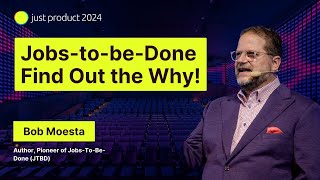
Bob Moesta gives a keynote on the Jobs-to-Be-Done (JTBD) framework, arguing that the "struggling moment" is the seed for innovation and that products are "hired" to make progress in people's lives. He contrasts supply-side (what companies build) with demand-side (how customers pull solutions), presents forces that push/pull and create friction, and outlines a buying timeline (first thought → passive looking → active looking → deciding → consuming). He illustrates JTBD with case studies (QuickBooks, Intercom, InVideo AI) showing how identifying distinct customer jobs and packaging features for those jobs drove rapid growth. Practical guidance: focus on customers' struggling moments, design for the progress they want (not the product), and accept trade-offs.
If you leave this talk with nothing, you should remember this, that the struggling moment is the seed for all innovation. Where your customers struggle is actually where all the gold is. And you need to focus on that. How many people know the company Intercom? They're mastering AI because they're focusing AI, not because AI can do AI, but what are the struggling moments it can address because they understood the customer, they met the customer. Where they're at. Think about it for a minute. I can't learn from books. I can't learn by myself. So that what I got to become a master at is asking questions. So what happened is they grew 5x in customers, but they grew another 3x in revenue. On top of that, they went from 5 million to 75 million in 2014. I'm the co founder or co architect of the Jobs to Be Done Framework. Good morning, everybody. Yeah, so I like to be the first speaker because everybody's had coffee. I have like 52 slides to go through in literally like 45 minutes. So get ready and we're gonna go. So my background is I'm an engineer and I'm from Detroit, Michigan. I've worked on over 3,500 products and I'm. I'm the co founder or co architect of the Jobs We'd Done Framework. The one thing I will tell you that's not up there is that I'm dyslexic. I had three close head brain injuries before I was seven years old. And I can't read and I can't write, or I don't read and write in a regular way. And what you start to realize is the fact is, I think of it as the greatest gift I ever got. Because think about it for a minute. I can't learn from books. I can't learn by myself. So that what I got to become a master at is asking questions and figuring out how to ask questions and learning. And to be honest, there's the rules you were taught as a kid that I want to kind of break. One of them was never ask a question that you don't know the answer to. Crap. You want to ask questions you don't know the answer to, you want to learn as much as you can. So I've worked on over 3,500 products. Things like Basecamp. I've worked with Basecamp since 2010. I've worked on the guidance system for the Patriot missile. I've worked on Pokemon, Mac and Cheese. I've built homes. I've done all these different things partially because I just Love to learn. And what happened is people realized that I could solve problems. When I was 18 years old, I happened to meet a gentleman named Dr. Deming. Let me see what the next slide is. So I've worked with all these innovators, thousands and thousands of innovators. But my first point was this gentleman who was right here in the center, this old man up here. I was 18 years old and I sat next to him, sat down next to him, and I asked him 52 questions in 22 minutes. I was that little kid who would ask a question and be so annoying. My mom had a rule called the three foot rule. If somebody came within three feet of me, I was allowed to talk to them. Oh, my God. I get to learn, right? So I talked to this man and he literally, he's counting the questions. I'm just asking. I'm just rolling. I'm also a little nervous, but I'm talking. I didn't know who he was. I thought he was somebody's grandfather. Turns out his name was Dr. Deming. Dr. Deming is the father of Lean. He's the father of Six Sigma. He's the father. He's the Toyota production system. And he took me to Japan when I was 18 years old. Ford was actually working on basically the product development cycle was 72 months from concept to customer, and Toyota's was basically 36 months. And so the goal was, how do we actually figure out how to reduce product development cycle time? And let's remember, I'm 18, 19 years old. I was an intern, but I became one of those low level people who learned all the methods and tools. It was like the crucible where I just worked on product after product after product, like day after day after day. So I was at Ford for almost nine years. But basically what happened is I've been innovating my whole life. And I wrote a book about it called Learning to Build. And it's really a homage to my four mentors, who again, dyslexic, told to be a construction worker or a baggage handler at the airport at 18. Basically, these people poured their knowledge into me. I feel like I'm a vessel to basically then apply all the things they taught me. So one of them is Dr. Deming, but there's some others. Dr. Clayton Christensen, who I co authored this theory with somebody named Genichi Taguchi, who taught me about how to prototype to learn. He told me again, 19, 20 years old. AB testing is the worst kind of testing you can ever do. Wait, what? Yeah, he taught me how to do designed experiments, how to think about all the variables, how to see things as systems and be able to figure that out. Remember, I'm an engineer, right? And the other one was Dr. Willie Moore, who taught me the humanity of the world. She was actually my first boss at Ford and she taught me things like don't walk in the front door, walk in the employee door, walk through the plant, see how things work. So I started not in software, but in hard goods. And so ultimately I came up with this. I reflected on my life and I basically wrote this book around kind of like how do I pass on the knowledge that I learned? And I realized there's five skills that really good entrepreneurs and innovators need to have in order to be successful. And ultimately we're going to talk about one of them today. So the first one is what I call empathetic perspective. Being able to see things from other people's perspective, not judging it, but being able to see the problem from all these different perspectives. Another one is uncovering demand. And we're going to go into that. But that's the fact that demand is. Products don't create demand. Demand exists inside people today. And what we do is we tap into the demand. The demand starts with a struggling moment. We're going to talk about that. Another one is actually causal structures. Knowing how to see things as systems and pull them out and be able to frame them and realize that systems are the boundaries by which we have control. This one, this I think is actually one of the most powerful pieces in the building side of things, which is prototyping to learn. 90% of our testing is prototyping to verify because we think we know. But Dr. Taguchi said it best. There's way more unknown than there is known and never forget it. He used to tell me that all the time. And the last one is making trade offs. We try to optimize all the time, but the reality is that for us to get good product out there, we need to actually learn how to make and frame trade offs. But today we're going to just focus on this one called uncovering demand, which is really the jobs to be done, theory and practice. So I was lucky enough to meet Clayton Christensen when I was. I want to say what, I'm 60 now, like 35ish. Somewhere around there. And I just walked in his office and I basically knocked on his door. He had a really cool sign outside of office it's called. It basically was a wooden sign he had made from recycled wood and it said anomalies wanted. I'm like, I'm an anomaly, for sure. Knocked on the door and said, I'm here. And the relationship went from there. But Clay said something very early on in our relationship that kind of blew my mind. It's this notion that questions create spaces in the brain for solutions to fall into. Questions create spaces in the brain for solutions to fall into. The reason why this blew my mind was the fact this is like, what question does a customer ask to say, today's the day they need a new CRM? And I realized that it comes from them, and we have to understand the context they're in. And so I went on a quest to find those questions and figure out what is going on in the customer's mind.
Right.
And so if you leave this talk with nothing, you should remember this, that the struggling moment is the seed for all innovation. Where your customers struggle is actually where all the gold is, and you need to focus on that. Trying to just inspire them is never enough. To be honest, I don't work that way. What I found is products that actually address struggling moments. People will pull it in their life, and they'll pull it in fast. And then, by the way, every time you solve one struggling moment, it goes to the bottom, and then all of a sudden, there's another one on the top. And so part of it is the roadmap that I build are all based on struggling moments. Not on features, not on technology. Where is the customer going, and how do I meet them where they are? So the basic premise of jobs to be Done is this, is that people don't buy products. They hire products to make progress in their life. And so think of it as like, it's about changing, switching from one thing to the next. So there's the old way of doing something, and then there's ultimately a new way of doing something, and they have to figure this out. But as a product guy, as an engineer, as a builder, what I realized was, I love the little baby up here. This is so awesome. The aspect here is that one is I have to have a circumstance. We are creatures of habit. We will do the same thing over and over and over again, right until we have a struggling moment. The struggling moment tells us that we need to do something different, and then we have to search. But here's the thing. It's just because I can actually, I have a struggling moment, but if I have no idea on the other side, this is where people bitch, but they don't switch. They need the idea on the other side. And the Idea is more the outcomes of what they're looking for. So think of it this way. If there's a river there, how many ways can I get across that river? How many ways? One, two, ten? A million? I can build a boat, I can build a dock, I can get a bridge, I can get a helicopter, I can dig a ton. I mean, we can go on and on and on, but without understanding the context they're in, how fast they need to get there, and ultimately what they're hoping for on the other side, I don't know what to build. And so part of this is to realize that I need to surround myself with the customer from what context they're in and what outcomes they want. And then actually building the product becomes way easier. And so ultimately, a job to be done is about the context I'm in. When the struggling moment I have, I struggle with. And then. So I can. So I can do what? If you have those statements, ultimately you actually have a good frame around it, but it's not at the top. People talk in pablum, how was your day? Fine. Was it fine? Was it really fine? I was talking to Thomas yesterday, and it's like he used a word, and I go like, so what do you mean by that? And you go, oh, gosh, here we go. And you start to go deeper and deeper and deeper, and you have to find the causation of it, what really happened to them, what was really going on. And so what happens is you have to realize most customers don't know what they want. So you have to learn how to frame it. And that's what I want to teach you today.
Come on.
There we go. So there's three underlying frames around this. One is called supply side versus demand side. We have the forces and we have a timeline. So when I went to engineering school, they told me a really big lie. And the lie is, build it and they will come. That's right. It's a lie. It's a big fat lie. I've built many things that nobody came for right very early in my career. It was just hard. And so I realized that ultimately it comes back to this notion of understanding the supply side and the demand side. The supply side is really the world we all know. It's what we build. It's the systems we have, the solutions we provide. It's all that kind of thing, Right? And then the demand side, though, is. And typically we push product to the market, but the other side is called the demand side. And this is where people are sitting there Having problems. And they literally pull product into their lives. And what I realize is there's a big wall between the two. It's 10ft wide, it's 100ft tall, or let's say 3 meters wide, 33 meters tall. And it's this wall. And what happens is we'll drill a hole in it and we'll look through it like our product and say, who's out there? We're looking about it through a little hole. Or we jump up really high and we see basic segments and markets. But typically we know this. I have a business system that produces a product. That product has features and benefits, experiences and attributes. Accrete spirit. We all know this stuff. But we then hop on top of that wall and look down on the market and we see things like markets and segments and Personas and all that other stuff. But the reality is that the fact is you have to actually jump down to the ground level and really understand what's going on in your life. The fact is it starts with a context. People have current behavior and then there's some context that gets wrapped around them that causes them to say, today's the day. It's like create that struggling moment. And if the struggle isn't that big, they just ignore it. But eventually it builds up. And once they say, okay, I gotta do something new, they think about new desired outcomes, right? And those desired outcomes end up turning into basically candidates I can have. But here's the thing is from a consumer perspective, think about it yourself. You can literally be thirsty and you can open the fridge, you've got water, you've got beer, you've got protein, you've got like all. How do you choose which thing? None of them are perfect. You have higher criteria, you have fire criteria. Like it's protein. I have protein, okay, I need the protein. Caffeine, I have already had two cups of coffee, I don't want to have that. And you end up making trade offs to actually pick the best thing for the moment. There's never a perfect solution, Never. Because life changes. And so ultimately it's understanding that. And what they do is they climb up that wall, oops, they climb up that wall, it went this time. And they just see company brands and product. They don't know how anything works. And so for me, I start on this side of the world and so ultimately I get my requirements not from the engineers, not from the functional people, but from the customer by understanding the outcomes they want and how do I design those outcomes to happen. So let me give You a quick example. I worked with a company called Intuit. They built a product called QuickBooks. And one of the things they found is the struggling moment was in the early days, they just had one product called Quicken, which is a personal finance product. And they found these small businesses using Quicken to run their small business. And, like, why are they doing that? It's not double accounting. And it was like, it was easy enough that the owners could use it. So they said, all right, we need to build a small accounting package. And they built two teams. One team was a bunch of accounting experts to say, what's the best way to do accounting for a small business? And I was on the other team who said, how do we actually build something to help small businesses? It turns out that the fact is that when we actually went side by side, they created a product that had 10,000 features. They wanted to talk about all the things they could do and everything. And what I realized is the key struggling moment that caused somebody to say, today's the day I need to get an accounting package was only two help me get paid or help me pay others. Those were the two things. This is 2002. You still had to write checks back then, right? And you start to realize that all of a sudden, if you talked about all the other stuff we could do, they'd go like, oh, I don't want all that.
Right.
But once we actually solved the paying problem, then they would have a payroll problem, then they have a loan problem, and then they have basically a tax problem. And you start to realize that you could solve more and more of the problems. And so instead of talking about all the things we could do, we understood the path that they needed and only talked about the features that were relevant at the time. QuickBooks is now a $9 billion product. It is literally the largest accounting package by almost three times the next competitor. And the reality is that the fact is that it's not the best product in the world, to be honest. If you ask people about QuickBooks, how many people hate QuickBooks? 90% do not like it, but they don't. It's not that they don't like QuickBooks. They don't like accounting. A small business owner wants to basically hire. If they want to hire somebody, they want to hire another painter, another baker. They don't want to hire somebody to do their accounting. And so we learned all that stuff really early on, and meeting them where they're at is what is really, really important.
Next slide.
Again, the struggling moment is the seed for all Innovation. So this is not a new idea. Ted Levitt, a Harvard Business School professor, said this in 1960. People don't want a quarter inch. They don't want a quarter inch drill or a quarter inch hole or. I'm sorry, they don't want a drill, they want a hole.
Right.
The fact is that the outcome is this. And so what I was taught when I went to Japan was something called the five whys. And I'd say this, this is where it gets hot. Why do you want to drill? I want a hole. Why do I want a hole? I want a plug. Why do I want a plug? I want a lamp. Why do I want a lamp? I want to read better. Perfect. I'm going to go work on the Kindle. I. I know that sounds really bizarre, but the reality is that at some point in time, by the way, the average drill life, the number of hours that it runs before it actually is thrown out is one and a half hours.
Right?
But it's always there to help you make it the whole. But the reality is like, you have to take steps back to see their life. We end up usually just talking about their product and how they use the product and what's about the product. And the thing is, we need to fit into their life. And so we have to understand their life, which is really important. So the second framework, so one is supply side versus demand side thinking. And I say, always start on the demand side, start on the right and go to the left.
Right.
Most of the time we think on the left and go to the right. This is the other thing, is somebody buying something is not random. I hate when people say, oh, if I get 100 leads, I'll get 25 proposals and 25 proposals. They think of it as probability theory. But the reality is Clay and I used to talk about the N of 1. If you look at what causes one person to buy your product, you'll learn more than trying to have a hundred. And so how do we actually analyze that? And so the way we analyze that is we look at the forces. And the forces are basically, there's fuel to help me change and there's friction to basically hold me back. Hold on, I gotta check on my clock. Can we start the timer in some way?
Thank you.
So one of the things I did was I built homes in Detroit, Michigan. Again, I tell Thomas, 26, 28 days of sun a year. Not a great place, but I love it. It's my home. Lived there my whole life. But I built for basically first time home buyers Divorced family with kids and downsizers. Think of your parents. And so the way to think about this is what would cause your parents to say, today's the day we're going to move out of the house you grew up in. And we call that push, push of the situation. Things like, I gotta shovel snow, the kids have moved away, has nothing to do with the product, has everything to do with their life. And so part of it is to understand the things that push people to say, you know what, we should move. But here's what happens is if they don't have the idea of what to do, they just complain. Your parents will complain forever about all this stuff, this and this. The taxes are so high, it just goes on and on, right? And then what happens though is that the moment that they see the idea in their mind, it creates pull. Oh my gosh. So I had a 1654 square foot, which is about 160 meter, 170 meter condo, two bedroom, two and a half bath, first floor laundry. It was basically amazing, right? And all of a sudden they'd say, oh my gosh, no more stairs. All of a sudden the push would come up. My knees hurt because the laundry's in the basement. I have to go up to those stairs. Oh my gosh. I don't have to do any of the maintenance because it's included. And so there's this pull. Now this is like in business school I learned like pain and gain. That's not this. This is context and outcome, right? And so it's understanding the context that they're in that makes them ready for your product. But then there's friction. So the moment they see that and they go, oh my God, this is amazing. The friction shows up first, is the anxiety. Where's the grocery store? Can I afford this? Can I sell my house? All these questions come up and then all of a sudden there's things over here called the habit, which is, I love my neighbors, I like the church I go to, whatever it is, the fact is there's friction along the way. And so you start to realize that. The fact is, what I was taught in business school was add more features to create more pull and people will. Another lie. More features is actually when you add more and more features, guess what you do, you create anxiety. And so part of it is to know the right set of features. So one of the things I heard them say, so one of the things I realized is that one of the anxieties they had is their house was about double the size of what they were moving into. And the fear is they hadn't moved in 30, 40 years and it was packing up all that stuff and there wasn't room for all that stuff. And so you'd realize they'd literally, they'd have the talk about why they needed to move. They'd literally see my condo, they'd sign a contract and three weeks later they'd come and cancel because of an anxiety. I'd go like, what happened? They go, we went to basically clean out the closets. One closet for three weeks, four boxes of Kleenex and not being able to throw anything out. And they basically said, can't move. So what did I do? I didn't create more feature. I literally said, you know what? I raised the price of my condo. I included moving two years of storage and a place to sort all your crap when the kids come so you can give it to them. 28% increase in sales. So it's not about my product, it's about the things wrapped around my product that I had to include.
Right.
And so part of this is actually understanding all of those different things and all the different forces that enable people to buy your product.
Right.
So for example, it's like they want your product, but it's like, I have a two year contract. What are you going to do? It's not a feature. You have to think about how are you going to actually help them make that progress?
Right?
So the big thing to me is most people treat things as random. In my house, the word random is worse than the F word in swearing because it actually causes you to wait. Random is, oh, I just have to wait for it to happen then. But the reality is everything is. Cause random is really the fact that we don't know. And I hate the fact that most people say, oh, it's random. My thing is we need to go figure out the causation behind it. You need to dig deeper and understand. Ultimately, I think of this as a set of dominoes. What dominoes have to fall to make people ready for your product. It's not a person, it's who, when, where and why. It's the four parts that make up the job. To tell me how, what, how and how much. So the last framework is called the timeline. This is the process by which they buy, not the process we sell. It's how they buy. There's a first thought. This is where I go back to Clay. They have a question in their head that says, boy, this really sucks. What can I do about it? It creates the space to see something. Once they create the space, they go to passive looking. Passive looking then basically leads to active looking. They which is deciding and consuming. And the way I think about this, again, I'm an engineer, right? Don't hold it against me. But the reality is each of these are systems. This is making the space in the brain. So marketing should be about actually asking questions and not answering. If I say, how'd you sleep last night? Need a mattress, nobody's going to buy. But if I just say how'd you sleep last night? If people are struggling with their sleep, they're going to eh, not too good. And it sits and it festers and then all of a sudden they start to learning. How is this aspect of before? Think of it like when I was thinking about when you have a car lease or you're buying a car and you had a major repair first maybe I should get a new car. And next thing you know, you're noticing every car on the road. Literally you didn't notice them the day before and today you do. It's because you actually are trying to learn, what should I do? That's called passive looking. You're not actually investing time, you just are now aware. And then eventually there's some event that causes you to say, you know what, I got to start to see the possibilities, I got to actually go drive some things. And then ultimately deciding is about trade offs, right? And then ultimately once you buy, it's about making the progress and then building the habit around it. And so ultimately it's about understanding how to engineer the journey to help them see it. But there's a very specific sequence. The other thing to realize is that I could be right here making trade offs, ready to buy. And Covid happens, struggling moments still there. What happens to them? They actually go back to here, passive looking. Because there's now new variables in their life that they have to change. The problem's still there, they have to figure it out.
But.
But ultimately people go back and forth on this timeline all the time. But you need to know how to meet them. And then you can't go from basically passive looking to deciding it doesn't work. They need to go through the process. It's how we buy everything. Sometimes for us as individual consumers, this can happen in 30 seconds. For some people this can happen in five years, right? And so ultimately knowing that is really important. So let's talk through, let's make this real. How many people know the company? Intercom. What is intercom? What is intercom? You can talk, it's okay. It's support, it's chat.
Right.
It's these kinds of things. Right? Well, here's the. Let me tell you a story of how it started. So that's Des Traynor, one of the co founders, and he had. This is his third startup. And he came down to this point where he started to basically say, like, one of the hardest things for him to do when he basically bought it and built his startups was when he basically went to scale it. He had to integrate everything back into all these pieces. So, like, when you have a. This is again, 2010ish, right? You had to buy marketing automation, you had to buy a customer database, you had to live chat, you have email. And it was all. They were all separate apps at the time. Nobody had anything that was together. And so what happened is he basically said, I think I want to build this bundle. And it doesn't have to be good at all of them, but it has to be good enough to actually integrate them. And so he basically came back and said, you, your customer, here it is. And the whole premise was having the data all in one place. So 2010, he had this idea, he started to flesh it out. He found a co founder, Owen McCabe, and basically started to build it out. And this is what it looked like on launch 2012. Manage your customers from cradle to grave. It was all about seeing the data all in one place. 2012, they did about three and a half million. By 2013, they got to about five million. But it wasn't. And Des was like, there's something wrong. There's something not moving with this thing. It doesn't make sense. So Des called me and said, basically, hey, would you mind talking to some customers? I knew him from some other things. And basically he said, we've talked to our customers, but we talked to them about our product. He wanted to talk to them about their lives. I said, okay. I said, no problem. So we sat down, talked to 10 or 12 customers. Not a lot, and I'll tell you why in a second. But ultimately, there we go. What we end up doing is with the 10 or 12 customers, we just found these patterns and they were kind of strange. They understood some of them. But the first one was there was a group of people who bought it to basically say acquire. And the challenge was, look, people are coming to the website, but they're not converting. I need a way to actually talk to them in the moment, be able to have them do that. And so I'm looking for. I hire Basically Intercom to help me acquire clients. Okay, there's another group that says, no, no, no, I have clients, I have lots of clients. They don't come back. I need to actually figure out a way to onboard and literally basically engage them more. And so it was a different group of people basically said, oh, I need to help, I want to engage.
Right.
There's a third group that was more like on the technical side and say, I want to know where people are starting stock so I can figure out where to build the new features. And then there was this third group which was. Or fourth group which was really the nominees, like, oh, we use it to run support. And they're like, what?
Huh?
Support? No, no, it's about the customer, it's not about this. And all of a sudden they realize like, okay, it's a legitimate job. And they realize that one thing is in this, when people were worried about acquire at the time they were competing with HubSpot and when they wanted to fix support, they were competing with something called Zendesk. And they realized that they charged one price and you got all of this for one price. So one of the things they started to realize is like, maybe we don't have one product here, we have four products. And they went, huh? And so they started to think about, if I was going to build a product just for this, what would it look like? And the other thing that they had is anybody who bought Intercom it would be bought, for example, by the people in a choir. And then they'd tell other people that they could use it, but nobody would use it. They'd only use it for the one purpose they bought it for, because otherwise it was free. And who wants a free product? Turns out people feel like if your product is free, its value is exactly what it's worth. And so ultimately we started to think about how to flesh it out. So we talked about the struggling moments that people had. One of the things we learned was they were buying all the feature keywords which were really, really expensive. But if you think about it, when people have a problem, they don't even know the solution yet. They just know like, how can I actually acquire more customers? They're not looking for a CRM. They don't even know a CRM, a small business. This is again, he's going in the entry level place where people are brand new to the product or brand new to building something. And so we talked about the struggling moments and then what we did is we talked about the outcomes that they wanted. Still not talking about the product.
Right.
And once they could click on that, then they could see how we could help them. And ultimately the fact is we were able to kind of do this for every one of things. So if they clicked in and it was part of it, they'd buy. If not, they'd look at some of the other things. The other thing they do is they broke apart and made them separate products. This was 30% less than HubSpot. This was 30% less than Zendesk. Sounds a little strange, but that's okay. What happened was, so we did this work at the beginning or the end of 2013, beginning of 2014. So they came back and literally within 90 days they came back and said, we've got this idea of packages. And so one of the things they thought was a job was observe. People use this to observe. Sure, they use it to observe, but they're not willing to pay for it. So it's not a job. Something is about making progress. And so ultimately observing is embedded in all of these. Because once they observe, they can take action. The other four are all actions they can take. And they just started and they took like 10% or 5% of the traffic and put it towards it. Conversion started to go through the roof. By 2000, end of 2014, they basically turned them from packages to products. Here's the crazy part. They didn't re engineer the product at all. They just turned off feature sets and said, this set of feature goes with this job and this set of features goes with that job. And this set. It's all one still platform. But they just turned off the features and then they said, oh, I'm going to charge different things. And so once you solve one problem right, it's off the list. Now there's new problems. The next problem was actually engaged. The next problem was then tech support. And you started to realize everybody could use it and they would pay them three to four times more.
Right.
So what happened is. And this is from. There's a great video by Matt Hodges, who was the CMO at the time, and how he talks about how you actually go to market with this. But ultimately from March 2014, when we did the jobs work, it was his first day and he was in my office in Detroit. He's an Australian and he really did not want to be in Detroit, but that's okay. But ultimately he says that they grew 5x in customers, but they grew another 3x in revenue. On top of that, they went from 5 million to 75 million in 2014. And so what Happened is it gave them the rights to basically go basically razor Series A. They raised money and what did they do? They actually went and ran conferences. They ran conferences around the world to literally become the expert. They hired people to basically talk about all these different problems. The craziest part is I had to sign like a non compete confidentiality. They would take my firstborn child kind of contract and they're out there talking about jobs and I couldn't talk about it, right? And finally I asked them for a release. But they wrote a book on jobs. I talked more or less the introduction of it. But they literally have been teaching people all of these things. And what happened is the closer they got to basically understanding the customer, so they spent part of the money on conferences to basically learn and to become dominant and to be known for the startup community. So this is again almost this kind of conference. Think about it, 15 years ago. And so ultimately the fact is they were able to. So 2018, they raised their Series B, Matt Hodges left and they went back to very similar positioning, product positioning, because at some point they had to be serious. Sales went flat. By 2019 they went back to it and they took the learn job and actually put it as part of Engage. So what happens is they end up with three products that do all these different things. Basically by 2019 they had a valuation of 1.25 billion because they understood the customer, they met the customer where they're at. They, their roadmap is whatever their customers are struggling with. So like AI for them, they're mastering AI because they're focusing AI, not because AI can do AI, but what are the struggling moments it can address. If you look them up, they are doing phenomenally in the AI space because again, they're using it to help engage, they're using it to help acquire, they're using it to help support. And so they do all these different things, but they do it at a very different level than people like Zendesk and HubSpot, because Zendesk and HubSpot are way up here. This was for the people who are just starting, right? So the story of this is basically the more that you understand your customer, the more you understand their struggling moments, the more you understand basically the positioning. This research is so foundational. You can use it in product, you can use it in marketing, you can use it in strategy. To be honest, there's a whole sales process around how to use this. But these 10 interviews and people go like, statistically it's not about, you know, that's not Significant. You can verify that. But the reality is that the real knowledge comes in the deep understanding of the n of 1 knowing how 1 customer does it, then knowing how another customer does it. By the time you get to 10, it all starts to repeat. From a discovery perspective, I don't need large sample. From a discovery perspective, I just need diversity in who I'm talking to. And so that's why we can do basically a whole round of research in six weeks or less. As an engineer, that's what I wanted. Most of the time. I'd try to do research, and it would get bigger and bigger and bigger. And, oh, by the way, surveys don't work here. Because here's the thing. In surveys, we put the answers we want to hear on the down as opposed to understanding their answers. And. And nine times out of ten, you need to probe deeper. In 1989, I went and learned criminal and intelligence interrogation methods, not waterboarding. But the reality is most people lie. They lie to themselves. Why'd you buy this new car? Oh, it was a great deal. That's not why they bought a car. It's the lie they tell themselves. But you have to understand the causation.
Right?
So I have 10. Perfect. So this was. This is Sankeet. Does anybody know what InVideo AI is? So Sankeet started a product, he's from India, and it's basically a video editing program. Very, very simple editing program, basically so you can put stuff on TikTok Instagram. It's so you can create better videos.
Right.
And he built the product in 2017 with no AI. And ultimately he had basically, he had traction. And at Some point, by 2022, it was just kind of starting to get flat. He had the leaky bucket. Lots of people coming in, but also lots of people leaving. And at some point, he was like, okay, I need to grow this more, but I don't know how. And I can try to stop the leaky bucket, but it turns out that at some point, I've got to do a lot of things. And I started to talk to him about some of the problems. He said, well, one of the problems is this.
Click. There we go.
Oh, too far back. One.
That's me.
That was me. He would say, look, we have so many different customers. Everybody's asking for different sets of features. We're building all these features. This customer wants that, this customer wants this. And it turns out like that as he did it. The fact is that the more features he built, the worse it got. He's like, what is going On I don't know what, like, I don't know what to build. And the thing is, we try to get more and more granular. And so ultimately they have so many different customers, they can't really go like, what do we build? They couldn't prioritize, right? And so ultimately.
Click, there we go.
The engineers were out of their minds. It just started to almost like. It's almost like it started to drag because it was so many features and they thought every feature would actually help bump it to the next level, but they had a fundamental problem. So he called me and said, basically, hey, can you just talk to 10 customers again? 10 customers only. And what we found was, is basically we did 10 interviews of recently people who started the video. So, like, not people who are the best users, but people who recently bought the people who also quit. We interviewed several of those and we got the story of why they came and why they quit. And then we also. But it's all about a variety of backgrounds. We wanted to make sure it was. Some were big companies, some were small companies, some were new people to it. Some people were very seasoned video people. And we just started to look at it. So the diversity of basically the people we looked at helped us with 10 interviews. Here's what we found. One is, we found three very, very different jobs. Job one is, I have a small business. I realized that TikTok's really important to me, that it's a good way to get customers. TikTok and Instagram. And ultimately it's like, how do I actually. Like I. But I run this myself and I don't want to hire somebody. I want to basically be able to do these videos very quickly and make them impactful. Job two were people who didn't have a business, but were just starting a business and wanted to actually learn how to do video. So it's similar to two, but it's. The difference is one, it has an established business, the other one does not have a business and they're trying to get into it. The third one were video experts, people who have used Final Cut and everything else, and they were using it to save time and be efficient. And so what they realized is they started to actually, they build a feature, for example, job three, and it would actually hurt people in job one. Oh, I'm going to add a timeline, editing, blah, blah, blah, blah, blah. People in job one, what's a timeline?
Right?
And so you ended up like almost helping one group, but actually hurting another group. And so every sets of feature, it's Almost like bipolar. And they keep adding features and it literally is. As they add more features back and forth, they slow the whole process down. So we decided to say, like, screw it, we're going to basically go back and to be honest, we're going to eliminate job three. We're going to ignore a complete market. Very gutsy call. But what they did is they said, all right, we're going to revamp the entire product, we're going to add AI to it and we're going to relaunch the product basically with AI and focus it on basically these novices and helping them do that. What happened? This is some of the crazy numbers, right? I see it over and over again. 0 to 25 million in six months, 190 countries, over 20 million users. And these are his numbers. And the thing is, he still gets complaints from the high end users to say the product is shit. He doesn't care. What he's doing now is he's building another product for them. So instead of having one product that tried to fit all, it's literally trying to meet people where they're at and understand those feature sets. So from a product perspective, the reality is lots of times we're trying to mishmash people who go together and there's inherent tension between the two segments, between the two jobs. And if you don't understand it, it's like you end up kind of trying to fix it and it actually just gets worse. That typically is a sign that you need to take two steps back and look at the hole because you're not seeing the big picture. All right, I'm pretty close. Five minutes poor stand those feature sets, right? So from a product perspective, the reality is lots of times we're trying to. Here we go. Three things you need to remember. One, find your customer struggling moments, own them, master them, and realize every time you solve one set of struggling moments, there are now a new set of struggling moments, right? Think of the iPhone. The iPhone started as basically putting three things in your pocket with one device. But what sucked, emailing, the big thing was reception. Reception was horrible and battery life was horrible, right? And then they mishmash people who go together and there's inherent tension between the two segments, between the two jobs. And if you don't understand it, it's like you end up kind of trying to fix it and it actually just gets worse. That typically is a sign that you need to take two steps back and look at the whole because you're not seeing the big picture. All right, I'm Pretty close five minutes. Poor. They improved that and then all of a sudden basically they actually added more apps. And then what happens is they had another power problem. So it got bigger and bigger. One of the reasons why it's bigger is they need more battery. And then all of a sudden the camera. You have people buying whole new phones, not because it was a phone, but because it was a better camera. All the struggling moments just keep evolving and you don't know what they are. I can't tell you what the next struggling moment is until I solve it. But once I solve it, it emerges very quickly. So you got it. So the notion of a roadmap like what should I be doing in November of 2027? Is a ridiculous question. I can tell you the struggling moment I want to go after in 2027, but I can't tell you the technology I have to have. Second thing, basically think about the progress that people are trying to make versus the product or the service. The progress, like I think I. Here we go. Three things you need to remember. One, find your science. Is it best here?
Right.
If I had one extra hour, I'd spend it solving the problem. To be honest, my thing of this is, how do I say if it's too hard to solve? It's typically because I haven't framed the problem right. And so nine times out of 10 is like if I'm literally pouring all my thing and trying to design it and it doesn't come, I gotta take a step back and look at the hole. I don't have it right. Taguchi taught me that too. The last one is trade offs. Learn what to suck at. I'm gonna say it again. Learn what to suck at. It's okay not to be perfect. This was very hard for me as an engineer to realize. But a kick ass half is better than a half assed hole. That's my friend Jason who says that a kick ass half is way better than a half asshole. It's really, really important. So here's the thing. Going to close it with this.
Again.
You're all software people, but you're consumers. So you'll understand this one. So I had four hours a quarter for 27 years with that man. I consider it one of the greatest gifts I ever got. And I would always ask like I always was worried that he would never hesitate me back because I'm not that smart, right? But the thing he really liked about me is I'd ask him all the stupid questions that none of his colleagues would ask him. And so he Appreciated the fact that I'd ask himself, what do you mean by that? I don't know what that word is. Most people would just let the word go by, and I'll go like, wait, what's that word? What does it mean? So I'm not afraid to look stupid, because I am. It's okay. But the questions make me smart. And so he asked me this question, so what is your greatest innovation? Because I've worked on so many things. And I was like, ah. My fast answer was the next one. He goes, no, no, no. I'm going to give you some context. You're dead. You're on the. We're both Christians, so you're on the pearly gates. There's a list. And ultimately, what's on that list that's going to get you into heaven? And that freaks me out a little bit because I'm like, pretty sure the guidance system for the Patriot missile is going to send me to hell. And then something else I worked on was something called Pokemon Mac and Cheese from Kraft Foods, which is amazingly delicious, but still probably going to send me to hell. Right? But ultimately, I got it. It was like. It just. It like, hit me. And so I went back the next time, like, I know what it is. And so I talked about it as. This is that I'm 20 years old. I'm driving around with this man. So he's 85 or 87 at this point. I'm 20. We're driving to this bar. We're in Des Moines, Iowa. And Dr. Deming, I was literally just a gopher for him, but I was like, just eyes, a sponge as well. And we're driving around and we're trying to head back to the airport. He was never close on time. We had to get him. It was just. It was lots of stress. And ultimately we'd end up having to fill the car up because this was back in the 90s and they had no refuel option. And to be honest, we'd rent a car, and I didn't really know the cars. And I would start to freak out, and I'd freak out and go like, oh, God, what side is that damn thing on? Is it on this side or that side? And every car seemed to be different. I couldn't figure it out. And Deming was like, this is a problem. I'm like, no, it's not a problem. I just need to find out where it is. He's like, we need to solve this. I'm like, can we just get to the airport? And finally I'm like, I just want to get a beer. Okay? Just let's get to the airport and get a beer. And ultimately, I'd drive it around, and I'd look at it on one side, be on the wrong side, and eventually I'd pull it over to the back, and he'd be like this. He's in the front seat screaming. And I'm literally just trying to go like, oh, my God, let's just get to the airport. But he literally then goes to my boss and says, he didn't really know my name. He just called me the kid. And he said, we need to get the kid to work on the gas tank problem. And I'm like, no, no, no, no, no, no, no, no. It's not a problem. And he convinced my boss to put me on this project, and we had a project team, and we went through the entire thing, and ultimately we basically. This is the embarrassing part. This is 1987. This is the gas tank gauge. And by 1992, five years, we had to come up with this little arrow that literally that tells you which side the filler cap is on. I make no money for it. It's ubiquitous to everybody else. And if half the room knows what it is, the other half of the room is going, what arrow? What are you talking about?
Right.
But next time you get in your car, look at the gas tank gauge or even electric, it'll tell you which side the plug is on. Thank you. Oh, my God. I want to say one thing, though. I have those three books. I have a new book coming out here called Job Moves. I've been studying for 10 years what causes people to quit your company and what causes them to go to the next job. And so I've written it from the employee's perspective, because I realized that employees hire companies more than companies hire employees. You choose where you want to work. And so ultimately, it's using jobs to be done on jobs. A little meta, but that's it. And then if you want to learn more, I have a podcast, and then I have these other books. Thanks.
All right, thank you.
Thank you.
More from Bobby
You Don’t Find Your Dream Job — You Design It | Bob Moesta, Co-Author of Job Moves

How to find work you love | Bob Moesta (Jobs-to-be-Done co-creator, author of "Job Moves”)
Hiring Your Next Job: Rethinking Career Moves with Michael B. Horn & Bob Moesta
The Knowns and Unknowns of Building Products (featuring Jason Fried and Bob Moesta)
Learning to Build - The five bedrock skills of product managers and innovators by Bob Moesta