Mastering Jobs Theory With Bob Moesta
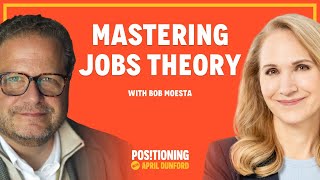
April Dunford interviews Bob Moesta, co-creator of Jobs to Be Done theory, on how to apply it to marketing and product positioning. They discuss the milkshake story and how Intercom used jobs theory to evolve their product.
Welcome to the Positioning show where we discuss topics related to the practical application of positioning for marketing, sales and product teams. I'm April Dunford, a consultant, author, and the world's leading expert on positioning for B2B technology companies. Hey everybody. Welcome back to another edition of the Positioning show with me, April Dunford. Hey, special episode today we got a guest. I don't have a guest very often, so when I do have a guest, you know it's going to be good. And so today's guest is the amazing, in comparison, terrible Bob Mesta. Some of you are very familiar with his work. He, he's, he's done a lot of things. He's a hard guy to do an introduction for because he's done so many things. Like when you get talking to him, he's had a handful of startups. He, you know, at one point he was selling houses. He had an investment bank once. But he is probably best known for his work on the, his the groundbreaking theory around jobs to be John, or jobs theory. And so if you're familiar with Clayton Christensen's work and the groundbreaking book Competing against Luck, he was one of the original researchers on that research. Bob's work is really focused on what motivates people and how people make decisions. So he's typically working with companies on innovation and looking at new products and how to innovate in a way that leads to lasting product success. What I thought would be really great is if we brought Bob on the podcast and talked about jobs theory and positioning in particular. Bob's concepts around jobs to be done had a big influence on the way I think about positioning and how I do positioning with my clients. So I thought it would be great to talk about that. I also thought it'd be neat to just get into some stuff that is more tech company focused because he does a lot of things outside of tech. But I wanted to get his opinion on things like product market fit and pivots and things like that. And so some of his ideas around that I think are really super interesting. I think you folks are really going to enjoy having Bob on the show here. Like, he's a, he's a guy that's worked with companies all over the planet. He's a lecturer at Northwestern University and Harvard. And so this is some like high quality education you're about to get here. So I hope you enjoy this episode as much as I did. The other thing that was really fun is Bob lives in Detroit. I live in Toronto. It's about a four and a half hour drive between our two places. So I drove down to rewired headquarters to meet with him in person. And so if you're enjoying the video on this, you'll get to see the two of us interacting directly. I don't usually get to do the full Joe Rogan here, where we are in a studio with the guest live, so that was really fun for me. Anyway, I hope you enjoy this episode.
Welcome to Detroit.
It's so good to be in Detroit. I drove all the way here from Toronto. We're coming at you live from the rewind from the Motown offices in Detroit.
So April and I have been trying to get together for, like, a couple years.
It's been stupid.
Yeah. And we were able to connect on Zoom, doing a lot of stuff, but. But for the most part, like, we're. We're four hours from each other, and now it's a home and home thing. So now I got to go up to see her, and she'll come down and see.
That's right. Now you got to get in the car, drive up the 401 to see me.
How did we get this? How did this come about this?
You know, like, I'm trying to think where I first met you in person. Like, we had cross paths and sort of blah, blah here and there, but I think it was. We were in Eastern Europe someplace at.
That's right.
We were at how to Web.
How to Web. Great conference with Bogdan.
Great conference.
Ryan speaking there this year.
Oh, my gosh. So much fun. So much fun.
Such a hungry crowd.
Yeah. And then. And then we've, you know, speaking circuit. Obviously, we met each other through that, but then.
But then there was times where, like, I needed some help or you needed some help, but we like, hey, what are you thinking?
I think it was a lot.
We were in parallel universe. Right.
I think it was a lot more immediate. Smell. What I. What I thought was so cool is like, you were the first person like, that I. That I met on my consulting journey.
Yeah.
That I thought had it figured out way better than me.
I would not say I had it figured out, but it might be a few years ahead.
I was like, man, I need to. I need to learn some stuff from Bob.
You were working so hard. I think when we first met, you were. You were doing, you know, almost a workshop every week, and you were just.
Kind of too much.
Just. Just jamming it all in. I'm like, okay, too much. You're gonna. This is. This is a marathon, not a sprint.
Yeah, no, exactly.
And. And you. You've done very well. But what do you want to talk about today?
Yeah, what I want to talk about today, I'm not entirely sure that my audience knows you.
Yes.
Or even the work that you do. In particular, jobs theory, jobs to be done, all that stuff and all of that. So could you give us a little bit of like, view from a million feet. Like, what's jobs theory? Which jobs to be done? Why should a bunch of founders and marketers or product marketers care about that?
Yeah. So I think it starts like I've been building things my whole life. My mom would tell you I was breaking. I was an engineer out of the. Out of the womb, breaking things. By the time I was to fixing things merely so I didn't get in trouble, I wasn't really that curious. But over time, I got very, very curious.
Yeah.
And I've been building things kind of my whole life. I've worked on over 3,500 different products and services, ranging from 500, the guidance system for the Patriot, Miss, Pokemon, Mac and Cheese Base Camp, and everything in between.
It's like those first two. Like, I like how we went.
Well, you got to anchor. Right.
Systems to Pokemon, Mac and Cheese.
Peter, let's come back to that.
Actually.
That's right. So. And part of it was the other thing is I'm dyslexic, so I can't read and I can't write it. So I would get these requirements documents from marketing about what was going on, and I couldn't make sense of it because they'd either have a Persona, and I'd say, well, can I go talk to this person? They're like, well, that person really doesn't exist. And you're like, yeah, but I want to see what, like, in context help me understand. And so I ended up learning a lot of different methods and tools. And one of them was called Quality Function Deployment, which was about how do we deploy the voice of the customer?
So cool.
And out of this, I realized that people valued things or weighted things differently depending on the context they're in. So context matters as much as the product.
So much.
And so that was where I started to bring in, like, how does context play a role? And then you start to realize, well, it's not only context, but it's the outcome.
Right.
So we. We've named that as like, the progress people are trying to make and that people really don't buy products. They hire them to. To basically make progress in their life. And so it's seeing how products fit into people's lives. And then from there I can actually design better products. And so that's really where this came from. And I've been doing it since the late 80s. I've been doing it primarily as my hack. And then I was able to team up with one of my mentors, Clay Christianson, and he helped turn it into a theory. I had no idea what he meant when he said, hey, let's turn this into a theory. But ultimately he wrote a book called Competing Against Luck. And that's kind of a classic where it's all 2016 as it came out. And from there, like, everything's kind of, you know, I'm doing that, that method jobs be done. But I have probably 25 other methods and tools I've been doing, but I'm most known for jobs to be done, so.
Interesting. So I have. I have this kind of relationship to jobs to be done stuff in that. You know, in the early days of me trying to figure out positioning, I went through this, this, this set of phases. So that at the beginning it really frustrated me that people talked a lot about what positioning was, why it was important, but nobody had a methodology for actually doing it. And so at one point I thought, well, I'm going to figure. So the way I did it was I started by busting positioning into pieces. Like, so there's five component pieces. It's competitive alternatives, distinct or differentiated capabilities, differentiated value, which is the key to everything. Best fit customer. So who cares a lot about that value and market category. And so, you know, when I got looking at that, I was like, okay, well, in order for us to have a methodology around this, I need to figure out how do I get to the best answer for each of those things?
Yes.
And I couldn't figure out everything kind of related to everything else.
But it was correlated. Is a lot of times nobody was getting to the under underlying causality of what caused these things.
Exactly. And so I was. I was stuck on, you know, the, the thing sort of felt like a spiral. I would pick a spot, we'd work around, and then we test it. And if it worked, great, we ran with it. If it didn't, we throw it out. We come back. But how I got out of that thinking was. I was listening to. I think it was you. Somebody talking about the milkshake story.
Probably Clay. Clay. Clay. So Clay is famous for telling the milkshake story, but I was the researcher on the milkshake.
Oh, my God.
So this was, this was a case.
Where like, give us the quick.
We were Hired by a. By a fast food service restaurant to basically, one of the things they.
Are you allowed to say, who are they? Like, okay, we can't say who.
We get it. We get it. We get a little. Imagine, though, I get a little trouble when I say who. But. But what happened is we asked him what was the least productive piece of equipment in the store, and it turns out it was the milkshake machine.
Interesting.
And so one of the things that we underlying believe is that most innovations come from anomalies. And so we went and looked into the data of the sales of milkshakes, and we found these three stores that sold milkshakes in the morning. And we're like, well, that's odd, right?
Why is he buying a milkshake in the morning?
And we're trying to figure it out. And it turned out that almost everybody who was buying milkshakes or were the stores that were open that were selling milkshakes, they had a long commute, so it was about anywhere from 25 to 45 minutes downtown, right? It was. It was a suburb of, you know, LA and Dallas and Atlanta. And they. They were stopping, and they were only getting a milkshake. They weren't getting anything else. And it's literally like, at this point, I'm like, okay, I'm gonna just. We gotta go to the stores. And so I'm literally sitting in lines knocking on windows, going like, I'm sorry, I know it's early, but, like, why are you getting a milkshake?
And would people think you're a weirdo? Like, are they like, who cares? Right? Yeah. I mean, some people are like, okay, Mr. Research dude, I'm gonna tell you what's going on in my mind.
That's right. But this was more like, why. Why this? Why now? Why not something else?
Right? And.
And this is where Clay starts to talk about the fact. This is what you realize is milkshakes doesn't. Doesn't compete with, you know, Coke. It competes with a. With a coffee, and it competes with, you know, a bagel and a banana. And these.
The idea was that these people were buying a milkshake in the morning for sleep.
They could sleep longer. Ultimately, it was that they could sleep longer, and they. They. Their stomach would not bother them later in the day. And so it was.
Right. So it had to be filling.
And they kept saying, well, is it healthy? It's like, it's got protein. It's got, you know, a fat. It's got carbohydrate. Carbohydrates in it. Like, like.
And it wasn't a big mess. Like, like an egg McMuffin is going to get all over my suit. So one of the things fits in a cup holder. And.
And one of the things we end up doing is we end up saying, well, how do we make a milkshake more breakfasty? And we made it a yogurt ch. Shake.
Right.
And so it was the beginning of the yogurt smoothies. So. And so. And so it's all that kind of thing that we were able to come up with, but it all came from the anomaly and then ultimately, you know, after a long. A fair, large period of time. But this company is now one of the largest producers of smoothies in the world, so.
Interesting. And see my aha moment that.
Almost 15 years to get it. This is the. This is the crazy part, because this is at 94. Right.
Right.
And most people didn't actually. So this is where the product preceded the positioning. And most people couldn't think of milkshakes for breakfast.
Right.
But ultimately, as they. They started to realize, like, I need something to sustain myself to lunch, and you start to realize that's when the positioning kind of caught up to the product.
Well, see, that's it. So, like, I had heard that story told a million times, and it was always, like, it was always told in the context of making a better product. So how do we know what to make? Like, so how do we know what to improve? And so we got to figure out the job that the product is doing, and if we can figure out that, then we give it. But the first time things really clicked for me is I had heard that story before, and I don't know what was different about the telling of it this particular time, but I'm listening to this story this time, and I. And it clicked for me. I was like, oh. The insight that came out of that research was the comparisons.
It's the competitive alternative, the real competitive alternatives, as opposed to theoretical, not what.
We thought in the office is what they were aging. So in the office, we're trying to design this milkshake thing because we think it's competing with Coke and in fact, it's competing with a donut.
That's right.
And that's really different.
That's right.
And so that the aha moment was me, for me was so I had my five component pieces. I needed to start with competitive alternatives, but the competitive alternative I needed was the real one. Like, if this product didn't exist.
Yes. What would a customer do exactly. And that's the thing is, is most people think of competitive alternatives is only when they're switching, what would they consider.
Right.
As opposed to. I think we Both know in B2B, it's over 50% of 50% don't get acted on because they already have a solution that. That's good enough.
It's okay.
And it's okay. And it's in Rails. But we never bring, you know, Microsoft Excel in as like, hey, that's our CRM.
Right.
It's more like, oh, you can have Salesforce or you can have High Rise, or you can have like, all these different ones. And it really like, no Excel.
Like, I have this thing in the workshops that I do and we talk about competitors. If you ask sales.
Yeah.
Who do you. They only give me the list of direct competitors. And they will overemphasize anybody they lose to.
Yes. Yeah. There's a bias to who they lose to and ultimately a buy. A bias for any. Even when they say, no, no action, it's like, yeah, but you don't have this and this and this. Okay, we got to have those features. And they think they can close one more. One more deal with one more feature. And that's where you get. Feature creep. Right.
Oh, my gosh. So. So much. So if I go. If I go to sales and I say competitive alternatives, they'll. They'll be like, this, this, this, 10, 5, and maybe not even that many. Like, they'll. But, you know, who gives me the worst list? Product.
Oh, yeah.
So I go over to product and I say, well, who's a competitive alternative? And they give me this list of like 30.
Right.
And then you'll go down that list of 30 and there's 20 there that sales has never seen in a deal. Never, ever. Right. So they're theoretical, competitive.
Right. That's what I.
The way I started describing it is their horizon competitors. Like, maybe if they got their act together and things change or whatever, we might see them on the horizon and maybe product needs to keep their eye on them a little bit or something.
So I have a different take on that. I think. I think their competitive reference is who can do the functions.
No, totally true.
Right. And so my thing is, is that we might never see them. Customers, remember? But you know what? They have a sorting function. We have a sorting function. We can both do these things. We can both actually print reports. So, you know, they. They could compete with us. And so it's this. It's this notion of, like, piecing together from, like, it's almost like what products do I compete with? Not through the customer's eyes, but through the functional elements of what it does.
Exactly. I googled it. And you know, and there's this. And. And you know, like. And I kind of call this. This is like the ghost. Right. Like it's living in our head, but it's not real.
Yeah, yeah, that's right. That's right. That's right.
So.
And it's in. It's to your point. I like the idea that it's theoretical. It's not bad. But it's the fact that they just. They end up seeing everybody as a competitor. And what you end up doing is you either overemphasize or under emphasize as opposed to really focusing on what progress is a customer trying to make.
That's exactly it.
This is where you get. You go awry. Like, if you look at the camera industry, the camera industry focused on each other so much that they lost the entire industry. That Apple.
Right.
The entire industry. It's like their unit sales are down 90% in 10 years. Not because they made bad product, not because they had bad positioning. It's the fact that they didn't focus on the customer that's the real problem. And so part of this is to realize the truth comes from the customer. And what's really interesting is most customers behave irrationally. There is like, when you ask them, it's like, it seems like, why in the world would they do that? And what you realize is that context makes the irrational rational.
Right.
And so that's why you have to get out of the room, stop thinking about just what people could do and talk about what people really do, what they actually do, and what is their reference point in their mind as they go into this situation and go like, yeah, I need to do something new.
Right.
And so most people think about. They talk about jobs and they say, well, you know, you're always looking backwards. And it's like, no, what I'm trying to do is connect the dots of how they did it in the past. So then I know how people are going to play it out in the future. Because how they did it is a pattern, and that pattern will repeat itself. And so ultimately I'm trying to find the causes that. Of what causes people to buy something as opposed to I have to convince somebody to buy something.
Right. Love it. Love it. Can you. Can you give us an example? We were talking earlier about intercom.
Yeah, yeah.
And yeah.
Such great people.
Yeah. Love them.
Yeah, yeah.
Hi.
Yeah. Hey, guys.
We Love you. So, but you were talking a bit about, you know, the original positioning. And so I thought it would be fun because we're on the positioning show to talk about your work there and, like, what you understand about how that positioning looked at the beginning and how it evolved and why it evolved and like, let's hear that.
Yeah, yeah. So I think Des and Owen had done two startups prior, and one of the things that they had realized is when they went to scale, they had a bunch of disparate databases and pieces that, as they tried to scale putting it together, connecting all those dots was very complicated and hard. And so every time you had to buy email server, you had to buy a chat, you had to buy all these different pieces. So this is 2010ish. Right. And so. And having sold their other previous startups, it was one of those things where it's like, you know, people would value if we put everything in one place, they don't need. They don't need the best of everything, but they just need it all in one place. And so the original positioning was, look, we're going to give you all the tools you need to start a SaaS business, and at the same time, we're going to give you basically all the tools that you need to basically make sure it all stays in one place around the customer. And they got to, you know, year one was like three and a half million, right. Which is pretty good. The year two was maybe it was three and then it was two. But when we got involved, Intercom guys.
Are listening to this going wrong, wrong.
But it was in this neighborhood by the time that Des and Owen reached out, because we had talked beforehand a couple of things, and they basically said, hey, would you come and do some interviews? Because, like, we're starting to stall. We're not. The growth rate isn't where we need it to be. Like, help us understand what else we can do. And so we went and we just did like 10, 12 interviews. Not a bunch of interviews, but we just interviewed people to say, what caused you to say today's the day that you need Intercom? Like, what, what hole was, was dug that intercom could fill?
Yep. And.
And we end up coming back with four really different jobs and none of them had to do with the original premise of data being all in one place. Right. And it turns out that some people hired it to basically help me acquire. People are coming to the site, but they're not converting. Help me convert. Well, it turns out that competes with HubSpot, another one we had was, oh, you know what, we have all these requests for technical requests for support. It's like, yeah, we're going to use Intercom for that. It's like, why would you use that? Turns out that competes with Zendesk. And so instead of having one positioning and one product, it turns out they end up having four really different products that came off the same platform. And so what's so cool about the story to me is that they, as a product person, what they did is they didn't actually build new features. The first thing they did is they just turned off features that were irrelevant to the job.
Right.
And so instead of trying to create four products, they literally just stripped away things to make the four products. And that's how they scaled it so interesting. And they went from basically 5 million to 75 million in 18 months, which is crazy.
That's crazy.
The team was amazing too.
So, yeah, I mean, execution on this stuff is such a big deal. It's one thing to talk about it theoretically and then even when you have the insight, it's like your folks with the milkshakes to turn it into a smoothie. Even when you have the insight that tells you this is what's going on and this is what folks are trying to do, being able to actually execute on that.
Yeah. Is like, well, and so this is where I. So I do a lot of work with startups and one of the things I talk about is like, if they have a vision of what they need to build, just go build it. Like the notion of trying to get them to figure out how to tweak it to fit the job is what happens. You end up having so much battle because in their mind it's their product, it's what they want to do, but once it's out of their mind, and now they want traction, now we can talk to customers because then they can hear, but otherwise they're trying to convince customers about the way they want to do whatever CRM or whatever they have going on.
Right.
And so to me, it's ultimately there's like mature startup people, second, third, fourth time founders, they know they have to find a struggling moment. They know they have to find basically a place where people are dissatisfied. But first time founders are typically so in love with the product that I almost got to tell them, like, go build what you're going to build and call me back, you know, dial me back when you're ready. And it works. And it's because they're really not ready to hear it. Right.
They're not ready to hear it. And. And it's all theoretical. Like. Like, the thing is, like, like with positioning work, really early stage folks will come to me and say, we gotta really nail the positioning before we launch. And I'm like, how on earth would we do that? Like, we just don't know right enough about who the. Who the who the customers are actually going to compare you to, how they go through a purchase process, how they make decisions.
Yeah.
Like, we know nothing about that. And we can interview ahead of time.
Yes.
To try and validate our positioning thesis.
Patterns of how people do it now and how do we get in their way.
Right. But then, but then, but then you put the thing out there, and what ends up happening is, oh, we interviewed people that look like this, but it turns out people that look like this actually love our thing and they're doing, you know, and so we don't know. We got nothing to grab onto.
But this is what, this is where. This is where people make the mistake. They call that a pivot. Oh, we're pivoting. Right.
Gosh.
And you start to realize that. That the pivot really comes from. From when you get to product market fit people are trying to build the product and bring people to the product as opposed to build the product and bring it to the people. And the pivot comes when you start to realize, like, I want, you know, 10 million people, I want, you know, this size company, all the. All the usual stuff that you put out to target. And you start to realize, like, but they're not buying it. They're. Or like, this is where I always. I have a big problem with Tammy. Total addressable market. Because at some point they talk about, like, well, there's 18 million small businesses in this geography that does this and this and this that we can target. I'm like, yeah, but how many are struggling? If they're not struggling, they can't see you. And so this is why positioning is so important, because positioning takes into account not only what your product is, but what it does for them in a very specific context.
Right.
And that's what that, to me, is. The is the is somehow we got taught that we need to develop products and talk about products almost irrelevant of context, and that it can solve anything and do anything in any situation. Or just don't talk about context. But context creates as much value as the product.
Absolutely.
This is like, I always say, do you like steak or do you like pizza? People go, huh? I'm like, well, I like both. It's like yeah, but let me, let me talk about the last steak situation. If I would have put pizza in, that would have been pizza been good. It's like, well, no. And so you start to realize that picking the right context to have people pull things into their lives is equally important. So I think of marketing's job is to be the radar system to helping people know that they have the struggling moment and then to be problem aware first and then to become solution aware as opposed to be solution aware and then educate them about the problem they might have.
Right, right. What do you think about, you know, the marketers right now try to. It drives me a little bit crazy, but. And I actually only see this in LinkedIn think pieces for some reason. Like it never comes up with an actual company outside of, of LinkedIn, but.
The academic realm or something.
I guess. Like there's this thing and people write so much about it and they're talking about how, you know, we have people that are ready to buy. So like you say people that are problem aware.
Yeah.
And then there's all these people that aren't problem aware. That's right. And so there's, there's kind of this thinking right now about we should be spending the majority of our time in marketing on this large swath of people that are not problem aware to try to wake them up to the problem. Like what do you think about that?
I just, like that's boiling the ocean to me. It's just a big way. So for me this is one of those things. Like so I built. One of the things I did is I built houses. And what I found is that like, and I sold to basically first time home buyers, divorced family with children and downsizers. Think of your parents, right?
Yeah.
And one of the things I learned about your parents is that a lot of times they talk about downsizing, but they don't really know what they want to do and how they want to do it. But the thing that activates them very quickly to really think about it faster is one of two things. One of them gets sick or one of their friends dies. And so you start to realize like, how do I get in their way? So I move my advertising from the real estate section because the real estate section is when you're openly admitting I'm looking.
Right, Right.
I'm trying to get to the point where you're not even look. You're saying you want to look, but you're not even looking yet. I moved it from the, from the, from the real estate section to the OBITUARIES And I literally said, want to move, don't know how to do this. Let us help. Because at some point, it turns out that downsizers literally look at the obituaries every day to see which one of their friends died. So. And you. And you start to realize. And to be honest, it got to the point where the local newspaper, the Joint Free Press, the editor came and said, like, we were one of the biggest real estate people, and they came and said, like, help me understand what's going on. We're involved in this thing called disruption theory. And you are fitting all the keys of what disruption theory is, because you're literally moving to other places where most people aren't. And I'm like. And then I told. Like, they had literally just come from clay. And it was just one of those very funny things that it closed the full circle. But this is the point is, I think you need to know where. How do they actually get activated to look, the thing is, is we can say that there's apathy. We can say that they're not. Not. We need to make them more aware. The reality is, they're aware of 10 other things that are way more important than whatever you're talking about. And this is the thing is, they're not.
Sorry, they are problem aware. Like, that's the thing. Like, I think. I think, like, in that example, they are problem aware. They're just not actively looking.
Yeah. Because there's.
And then there's a big difference between being not problem aware at all.
Yeah. But there's something that causes people to go active, and that's what. And this is the difference is that I think the biggest disservice to marketing education is that they don't have enough rigor in the sciences. I think that they have way more correlation than causation. And. And at the same time, the fact is, is, like, at some point, if it correlates, then I can make what. I can make it true. And the reality is like, no, this has to happen. And then that has to happen. If it happens in the opposite sequence, it doesn't happen.
It doesn't happen.
And that's where people kind of miss it. And that's where I think positioning should be about guiding people and helping people to buy. It has nothing to do with helping us to sell.
Exactly. Exactly.
Right. So that's that.
I mean, we just pull out. Hey, hey, you know, we should just pull that out. That'd be the sign. That'd be the. The soundbite for the episode. Yeah, but it really is about that.
But that's. But that's why I think that's how.
Positioning goes off the rails and doesn't make the jump from marketing to sales. Like, sometimes what you've got are these companies, and they do great positioning in the marketing team. So the marketing team's really nailing it. They really understand the answer to that question. Why. Why buy us versus the other guys? What are you going to get from our stuff that you're not going to get from everyone else? But then the lead flips over to sales and sales goes into sales mode as opposed to how do I help you buy? I'm really interested in this right now, by the way.
It sounds very similar. It feels like they're analogous, but when you dive deep into that, though, they're so, so different. Like the process. The interesting part is I've done a lot of research in the sales process. I believe that the sales process is run by finance more than anybody else. It says it's run by sales and by marketing. But when can I give a discount? Only when finance has done a bad projection. If you give me three more days, I close them after the quarter. That does us no good because now I got to go talk to the.
The bank.
And you start to realize, like, how in the world does. Does finance give the right to give a discount? But yet, yet ultimately the fact is, is like, I. I'm actually devaluing the business by giving that discount to meet a projection that you made a mistake about. That makes no sense.
That makes no sense at all. What do you think about. I want, I want to come back to. We were talking about pivots and things on pivots. Yeah. What do you think about the concept of product market fit? Do you think this is a useful concept? And, and I, I say this like I'm a person that talks a lot about. I don't actually. I really hated it when the concept first came out. And it's not so much the concept of it. It's what people want to do with product market fit when they have it. So there's this idea that there's this magical moment. We can't measure it. We don't know. It's like a gut feel. We know it when we have it, and then when we have that, the thing we go do, we're all in agreement about what the thing it is we go do. Once we have that, the thing we go do is we smash our foot on the gas for marketing and sales and go, go, go. But I was Always the person in charge of smashing the foot on the gas. And I was always like, well, do we. Do we understand why we have product market fit? And like, what does it mean? Like, who is the market we actually fit with? And most of the time there was not a clear definition of that. Therefore I couldn't smash my foot on the gas. But I was curious. It just came to my mind.
I think about is. I always think about it actually opposite, which is they think about product market fit. Because it's like, how do I get the market to fit my product? How do I find the market? Yes. Versus market product fit, which is these people who have this problem, what's the best product to help them make the progress they want to make? So again, it gets back to causation. Right.
How would you know if you have it? If you think about it that way, is there a way that we know.
We got it oh, so very early on? There are things. So what's so interesting is you start to ask people of like, how do you know this is working? And you can hear people go, like, you know what? They'll use really loose words like, the vibe. The vibe is just different. I'm like, what does that mean? It's like, well, everybody's got a little bit more energy, everybody wants to learn a bit more. And you start to really like. And so what happens, There's a lot of early indicators of when you have it, but most people aren't asking about it.
Right.
And they're asking the wrong way because they're trying to standardize it. And so the earliest signs of product market fit are very qualitative and they're very emotional.
I agree with that.
And most people are trying to get very hard numbers to do it. And so the other part, which I, I think is a is. Is a problem, is that most people don't understand product market fit implies once you have it, it's always there and it's dynamic. And so I might have product market fit today. And then Covid happens and then I don't have product market fit anymore. And so product market fit is a is a. Is. Is almost like a machine. You have to dial all the time and know how the. How the, the market is changing.
Positioning is like that, right? Like, like people get this idea. This is part of the reason why people get stressed out when they're doing positioning is they have this idea, we're going to carve it into the stone tablets.
Yeah.
And it's going to never change. Everyone gets very anxious about it. And then it's like, but. But, you know, our product doesn't stay the same. The market doesn't stay the same. The competitors aren't sitting around building the same thing every year.
Like, if we have to change the position, boy, the markers can't be. Be that good. It's like, no, that has nothing to do with it. Right? It's like. It's like, well, we've. We tried that positioning two years ago. It didn't work. You know what? That positioning might work now because the environment changed. I don't understand. Like, well, we tried that and it won't work.
Yeah, we tried it once and it didn't work. Yeah, I get that. I get that a lot. And so I do think it helps people sort of relax about the positioning, though, when they get this idea that it's this kind of dynamic thing. The same way the markets are dynamic, your competitors are. Damn it. Your product itself, like, you're building stuff. And your product two years from now is going to look different. It's going to have different capabilities. And, you know, and. And. And everybody says, oh, okay, good. And then people kind of relax about it. The other thing that I get a lot is, like, people will look at. And I read a lot of books that write case studies this way too, and they'll say, Salesforce, you know, their positioning looked like this. And what they're talking about is Salesforce is positioning at 2 billion revenue, 10 billion, wherever they're at different. And. And they'll try to extrapolate that back and say, well, this is why they were successful in the very early days. It's like, dude, their positioning was totally different right, in the early days. And so you're telling these little startups, oh, do it like this. And it's like, you would never do it like that. They didn't do it like that.
They didn't do it like that when they were this size either. And this. This is the thing is, is people don't understand that. That, like, this is where, again, I think people are trying to build pro process too soon because they. They. They literally are trying to scale things before they understand how they work. That's really what we're trying to do is how do customers work? How do customers buy? Not how does my product work? And so part of this is to realize, like, I was just talking to somebody earlier, and I said, like, you know, I have a glass. That glass, as it sits on the table, has no value. It only has value when I as a customer interact with it, pour Something into it and drink it. And again, it's the context of, like, is the liquid more important than the glass? Well, if I don't have a place to drink, then yeah, yeah. If I can drink it out of the can, then it actually possesses less value because the context I'm in. And so you start to realize, like, people have been trying to, you know, almost like, wash away context, wash away these other pieces to kind of say, here's how we're different and unique. And the reality is, like, at some point, the context is just as important to understand that value. And value is ultimately you and I had talked about. This is in my mind, I have two kinds of value. There's customer value. There's demand side value, which is the money I'm willing to give you to help me make progress.
Right.
And then there's supply side value, which is the profit that I make from literally helping you make that progress. And so whether if I don't make any money or I make a ton of money, the reality is, like, I still will only make so much money from one thing.
So this was awesome.
Yep.
Thank you so much for coming on.
And one thing for coming down, too, is I need to come on up. But at the same time, this was just. It's always good to spend time.
It's good to spend time. And thank you for, like, the, you know, the whole Joe Rogan experience we're having here. We've never done this outside of my office together, so excited.
In less than an hour, we're like, okay, we're setting up with all the.
Equipment in the world, I might add. But anyways, thanks so much.
Thank you. See ya.
All right, bye. All right, so that's it. I hope you folks enjoyed the episode. I thought it was so much fun talking to Bob about this stuff. I just wanted to come on and say thanks again for listening. I really appreciate you folks hanging out and being with me on this journey. As always, I'm going to ask you, like, please, please leave me some feedback. Give me a rating. Give me a review. This podcast is new, and so all that stuff really means a lot to me, and it's important to me to understand what's working and what isn't. The other thing I was going to mention is I got a book coming out. I mentioned it a little bit, but we're getting very close to the launch of that book. So by the time this episode goes live, oh, we're going to be so close. The book is sales pitch, and you're going to be able to pre order it soon or order it depending on when you're listening to this podcast. I cannot wait to get it out. I'm so excited. That's it for this week. Thanks so much and I'll see you next week.
More from Bobby
You Don’t Find Your Dream Job — You Design It | Bob Moesta, Co-Author of Job Moves

How to find work you love | Bob Moesta (Jobs-to-be-Done co-creator, author of "Job Moves”)
Hiring Your Next Job: Rethinking Career Moves with Michael B. Horn & Bob Moesta
The Knowns and Unknowns of Building Products (featuring Jason Fried and Bob Moesta)
Learning to Build - The five bedrock skills of product managers and innovators by Bob Moesta