You Don’t Find Your Dream Job — You Design It | Bob Moesta, Co-Author of Job Moves
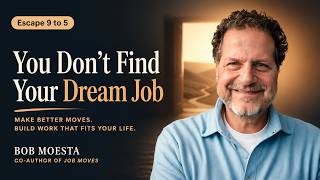
A 2025 YouTube interview with Bob Moesta about designing a meaningful career rather than passively finding a job. Moesta recounts overcoming dyslexia, early internships (including working with Dr. Deming at Ford), building seven startups and working on ~3,500 products, and learning from mentors (W. Edwards Deming, Genichi Taguchi, Willie Mora, Clayton Christensen). He explains the Jobs-to-Be-Done framework (people 'hire' products/services to make progress), summarizes research behind his book Job Moves (1,000+ interviews over ~15 years) and gives practical career tools: identify energy drivers/drains, know what you are (and aren't), prototype moves, use 'jobcations' to regain control, and treat time as the most precious resource (inspired by Taguchi's Seiko watch). Personal practices include choosing a made-up 'death day' to focus priorities and delegating tasks that drain energy. The episode mixes life anecdotes, actionable frameworks, and prototyping examples for career transitions.
Questions this video answers
About 3,500 products.
Seven startups.
W. Edwards Deming (met at 18), Genichi Taguchi (met at ~20), Willie Mores (met at ~24), Clayton Christensen (met at ~30).
Over 1,000 interviews across about 15 years of work.
March 2013 (she said the incident was March 2013).
If you can travel back in time to give your 20 year old self career advice, what would you say?
He was told he'd never amount to much at 18. They said, go be a baggage handler. Think of it as like, I'm a dyslexic, illiterate kid at 18 years old told to be a baggage handler at the airport or a construction worker. But Bob Moesta didn't just escape that Fate. He built seven startups, worked on 3,500 products, and became one of the minds behind Clayton Christensen's legendary jobs to be done theory. If I stand it myself at 20 years old and look forward and I kind of go like, let me tell you all the things you're going to do, I would have told you there's no way in hell I would have done any of that. And it all started with curiosity. Dr. Deming looked at me and said, you are a curious kid. How would you like to help me be an intern at Ford and I was a college student. I said, sure. From navigating career chaos to helping others figure out what energizes them. When you walk into a situation and you start talking about something and you end up with more energy than when you started, like, that's something you should be doing. And if you actually walk into a situation and it literally sucks the life out of you, that's probably something you shouldn't be doing. So the first thing is most people think that work is supposed to actually have all of the things in it that make their life happy. In this conversation, Bob shares what it really takes to find clarity. Starting with a question most of us avoid was, I picked a death day. Let's pretend like I'm gonna die on that day. I will only see my kids 20 more times in my life. That just killed me. Like, wait a second. What? Sometimes clarity doesn't come from planning. It comes from confronting uncertainty. The moments that shake us often shape us.
So two gunmen came into the restroom and asked everyone for money. And then that was what put me in perspective. If those people came in and they're crazy, I'd be dead. But luckily, I survived. I can only have this second, this present moment that belongs to me. So I should do my best for every single moment in my life.
That's what this episode is about. Seeing clearly, living intentionally. His mission now be the greatest footnote in someone else's story. Four people poured their knowledge into me, which enabled me to do all these other things. And so to me, I feel like I want to be the greatest footnote in history. Bob's newest book, Job Moves, helps you figure out when it's time to walk away from a job, a role, or even a dream. This episode is for anyone asking, what now? What's next? And how do I know when it's time to move on?
Hi, Bob.
Hi, Lydia. How are you?
Great. Thank you so much.
No problem.
I'm excited to share my podcast called Escape 9 to 5 is to show people that a different life portfolio life that other people inspiring people like yourself who has crafted this different journey. You have started many careers and then you're now currently you have a new book. It's called Job Moves. Usually I start the podcast with true truth and a lie as a icebreaker. It's a little bit of fun game for me and also for my listeners. So if we can try a little bit, then I'll guess which one is the lie.
Okay, let's see. I've lived in the same place for my entire life. I'm an engineer and I love to build things, and I'm an artist and I've done over 800 paintings.
I think. I think the last one is a lie.
That's not true. Nope. I've done over 800 paintings.
Really?
I've lived. I've lived here almost my entire life, but I lived four years away in college and three years when I lived in Europe. But for the most part, I've raised my family basically a mile from where I grew up. So I. I've lived not my whole life here, but for. For the most part, I would say 50 of my 60 years, I've lived in the same place.
Yeah. That's why I didn't get the right. Because I imagine for somebody like you, who's so well traveled, you must have lived elsewhere. But then for some reason, I. You give me the sense that you've been in roughly the same place for a long time.
So. So what's interesting about that as it relates to the 9 to 5 is I needed a. I needed a foundation of security and a foundation of. Of something that was comforting. So I've done seven startups, but I did them all in different cities.
Yeah.
And so I could go work somewhere for 18 hours a day and I didn't have to worry about my family. And I could literally then come home on Thursday or Friday and do whatever I needed to do. But I could work. I could do 90% of my work while I'm away. But if they would have come with me, I would have had. I mean, they would have had to reset. And I would have had to reset. It would. Very, very difficult. We. We basically. My wife and I agreed to basically kind of have one foundation, and then we would kind of. She knew that I was a. I was a restless soul and I needed to always kind of travel a little bit. And there was a point in my career where I didn't travel. And my kids even said, dad, it's time for you to go travel somewhere you don't need to be around so much.
There's a family that.
We are those instigators.
Yeah, yeah, yeah. I. I would love to dive into all of your stories and if you can share a little bit of your very, very early journey of your early career, because you've joked about being unimportant.
My mom would tell you, I was an engineer out of the womb. I was breaking things by the time I was three. I was fixing things by the time I was five. I built my first set of products by the time I was 10, which was speakers. I basically learned how to wind, do windings and crossovers and all that kind of stuff. And. And I just. I've loved to build things my whole life. At the same time, I had three close head brain injuries before I was 7 years old. And I can't read and I can't write. So technically, I'm dyslexic and so. Dyslexic, adhd. I have kind of some. I'm neurodivergent in that aspect. Right. But in 1972, when I got kind of labeled that the way the schools worked here in the States was I got just put into a room. So there was no really special ed at the time. And so ultimately I got no help. And so we had to move school districts. And ultimately my mom told me that I had to kind of hide that I had this disability. I consider it actually the greatest gift I ever got because the disability caused some super abilities for me to see things and do things differently. So, for example, I could never learn through books, so I had to learn through asking questions. So I was that little annoying kid who asked a thousand questions that you'd be like, oh, my God, does this guy ever go away? But that's the superpower it developed for me. And so ultimately, my first job, my first real job, was at Ford Motor Company, But I got it by sitting down next to a gentleman that I thought was somebody's grandfather, and I asked him 52 questions in 22 minutes. I only know that because he told me that. And it turns out his name was Dr. Deming. And Dr. Deming looked at me and said, you are a curious kid. How would you like to help me and be an intern at Ford? And I was a college student. I said sure. And he took me to Japan. And so ultimately I worked for Ford for almost nine years helping them kind of implement the Toyota production system method and learning all the notions Lean and all that other stuff. And so I was able, I was like on the front lines of that kind of stuff. And so that's, that was the foundation of my career. But ultimately I had a hard time navigating the politics within Ford and I got asked to pack my box and leave. So ultimately I, I did my. And what was interesting is I couldn't really go find a job because at some point my resume was never good enough in terms of like just grammatically to basically anybody would look at it and go like who were you? And so I did my first startup when I was like 26, 27 years old.
Wow, what was that startup about?
So that startup was a startup with it's called PD Meston Associates. And we, I, I had a non compete, I guess between now and then I actually ended up doing some work with the Department of Defense. But ultimately I ended up working in the food industry and helping develop food products. And so I took all my knowledge of how to the technical part of developing products and the marketing part of developing products and I partnered with a gentleman named Rick Peaty and We built a me from 1993 to 1990, 1999 around basically helping companies develop food products. So I in that time period I did almost a thousand food products.
It wouldn't be a very natural next step if you would ask me from Ford to food product producers.
Yes. So what's interesting is I think what I learned when I was at Ford was such fundamental learnings about how things work and the system like the notion of systems thinking, the notion of cause and effect, the fact that there is more unknown than there is known that I didn't have the angst of kind of moving industries because at some point in time I realized that mostly most people don't know how things work. And so ultimately being able to. It turns out that food products are actually more complicated in some cases than let's say even weapon systems or the automotive part of it. Because at some point there's not as good technical measures. And so you start to realize there's a whole new way you have to do things. And so one of the things I would, I pride myself on is that I love to learn. And I. And I realized that I say I'm not a great student from a traditional perspective, but when I go down a rabbit hole, I end up knowing something about something, like, way more than most people because I can't stop myself from asking those questions. Like, the questions kind of come like a wave of like, oh, what about this? What about this? And if you've ever heard me do an interview with somebody, it's like I'm asking a thousand questions very, very quickly and ultimately I'm building the story where I can kind of piece together everything and then I can start to actually predict. Like, so that means you probably did this. And they're really like, how did you know that? So the gift of being, of getting to being dyslexic and not being able to read has basically transformed into the superpower of being able to ask questions to anybody about anything and seeing patterns and things that most people can't see. And so I'm a very firm believer that we all have a superpower and we all have kind of kryptonite. We have something that holds us back. But the ultimate thing is that our, our superpower comes from the fact that we're not good at those other things. And so ultimately, when we, when we try to develop the things that we're really bad at, we actually hurt ourselves from being the. Having the superpower that we innately have.
Yeah, I think that's a really, really interesting and inspiring concept because when I found your content actually from Danny's podcast is when you talk about every disability comes with a super ability. And also I think it's the way when I coined this podcast called Escape 9 to 5 is myself, I was laid off twice. I think a lot of people have been laid off nowadays. It's never like a rare situation anymore. But it, what, what I think, what find. What I find interesting is like how you deal with these stories in our mind. It's about how you see the disability is also how I tell myself the story, how I can come back again from being at the bottom of my career. What feels like there is no way out to build a personal brand, to reach out to people like yourself and share the story so that other people can see it. It talks about the failure and lessons. You launched products, turnaround companies and make feedback. Can you share something that might not have end up that well, but you learned something along the way?
Yeah, yeah. So. So one of the startups I worked on was a. Was a company called Corestone and we built, basically did countertops and we Home Depot and Lowe's. And one of the things that was, it was my second startup and I was, I was brought in as a VP of sales and marketing. And one of the reasons why I took it is because I knew nothing about sales and marketing. I was able, I was able to kind of fake my way into it, but the reality is like, it's one of those things where I want to get better at it and I know that I can do it. And, and the way I had looked at it and the way I'd done things in the past, I'm like, this, this shouldn't be that hard. And so ultimately we were able to kind of, when I got there, we were doing about 500,000 in sales. When I left, they were, or when we got sold, we were doing about 20 million in sales. But the biggest part of it was is the learning about how the interdependencies of the system work. I was basically told to go sell as much as I could as fast as I could, which in a startup world makes a lot of sense, right? But when you're a physical product, you actually have to have the capacity and the cash flow to support all those things that was going on. And so it turns out I sold things so fast that we ended up running out of cash and actually putting the company at risk because of it. And so part of this is that the lesson that I learned is that in a lot of cases, the fact is I always like. So the rabbit hole I went down is like, why do we need to grow? And it turns out that one of the biggest pushes for us to grow is the banks. It's, everybody tells us that we need to grow, but when are you big enough? And like, I'll say that if you're trying to build a very, very large product that does, you know, it's a billion dollar product. I mean, I've done a few of those. But the reality is, is most products aren't that way. And the reason why you try to grow, or to be honest, you push yourself to grow so fast is because of the way that the debt is structured. And so you start to realize, like, at some point though, you don't think that finance and sales have anything in common or that they, they're interconnected. The reality is, is like they are very, very well connected. And so to see it not as two, two departments, but to see it as one entity. And so that's really the lesson that I learned, is that we, we might have 10 departments, but we only have one business. And they all need to understand how they work together. And ultimately the, the weakest link is the thing that actually causes the company to fall. And so part of it is to realize, you know, I'm not, I'm not a big finance guy. And so what I do is I make sure I have a really good finance person in my corner because I don't really want to pay attention to it, and I want to go where my skills are. And so part of this is me learning about kind of how to build a team around me that actually helps complement me as opposed to building a team around me of people who are just like me.
Yeah, exactly. I come from an investment banking background, so when I was working with startups, I can feel that if you're sitting outside of the company, you have one goal, but for the company themselves, sometimes they might not have enough financial literacy to understand what is the best for them. And that's sometimes very, very dangerous for a startup too. That's a great lesson there. We talked about lessons and I just wanted to touch upon. Because last time you showed me your mentors, you have those four photographs on your, on your wall. You've worked with many of the greatest minds like Clayton Christensen, Ru Edwards Dennis, and others. What's one lesson?
I've been lucky enough. And I feel, I feel like I don't, I don't really believe in luck. I know that there's a. That timing and preparedness create luck. But, but ultimately there's stuff that comes to us or happens to us for a reason. And what I would say it's better for me to put intention or some reason behind it than say it was random. I feel like randomness is a really bad concept because it forces us to wait. Right. And so ultimately the fact this is like I've had my four mentors are Dr. W. Edward Stemming. I met him when I was 18 years old. Dr. Genichi Taguchi, who is a father of quality engineering. I met him when I was 20 years old. I met Dr. Willie Mora when I was 24 years old. I met Clay Christianson when I was 30 years old. And so those people, like, think of it as like, I'm a dyslexic, illiterate kid at 18 years old, told to be a baggage handler at the airport or a construction worker. And I, my mom, first of all, my mom told me that was ridiculous. The. I'm, I'm very good at math, I'm very bad at English or any kind of Communication, written communication. And, and so ultimately the fact is, is those four poured their knowledge into me to enable me to go from almost being like nothing to I've worked on 3500 products, I've done seven startups, I teach at five different schools, I've written five books. Like, I've done all these crazy things from that. If I stand at myself at 20 years old and look forward and, and I kind of go like, let me tell you all the things you're going to do, I would have told you there's no way in hell I would have done any of that.
Yeah, I think sometimes, a lot of times when we look at successful people, then they will all, we'll all contribute to their success, to luck. But actually like you said, it's nothing random. It's all, sometimes we move to one direction and then something happened to us and then we grab that opportunity and it becomes luck. But it's not because luck happened to us and we do nothing. If we just sit at home, then it wouldn't happen.
So my, my mom told me basically her, she had a somebody she would, my mom was a school, she was a first grade school teacher for 30 years and she, she commuted with somebody and she was in the Detroit public schools and she commuted with somebody and, and she, the person she commuted with was upset at one point in time because I had this internship, son didn't have an internship and she was asking if I could actually help him get an internship. And my mom basically said like, look, you could say what you did was you got, you got lucky to meet Dr. Deming, but a lot of people meet Dr. Deming, but very few people follow up and very few people actually do what they're supposed to do and actually kind of help him be better and do all those other things. And so you have to realize like there might be an essence of luck in it, but the reality is there's also the skill to know how to actually take an opportunity and turn it into something that's positive. And that's what she constantly reminded me about is the fact is you need to have gratitude, you need to be humble, but you also need to realize there's still work you have to do and nothing comes easy. And so that's kind of something that sits in the back of my head all the time.
You've met all of those great figures in your youth from 18 to 30, but if you can travel back in time as of now, travel back in time to give your some 20 year old self 10 seconds of career advice, what would you say?
So I actually got it from Dr. Taguchi, and I live it every day. But. And this is the piece of advice I actually push to everybody else. Is that so when I was in Japan, it was like I was 20, I was a junior in college, I was going to leave Japan. And Dr. Taguchi, basically, to say goodbye, he had a present for me. The present is wrapped, like, in my terms, it was like, you know, wrapped very Japanese is like, no, there's no tape. It's all very, very, you know, it's, it's, it's like. Feels like it's origami. And I open it and it's a watch, and it's a Seiko watch. And he goes, I'm giving you this watch not to tell time. I'm giving you this watch because time is the most precious of all the resources you have. And the reality is, is that at some point you need to be very intentional how you spend your time and that ultimately there will people who. There'll be people who want to steal your time. And those people who steal your time are worse than a thief, because at least if somebody, a thief steals something from you, you can get it back, but you can never get your time back. And so I want this watch to remind you that this is the most precious of all your resources. And he gave me that watch when he was 60 and I was 20. And that, that is the thing. And to be honest, what I wish I did is so I got the advice, but I didn't really start to appreciate it till I was in my 30s or 40s. And the reality is, is like, at some point in time, I think time is that most precious thing. That to be honest, one of the things that I did like almost seven, eight years ago was basically, I sound a little morbid, but one of the things I did to actually help me become more and more focused was I picked a death day. So. And it sounds morbid, but it's this aspect of, of. So I'm. I started at about 5,000 days, and now I'm down to a thousand days. And what this does is it sounds really strange, but I actually took my mom's birthday and her death day. My mom died when she was 63, and she always would say, oh, I'll do this when I retire. No, no, I don't want to do that. I'll do that when I retire. She retired and four months later she was dead of colon cancer. So I took her birthday and her death day and said, let's pretend like I'm going to die on that day. My mom didn't know she was going to die, but I'm going to pretend like I'm going to die on that day. I totally made it up. But ultimately, the first thing I realized is, is if I only have. If I only have five, six years left when I started this, that I have four children, and I have. And I see them and they're all over the country, and I only see them once a quarter. I will only see my kids 20 more times in my life.
Yeah, that's a profound.
That just killed me. Like. Like, wait a second. What? And then you start to realize, like, like, so what? The first thing I did is I actually fired the bottom 20% of my clients. And then I figured out ways to get closer and closer to wherever my kids are. So I now lecture all over the place. And so I'll find a time to go lecture at Cal Berkeley. I'll go find a time to lecture at Oregon, because I've got kids in San Francisco and kids in Oregon. And ultimately it's like, how do I actually make sure that. And how do we find time to get together? So my kids buy me the ICON pass for Father's Day, and then I buy them Icon pass for their birthday, and then we actually get to ski together. So it's all these different things that it's like. And so, like, writing the books. Like, I can't read and write, so why would I write a book? Well, part of it is I only have a thousand days left, and I've got to do these things. How do I pass on this knowledge? Because I didn't create this knowledge. These people poured their knowledge into me. How do I actually do it for it? So I. I literally build all the research, I figure out everything around the book, and then I find people to help me write the book. And so. And so this is where, like, people go, like, you can't be dyslexic and be an author. I'm like, you can?
You can. You can. I think that, like, the whole story of your evolution of you, how you grow from when you're 20 years old to now. And all of those life stories is just what we need to listen. What I realized, because when I was 22, I encountered gun violence. It's not. I'm still alive, so I'm, like, extremely lucky. It was in a Japanese restaurant in Rochester, New York. So two gunmen came into the restaurant and asked everyone for money. But that was the first time I encountered it.
And yeah. Yeah, that was so scary. So scary.
AK47. Right. And then that was what put me in perspective. I was like, if I got an internship in Goldman, let's say. Because that's what all I wanted to do.
Yeah, of course. Goldman's gold.
But then those people. And if those people came in, they're crazy. I'd be dead. But luckily, I survived. It was Exactly. It was 12 years ago, March 2013. And that really put me in perspective. Perspective. And then I make life decisions way better than before because every now and then, I would forget about this a little bit the more. Yeah, this is.
But by the way, this is what people don't really understand. At least I. At least I feel that most people understand is in the middle of something bad, there is always some good.
Yes.
And in the middle of something good, there's always some bad. But you need to find it and see it both. Because at some point in time, everybody will say, oh, God, Covid was so horrible. But if I say, what was the best thing about COVID Oh, my God, I didn't have to commute to work. Oh, my God, I got to exercise. Oh, my. Like, and so even though it's in the middle of something bad, there's always something good around it. And so part of this is, to me is this is where I'm so old. I'm to the point where when something bad happens, I get excited because I'm like, okay, where's the good in this?
Yeah, right.
Because it's. I'm almost, like, trained like Pavlov's dog to look for the bad. One of the things I do is I was a. I'm a co architect of a framework called jobs to be done. And the fact is that people don't hire. They don't buy products. They hire them to make progress in their life. And that all innovation is started from a struggling moment. And that you start to realize that the struggle is the. Actually the beginning of your transformation. And so when you have this struggling moment, most people kind of freak out, but it ultimately gives you perspective and context to then realize you have to do something different. And so ultimately that, like, to me, I think the notion is, is struggling moments are very important. Like, for my kids, one of the things we did with our kids is we felt if we helped our kids too much, we were robbing them of the ability to innovate. So when they would struggle with something, we would actually enable them to basically go find a way to either solve it or in Some cases fail at it, but how would they learn from it? And so the notion of, like, as a parent, to walk in and take care of something for a kid, because I want to. I want them to focus on something else. It's like they end up with no skills to actually figure out how to handle struggling moments. And so to me, struggling moments are the key to all of this.
Yeah. The only way to grow is to learn, I think, from the struggling. And you talked about.
And let's be clear. Sorry, I. Sorry, but let's be clear. Nobody wishes you to be held up at gunpoint. Nobody wants that to happen. And so the reality is, is like. So when it happens to you, it's horrible. Right. But the reality is, is like, it's. It's the human experience that can actually take a really bad experience and twist it into something that actually helps you become a better person. That's what humanity is about.
Yeah. At that moment, I just realized nothing really horrible happened. They come in, ask for money, nobody get hurt. But what I realized is I don't have. I would never know what's going to happen next. Second, I could walk out of a door and somebody crazy.
Exactly.
I can only have the second, this present moment that belongs to me. So I should do my best for every single moment in my life. And that's my realization out of that.
That's right.
That's right.
I'm spending more and more time in the present. Like, so the thing that I realize is the present is an infinitely thin line. It is so thin that, like, the moment I think about the present, the present is gone, and now it's the past. And so the notion is, how do you actually realize that most of your fear comes about fear of the future? And most of your anxiety comes of something that happened in the past. And you can't do anything about either one of those things. And so part of this is building a new frame around your head to basically say, like, the more I'm in the present, the more I actually impact I can have. And so this is to your point of knowing how to. How to take some bad experiences, but how to convert them so you can behave better in the present.
Yeah, exactly. So talking about the present, we got to talk about jobs to be done and also job moves. Can you quickly break down jobs to be done for listeners who are unfamiliar with this framework and explaining how the new book is built on that?
Yeah. Yeah. So. So, because I'm. I couldn't actually read any of the marketing reports I got so I would always ask to go talk to four or five or ten customers about why they bought our product or what was going on with the product, or where did they struggle and what did they try to do to solve it. And so the premise is that people, again, don't buy products. They hire them to make progress in their life. And it's not random that somebody buys anything. Everything is actually caused. There's things that have to happen to them to make them ready to say, today's the day I need a new CRM, or today's the day I need a new car. They just don't randomly go out and buy it. And typically, randomness is decided because you can't explain it, but it doesn't mean that there weren't causes. And so part of this is basically going deeper and deeper into what are the underlying pushes that pushed you to change, what was. What were you hoping for, what pulls you to change, and then the friction of what's the anxiety of that change that's kind of holding you back. And what's the habit that you have that holds you back? And so by framing things that way, you can then understand how to position your product better, how to position your services better, et cetera. I took that concept, and then I worked with Ethan Bernstein, who's at the organizational behavior school at Harvard, and then Michael Horn, who's at the education college. We did a bunch of research, and we did what we would say is what caused people to say, today's the day they're going to leave this job and go to a new job. And it seems pretty, like, obvious, but what you start to realize is that most. And think of it as like an exit interview, but most exit interviews are lies. 53% of the people who said they got more money did not get more money, but they didn't want to tell people the real reason why they were leaving. And so I didn't do this for any company or any corporation. I just literally I got onto a place called Respondent, and I just. I just started interviewing people say, like, why did. Tell me you got a new job. Tell me what happened that caused you to get a new job. And the notion here is it's. It's not really focused on people who got laid off or got fired, but more like those people who basically decide that they don't want their boss's job and they don't know where to go next. How do you decide where to go next? And so out of that work came this book called Job Moves, which is Using and helping people realize, like, how do you navigate your career? Because one of the other misnomers is that most people feel that HR is, is there to represent them and help them find their next job. And when you really get into it, you realize HR's job is to manage risk and to fill holes and to basically manage procedures. But they're not actually in the employee's corner. And so it's written from the perspective of understanding how to help an employee. Because in the end of the day, the employee hires the company more than the company hires the employee.
Yeah. So you basically you move from how do you hire a product to help you solve a problem to how do you hire a job to help you advance your career?
Exactly, exactly. Right. It's that simple. But the we've did over a thousand interviews. It's 15 years worth of work work. It's one of those side gigs or side projects you have that you just kind of keep running. And then all of a sudden it's like, you know what? The great resignation happened. We got approached by a publisher and we said, all right, let's write this book. And so two years later the book comes out. So I have, I have five more books. But like that, like they're all kind of side projects on that kind of topic and those kinds of things.
If you were to tell people who are stuck in their 9 to 5 job. Because every like this morning I was just talking to a friend, even though now I'm like just started my career in startup and with no comparison to all my friends who are earning 67 figure salary. But sometimes they would be like, we really hate our job. What would you say to them? How do they transform this career struggle and use your job moves during work?
So I think there's a couple things. One is some people hate their jobs because they don't get to do the work they love to do. And so we talk about in the book this notion of energy drivers and energy drains. There's things where at work, when you go into it, you're like, oh my God, I love to do, like, I love to do the analysis I love to do, you know, find the opportunity. I hate to write the memos, I hate to write the, you know, I hate to do the IPOs, I hate to do like. And so there's stuff where you, you end up realizing that you have a portfolio of things that you affinitize to and things that repel you. And so ultimately, and it's more the way I describe it is when you Walk into a situation and you start talking about something, and you end up with more energy. Like, in your body, you're more excited, more energy than when you started. Like, that's something you should be doing, Right? And if you actually walk into a situation and it literally sucks the life out of you, that's probably something you shouldn't be doing. And so the first thing is, is most people think that work is supposed to actually have all of the things in it that make their life happy. And what I would tell you is, and most people are working very long hours, but very few of them have hobbies. Very few of them have something that they loved. I like people who love to write. Go journal. Just like, journal what, like, do things. Some things that give you energy. And so part of it is to do. To do some of that stuff. The second part is to realize, like, if you really want to get out of it, you need to actually start to realize two really important things. One is, who are you and who aren't you? Right? What are you good at? What are you not good at? And this is where you have to look in the mirror and look at the hard stuff as well. Because you can say, I'm good at this and this and this, but I want to know what you suck at. Because what you suck at is actually the kind of the. The key to basically finding your next really good career move because you want to design the stuff that you suck at out. Because it just like. So, for example, for the first 35 years of my life, I spent an hour a day learning and practicing how to spell. And as a dyslexic person at 35, I finally realized, like, okay, this is just not going to happen. I'm not going to do the. I can't do crosswords. Like, I can come up with the word. I can't figure out how to spell the word to put in the crossword puzzle. And so what I realized is as an hour a day spending to learn something that I know I'm never going to get. The reality is I got seven hours back. That's when I started to paint. Because I loved. Yeah, yeah.
And so that's paintings behind you from you.
Yeah, All. Yeah, all those behind me are mine. Like, I. My wife won't hang them in the house, so I have to hang them in my office. But I. I give most of them away. But ultimately, the fact is. And I. And to be honest, when I paint, all I really like to do is mix the paint. There's something about mixing the Paint. And applying the paint. I love the. Like, trying to figure out what the picture is is, like, too much for me. So I built an algorithm to take a photograph, strip it down, and then I print it on a canvas, and then I can paint on the canvas. And so I just worry about mixing and brush strokes.
Created a canvas for you.
For me. Right. And it's not like, for nobody else. And I don't really care how any. I'm not worried about people judging my art. Some people would say it's art, some people say it's not art. I don't really care. It gives me energy. That's all I care.
Yeah. I want to double click on the point because we started from someone who work long hours, and then they need to find a time. I think that's the most struggle piece. Because if we enter a conversation, like, let's say I'm talking to my friend, I was like, you need to find the time. They would be like, I have no time. You have no clue that I have no time.
But see, time is. Time is not the problem. Priority is the problem.
Exactly. Yeah.
And so what happens is you don't. So the second part of the. There's two questions. Who are you? And who are you not? I consider that one question.
Yeah.
But the second question is, what do you want? And that is very hard for people to articulate because most people can tell you not what they want, they can tell you what they don't want.
Yes. Yes.
But they have no idea how to articulate an experience that they've never had. And so part of this is the reason why this podcast is so important and why I'm happy, so happy to be on it, is this is what you want to be able to do, is help people see possibilities.
Yes.
Like, nobody's going to replicate what I do, but they're going to get an idea from what I do and say, oh, that's how he painted. Oh, maybe I could do something like that. Right. And ultimately, it's this aspect of being able to navigate your way to finding where you get energy. Because what. And what I'll tell you is the moment that you're working, you're doing a job, and over 50% of the work gives you energy. You are not working anymore.
Yeah.
Most people do 80, 90% of the work they hate for the 5 to 10% of the work they love. But if you can just, like, there's always going to be work that you hate to do. Like, I hate to do expense reports. I got to look At P and L statements, I don't really like it. I have somebody else who helps me with it. But the reality is like. Like, I try to cut all that stuff and delegate it to people I trust, and then ultimately, so I can do the best work of the work that I do, which is things like this.
Yes, I really gained. I feel like I've now refreshed my energy just by talking to you. So thanks so much again for agreeing to the podcast. And to be honest, this is a very selfish podcast for myself. When I started it. I don't have role models like yourself. I don't have stories. I'm not a, you know, genius kid who just start startup when I was 15. I'm like a traditional career path. Penny off the lawyer. I don't have anyone around me who show me differently. That's why I'm like, let me talk to people who have status and who have stories to share. So speaking of stories, you study, like, a thousand Korea transitions.
Yeah.
If there's one you can share with us.
Let me think of one. So there's. There's this one that I really liked. Her name was Claire, and she was a neuroscientist, and she was running a lab. She's from the United States, but she was in Ireland running a lab for doing clinical trials. And then Covid hit and she had to come home. And when she came home, she basically went and. And she. She ended up trying to find any job she could get that was close to her. Her parents, so she could kind of live at home and do what she needed to do. But it was like, it turns out it was at a hospital as kind of like a nurse. Assistant. Assistant, right. She wasn't a nurse. She was a neuroscientist, but is like, okay, I can do job, but she could work, and she'd have four days off, and she could go climb mountains and do these other things, and she really liked that. But eventually she got to the point where the work just sucked the life out of her. And she's like, all right, what do I want to do next? And when we sat down to prototype, like, so what part of the process is to figure out who you are and, you know, what makes you tick? What do you love? What gives you energy, what sucks your energy? And then what do you want? And so there's this step in the process where we talk about prototyping really, really different things. And so when we looked at her skills and what was going on, the range of things she could do is she could be a design researcher at ido. She could be a National Geographic core trip coordinator. She could be. Go back to school and get a physician's assistant or PA license, or she could become a, a technical writer.
Right?
And they're just so diverse and there's so many different things that then she went and I told her to go, like, I, why don't you go find three or four people in each one of those categories and go interview them?
Yeah.
So you know what, so you not, not to interview like for a job, but just interview to say like somebody who had the job, what was it like to do that job? And she ended up doing like 10, 12, maybe 15 interviews. And ultimately she was able to kind of size up like, oh, this idea of a Nat Geo coordinator, like, I can travel, I get to teach, I get to build a curriculum. Turns out that was not what that job was at all. It was just, it was literally a glorified travel agent. And she's like, I'm out of that. And then she's like, you know, I could be a design researcher and I could do that, but like, like, you know, I've got to start at the bottom and here's where I have to be. But I could do this and this and this. And then ultimately she came down to the conclusion of basically merging two of them, where she took a job as a freelance writer and ultimately went back to PA school. Because that's the thing that she felt she wanted to be. She didn't want to be a doctor, but she felt like being able to help people was her true calling and she was able to kind of transition herself and, and now she's a full time pa. Yeah. Right. So this, this notion though is, is like, it's, I think about it as like climbing a mountain, right? You, you can, you can kind of say where you want to go, but you have to actually take into account the context of the day you're climbing. Because when you, that day you're climbing, it might be raining, it might be snowing, it might be sunny, it might be like, you've got to be able to take all of that into account to realize like you want to go that direction, but what are the skills you really need along the way? And so to me, I feel like the average person has a, stays at a job about four years, right? And so every four years people are looking to change. There's like, I love Kim. Scott's got a book called Radical Candor and she talks about the notion of a rising star versus a rock star. And I would tell you, like, in my. In my early career, till I was 35 or 40, I wanted to be a rising star. I wanted a higher position. I wanted actually more responsibility. But once I had children and I was kind of doing other things, it was kind of like, okay, I want to be a rock star. What's the thing I want to be really good at? And I'm going to surround everybody else around me. And so a lot of times people think that people leave jobs because of the job, but a lot of times people leave the job because they've changed. Right?
Yeah.
That's where you start to recognize that stuff. That's right.
Yeah. Yeah. It's. It feels to me the story that you. You told is treating your career and your job as if you're treating a science experiment. So you talk to people, figure out all the. All the assumptions, what works, what not, and eventually you come up with some type of prototype that works for you.
That's right. But the thing is, you've got to go deep enough into yourself. You have to look in the mirror long enough. You have to know not only what you're good at. Like, one of the reasons why I like Strength Finders is it gives you language to talk about yourself that you usually don't have to do. The other part is it also identifies those things you suck at that most people don't recognize. But the bottom. The bottom five things. So I've taken Strength finders every year for the last 25 years. And what I'll tell you is that my bottom five has always been my bottom five. Like, one of my bottom five is a harmonizer. I'm just not a harmonizer. Like, it's about getting people to get along. Part of it is because I believe that innovation and product are a contact sport. I need conflict. Conflict actually helps us create better stuff.
Yes.
And so the more we argue, the better we're going to be. And the fact is we need to actually be very good arguers. And so the notion of harmony is like, the opposite of that. I feel like when we build a product that's built in harmony, we end up with a product that is compromised on everything, and you end up with something that just is. Like, I would say the Pinto or the pacer was a. Was a. Was a. Was a collaborative, you know, kind of like that was built on harmony. And it's like at some point, it's not successful. And so those are the kinds of things that you need to know about yourself. And you need to be able to articulate. So when you're doing a job interview, it's like, look, I'm really good at this. If you want me to do that, I can do it. But it's literally going to take me three times as long as somebody else because of this and this and this. And again, what's interesting is what we're finding is as people go in for interviews, it's actually refreshing for people to actually tell. Tell them specifically what they suck at. That because they always ask, what's your weakness? And like, they'll say, oh, my weaknesses. I work too much. Like, come on, that's just not a real weakness.
I'm a perfectionist. Something like that.
Yeah. So. So anyway, it's. It's been a very interesting life. I. Like I said I have, I think I have. Let me just. I think I want to say it's like a thousand 15 days left. How many got. I got a thousand and two days left. Where is it? There it is. Thousand and two days left. That's third. That's 32 months. And so what's so interesting as I get closer and closer. So think of it this way. It's a date I made up.
Yes.
It's enabled me to change my behavior and do so much good in the world and good for myself. I've lost a hundred pounds. I've done everything I can to kind of make sure I can live past that date. I don't know if I can make it past that date because I don't. I mean, I don't have really too much say in that. But ultimately the fact is it's allowed me to actually behave in a much better way. And ultimately it's a lie. It's really a lie. I've made up that that is useful. And so this is where I've come to the conclusion of me deciding how the meaning behind things. So it empowers me and gives me energy, is kind of what I'm doing now. And so, for example, right now I'm not looking for any more opportunities. I'm literally just letting opportunities emerge in front of me. And so in the last two last year, I like, I wrote this book. I said no more books. I already have five more books in my head. I said I'm going to start to think about retirement. I have two startups that I started in the last year, seven months. Like, it just. Stuff keeps coming because I now can see it where before I couldn't see it.
I think it's very important to know what to say no to. And putting yes. A time limit on your time is putting a. Putting you in perspective in when. Whenever you come across anything. And you've also said that you've done more in the past two years than the last 10.
Yeah.
Was that because you started this clock?
Yep, that's right.
Exactly. Because.
Because it. Cause it forced me. What, to say no to. It forced me to tell me what to stop. It literally figured out, like, what's important to me and what's not important to me, because in a lot of cases, I just did what was important to others.
What's important to you now is this, to teach and to share what you've learned in your life.
So that's. That's so my. I will. So, one of my mentors is Clay Christensen. He wrote a book, how will you measure your life? And I. I continually measure my life by the number of people I help help. So your podcast is basically a distribution channel for me to spread my knowledge so other people can learn it. So ultimately, I. I try to do every podcast I can because it helps me help maybe one, one hundred, a thousand, a million people. And so ultimately, that's. That's. That's why I'm on Lenny. That's why I'm on yours. That's why. And so. And what I want to know is how to help the people who are your listeners. I'm not. I'm not trying to promote me. I'm trying to help them make progress in their lives.
Yeah. And ultimately, when you help 100, a thousand million, a billion people, it's unavoidably come back to you as well. And it's the best feeling.
I think, like, a hundred years from now, nobody will know who I am. That's fine. Right? So it's really not about that, but to realize, like, at 18 years old, I had no future. I was literally told to be just a cog in the machine. And yet then four people poured their knowledge into me, which enabled me to do all these other things. And so to me, I feel like what I want to be is, like, the way I say it is. I want to be the greatest footnote in history. Right. And so. So, like, when people say, like, thank you for doing this, or, boy, I did this, like, that they could utilize whatever thinking I had, and it helped them build whatever they want to build. I don't need to build anymore, but I want to help other people build to inspire others.
I think one of. I'm really inspired by you and would love to implement The Jobs to be done and job moves framework to every aspects of my life. So I wanted to ask for a live problem solving. I'm now crowdfunding my podcast. So before I have another podcast, it's on climate, right? So it's called Bite Size Climate Tech. And I'm crowdfunding the season four on Kickstarters. So I have 10 days left. As of now, I'm struggling to have exposure for this campaign. And also it's a difficult concept for me to. I've reached out to 300 people just manually, by hand, all of my friends, all the past contacts. It's first, difficult to help them understand the urgency of the campaign and two, difficult to convince them if they're not in the field to give me a little bit of what should I do for the next.
What you're asking for is the most precious of all the things they have, which is their time.
Yes.
Right. And so part of it is to think about what is, what is the rabbit hole you want to lead people down and what makes them like. So, for example, like, like what I would do is I would actually start to interview people who became very, very passionate about climate change and understand because at some point they weren't passionate about climate change, and then they were passionate about climate change. What caused them to change their position on climate change? So the thing is, is what had to happen to them. And like, what I would say is it might be I had to go through a fire. We had these four, these, these, these, these fires. Like, all of a sudden that became real to me. And now all of a sudden this is a real thing to me. Like, okay, and, and so by understanding what causes, to activate people to basically realizing that climate change is real, ultimately that's the thing you need to advertise, is to say, like, you know that this is a problem. Most people don't. Here's how we're going to stay on the cutting edge of it.
Yes. That's actually a new segment that I incorporate in season three. So I asked people why people work in climate and I just. Yesterday I posted a short clip about one answers on LinkedIn. So hopefully that's exactly what I should do.
But ultimately think of it as there are way more uneducated people about climate change than there are people who are knowledgeable of climate change. But what we really want to do is you want to convince the people or you want to inform the people who don't know, but they don't even know how to know. And so my thing is what you need to do is study the people who change. They went from not knowing to knowing. That's what the podcast should be doing, is learning how to activate people into climate change as opposed to just. Just helping the people who know about climate change go deeper.
Yes. That's a great segue. Thank you so much, Bob. Thank you. And then the other thing is usually when we talk about Escape 9 to 5, it's people who have a job from 9 to 5 to maybe entrepreneurship. And you have this notion about job cation in entrepreneurship. When do you know to step away from startup entrepreneurship?
There's four quests. One quest is like you're at a place that it's just, just so bad that you don't even know where you want to go, but it's so bad you got to get out. So one quest is just help me get out. The second one is basically, help me, help me take the next step. I've learned everything I've had to learn here. I'm ready for the next thing. Help me find the next step. Those are kind of two very usual kind of steps. But the other two are. One is help me regain control, which is like, it's like I'm doing the work I love to do, but the fact is there's just too much of it and ultimately I have to figure out how to regain control and say no so I can continue to do the work I love and it doesn't burn me out. The other one is about regain alignment, which is people are now asking me to do more and more different things. And ultimately, you know, I like to be an engineer, but somehow I'm a marketer and I want to actually get rid of. I want to get back to being an engineer. Right. And so what you start to realize is the jobcation is one of those things where this takes energy and time and commitment to do it. And so what I coined the phrase jobcation around when I went to build houses. I had done, at the time, I had done two startups. I had started a private equity firm around 2000. What happened is that turned into a turnaround firm dev, as opposed to a private equity firm where we'd end up buying stuff for 10 cents on the dollar, selling it for 20 cents on the dollar. It was very invigorating. I did 25 transactions in three years. It was kind of amazing. But at the same time, it was so busy, my family started to suffer. I ended up kind of traveling just so much. I got sick, I got heavy. Like all these different things and so it got to the point where my wife basically tapped me on the shoulder and said, like, this isn't working for us. And so I ended up kind of basically shutting it down and returning the money. And my jobcation was to go and find a job where I could actually do. I didn't have to travel at all and I could work nine to five. And I. And to be honest, I was in a place where I wouldn't necessarily make. Make a lot of money, but I would make money. And to be honest, they appreciated me being there so much. So it's like I figured I could actually do this job with one hand tied behind my back and I could make it work. And so ultimately it's, it's a job that you go find that is usually beneath you or below you or kind of like just one step that's kind of like it's not, it's not a step of progress, but it's a step back so you can actually do the things you need to do. But it allowed me to, to rebuild my relationship with my wife, be there for my kids, not have to travel, get my health back up. And then literally by 2000. So I did from 2005, the, the home building. I did from 2005 to 2007, 2008, and then I went back to a startup because I was actually rested and ready to go, and I did a software startup at that point in time. And so ultimately the jobcation is that notion of like, how do I just take a step back, regain control?
Sure.
I think 25 years ago that was not accepted to have a gap in your, in your, in your resume. But I feel like these days there's like, it's very impressive for people to say, yeah, I had to take a break because this is what was going on. Now I'm ready to do this. I don't think people look down at that at all anymore.
No, I think now it's more about if you take the career break intentionally, then you, you're creating something else that's outside of the traditional route and that when you come back, you have more to offer.
I think self awareness is more valued than, than grind. Yes, you might know how to grind, but the fact is I need you to know who you are and what you're about and what you're good at. What you're not good at is way more powerful to me than knowing that, hey, I can do anything and I can get it done and I can burn myself out.
Yeah. Yeah. If you, you wanted people to Want to have one key insight from job moves that you hope everyone walks away with.
What would you say that throughout your life you will change and that sometimes it's the. It's the company, sometimes it's you, sometimes it's. It's the environment. But to realize that the fact is, is that change is not a bad. I think most people feel like when I have to change jobs, it's a bad thing. I want you to. I want people to realize that changing jobs is about growth. It helps you grow as a person. And not that you need to do it often, but when you like. I met up with a friend of mine who worked at Ford, when I worked at Ford, and he had been there for almost 40 years. And it's to the point where he's literally hadn't changed at all. Like, he's just an older version of himself, but like his. His mentality. And I just realized, like, there's so much more to life than that. And I'm. I'm so glad that, that I had the opportunity to. To leave Ford because I was able to kind of do all these other things. I want you to realize that life is meant to be lived and it's meant to. To have both ups and downs and to realize when you're down, there's an up. And when there's an up, there's always going to be a down. And just get used to, used to the change and enjoy. And enjoy the changes. The changes are actually kind of where, like, if I look back on my life, the changes is where all the. All the. Is.
Yes. Change and uncertainties are the only stuff in life that's. Right.
There's not. The interesting part is, I would tell you my threshold for risk is changed in that what I thought was risky before is not risky at all. And there are other things of risk that I see that I never even knew that were risky back then. And so part of it is the, the way you view risk changes throughout your life.
Yeah. Yeah. So before we jump into the lightning round, I wanted to ask what's next for you? You've done so much. Five books ahead or what's getting you excited right now? What's the next big project?
One thing that's really interesting is I have a house that I raise my kids in, and my wife and I have decided to redesign our house.
Yeah.
To basically live for the next 30 years in it. So we're putting in an elevator. We're putting. We're. We're redesigning it to have a nursery for the grandchildren, we're, like, doing all these CR. Things that everybody's like, why aren't you downsizing? I'm like, I don't want to downsize. I want my family to come back to me. Right. Or I want them to be around me. And so one of those things is to. Is to. To. To. To transition from a parent to a grandparent is going to be. That's for sure, in the future. My daughter's due in July. But I think the fact is, is. Is. I think there's my. The books that I like to write are about big decisions. So I've done one about choosing college. I've done one about your career. I want to do one around kind of finding a life partner. Like, so I really want to dive down that deep hole of, like, what's it really take to figure out? Like, to go really fine. Because I feel like the apps are actually making it worse and not making it better. And so, And. And again, I've been married to the same person for 34 years, so I don't. I. I don't know what it's like to date. But, like, the notion is, is I know for my children and my grandchildren, it's a very tough thing. So can we kind of unpack that world? I have another book around this one I've been researching since 2010. So it's. It's. It's. It's already 15 years of research, but it's like I've been studying people who switch religions, and it doesn't matter which religion they switch from or to, but it's understanding what causes them to say that they're leaving this religion and what are they hiring this next religion for? Because I feel like there's a lot of people who have. Who need some notion of what, like a bigger orientation to the world. But the fact is, is organized religions aren't. Aren't actually doing the job anymore. And so it's. The basic premise is what. What. What job does God do?
Yeah, it's to apply that framework to everything in relationship, life decisions and personal growth. A fun one. When we talked about the development of AI nowadays, I. I just wanted to ask what. What would you think AI would create, like, a hilarious job title in 10 years?
Oh, yeah.
People can prepare for that.
So I think AI is. So I have a very specific kind of line of thinking around AI and the fact that, that I want it to be a disruptive innovation. And what that means is. And then clay's. Clay's term is disruption happens from below, not from above. And what that means is that it usually, usually most new technologies, when they actually go after the underserved, they actually then figure out how to hone and refine their thing because they're better than nothing. And then they become the disruptor. I believe that AI is trying to be too much too fast, and ultimately it's, it's. It's going to have some big lumps in it. But the fact this is like I'm using it to actually eliminate all the things that I don't like to do. Do. Right. And so instead of trying, so. So what's interesting is I realized if. If I love to do it and you wrap a process around it, I hate to do it. But the things I hate to do, when you wrap a process around it, I love to do it. And so part of it is being able to actually figure out kind of where I should be applying AI and not applying AI and how to do that. And so that's that I'm. So, for example, one thing I'm doing is I'm trying to build my own private little LLM where I'm loading everything from Clay Christensen into it. And then what I'm trying to do is then turn it into a. So I can have a conversation with Clay because he's passed, he's not alive anymore. And so can I actually build a version of Clay that would actually allow me to have a conversation with Clay about AI?
Yeah, yeah.
So it's very, it's very interesting on that, on that front. And then I have to have two startups that I've done and I've. I think I built an equation that. Where I find co founders who are very hungry, they're very capable, they're very hungry in terms of wanting to learn new ways. And I can be a co founder without having to do all the grind. And so ultimately being able to kind of facilitate some more startups would be something I would be very interested in.
Yeah. As a development of AI is something to look, look forward to, I think in the next three to five years.
I think so. So the interesting thing to me is I go back to when I was at Ford. We were just getting the IBM, like desktop computer computers at Ford. We had a. We had a typing pool where there were people who sat in the typing pool and typed. So every report you'd get, you'd have to send to the typing pool. And there were like 15,000 people in the typing pool because everything had to be formalized. And so when the PC came out, there was this big uproar about, well, what are those people going to do? Like, if we all do our own typing, then who's going to do what? And it turns out that all those people end up kind of going back into the organization and learning how to do a whole bunch of other stuff besides typing. And so to me, this is the same thing AI is going to do is it's like, though everybody's worried is going to take their jobs, it's going to be. The fact is AI is not going to take your job. It's people who know how to use AI will take your job.
Yes, yes, I agree.
Right.
I want to ask, what do you think that is one skill that people should continue developing so that eventually they wouldn't be replaced by AI?
Let's say curiosity.
Curiosity.
Like, here's the thing is. So curiosity requires two things. Humbleness to say you don't know and courage to actually ask the question. And if you think about what a prompt engineer does, is all they do is ask questions. So I've been a prompt engineer my entire life because I can't read. That's the gift I got.
Yes, yes. That's so profound.
So my thing is, if you, if you can remain humble and you can remember, remember that there's way more unknown than there is known. And the fact is, what you learned yesterday is not necessarily applicable to today. The fact is, the number one thing you have to do is continue to learn. And that requires you to ask questions.
Ask questions, ask good questions.
So I always say never, never leave a question in your stomach. You know, when you're asking somebody a question like, oh, I don't know how to ask this, this is going to be a rude question. Like, like nine times out of ten, the question that you're trying to ask, they want to answer, and you. You just never asked it.
Yeah, yeah, exactly. Speaking of questions, it's time for a lightning round. Are you ready?
Got it. Let's do it.
Let's do it. One book that changed how you see innovation.
Yep. How to Fly a horse.
How to Fly.
And it's a book about basically how innovation is about experimentation and having a different perspective. And it starts, it starts with the story of Goddard and the Wright brothers. And how did the Wright brothers, who had no technical knowledge, had very little funding, figure out how to make a plane? Fi versus Goddard, who had all the. All the resources, all the brains, all the money, and he couldn't make it work. And so it's this aspect of realizing that it's about experimentation and about looking at data and realizing that you don't know what you don't know.
Thank you. I put that on my to read list. Best and best and worst advice you've ever received.
I think the best advice is the time one that I talked about earlier, which is time is the most precious of all your resources. I think that the worst piece of advice I ever got was in engineering school is the notion of build it and they will come. I think that. I think that's horrible. The reality is, like, whatever you think you want to build is not what anybody else wants. And to realize that that's. That's the reality. Build it and they will come is a horrible. It's a lie.
Yeah. I can't believe they give some such advice in the past.
Yeah, well, it was a long time ago too.
The daily habit to stay sharp.
Yeah. I would say I'm an early riser. I have. I have time to think. Literally. I think the best thing I would say is for the longest time, I would say I'm in the office by 6, 6. And I have time from 6am to 9am to get all of my stuff down. So when people come in the door at 9, I can help them do whatever they need to do. But I try to get my, my work done first.
Okay, that's a great one. A recent tool or gadget that dramatically improves your life.
There's an app, it's called How We Feel.
How We Feel.
It's free. It's an app around so. So being. Being neurodivergent, one of the things that I have done for most of my life is suppressed a lot of my emotions. And so I know, I know how I say I have a feeling, but I have no idea how to label that feeling. And so this app actually gives you a mechanism to kind of say, it'll help me throughout the day to say, how do I feel? And when I check in, it'll ask me. It gives you kind of four quadrants of, you know, I'm, I'm high positive, I'm low positive, low negative, high negative. And when you click on it, it then gives you a bunch of words that you have to go, like, oh, do I feel eager? Do I think you feel enthusiastic? Do I feel determined? Like, you start to realize, like, that's what this is. And then you pick the word. And so it allows me to actually connect and connect my emotions, like how I feel to a word that I've never had to do before. So that that's really helped me kind of realize what emotions are going on for me. It's. It's exciting.
Yeah. Final one is a seemingly reckless decision that unexpectedly paid off.
To write a book. You didn't want to write a book. Like. Like, the notion is, like, so we all have imposter syndrome, but, like, the notion of being able to say, like, okay, I can't read a book, but can I write a book? And I'm like, well, why would I want to write a book? And ultimately, I want to pass down the knowledge that people have given me to somebody else. And I realize it's a medium to do that, but in. In the. In the hindsight, it's like. Like, I don't know how to write a book. I don't know what I'm supposed to do. And I started by dictating it, and then I couldn't read it, and then I had to listen to it and then edit. It just turned into this really, really complicated. And then I found people who love to write but have nothing to write about, and that changed everything for me.
Yeah.
And so that's how I write books now, is I go. I literally go find things I'm interested in. I go do all my research in it, and then I go find other people who are interested in it but love to write, and then we come together.
Yeah. That's a great combination of your passion. Your passion and other people's skills, I think.
But you. But you also are able to build new relationships. Like, I didn't know Ethan Burstein that well. And out of this, this. This whole aspect of all this work. Ethan's one of my best friends.
Yeah. Yeah. One final bonus one I want to ask a fun question is, if you had to teach a completely random skill, like llama farming or disco dancing, what would it be?
Why you left. Washing a car or cutting your lawn.
Okay.
The reason is. Is that. That so. So one of the things that I realized very early is that I get so much satisfaction out of these two events. These two. These two things, and learning how to. It's almost Zen, like, for me, because very few things can you do in one sitting in your life. Like. Like, in two hours, I can take my. My yard. And it goes from being, you know, overgrown and all these other things to looking pristine. And so everybody around me has other people to cut their grass. They take other people to wash their cars. But, like, the fact of being able to do the work and then have the pride of the finished thing. Like, I believe cooking can Be that way too, but I'm just not quite there yet. But like ultimately anything where you can actually do something in a, in a, in a very finite set of time that actually makes you feel like you're making progress.
Us. That's a good one. Okay, so we have a closing tradition that you answer a question from a previous guest. So his question is, what's the biggest problem facing mankind?
I think it's education. I think it's education because I think, I think in the end we've tried to standardize education and we've made education about knowledge, but education is really about thinking. And that I'm, I spend most of my time trying to teach people how to think, not what to think. And I believe that our education system is really focused on telling people what to think, not how to think.
Yeah. Also I feel like it's about curiosity, to keep that curiosity in life.
That's. That's right. Well, I think that's the notion is the goal is to actually create minds that are curious. And so it's, that's ways to think, not, not, not what to think.
Yeah.
Okay.
I'll leave a question for the next guest.
What's the most significant event that affected the world the most in the last 25 years?
Wow. Bigger and bigger questions.
I hope what's what? Like, because I think we have a hard time realizing like what's a big event and what's a small event? Because the way everything gets sensationalized, we think there's big events and they're turn out to be small events. And then things that are small events turn out to be big events. So like, what in hindsight are the big events that really shaped the last 25 years that we didn't think was a big event?
What would you say to that question?
I think one of it is the financial crisis of 2007, because I think what people don't realize that most wealth transferred in that time period than any other time period, even more than the Great Depression. And so you start to realize that most of the time really good ideas, great startups happen in very down markets.
Yes.
And so having, having a reset of some sort, having people get laid, like in Detroit we had a bunch of people get laid off. We had more entrepreneurial startups in Detroit during that time of layoff than any other time ever. And so you start to realize like those, these are the things where we think it's a bad thing, but it actually turned out to be a great thing.
Yeah. Well, thank you so much for today's. Conversation. You help us navigate from struggle to change, curiosity to education. It if our listeners want to find you, what's the best way to reach out to you?
LinkedIn. Just link in with me, tell me what it is.
Yeah, that's what I did.
Honestly, that's the best way to do this.
Yeah. Thank you so much.
Great.
It's such an insightful conversation. I look forward to next time. Invite you back again when you have new project.
You got it. Thank you. Thank you.
Thank you Paul. So that's another episode of Escape 9 to 5. Escape 9 to 5 is my way to help people visualize and see the stories behind those who have changed their life from a traditional 9 to 5 job to a different portfolio life. If you like this video, you might resonate with this video as well. All the links would be in the show notes and feel free to check out if you listen to this on Apple Podcast or Spotify. And if you like it, don't forget to give us a five star review. It really helps the podcast to be discovered by other people and you will like any specific clips or mantras or any takeaway from this video. Please share with us in the comments down below. Share with your friends and family. That really, really helps the podcast. Thanks for being on this amazing journey. Until next time. I hope this episode give you a little bit of inspiration, nudge you a little bit to do something on your own or just try something out. For the first time ever, we're here with you. We have this whole community and all the guests coming. I'll see you next time.
More from Bobby

How to find work you love | Bob Moesta (Jobs-to-be-Done co-creator, author of "Job Moves”)
Hiring Your Next Job: Rethinking Career Moves with Michael B. Horn & Bob Moesta
The Knowns and Unknowns of Building Products (featuring Jason Fried and Bob Moesta)
Learning to Build - The five bedrock skills of product managers and innovators by Bob Moesta