Dizzy honors the U.S. Armed Forces and Pearl Harbor heroes on day 12 of his gratitude challenge, reflecting on the December 7, 1941 attack that killed over 1,100 sailors and shifted America to global superpower status. He credits his mentor Captain Rothschild for his rise from Ensign to Commander, and highlights Doris Miller, the first African-American Navy Cross recipient.
Chapters
Alright, hello everyone, this is Dizzy. Today is day 12 of 21 Days Grateful Challenge, and today I am so thankful and grateful for the US Armed Forces. Really a force for good, supporting and defending our Constitution here in America, but also defending freedom and democracy, not just here in the U.S. but around the world. And today is December 7th, 2021, and if you remember exactly 80 years ago, right, there was the attack on Pearl Harbor, and this is what the Honolulu Star Bulletin printed that day: "War, Oahu bombed by Japanese planes." So today is what FDR called the day of infamy. More than 2,390 people died in this country, and those people really are heroes, and it's just incredible what America did to come together, and we entered the war, and 4 years later, right, September 2nd, 1945, the war was over, and America was definitely a superpower, really a force for good in this world. So for today, I would like to challenge my very first IP mentor, the most impactful as well. The man who really gave me the blueprint to really promote from O-1 as an ensign to become a lieutenant commander. He told me exactly what to do and how to do it, and I followed the blueprint and it worked. And I remember back then I was the one and only IP officer in the entire state of Alabama, and I couldn't wait for the days I would fly to Norfolk Network Camp used to be the mecca for IP officers, and I would go there to see what senior IP officers look like, what they smell like, and how they acted. And I just wanted to learn so much more about our community. And it's kind of interesting how today I am a commander now, and I am playing a role I was seeking back then, 2007. And I have a lot of mentees myself, and I'm really paying it forward. But anyway, Captain Rothschild, if you accept the challenge, you will be grateful for one thing every single day for 21 days, and each one of those days you are going to challenge somebody in your network. And before I go, I want to take just a few minutes to remember some of the heroes on this day, December 7th, 1941 AD. Years ago. People like First Lieutenant George Cannon, Captain Mervyn Sharp Benyon, Ensign Francis Flaherty, Chief Boatsman Edwin Joseph Hill, Lieutenant Commander Samuel Glenn Fuqua, Rear Admiral Isaac C. Kidd, Ensign Herbert C. Jones, Chief Aviation Ordnanceman John William Finn, Chief Radioman Thomas James Reeves, Lieutenant Commander Donald Kirby Ross, Machineist's Mate First Class Robert R. Scott, Chief Watertender Peter Tomic, Captain Franklin Van Valkenburg, Seaman First Class James Richard Ward, Commander Carsten Young, so many others, including Cook Third Class Doris Miller, who was, by the way, the very first African American to be awarded the Navy Cross, the highest decoration for valor in combat after the Medal of Honor. So again, very, very thankful for all of these heroes, and I really aspire to lead like them. And in the US Navy, like you've seen all of the names I've listed, it goes from enlisted to officer. Really everybody in the Navy is really trained to be a leader, right? To be selfless and to really do what it takes to take care of your buddy, the people in front and behind you, right? We never leave anybody behind. And that's really the type of leadership I am aspiring to. So before I go, I'm going to play a short clip about this day, December 7th, 1941, the day in infamy.
The day of infamy is how we Americans have come to remember the attack on Pearl Harbor. And we owe that phrase to the American president who knew exactly what was called for in a moment of crisis. David Martin takes us back.
This is John Daly speaking from the CBS newsroom in New York. The Japanese have attacked the American naval base at Pearl Harbor, Hawaii, and our defense facilities at Manila, capital of the Philippines.
President Roosevelt knew war was coming, but not like this.
The attack apparently was made on naval and military activities on the principal island of Oahu.
On that Sunday, he was working on his stamp collection in his private study in the White House, now preserved in this panoramic photo.
The phone rings at this desk. It's the Secretary of Navy on the line.
Herman Eberhardt is the curator at the FDR Library in Hyde Park, New York.
And he tells the president that the Pearl Harbor Naval Base is under attack.
It was 1:47 PM Washington time. And what was the president's first reaction?
First reaction was to shout into the phone, "No!" sort of in a state of disbelief.
The critical hours that followed were recorded moment by moment by the people around the president, sometimes in hastily scrawled notes on random scraps of paper, now on display for the 75th anniversary of the attack.
We wanted to take people inside the White House on one of the most important days in American history.
Paul Sparrow is director of the FDR Library.
It was the worst day of his presidency. It was the worst military defeat in American history.
In an hour and 5 minutes, the battleship Arizona was completely destroyed and 4 others severely damaged.
I think December 7th, 1941 is perhaps the most important day in American history. It is the transition day when we shifted from being an isolationist nation to being a global superpower.
At 3:05 in the afternoon, the President convened a war council with his chief military and diplomatic advisors. How do they describe him?
Angry but composed. He's clearly upset, but he is under control, and he is processing information, and he's not losing his cool.
At 3:50, as Roosevelt noted in his own handwriting, he received this update: Severe damage. The battleship Oklahoma has capsized. Airfields attacked. Hangars on fire. Heavy personnel casualties. Then he turned to his secretary, Grace Tully, to compose a message to the American people.
She says that he lit a cigarette, took a long drag on the cigarette, leaned back in his chair, and then just began to dictate the speech. She said he dictated most of it without interruption, punctuating, letting her know where the periods and the exclamation points needed to go. After he finished, she left the room and typed it up, brought it back to him, And then FDR himself did all of the editing in pencil to his own speech.
And here it is, edited by Roosevelt in his own hand.
This is one of our most treasured documents here at the Roosevelt Library.
2.5 pages in length, it begins with what would become one of the most famous lines in American history.
He takes that first sentence, which originally read, "Yesterday, December 7th, 1941, a date which will live in world history." He strikes out "world history," changes that to "infamy," and in the process transforms that sentence into one that really rings down through the decades to us today.
Yesterday, December 7th, 1941, a date which will live in infamy, the United States of America —was suddenly and deliberately attacked by naval and air forces of the Empire of Japan.
Some of his advisors, the Secretary of State, Secretary of War, wanted him to deliver a much longer speech.
The State Department drafted this 17-page speech rehashing the history of U.S.-Japanese relations. But Roosevelt set it aside and went with his gut.
He knew what the American public wanted to hear, that we have been wronged and that we will find a way to victory.
No matter how long it may take us to overcome this premeditated invasion, the American people in their righteous might will win through to absolute victory.
For all his public confidence, Roosevelt also had moments of private despair. How did he express that despair?
He felt that he was going to go down in history as a terrible president, that this would ruin his, his place in history.
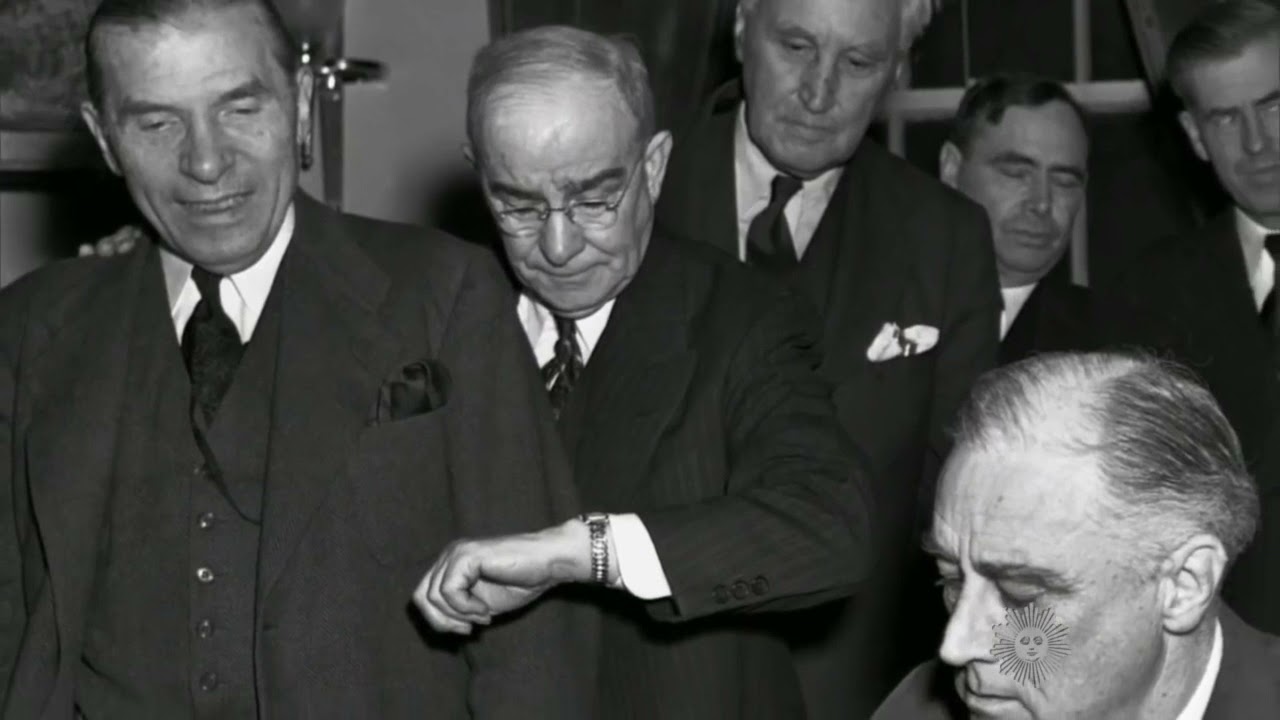
When he addressed the joint session of Congress, Roosevelt, who was paralyzed by polio from the waist down, insisted on walking to and from the podium.
He's supporting his weight, as he did in public, on a cane and on his son's arm. By holding his weight In that manner, he's able to pitch his body forward slowly and walk to the rostrum to deliver the speech.
Well, it just gives you chills thinking about it.
Yeah. I ask that the Congress declare that since the unprovoked and dastardly attack—
He put the weight of the world on his paralyzed legs and carried America from the past into the future. And changed us from an isolationist nation into a global superpower.
A state of war has existed between the United States and the Japanese Empire.
The speech lasted just 6 and a half minutes, but it transformed the nation from a state of shock into a state of war.